

Balban tomb
Credit: Mahi zahidi · CC BY-SA 4.0 · source

Coins from the Delhi Sultanate:Ghiyas-ud-din Balban Years: 1266-1287 Denomination: 2 Ghani Metal: Billon Weight: 3.6 g Diameter:16.94 mm Shape: Round
Credit: SpeakingArch · CC BY-SA 4.0 · source
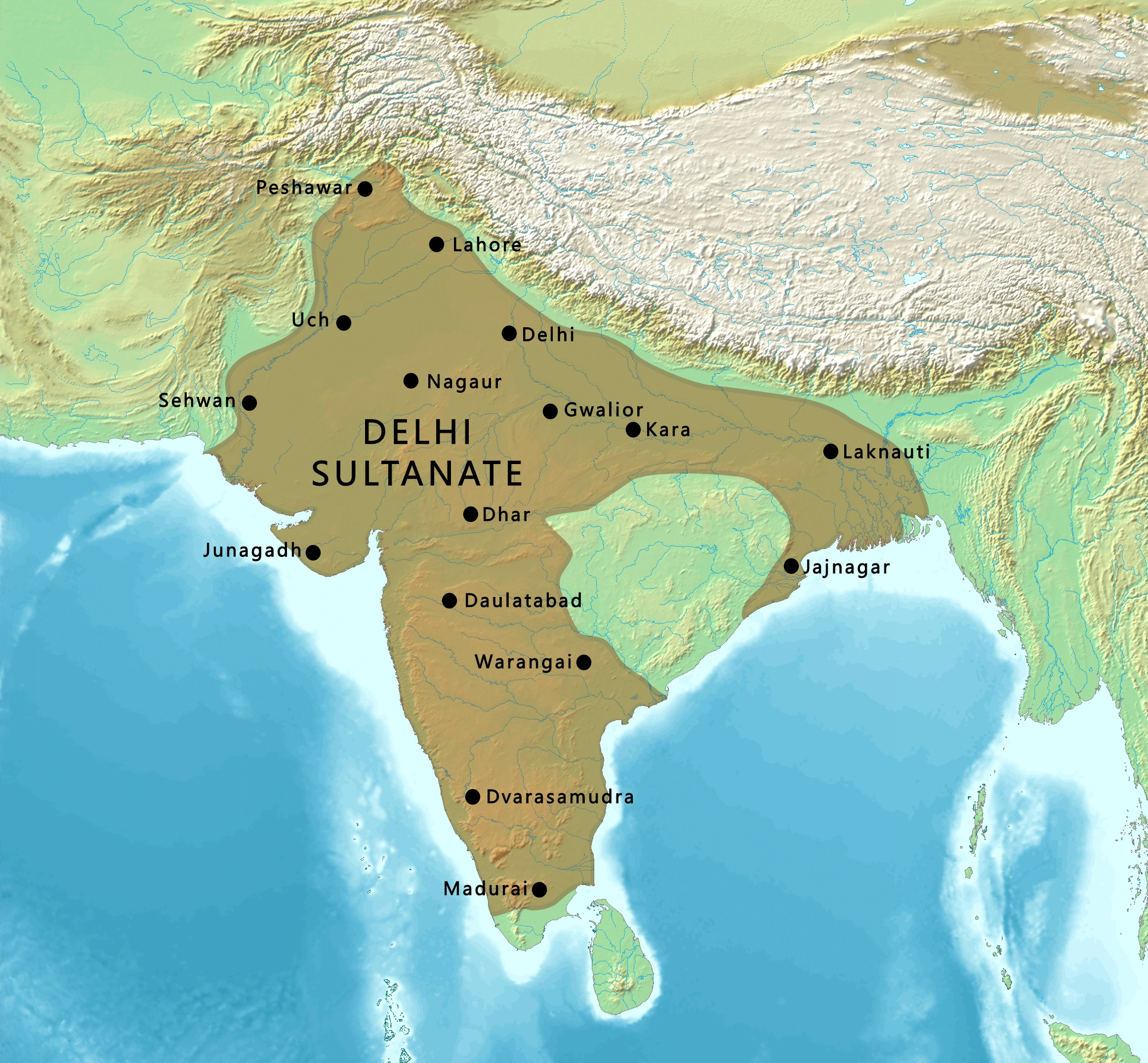
Map study
Delhi Sultanate territorial overview: regional orientation, not the exact boundary of every Sultan’s reign.
- Read the source date and legend before interpreting territorial extent.
- Compare core regions, neighbouring powers and geographic barriers; historical borders and influence are approximate and changed over time.
Credit: Koba-chan; DEMIS base map · CC BY-SA 3.0 · sourceConverted to WebP on an opaque white background; proportionally resized without cropping. Original cartography and legend retained.
1. From slave officer to Sultan
Balban's career illustrates the opportunities for military slaves within the early Delhi Sultanate. Of Central Asian Turkish origin, he was brought into the slave trade and purchased by Iltutmish. He rose through military and administrative service and became associated with the Shamsi nobles, the influential slave officers of Iltutmish. Their leading circle is conventionally called the Turkan-i Chahalgani, or the Forty. It was an aristocratic grouping rather than a permanently constituted council with an unchanging membership of forty.
During the unstable decades following Iltutmish's death in 1236, nobles repeatedly intervened in succession. Balban emerged as a dominant figure under Sultan Nasiruddin Mahmud. As naib, or deputy, he exercised extensive executive authority, and his daughter married the Sultan. His temporary displacement in 1253, followed by his restoration, demonstrates that his ascendancy remained contested by rival court factions.
On Nasiruddin Mahmud's death in 1266, Balban assumed the throne as Ghiyas-ud-din Balban. He inherited a kingdom threatened by noble factionalism, provincial autonomy, insecurity near the capital and Mongol pressure. Consolidation, rather than large-scale territorial expansion, therefore became the central objective of his reign.
- Dynastic placement: Iltutmish and Raziyya preceded him within the Mamluk period; the Khalji dynasty began only in 1290.
- Distinguish his long political ascendancy as naib from his formal reign as Sultan, 1266–1287.
Timeline
1236
Iltutmish dies; subsequent succession struggles provide the setting for Balban's rise.
1246–1266
Nasiruddin Mahmud reigns; Balban becomes the dominant deputy, though his authority is briefly interrupted.
1266
Balban becomes Sultan of Delhi.
Around 1281
Balban suppresses Tughril's rebellion in Bengal and installs Bughra Khan.
1285
Prince Muhammad dies fighting the Mongols.
1287–1290
Balban dies in 1287; succession conflicts follow, and Khalji rule begins in 1290.
2. Kingship, court culture and control of nobles
Balban argued that royal authority required dignity, distance and unquestioned obedience. Drawing upon Persian monarchical traditions, he associated kingship with divine sanction and the idea of the sovereign as the shadow of God, commonly expressed as Zill-i Ilahi. This elevated political status should not be confused with a claim to prophethood or personal divinity. He also claimed descent from Afrasiyab, the legendary Turanian ruler of Persian epic tradition, to compensate for the perceived social disadvantage of slave origins.
Court ceremonial made this ideology visible. Balban maintained solemn behaviour, avoided familiar interaction with courtiers and insisted upon elaborate etiquette. Sijda, or prostration, and paibos, or kissing the ruler's feet, are associated with his court. Such practices asserted royal superiority but could invite religious objections when they appeared to resemble forms of worship. Persian cultural forms and the celebration of Nauroz reinforced the prestige of monarchy.
Having risen through the Turkish aristocracy, Balban understood its capacity to dominate a weak ruler. He curtailed powerful Shamsi nobles and broke their capacity to act collectively against the throne. The standard statement that he destroyed the Forty is best understood as the weakening of an aristocratic power bloc, not the abolition of a modern statutory body.
His political outlook was markedly aristocratic. Chroniclers describe his preference for high-born officials and contempt for people considered low-born. Thus, the strengthening of central authority did not imply social equality. Severe punishment of officials was intended to enforce obedience and royal justice within a hierarchical order.
- Exam terms: Chahalgani—elite Turkish nobles; sijda—prostration; paibos—kissing the ruler's feet.
- Persianised kingship and strict etiquette served a political purpose: reducing familiarity between the Sultan and competing nobles.
Logic of Balban's consolidation
- 1. Identify noble rivalry, local disorder and frontier threats
- 2. Elevate royal authority through ideology and ceremonial
- 3. Control officials through intelligence and punishment
- 4. Secure territory through garrisons and military campaigns
- 5. Protect revenue routes and strengthen central obedience
3. Internal security and administration
Balban's coercive approach is conventionally summarised as a policy of blood and iron. The expression is a later descriptive label rather than the name of a formal medieval programme. He regarded secure roads, reliable revenue collection and obedience to officials as essential to the survival of the Sultanate. Armed groups and local chiefs around Delhi had exploited earlier political instability.
He campaigned against the Mewatis near Delhi and pursued punitive measures in the Doab and Katehar, in present-day western Uttar Pradesh. Forest clearance, military posts, garrisons and harsh punishments were used to secure routes and restrict resistance. These measures connected military action with administrative control: land revenue and communications could not remain dependable where royal officers and travellers faced persistent attacks.
An extensive intelligence system helped the Sultan supervise nobles and provincial officers. Barids supplied reports on official conduct, and concealment of misconduct could itself attract punishment. Accounts of stern action against powerful officials illustrate the ideal that royal servants remained answerable to the monarch. Such anecdotes also served the chroniclers' purpose of presenting Balban as an exemplary disciplinarian.
Balban strengthened military administration associated with the Diwan-i Arz, the department responsible for military organisation. Nevertheless, he should not be credited with Alauddin Khalji's later market-control system or the well-known systematic use of dagh and chehra under that ruler. For Prelims, administrative measures must be matched carefully with the correct Sultan.
- Mewat: region south and south-west of Delhi associated with Balban's campaigns for capital security.
- Doab: land between the Ganga and Yamuna; Katehar: broadly associated with the later Rohilkhand region.
- Barid: intelligence and reporting official; Diwan-i Arz: military department.
| Instrument | Meaning or application | Political purpose |
|---|---|---|
| Sijda and paibos | Ceremonial submission before the Sultan | Emphasise royal superiority |
| Control of Shamsi nobles | Curb aristocratic factions and powerful individuals | Free monarchy from noble domination |
| Barid network | Intelligence and reporting | Supervise officials and detect disobedience |
| Garrisons and fortified posts | Deployment near insecure routes and frontiers | Secure communications and resist attacks |
| Bengal campaign | Suppression of Tughril's rebellion | Reassert provincial subordination |
4. Mongol frontier and the Bengal rebellion
Mongol expansion made the north-western frontier the Sultanate's principal external concern. Balban strengthened forts and garrisons in the Punjab frontier zone and placed important commands under trusted officers and princes. His approach was largely defensive: preserving Delhi's core territories took priority over distant conquest. The frontier depended upon a network of fortified positions and military commanders rather than a continuously controlled modern border.
Prince Muhammad, Balban's eldest son, held an important frontier command centred on Multan. He was also associated with the patronage of Persian literary culture, including Amir Khusrau. Muhammad's death while fighting the Mongols in 1285 was both a military setback and a dynastic disaster because he had been regarded as the likely successor.
Bengal presented a different problem: its distance from Delhi encouraged governors to seek autonomy. Tughril, Balban's governor there, rebelled and assumed sovereign authority. After earlier efforts to suppress him failed, Balban personally led the campaign, crushed the rebellion around 1281 and imposed exemplary punishments. He then placed his son Bughra Khan in charge of Bengal, stressing loyalty to Delhi.
- Do not confuse Balban's suppression of Tughril in Bengal with Muhammad bin Tughlaq's fourteenth-century campaigns and rebellions.
- Mongol defence and provincial rebellion reveal two distinct limits on central power: external military pressure and internal centrifugal tendencies.
5. Legacy, succession and historical evidence
Balban restored the prestige of the monarchy and strengthened the conditions for more assertive Sultanate government. Yet his system remained heavily dependent on personal authority, fear and loyal appointments. After his death in 1287, his grandson Kaiqubad became Sultan, but factional conflict returned. The rise of Jalaluddin Khalji in 1290 ended Mamluk rule, showing that administrative consolidation had not produced a secure dynastic succession.
Balban's tomb stands in the Mehrauli Archaeological Park in Delhi. Its ruined structure is frequently cited as containing one of the earliest surviving true arches in Indo-Islamic architecture in India. A true arch uses wedge-shaped voussoirs to transfer loads, unlike a corbelled opening formed by projecting successive horizontal courses. This makes the monument relevant to both political history and art-and-culture preparation.
Ziyauddin Barani's Tarikh-i Firuz Shahi is a major source for Balban's reign, but it was written decades later and reflects the author's aristocratic and moralising concerns. Minhaj-us-Siraj's Tabaqat-i Nasiri is particularly valuable for the earlier Sultanate and Balban's rise, rather than for his entire reign. Statements about royal justice and social hierarchy should therefore be read as evidence of political ideals as well as descriptions of practice.
- Overall assessment: a consolidator of the Sultanate rather than a ruler primarily remembered for territorial expansion.
- Historical distinction: strong monarchy did not automatically produce stable succession or permanent provincial obedience.
Real-world case studies
Bengal: distance and provincial autonomy
Tughril's rebellion demonstrated the difficulty of governing a wealthy, distant province from Delhi. Balban's personal intervention restored obedience, but reliance on his son Bughra Khan also revealed the importance of dynastic trust where routine central supervision was weak.
Mehrauli: architectural evidence
Balban's ruined tomb provides material evidence beyond court chronicles. Its surviving true arch illustrates experimentation with arcuate construction in early Sultanate architecture. It should be distinguished from the Alai Darwaza, built under Alauddin Khalji in 1311.
Previous year questions
No source-linked PYQ is available here yet. Use the practice questions below.
Practice questions
Practice MCQ 1
With reference to Balban, consider the following statements: 1. He exercised authority as naib under Nasiruddin Mahmud. 2. He established a comprehensive market-control system in Delhi. 3. He used Persian court ceremonial to strengthen monarchy. Which of the statements given above are correct?
- A. 1 and 2 only
- B. 1 and 3 only
- C. 2 and 3 only
- D. 1, 2 and 3
Practice MCQ 2
Which one of the following pairs is correctly matched?
- A. Tughril's rebellion — Bengal
- B. Prince Muhammad's frontier command — Madurai
- C. Balban's tomb — Daulatabad
- D. Chahalgani — Department of market supervision
Practice MCQ 3
Which of the following best describes Balban's principal political objective?
- A. Replacing monarchy with collective government by the Forty
- B. Conquering the Deccan through permanent provincial annexations
- C. Consolidating royal authority while securing internal order and the north-western frontier
- D. Transferring the capital from Delhi to Bengal
Mains practice · Balban strengthened the Delhi Sultanate, but his consolidation remained vulnerable to dynastic and provincial instability. Discuss. Answer in 250 words.
- Introduce the crisis of authority inherited from the post-Iltutmish period.
- Explain Persianised kingship, court ceremonial and control over Turkish nobles.
- Discuss intelligence, military organisation and coercive restoration of internal order.
- Examine Mongol defence and the suppression of Tughril's rebellion.
- Assess dependence on personal authority and trusted family appointments.
- Conclude with Prince Muhammad's death, succession difficulties and the Khalji accession in 1290.
Further reading
- Satish Chandra, Medieval India: From Sultanat to the Mughals, Part One.
- NCERT, Our Pasts–II, chapter on the Delhi Sultans.
- Peter Jackson, The Delhi Sultanate: A Political and Military History.
- Ziyauddin Barani, Tarikh-i Firuz Shahi, available translations; read critically as a later court-centred narrative.
- Archaeological Survey of India: resources on Delhi's Sultanate monuments and Mehrauli.
Preparing for UPSC Civil Services? Get classroom teaching, answer-writing evaluation and mentorship at Pragnya IAS Academy, Ashok Nagar — see why aspirants choose us for IAS coaching in Hyderabad.