

Rajia Sultana's tomb at Bulbulikhana, near Turkman Gate, Old Delhi. It is situated in ruined and neglected condition.
Credit: Pinakpani · CC BY-SA 4.0 · source

View from inside the Fort in Bathinda
Credit: en:User:Guneeta · Public domain · source
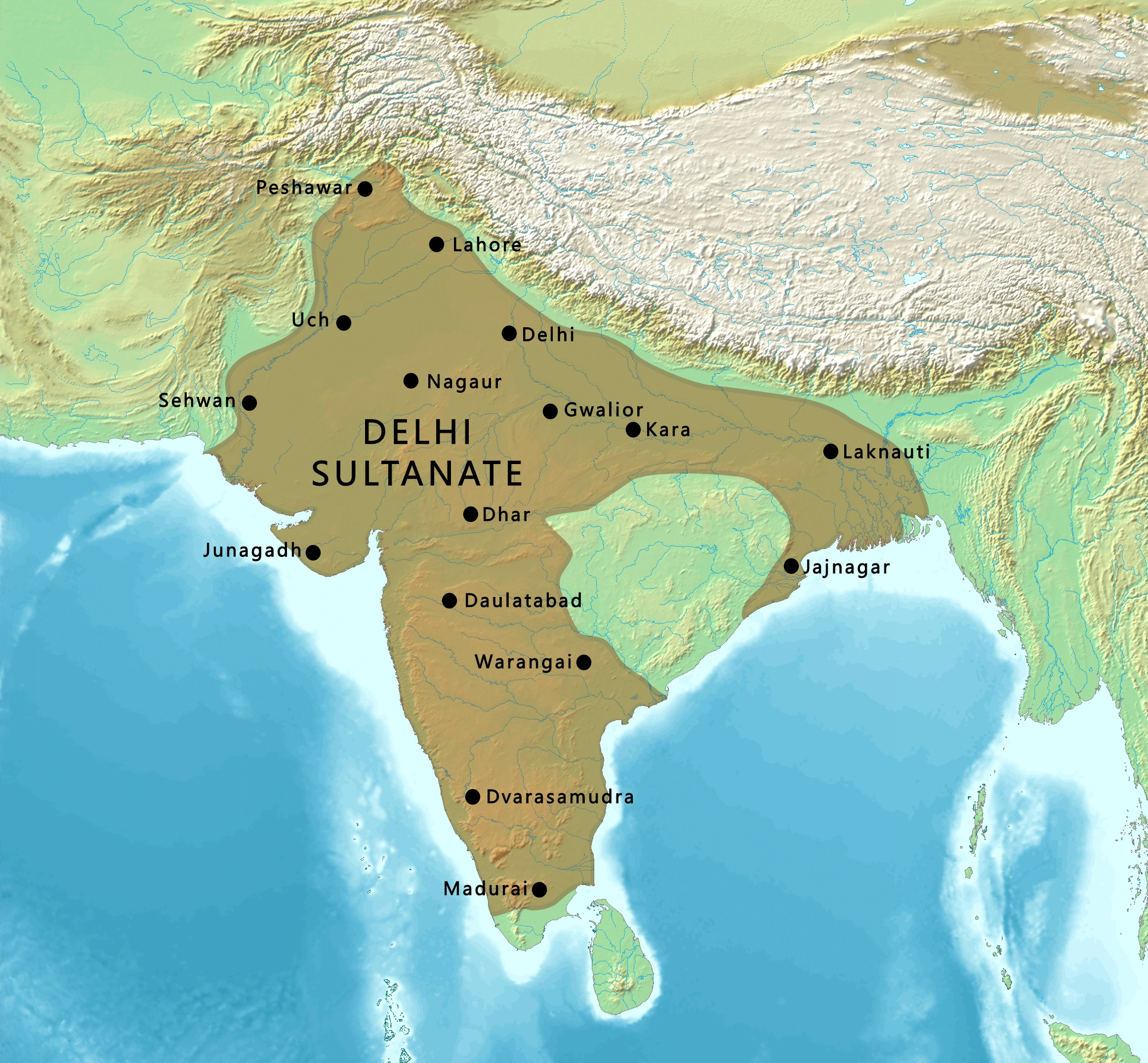
Map study
Delhi Sultanate territorial overview: regional orientation, not the exact boundary of every Sultan’s reign.
- Read the source date and legend before interpreting territorial extent.
- Compare core regions, neighbouring powers and geographic barriers; historical borders and influence are approximate and changed over time.
Credit: Koba-chan; DEMIS base map · CC BY-SA 3.0 · sourceConverted to WebP on an opaque white background; proportionally resized without cropping. Original cartography and legend retained.
Historical setting and the succession problem
Razia inherited a sultanate that Iltutmish had substantially consolidated but whose succession remained unsettled. The early Delhi Sultanate had no consistently enforced rule of primogeniture. Royal birth mattered, but accession also depended on military resources, acceptance by influential nobles and control of Delhi. The death of a capable ruler could therefore produce competition among royal relatives and military commanders.
Iltutmish’s trusted slave-officers formed an influential political elite. They are commonly associated with the Turkan-i Chihalgani, or the Forty. This should not be imagined as an unchanging constitutional council with precisely defined powers. It was an elite network whose members could cooperate or compete over appointments, revenue assignments and succession.
Iltutmish’s promising son Nasiruddin Mahmud died in 1229. According to the chronicler Minhaj-i Siraj, Iltutmish subsequently regarded Razia as better qualified than his surviving sons and designated her as successor. Accounts connect this judgment with her successful management of Delhi during his absence on campaign. Nevertheless, a ruler’s nomination did not automatically bind the nobles.
- The dynasty is called Mamluk because several early rulers had backgrounds as military slaves; Razia herself was not a slave.
- Keep Iltutmish’s son Nasiruddin Mahmud distinct from the later Sultan Nasiruddin Mahmud, who ruled Delhi from 1246 to 1266.
Timeline
1229
Iltutmish’s son Nasiruddin Mahmud dies, sharpening the succession problem.
April 1236
Iltutmish dies; Ruknuddin Firuz succeeds despite the reported nomination of Razia.
Late 1236
Razia becomes Sultan after the collapse of Ruknuddin’s regime.
1240
Altunia’s rebellion and a military revolt lead to Yaqut’s death and Razia’s capture; Bahram Shah takes the Delhi throne.
October 1240
Razia and Altunia die near Kaithal after failing to recover Delhi.
Accession in 1236: nomination versus political acceptance
After Iltutmish died in April 1236, Ruknuddin Firuz was placed on the throne instead of Razia. His mother, Shah Turkan, exercised considerable influence. Their conduct alienated important groups, while provincial unrest weakened the new regime. Ruknuddin’s reign lasted only a few months.
Razia mobilised support in Delhi against Shah Turkan and Ruknuddin. Her accession later in 1236 reflected both her dynastic claim and the immediate political failure of her rivals. The participation of the capital’s inhabitants was significant, but it should not be described as a modern democratic election. Urban backing helped establish legitimacy in a struggle otherwise dominated by royal and military elites.
Her accession did not end resistance. Several provincial governors opposed her, and the former wazir Nizam al-Mulk Junaidi supported the opposition. Razia used negotiation and divisions within the hostile coalition to weaken it. Her initial success demonstrates political ability: she was not merely a passive nominee dependent on a single patron.
- Exam sequence: Iltutmish → Ruknuddin Firuz → Razia → Bahram Shah.
- Iltutmish’s preference for Razia and the nobles’ initial selection of Ruknuddin reveal the limits of royal nomination.
Political trajectory of Razia’s reign
- 1. Iltutmish reportedly nominates Razia
- 2. Nobles initially enthrone Ruknuddin Firuz
- 3. Regime failure and support in Delhi enable Razia’s accession
- 4. Independent rule and appointments intensify opposition
- 5. Rebellion and military defection cause deposition
- 6. Alliance with Altunia fails to restore her throne
Royal authority, administration and court appointments
Razia sought to rule in her own right rather than remain secluded behind palace intermediaries. Chronicles describe her appearing publicly, conducting government and wearing attire associated with male sovereignty, including a tunic and headgear. Such actions asserted the visibility expected of a military ruler while challenging prevailing expectations about elite women.
Her government broadly operated through existing Sultanate institutions. The central court, military commanders and provincial revenue assignments remained essential. Her brief reign should not be credited with an entirely new administrative system or sweeping reforms unsupported by evidence. The central political issue was who would control offices and resources: the sovereign or powerful nobles.
The appointment of Jamal al-Din Yaqut, an Abyssinian or Habshi officer, as amir-i akhur, superintendent of the royal stables, became especially contentious. In a cavalry-based polity, responsibility for the royal stables was a significant court office. His advancement challenged the privileged position of Turkish officers and became a focus of opposition.
Razia’s promotion of a non-Turkish officer can be read as an effort to widen her support base, but it should not be converted into a modern programme of racial equality. Similarly, stories of a romance between Razia and Yaqut are not securely established by contemporary evidence. Political hostility and later storytelling must be separated from demonstrable facts.
- Amir-i akhur means superintendent or master of the royal stables, not chief minister.
- The term Sultan stresses her position as sovereign; she is also conventionally called Razia Sultana in historical writing.
| Person or institution | Association | Exam significance |
|---|---|---|
| Iltutmish | Father and reported nominator | Royal nomination did not ensure succession |
| Ruknuddin Firuz | Immediate predecessor | Brief reign in 1236 |
| Jamal al-Din Yaqut | Abyssinian amir-i akhur | Appointment intensified elite resentment |
| Malik Altunia | Governor of Tabarhinda; later husband | Rebel who became her ally |
| Turkan-i Chihalgani | Influential Turkish elite network | Contested control over monarchy and appointments |
| Minhaj-i Siraj | Author of Tabaqat-i Nasiri | Contemporary evidence and gendered judgment |
Rebellion, deposition and death
Razia faced recurring resistance from military governors. In 1240, Malik Altunia, governor of Tabarhinda, generally identified with present-day Bathinda in Punjab, rebelled. Razia marched against him, but a revolt within her own forces overturned her position. Yaqut was killed and Razia was taken prisoner.
Meanwhile, nobles in Delhi raised her half-brother Bahram Shah to the throne. This showed how quickly control of the capital and elite support could outweigh an incumbent ruler’s claim. Razia subsequently married Altunia and joined him in an attempt to recover Delhi. The alliance was politically consequential, regardless of later romantic interpretations of their relationship.
Their forces were defeated, and Razia and Altunia were killed near Kaithal in October 1240. Her overthrow resulted from interacting causes: factional competition, hostility to her independent exercise of authority, resentment over appointments and prejudice against female rule. Explaining the fall solely through either gender or a supposed love affair obscures the wider struggle over sovereignty.
- Distinguish Tabarhinda or Bathinda, associated with her capture, from Kaithal, associated with her death.
- Her reign belongs to the thirteenth-century Mamluk phase, not the later Khalji or Tughlaq periods.
Sources, gender and historical significance
Minhaj-i Siraj’s Persian chronicle, Tabaqat-i Nasiri, is central to studying Razia. He acknowledged her intelligence, justice and qualities as a ruler, yet treated her being a woman as a fundamental political disadvantage. His account therefore supplies evidence both about her capabilities and about the gender assumptions of the milieu in which he wrote.
Chronicles were not neutral administrative records. Their authors wrote within courtly, religious and patronage contexts. Later narratives, popular literature and screen adaptations often amplify romance and personal drama. An exam-oriented account should prioritise well-supported political developments and distinguish contemporary testimony from later embellishment.
Razia’s reign is important not because it permanently transformed women’s status, but because it exposed tensions within Sultanate kingship. Dynastic legitimacy could support a woman’s claim, yet military patronage and elite acceptance remained decisive. Her experience also anticipates the broader contest between strong monarchy and powerful nobles that became prominent under Balban.
- Avoid calling Razia the first or only woman ruler of India; the accurate distinction is the only woman ruler of the Delhi Sultanate.
- For analytical answers, combine succession politics, noble factions, court appointments and gender rather than relying on a single-cause explanation.
Real-world case studies
Yaqut’s appointment: officeholding and elite privilege
Yaqut’s elevation illustrates how appointments could become contests over access to the ruler and military resources. Turkish resentment was not simply a personal quarrel: it reflected resistance to an outsider’s advancement and to Razia’s discretion as sovereign. The episode supports a political explanation without requiring an unproven romantic narrative.
Minhaj-i Siraj: praise constrained by gender
Minhaj’s recognition of Razia’s governing abilities alongside his objection to female sovereignty offers a useful exercise in source criticism. A chronicler may preserve valuable information while interpreting it through social prejudice. His judgment should therefore be analysed, not automatically adopted.
Previous year questions
No source-linked PYQ is available here yet. Use the practice questions below.
Practice questions
Practice MCQ 1
With reference to Razia, consider the following statements: 1. She succeeded Iltutmish immediately after his death. 2. She belonged to the Mamluk dynasty of Delhi. 3. Bahram Shah occupied the Delhi throne after her deposition. Which of the statements given above are correct?
- A. 1 and 2 only
- B. 2 and 3 only
- C. 1 and 3 only
- D. 1, 2 and 3
Practice MCQ 2
Jamal al-Din Yaqut, associated with Razia’s reign, held which of the following offices?
- A. Wazir
- B. Chief qazi
- C. Amir-i akhur
- D. Governor of Bengal
Practice MCQ 3
Which of the following pairs is correctly matched?
- A. Tabaqat-i Nasiri — Minhaj-i Siraj
- B. Tabarhinda — Place of Iltutmish’s burial
- C. Kaithal — Capital established by Razia
- D. Turkan-i Chihalgani — Council established by Alauddin Khalji
Mains practice · Razia’s downfall reflected both the political structure of the early Delhi Sultanate and the gender norms of its ruling elite. Discuss. Answer in 150 words.
- Introduce her reign, 1236–1240, and her exceptional position as a woman sovereign.
- Explain uncertain succession and the limits of Iltutmish’s nomination.
- Examine noble factions, military dependence and competition over appointments.
- Use Yaqut’s advancement and Altunia’s rebellion as political examples.
- Discuss gendered resistance using Minhaj-i Siraj’s assessment.
- Conclude with a multi-causal explanation; avoid unsupported romance narratives.
Further reading
- NCERT, Our Pasts–II, chapter on the Delhi Sultans.
- Satish Chandra, History of Medieval India, discussion of the early Delhi Sultanate.
- Peter Jackson, The Delhi Sultanate: A Political and Military History.
- Minhaj-i Siraj, Tabaqat-i Nasiri, translated by H. G. Raverty; read with attention to the chronicler’s perspective.
Preparing for UPSC Civil Services? Get classroom teaching, answer-writing evaluation and mentorship at Pragnya IAS Academy, Ashok Nagar — see why aspirants choose us for IAS coaching in Hyderabad.