

Charminar at Hyderabad, India
Credit: DidierTais · CC BY-SA 3.0 · source

Golconda Fort, India
Credit: Bernard Gagnon · CC BY-SA 3.0 · source
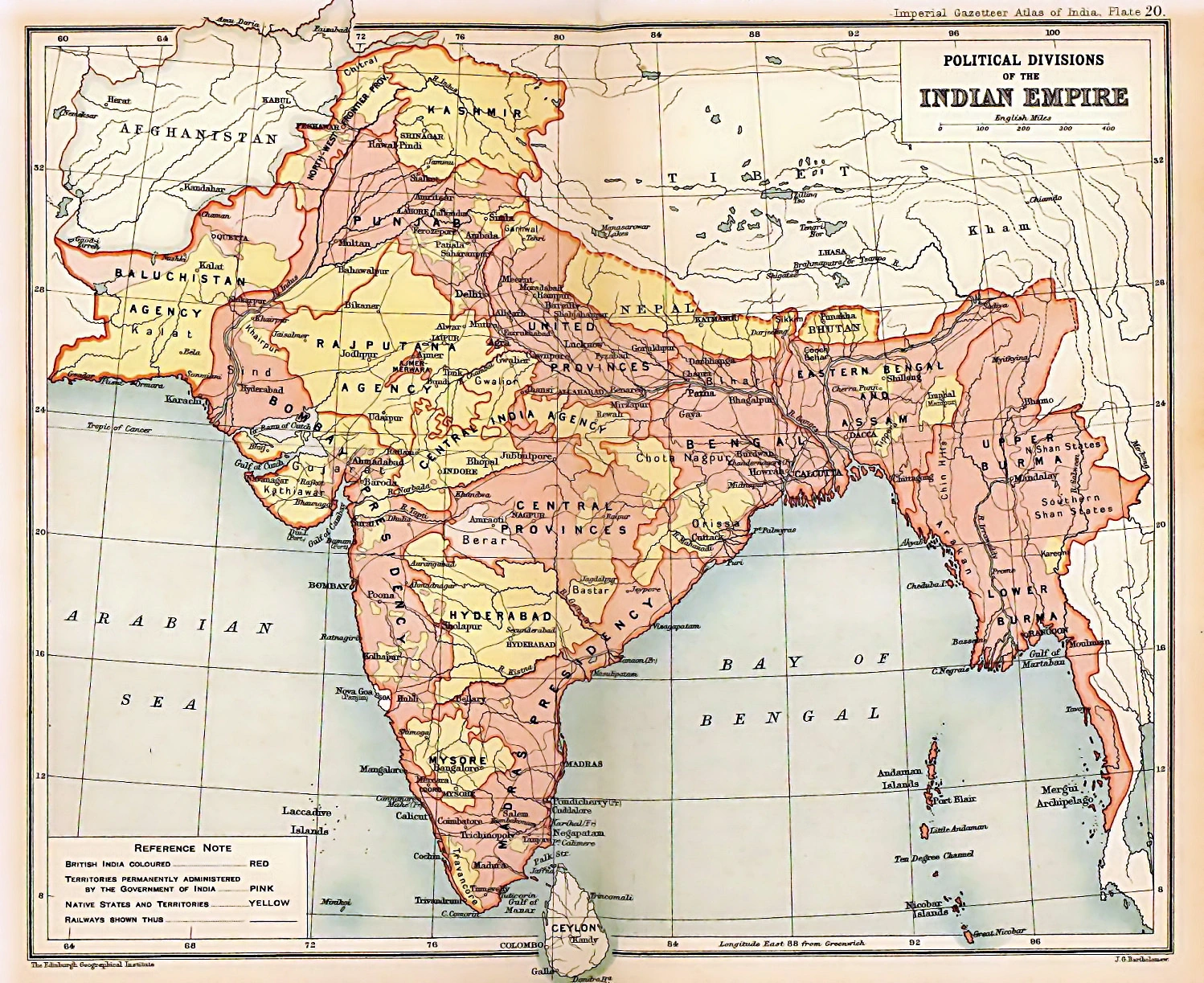
Map study
British Indian Empire in 1909: historical provinces and princely states, not contemporary Indian state boundaries.
- Read the source date and legend before interpreting territorial extent.
- Compare core regions, neighbouring powers and geographic barriers; historical borders and influence are approximate and changed over time.
Credit: Edinburgh Geographical Institute; J. G. Bartholomew and Sons · Public domain · sourceConverted to WebP on an opaque white background; proportionally resized without cropping. Original cartography and legend retained.
1. Regional setting and Qutb Shahi origins
Hyderabad belongs to the history of the eastern Deccan, particularly the Telangana plateau and the Musi basin. Its medieval background lies in the Bahmani kingdom, established in 1347, and the regional sultanates that emerged as Bahmani authority weakened. Golconda was initially a provincial centre rather than a separate kingdom. Sultan Quli, a Bahmani governor of Turkmen origin, established independent Qutb Shahi rule in 1518. Golconda Fort became the dynasty’s fortified capital.
The Qutb Shahis were one of the five principal Deccan sultanate dynasties, alongside the Adil Shahis of Bijapur, Nizam Shahis of Ahmadnagar, Imad Shahis of Berar and Barid Shahis of Bidar. These states alternated between warfare and cooperation. Golconda participated in the Deccan coalition that defeated Vijayanagara at Talikota in 1565. The battle altered the regional balance but did not immediately extinguish Vijayanagara political traditions.
The kingdom expanded across much of Telangana and parts of coastal Andhra, linking an inland political centre with productive agrarian districts and Bay of Bengal commerce. Its population was predominantly non-Muslim, while its ruling dynasty followed Shia Islam. Persian courtly traditions interacted with Telugu-speaking local society. This combination makes Golconda and Hyderabad important examples of regional state formation rather than merely provincial extensions of North Indian political history.
- Distinguish Golconda, the older fort and kingdom, from Hyderabad, the planned city founded later.
- Do not confuse the Nizam Shahis of Ahmadnagar with the eighteenth-century Nizams of Hyderabad.
Timeline
1518
Independent Qutb Shahi rule established at Golconda.
1591
Muhammad Quli Qutb Shah founded Hyderabad and commissioned the Charminar.
1687
Aurangzeb annexed Golconda.
1724
Asaf Jah I established effective autonomy in the Deccan.
1763
Hyderabad became the settled Asaf Jahi capital under Nizam Ali Khan.
1798–1800
Subsidiary alliance and subsequent treaty consolidated British influence.
September 1948
Operation Polo brought Hyderabad State into the Indian Union.
2. Foundation, urban form and monuments
Muhammad Quli Qutb Shah founded Hyderabad in 1591 on the south bank of the Musi, east of Golconda Fort. The new capital provided space for royal establishments, markets, residential quarters and ceremonial avenues beyond the older fortified settlement. Mir Momin Astarabadi, a leading minister, is associated with its planning. The Charminar formed the symbolic centre of an urban design organised around intersecting roads and nearby commercial spaces.
The Charminar, also dated to 1591, combines four monumental arches with four minarets and contains a mosque on an upper level. It should not be confused with a royal tomb. Popular accounts connect its construction with the end of an epidemic, but this explanation should be treated as a tradition rather than an uncontested fact. Similarly, stories linking the city’s original name to Bhagmati are historically debated.
Other monuments illustrate continuity across reigns. Construction of Mecca Masjid began under Muhammad Qutb Shah in the seventeenth century and was completed under Aurangzeb. The Qutb Shahi tombs stand near Golconda Fort, not around the Charminar. Hussain Sagar predates Hyderabad’s foundation: it was constructed in 1562 under Ibrahim Qutb Shah. These sites reveal a landscape shaped by water management, fortification, religious patronage and royal commemoration.
- Monument identification: Charminar belongs to Muhammad Quli Qutb Shah; Hussain Sagar belongs to Ibrahim Qutb Shah’s reign.
- Chowmahalla Palace belongs to the later Asaf Jahi political landscape, not to Hyderabad’s original Qutb Shahi foundation.
Changing political frameworks
- 1. Weakening of Bahmani authority
- 2. Independent Qutb Shahi kingdom at Golconda
- 3. Foundation of Hyderabad as a new capital
- 4. Mughal annexation in 1687
- 5. Asaf Jahi autonomy from 1724
- 6. Subsidiary alliance and British paramountcy
3. Economy, society and Deccani culture
Golconda’s prosperity rested on agriculture, craft production, taxation and trade, not diamonds alone. Irrigation tanks supported cultivation across a region with uneven rainfall. Textile production in the kingdom’s eastern districts connected weavers, merchants and overseas buyers. Machilipatnam, also called Masulipatnam, was a major Coromandel port through which Indian merchants and European companies participated in Bay of Bengal and wider Indian Ocean commerce.
The expression Golconda diamonds refers to a commercial and political association, not a mine located inside Golconda Fort. Important diamond workings lay in the wider kingdom, including the Krishna valley; Kollur was especially well known. European travellers such as Jean-Baptiste Tavernier described the diamond trade. Diamond revenues and luxury commerce supported courtly consumption, but coastal textiles and agrarian resources were equally important to the kingdom’s wider economic structure.
Hyderabad’s culture developed through interaction among Persian-speaking migrants, Deccani Muslims, Telugu elites, artisans and trading communities. Persian served as a major court and administrative language, while Dakhni developed as a literary language. Muhammad Quli Qutb Shah was himself a notable Dakhni poet. Telugu literature also received royal and elite patronage. Architectural forms combined Persianate elements with local building practices, producing a recognisably Deccani style.
Religious affiliation did not create a simple separation between rulers and subjects. Hindu officials held important posts; Akkanna and Madanna became influential under Abul Hasan Qutb Shah. Their prominence also generated factional conflict. Shared festivals, Sufi institutions and local devotional practices encouraged cultural interaction, although patronage, hierarchy and political violence remained part of social life.
| Feature | Qutb Shahi phase | Asaf Jahi phase |
|---|---|---|
| Political origin | Fragmentation of Bahmani authority | Weakening of Mughal provincial control |
| Conventional period | 1518–1687 | 1724–1948 |
| Founding ruler | Sultan Quli | Nizam-ul-Mulk Asaf Jah I |
| Capital association | Golconda, followed by Hyderabad | Early association with Aurangabad; later Hyderabad |
| External relationship | Mughal suzerainty followed by annexation | Nominal Mughal allegiance followed by British paramountcy |
4. Mughal conquest and the rise of the Nizams
Mughal pressure on Golconda increased during the seventeenth century. A settlement in 1636 under Shah Jahan imposed Mughal suzerainty and tribute obligations. Aurangzeb later pursued direct annexation: Bijapur fell in 1686 and Golconda in 1687 after a prolonged siege. Abul Hasan Qutb Shah, the last ruler, was imprisoned, and the kingdom became part of the Mughal imperial system.
As Mughal authority weakened after Aurangzeb’s death in 1707, powerful provincial governors gained greater control over revenues and military appointments. Chin Qilich Khan, known as Nizam-ul-Mulk and Asaf Jah I, had served as Mughal governor of the Deccan and briefly as imperial wazir. His victory over Mubariz Khan at Shakar Kheda in 1724 established effective autonomy. This is the conventional starting point of the Asaf Jahi state.
The Nizam did not initially proclaim a complete constitutional break with the Mughal emperor. Hyderabad therefore fits the category of an eighteenth-century Mughal successor state, comparable in this respect with Awadh and Bengal. Aurangabad remained an important early Asaf Jahi seat, and Hyderabad became the settled capital under Nizam Ali Khan in 1763. Administrative continuity included revenue assignments, military households and negotiated relations with landed intermediaries.
- 1591 marks the foundation of Hyderabad city; 1724 marks the establishment of autonomous Asaf Jahi power.
- The eighteenth-century state should be understood through practical autonomy combined with nominal Mughal legitimacy.
5. European intervention and the later historical legacy
After Asaf Jah I died in 1748, succession disputes drew Hyderabad into Anglo-French rivalry. French support for rival claimants and the influence of the commander Bussy connected Deccan politics with the Carnatic Wars. The eventual weakening of French power increased British leverage. The Nizam also faced Maratha pressure, demonstrated by Hyderabad’s defeat at Kharda in 1795.
In 1798, under Lord Wellesley, Hyderabad accepted a subsidiary alliance and dismissed its French-trained corps. The arrangement stationed a British-supported force at the Nizam’s expense and restricted independent diplomacy. A further treaty in 1800 involved territorial cessions to maintain the subsidiary force. Hyderabad retained its dynasty and internal administration but operated under expanding British paramountcy; it was not an ordinary directly administered British province.
The later state contained Telugu-, Marathi- and Kannada-speaking regions, so its boundaries cannot be equated with present-day Telangana. After independence in 1947, the Nizam sought to remain outside the Indian Union. Operation Polo in September 1948 ended that position. These later events extend beyond medieval history but help distinguish the successive meanings of Hyderabad: a Qutb Shahi city, an Asaf Jahi capital and a large princely state.
Real-world case studies
Machilipatnam: an inland kingdom’s maritime connection
Machilipatnam connected Golconda’s textile-producing hinterland with overseas markets. Indian merchants, the Dutch and the English operated within a trading environment regulated by regional authorities. It demonstrates why Deccan political history must include coastal commerce rather than focus exclusively on inland forts and courts.
Charminar: monument and urban centre
The Charminar’s position amid roads and bazaars illustrates the integration of royal symbolism, worship and commerce in Hyderabad’s planning. The surrounding market landscape, including Laad Bazaar, makes it a useful example of the continuing relationship between built heritage and urban livelihoods.
Previous year questions
No source-linked PYQ is available here yet. Use the practice questions below.
Practice questions
Practice MCQ 1
Consider the following pairs: 1. Foundation of Hyderabad — Muhammad Quli Qutb Shah; 2. Establishment of Asaf Jahi autonomy — 1724; 3. Annexation of Golconda — Shah Jahan. Which of the pairs given above are correctly matched?
- A. 1 and 2 only
- B. 2 and 3 only
- C. 1 and 3 only
- D. 1, 2 and 3
Practice MCQ 2
With reference to Golconda’s economy, consider the following statements: 1. The term Golconda diamonds implies that the principal mines were inside Golconda Fort. 2. Machilipatnam linked the kingdom with Indian Ocean commerce. 3. Agriculture and textiles were important alongside diamond commerce. Which statements are correct?
- A. 1 only
- B. 1 and 2 only
- C. 2 and 3 only
- D. 1, 2 and 3
Practice MCQ 3
Which description best characterises Hyderabad under Asaf Jah I after 1724?
- A. A directly administered British province
- B. A restored Bahmani kingdom
- C. A Portuguese-protected coastal principality
- D. A practically autonomous Mughal successor state retaining nominal imperial allegiance
Mains practice · Hyderabad illustrates both cultural regionalisation in the medieval Deccan and political decentralisation in eighteenth-century India. Discuss. Answer in 250 words.
- Trace Qutb Shahi origins to the fragmentation of Bahmani authority.
- Explain Hyderabad’s foundation, planned urban form and regional commercial connections.
- Discuss Persian, Dakhni and Telugu cultural interaction without assuming an absence of social conflict.
- Outline Mughal annexation and the subsequent emergence of Asaf Jahi autonomy.
- Distinguish practical independence from nominal Mughal legitimacy.
- Conclude with the transition from regional autonomy to British paramountcy.
Further reading
- NCERT, Our Pasts II: Eighteenth-Century Political Formations.
- Satish Chandra, Medieval India: From Sultanat to the Mughals, Part Two.
- H. K. Sherwani, History of the Qutb Shahi Dynasty.
- Telangana Department of Heritage: official monument and museum resources.
- Archaeological Survey of India: Hyderabad Circle monument resources.
Preparing for UPSC Civil Services? Get classroom teaching, answer-writing evaluation and mentorship at Pragnya IAS Academy, Ashok Nagar — see why aspirants choose us for IAS coaching in Hyderabad.