
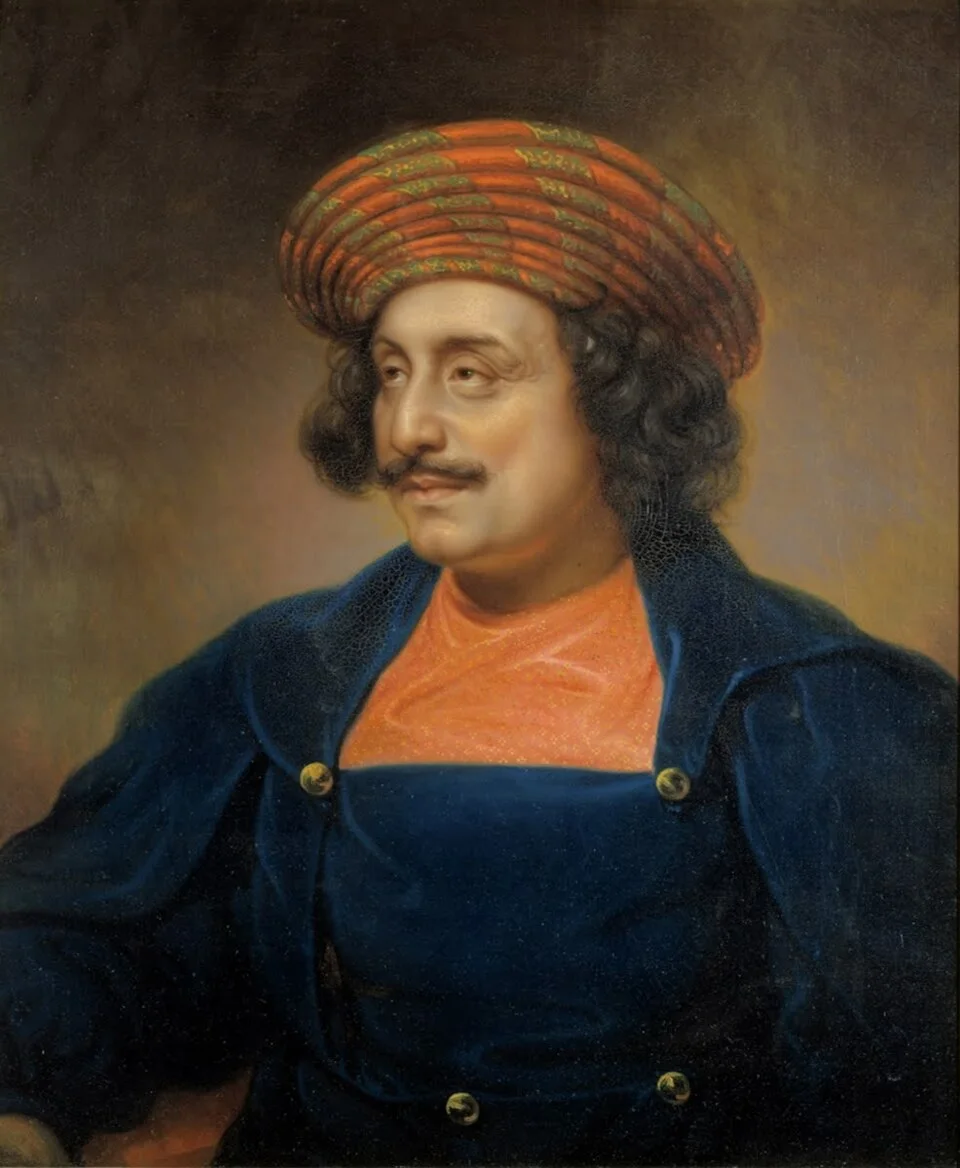
Portrait of Raja Ram Mohan Roy attributed in the supplied metadata to Rembrandt Peale, 1833.
Credit: Rembrandt Peale · Public domain · sourceResized and converted to WebP; uncropped.
1. Historical setting and intellectual formation
Ram Mohan Roy emerged during the consolidation of East India Company rule and the expansion of print, missionary activity and Western education in Bengal. Calcutta became an important centre of administrative power and intellectual exchange. Roy used this changing public sphere to question inherited practices while resisting claims that Indian civilisation lacked intellectual or ethical resources. He is commonly described as a pioneer of the Bengal Renaissance, although this label should not obscure the movement’s initially narrow, educated social base.
Born into a Bengali Brahman family, Roy studied Sanskrit, Persian and Arabic, and later acquired English. His familiarity with Hindu philosophical traditions, Islamic monotheism and Christian thought encouraged comparative religious inquiry. He worked in the Company’s revenue administration before settling in Calcutta in 1815. This experience also exposed him to colonial institutions and agrarian conditions.
His early Persian treatise, Tuhfat-ul-Muwahhidin, with an Arabic preface, questioned religious superstition and defended belief in one supreme being. Its title is generally translated as A Gift to Monotheists. Roy’s intellectual method combined reason, ethical judgment and textual interpretation. He was neither simply a defender of inherited orthodoxy nor an uncritical adopter of European ideas.
- Core approach: reform society through reasoned debate, reinterpretation of scripture, education, petitions and legislation.
- Historical significance: helped establish an Indian-led public discourse on religion, rights and social reform under colonial rule.
Timeline
1772
Born at Radhanagar in Bengal.
1815
Established the Atmiya Sabha in Calcutta.
1820
Published The Precepts of Jesus.
1821–1823
Sambad Kaumudi and Mirat-ul-Akbar became vehicles of public debate; Roy challenged the 1823 press restrictions.
1828
Founded the Brahmo Sabha.
1829–1830
Sati prohibited in the Bengal Presidency; Brahmo meeting-house trust deed executed in January 1830.
1831–1833
Lived in Britain as Akbar II’s representative; died near Bristol on 27 September 1833.
2. Religious reform: from Atmiya Sabha to Brahmo Sabha
Roy founded the Atmiya Sabha in 1815 as a forum for discussion of theology and social questions. He translated and published selected Upanishads and Vedantic writings, seeking to demonstrate that belief in a single supreme reality had authoritative foundations within Hindu thought. He opposed image worship, elaborate ritualism and priestly claims that obstructed independent inquiry. His critique also connected religious divisions and caste restrictions with weaknesses in social cohesion.
The Brahmo Sabha, founded in Calcutta in 1828, institutionalised collective worship of one God without images. Its meeting house was governed by a trust deed executed in January 1830. The deed provided for worship of the Eternal, Unsearchable and Immutable Being and excluded images, sacrifices and the denigration of other religious objects of worship. It promoted charity, morality and harmony. The institution subsequently became widely known as the Brahmo Samaj.
Roy’s engagement with Christianity was selective and critical. The Precepts of Jesus: The Guide to Peace and Happiness, published in 1820, highlighted moral teachings while separating them from miracles and doctrinal claims. This brought him into controversy with Christian missionaries. He was sympathetic to Unitarian ideas but did not convert to Christianity. His religious universalism sought shared ethical principles without accepting the exclusive authority of any one organised religion.
- Distinguish the Atmiya Sabha of 1815 from the Brahmo Sabha of 1828.
- Debendranath Tagore and Keshab Chandra Sen belong to later phases of Brahmo history; their initiatives should not automatically be attributed to Roy.
Roy’s characteristic method of reform
- 1. Identify an oppressive practice or restrictive institution
- 2. Test its justification through reason and textual inquiry
- 3. Publish arguments and organise discussion
- 4. Mobilise petitions and public support
- 5. Seek institutional reform and, where necessary, legal protection
3. Sati, women’s rights and the role of legislation
Roy’s best-known social campaign opposed sati, the burning of a widow on her husband’s funeral pyre. Through pamphlets, petitions and public controversy, he challenged the claim that the practice was an obligatory religious duty. His 1818 dialogue between an advocate and an opponent of widow-burning used scriptural interpretation alongside humanitarian reasoning. He stressed that a widow’s continued life was compatible with authoritative religious teaching.
Governor-General Lord William Bentinck issued Bengal Regulation XVII on 4 December 1829, declaring sati illegal and punishable by criminal courts. Its immediate jurisdiction was the Bengal Presidency; prohibition was extended to the Madras and Bombay Presidencies in 1830. Roy supported the measure and opposed orthodox efforts to overturn it. For examination purposes, distinguish the reformer who mobilised argument against sati from the colonial authority that enacted its legal prohibition.
Roy’s concerns extended beyond sati to women’s education, polygamy and economic dependence. In his 1822 tract on encroachments upon women’s ancient rights, he criticised restrictions on female inheritance. His arguments often drew on older legal and scriptural traditions to show that contemporary practices were not timeless or unavoidable. However, the Hindu Widows’ Remarriage Act of 1856 belongs to a later campaign prominently associated with Ishwar Chandra Vidyasagar, not Roy.
- Sati abolition illustrates interaction between Indian reformist mobilisation and colonial legislation, rather than the exclusive achievement of either.
- Roy combined moral criticism with arguments acceptable within the scriptural vocabulary of his opponents.
| Institution or publication | Date | Exam-relevant association |
|---|---|---|
| Atmiya Sabha | 1815 | Discussion of religious and social reform |
| The Precepts of Jesus | 1820 | Christian ethical teachings; controversy with missionaries |
| Sambad Kaumudi | 1821 | Bengali journalism and social reform |
| Mirat-ul-Akbar | 1822 | Persian newspaper; discontinued during the 1823 press controversy |
| Vedanta College | 1825 | Indian philosophical learning alongside Western knowledge |
| Brahmo Sabha | 1828 | Institutional monotheistic worship without images |
4. Education, journalism and political rights
Roy advocated education in modern scientific and useful knowledge. He established an Anglo-Hindu school in 1822 and the Vedanta College in 1825, combining engagement with Indian learning and access to Western knowledge. In his December 1823 letter to Governor-General Lord Amherst, he criticised the proposed concentration of public funds on traditional Sanskrit instruction and urged teaching mathematics, natural philosophy, chemistry and anatomy. This was not a wholesale rejection of Sanskrit: Roy himself used Sanskrit texts extensively.
Print was central to his reform strategy. Sambad Kaumudi, a Bengali weekly associated with him from 1821, discussed social and public issues. His Persian weekly Mirat-ul-Akbar began in 1822. He protested the restrictive press regulations introduced under acting Governor-General John Adam in 1823 and discontinued Mirat-ul-Akbar in protest. His journalism helped make government policy and social custom subjects of public scrutiny.
Roy also demanded fairer administration, legal equality and protection against arbitrary power. In evidence and representations concerning British India, he discussed revenue administration, the condition of cultivators and judicial reform. He favoured separating judicial and revenue functions. His position was reformist and constitutional: he sought institutional safeguards under existing rule rather than organising a movement for national independence.
- Press freedom, scientific education and social reform were interconnected elements of his programme.
- Do not confuse his 1823 educational representation with Macaulay’s Minute of 1835, issued after Roy’s death.
5. Visit to Britain, legacy and limitations
The Mughal emperor Akbar II conferred the title Raja on Roy and sent him to Britain as his representative concerning imperial allowances and related claims. Roy reached Britain in 1831. There he engaged with political and intellectual circles, supported the retention of the anti-sati regulation and contributed information to debates on Indian administration. He died near Bristol in 1833; his tomb is at Arnos Vale Cemetery.
His legacy lies in linking religious reinterpretation to public reasoning and practical social change. Later Brahmo leaders expanded and modified this institutional inheritance. Yet his movement depended heavily on urban, educated networks and did not constitute a mass peasant or working-class mobilisation. His selective confidence in British liberal institutions also coexisted with the realities of colonial domination. A balanced assessment recognises him as a foundational modern reformer without attributing every later reform or nationalist idea to him.
- UPSC focus: connect personalities with organisations, publications, legislation and dates.
- Analytical theme: Roy combined indigenous intellectual resources with selective borrowing from global liberal and religious currents.
Raja Ram Mohan Roy: Reform through Reason and Scriptural Debate
Raja Ram Mohan Roy linked religious reinterpretation with social and intellectual reform. Drawing on the Upanishads and engaging with Islamic and Christian thought, he defended monotheism and questioned idolatry and practices sustained by uncritical custom. The Brahmo Sabha, founded in 1828, provided an institutional setting for worship and discussion centred on one God. His approach was neither a wholesale rejection of Indian traditions nor an unquestioning adoption of European ideas: he used scriptural argument and rational criticism to challenge established authority.
His opposition to sati combined ethical objections with arguments against its supposed scriptural necessity. This advocacy helped shape the reform climate, but the legal prohibition in the Bengal Presidency in 1829 was enacted under Governor-General William Bentinck; reform advocacy and colonial legislation should not be conflated. Roy also supported women’s property rights, scientific education and freedom of the press. His career illustrates how print, petitions and public debate expanded the arenas of reform in colonial India. The supplied metadata identifies this image as a portrait of Roy, making it directly relevant as a biographical illustration; it does not independently establish his ideas, actions or social influence.
- Prelims distinction: Roy founded the Brahmo Sabha, not the Arya Samaj, which was founded by Dayanand Saraswati.
- Mains connection: Examine how religious reinterpretation, women’s rights and education reinforced one another within Roy’s reform programme.
- Evidence caution: A portrait supports identification and commemoration; assess reform claims through writings, petitions, contemporary debates and legislation.
Real-world case studies
The anti-sati campaign and Regulation XVII
Roy challenged the religious necessity of sati while orthodox groups defended its continuation. Bentinck’s 1829 regulation converted prohibition into an enforceable criminal-law measure in the Bengal Presidency. Roy subsequently defended it against opposition. The episode demonstrates how indigenous debate, public mobilisation and state action could interact, while also showing why legislation alone cannot explain the origins of reform.
Mirat-ul-Akbar and press freedom
The licensing restrictions introduced in 1823 threatened the emerging Indian press. Roy participated in representations against them and discontinued his Persian newspaper Mirat-ul-Akbar in protest. His response connected freedom of publication with accountable government and established an early precedent for constitutional resistance to colonial restrictions.
Previous year questions
No source-linked PYQ is available here yet. Use the practice questions below.
Practice questions
Practice MCQ 1
Consider the following pairs: 1. Atmiya Sabha — 1815; 2. Brahmo Sabha — 1828; 3. Vedanta College — 1835. How many of the pairs are correctly matched?
- A. Only one
- B. Only two
- C. All three
- D. None
Practice MCQ 2
With reference to Raja Ram Mohan Roy, consider the following statements: 1. Mirat-ul-Akbar was a Persian newspaper. 2. He opposed the restrictive press regulations of 1823. 3. The Precepts of Jesus defended miracles as the essential basis of Christian ethics. Which of the statements given above are correct?
- A. 1 and 2 only
- B. 2 and 3 only
- C. 1 and 3 only
- D. 1, 2 and 3
Practice MCQ 3
Which one of the following statements about the prohibition of sati is correct?
- A. Roy enacted the prohibition while serving as Governor-General.
- B. Bengal Regulation XVII of 1829 prohibited sati in the Bengal Presidency.
- C. The Hindu Widows’ Remarriage Act of 1856 first prohibited sati.
- D. The prohibition was introduced through Macaulay’s Minute of 1835.
Mains practice · Raja Ram Mohan Roy’s reform programme combined indigenous intellectual traditions with modern ideas of reason and rights. Discuss with reference to religion, women’s status, education and the press. Answer in 250 words.
- Locate Roy within early nineteenth-century Bengal and the emerging print-based public sphere.
- Explain Upanishadic monotheism, comparative religious inquiry and the Brahmo Sabha.
- Connect scriptural and humanitarian arguments against sati with advocacy of women’s inheritance rights.
- Discuss modern scientific education and the 1823 letter to Amherst.
- Use Mirat-ul-Akbar and opposition to press restrictions to illustrate constitutional public action.
- Conclude with his lasting influence while noting his limited social base and reformist relationship with colonial institutions.
Further reading
- NCERT, Our Pasts–III, chapter Women, Caste and Reform.
- NCERT, Themes in Indian History, Part III, chapter Colonialism and the Countryside, for the Bengal context.
- Bipan Chandra and others, India’s Struggle for Independence, discussion of socio-religious reform.
- Raja Rammohun Roy, The English Works of Raja Rammohun Roy, including writings on sati, education and women’s rights.
- Brahmo Sabha Trust Deed, 1830, and Bengal Regulation XVII, 1829, as primary documents.
- https://commons.wikimedia.org/wiki/File:Portrait_of_Raja_Ram_Mohun_Roy,_1833.jpg
Preparing for UPSC Civil Services? Get classroom teaching, answer-writing evaluation and mentorship at Pragnya IAS Academy, Ashok Nagar — see why aspirants choose us for IAS coaching in Hyderabad.