
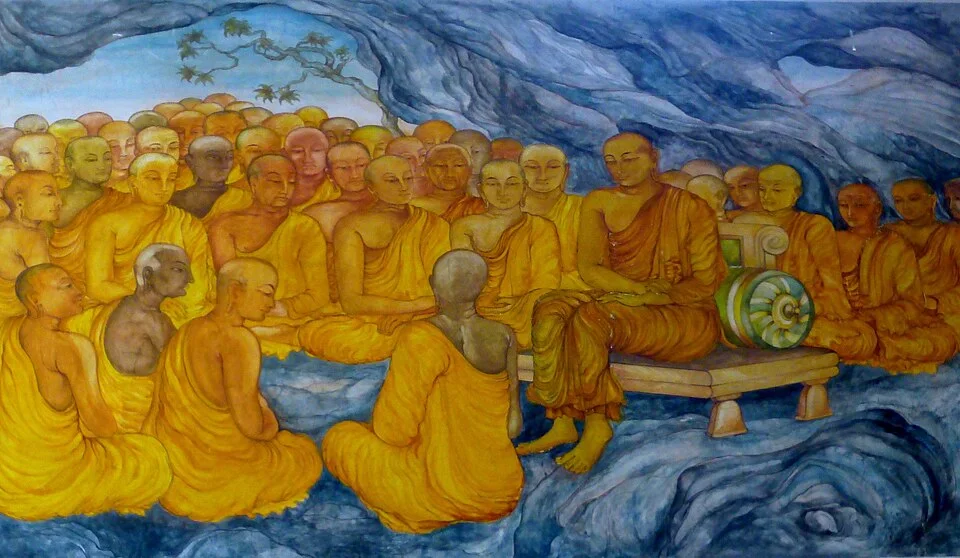
Mural depicting the First Buddhist Council at Rajagaha, Nava Jetavana temple, Shravasti; photograph by Anandajoti, CC BY 2.0.
Credit: Photo Dharma from Penang, Malaysia · CC BY 2.0 · sourceResized and converted to WebP; uncropped.
1. Meaning, sources and historical interpretation
A Buddhist council is commonly described through terms such as sangiti, meaning collective recitation. In a religious community whose teachings were initially transmitted orally, assembling learned monks helped preserve authoritative formulations of doctrine and discipline. Councils also addressed disagreements over acceptable conduct, membership of the Sangha and interpretation of the teaching. They therefore illuminate both the intellectual history of Buddhism and the institutional development of its monastic order.
Evidence comes mainly from Buddhist literary traditions rather than contemporary records of the proceedings. Vinaya texts of different schools, the Sri Lankan chronicles Dipavamsa and Mahavamsa, commentaries and later northern accounts preserve overlapping but sometimes conflicting narratives. Numbers of participants, speeches and claims of complete doctrinal agreement should consequently be understood as traditional representations rather than independently verified facts.
For examination purposes, distinguish the standard textbook sequence from claims requiring qualification. Early Buddhist traditions broadly remember the councils at Rajagriha and Vaishali, whereas recognition and numbering of subsequent councils differ considerably. The Pali canon is the canonical collection of Theravada Buddhism; other schools transmitted their own textual collections. No single council can safely be said to have created the entire Buddhist canon for every school.
- Vinaya concerns monastic discipline; Sutta or Sutra contains discourses; Abhidhamma or Abhidharma presents systematic doctrinal analysis.
- Royal patronage supported assemblies, but monks supplied their religious authority.
Timeline
Shortly after the Buddha’s death; conventionally c. 483 BCE
First Council at Rajagriha: collective recitation of teaching and discipline.
About a century later; conventionally c. 383 BCE
Second Council at Vaishali: examination of the Ten Points concerning monastic conduct.
c. 250 BCE
Third Council at Pataliputra in the Theravada account, under Ashoka.
First century BCE
Sri Lankan Fourth Council tradition: the Pali canon is committed to writing.
Conventionally second century CE
Northern Fourth Council under Kanishka, associated with Kashmir and Sarvastivada scholarship.
1871 and 1954–1956
Later Theravada councils at Mandalay and Yangon respectively.
2. First Council: preservation at Rajagriha
The First Council is traditionally placed shortly after the Buddha’s mahaparinirvana, at Rajagriha, present-day Rajgir in Bihar. Its venue is identified with the Sattapanni cave, also rendered Saptaparni. Mahakassapa, known in Sanskrit as Mahakashyapa, presided, and King Ajatashatru of Magadha is remembered as its patron. Traditional accounts describe an assembly of 500 accomplished monks.
Its central purpose was to establish an agreed recitation of the Buddha’s teaching and the rules governing monastic life. Upali recited the Vinaya, while Ananda, the Buddha’s close attendant, recited the discourses. The opening formula frequently encountered in Buddhist discourses, conventionally translated as 'Thus have I heard', expresses this lineage of remembered teaching. The proceedings underline the importance of collective memory and specialist reciters before manuscripts became the principal means of preservation.
The frequently quoted date of about 483 BCE follows one conventional chronology of the Buddha’s death. Modern scholarship does not accept a single uncontested date for that event, so 'shortly after the mahaparinirvana' is the safer historical formulation. Similarly, attributing the completed three Pitakas in their surviving form to this assembly oversimplifies a long process of textual development. The clearest standard association is Ananda with discourses and Upali with discipline.
Understanding the councils’ institutional role
- 1. Concern over preservation, discipline or doctrine arises
- 2. Senior monks assemble, often with royal support
- 3. Teachings or disputed practices undergo collective examination
- 4. An authoritative recitation or interpretation is affirmed
- 5. A particular Buddhist tradition preserves and transmits the outcome
3. Second Council: discipline at Vaishali
The Second Council took place at Vaishali, in present-day Bihar, traditionally about a century after the Buddha’s death. Conventional examination accounts date it to about 383 BCE and associate it with King Kalashoka. Sabbakami is commonly identified as the presiding elder, while Yasa and Revata played important roles in challenging and examining disputed practices. The traditional number of participants is 700 monks.
The immediate controversy concerned the Ten Points attributed to monks of the Vajji region. These included storing salt in a horn, certain practices involving meals and communal procedures, and accepting gold and silver, commonly understood in this context as money. The dispute was therefore primarily about Vinaya observance, not about the existence of God, the theory of rebirth or the later Mahayana ideal of the bodhisattva. The disputed practices were rejected in the traditional account.
Textbooks often connect this council directly with the first major division between the Sthaviras, or Elders, and the Mahasanghikas, or Great Community. The chronology and causes of that division are disputed, however, and the disciplinary settlement at Vaishali should not be treated as an unquestionably documented moment of formal schism. Nor should Sthavira be equated automatically with modern Theravada: the early schools developed through subsequent differentiation.
| Council | Place | Patron | Leading figure | Principal association |
|---|---|---|---|---|
| First | Rajagriha | Ajatashatru | Mahakassapa | Ananda: discourses; Upali: Vinaya |
| Second | Vaishali | Kalashoka | Sabbakami | Ten Points; monastic discipline |
| Third | Pataliputra | Ashoka | Moggaliputta Tissa | Kathavatthu; missions in Theravada tradition |
| Fourth, northern tradition | Kashmir | Kanishka | Vasumitra | Sarvastivada; Mahavibhasha tradition |
| Fourth, Theravada tradition | Aluvihara, Sri Lanka | Vattagamani Abhaya | Assembly of Theravada elders | Writing down the Pali canon |
4. Third Council: Ashoka, doctrinal scrutiny and missions
The Third Council is placed at Pataliputra, modern Patna, during Ashoka’s reign, conventionally around 250 BCE. According to the Theravada tradition, Moggaliputta Tissa presided over approximately 1,000 monks. The assembly sought to purify the Sangha by identifying persons and views considered incompatible with authentic Buddhist teaching. Its narrative links increased royal support with the problem of people entering the monastic community for material advantage.
The Kathavatthu, a text examining disputed doctrinal propositions, is traditionally attributed to Moggaliputta Tissa and associated with this council. It forms part of the Theravada Abhidhamma Pitaka. This association should not be expanded into the claim that every Buddhist school accepted the council or that the whole Abhidhamma tradition originated at this one meeting. Different schools developed distinct Abhidharma collections and doctrinal positions.
Sri Lankan chronicles connect the council with organised missions to several regions, including Sri Lanka. Mahinda, traditionally Ashoka’s son, is credited with bringing Buddhism to the island during the reign of Devanampiya Tissa. Sanghamitta is associated with establishing the lineage of Buddhist nuns there and bringing a branch of the Bodhi tree. Ashoka’s inscriptions independently demonstrate his concern for religious and monastic affairs, but they do not directly describe this council; the detailed narrative remains dependent on Buddhist literary sources.
5. Fourth councils and the evolution of textual authority
The northern Fourth Council is associated with the Kushana ruler Kanishka, conventionally placed in the second century CE. Standard Indian examination accounts locate it at Kundalvana in Kashmir and name Vasumitra as president, with Ashvaghosha as a leading participant or vice-president. These details derive from later traditions, and the council’s exact setting and chronology remain debated. Its principal doctrinal association is with the Sarvastivada school and the extensive commentary tradition represented by the Mahavibhasha.
It is misleading to state that this council simply founded Mahayana or formally divided Buddhism into Mahayana and Hinayana. Mahayana emerged gradually through diverse texts, practices and communities. Sarvastivada was an early Buddhist school with its own monastic and scholastic traditions, not a synonym for Mahayana. Sanskrit became increasingly important in Buddhist scholarship, but this was a wider historical development.
Theravada tradition identifies a different Fourth Council in Sri Lanka under King Vattagamani Abhaya, also called Valagamba, in the first century BCE. Associated with Aluvihara near Matale, it is remembered for committing the Pali canon and its commentarial tradition to writing amid threats to oral preservation. Later Theravada councils were held at Mandalay in 1871 and Rangoon, now Yangon, in 1954–1956. Their numbering reflects a particular lineage rather than a universally shared Buddhist chronology.
First Buddhist Council: Tradition and Historical Evidence
The supplied metadata identifies this temple mural as a representation of the First Buddhist Council at Rajagaha, or Rajagriha, identified with present-day Rajgir in Bihar. The photographed mural is located at Shravasti in Uttar Pradesh: its location must not be confused with the council’s traditional venue. As a later artistic representation, it illustrates Buddhist remembrance rather than providing contemporary archaeological evidence for the assembly.
According to Buddhist tradition, the First Council met after the Buddha’s death under the leadership of Mahakassapa, with royal support associated with Ajatashatru. Ananda is credited with reciting the teachings, while Upali recited the monastic discipline. These accounts explain how communal recitation and verification were understood to preserve authoritative instruction in an oral culture. They should not be read as proof that the complete surviving Buddhist canon was written down or finalised at this meeting.
For ancient Indian history, councils connect monastic organisation, transmission of teachings and royal patronage. However, accounts preserved by different Buddhist schools differ in their chronology and interpretation. The mural is therefore useful as an illustration of a council tradition, while historical reconstruction requires critical comparison of textual sources.
- Prelims distinction: Rajagriha is the traditional First Council venue; Shravasti is the location of this mural.
- Conceptual distinction: communal recitation is not synonymous with writing, printing or fixing every part of the Tripitaka.
- Mains caution: royal patronage supported assemblies, but does not establish uniform doctrine or universal acceptance of their decisions.
Real-world case studies
Aluvihara: safeguarding an oral inheritance
Sri Lankan tradition links the writing of the Pali canon to famine, political insecurity and the loss of learned reciters under Vattagamani Abhaya. Aluvihara illustrates how threats to a community could encourage a major change in its method of preserving knowledge. It also shows why the label Fourth Council requires a tradition-specific qualification.
Mandalay: a canon inscribed in stone
Under King Mindon, the Pali canon was inscribed on 729 marble slabs at Kuthodaw Pagoda in Mandalay, a project associated with the setting of the Fifth Council of 1871. The site provides a tangible example of royal patronage and the use of durable material to preserve an authoritative religious text.
Previous year questions
No source-linked PYQ is available here yet. Use the practice questions below.
Practice questions
Practice MCQ 1
Consider the following pairs: 1. First Council — Upali’s recitation of monastic discipline. 2. Second Council — Controversy over the Ten Points. 3. Third Council — Patronage of Kanishka. How many pairs are correctly matched?
- A. Only one
- B. Only two
- C. All three
- D. None
Practice MCQ 2
Which statement most accurately describes the Fourth Buddhist Council associated with Kanishka?
- A. It was convened at Vaishali to resolve the Ten Points.
- B. It first committed the Pali canon to writing in Sri Lanka.
- C. It is associated with Kashmir and Sarvastivada scholastic activity.
- D. It definitively founded Mahayana as a separate religion.
Practice MCQ 3
With reference to Buddhist councils, consider the following statements: 1. The Kathavatthu is traditionally associated with Moggaliputta Tissa. 2. Ashoka’s inscriptions provide a direct account of the proceedings of the Third Council. 3. Different Buddhist traditions recognise different Fourth Councils. Which statements are correct?
- A. 1 and 2 only
- B. 2 and 3 only
- C. 1 and 3 only
- D. 1, 2 and 3
Mains practice · Buddhist councils reflect both the preservation of a shared religious inheritance and the growth of diverse traditions. Discuss. Answer in 250 words.
- Explain collective recitation and the importance of oral transmission.
- Use Rajagriha to illustrate preservation of discourses and discipline.
- Discuss Vaishali as a disciplinary dispute, qualifying its direct identification with the first schism.
- Connect Pataliputra with Theravada accounts of doctrinal scrutiny, Kathavatthu and missions.
- Contrast Kanishka’s Sarvastivada-associated council with the Sri Lankan writing of the Pali canon.
- Conclude with the importance of royal patronage and the limitations of retrospective, school-specific sources.
Further reading
- NCERT, Themes in Indian History, Part I, chapter: Thinkers, Beliefs and Buildings.
- Upinder Singh, A History of Ancient and Early Medieval India.
- A. K. Warder, Indian Buddhism.
- The Mahavamsa, translated by Wilhelm Geiger: consult critically as a Sri Lankan Buddhist chronicle.
- UNESCO Memory of the World: Maha Lawkamarazein or Kuthodaw Inscription Shrines.
- SuttaCentral: translations and comparative resources for early Buddhist discourses and Vinaya texts.
- https://commons.wikimedia.org/wiki/File:Nava_Jetavana_Temple_-_Shravasti_-_013_First_Council_at_Rajagaha_(9241729223).jpg
Preparing for UPSC Civil Services? Get classroom teaching, answer-writing evaluation and mentorship at Pragnya IAS Academy, Ashok Nagar — see why aspirants choose us for IAS coaching in Hyderabad.