
Map study
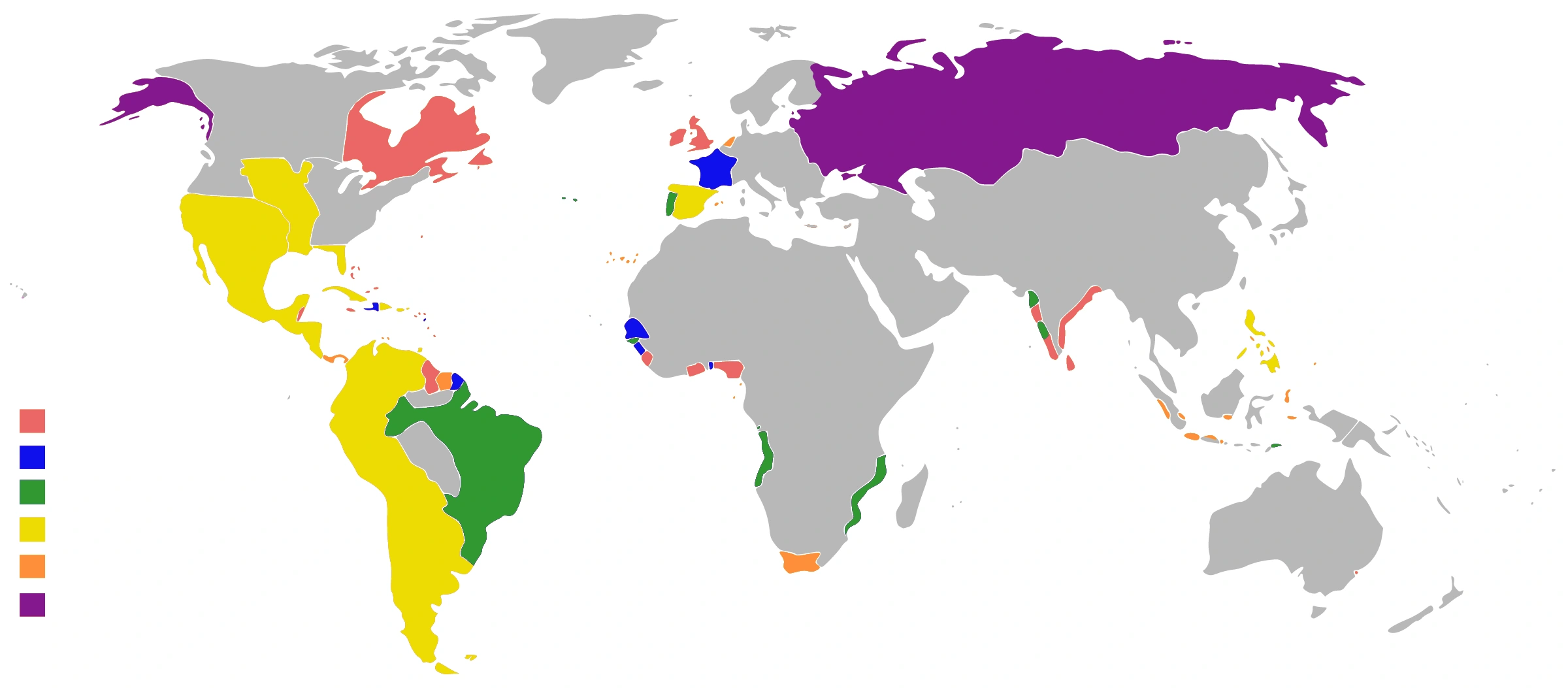
Colonial empires in 1800: global context for European expansion. A date-specific map, not the maximum territorial extent of every colonial power.
- Read the legend and reference date before interpreting regional patterns.
- Relate the map to the article’s topic; verify current administrative boundaries or data separately.
Credit: George Tsiagalakis · CC BY-SA 4.0 · sourceConverted to WebP on an opaque white background; proportionally resized without cropping. Original cartography and legend retained.
Origins and commercial settlements
The French entered the Indian Ocean trading system after the Portuguese, Dutch and English had established important positions. In 1664, Jean-Baptiste Colbert, finance minister of Louis XIV, organised the French East India Company, or Compagnie des Indes orientales. It received royal privileges and substantial state support. Its formation reflected mercantilism: European governments sought overseas commerce, favourable trade balances and national power through privileged trading companies.
The French established a factory at Surat in 1668 under François Caron and another at Masulipatam in 1669. These factories were commercial establishments, not manufacturing plants in the modern sense. They procured goods, maintained warehouses and conducted transactions under permissions negotiated with Indian authorities. Indian textiles, particularly those of the Coromandel Coast and Bengal, were central to European commerce.
French activity at Pondicherry began in 1673, and François Martin developed the settlement from 1674. Its coastal location and access to textile-producing districts helped it become the principal French base in India. The Dutch captured it in 1693; it was subsequently restored following the Treaty of Ryswick of 1697. Chandernagore in Bengal, and later Mahe, Yanam and Karaikal, widened the French commercial network. These scattered settlements never initially constituted a continuous territorial empire.
- Present-day locations: Puducherry and Karaikal on the Tamil coast; Yanam in Andhra Pradesh; Mahe on the Kerala coast; Chandannagar in West Bengal.
- Distinguish François Martin, associated with Pondicherry’s early development, from Dupleix, associated with political expansion.
Timeline
1664
Establishment of the French East India Company.
1674
François Martin begins developing Pondicherry as a French settlement.
1746–1748
First Carnatic War; French capture and subsequent restoration of Madras.
1749–1754
Second Carnatic War; succession interventions and eventual recall of Dupleix.
1760–1763
Wandiwash, surrender of Pondicherry and Treaty of Paris end the major French territorial challenge.
1954–1962
De facto and de jure transfers of the four remaining French establishments to India.
From commerce to political intervention
The weakening of effective Mughal authority created opportunities for European companies, but Indian rulers remained active participants rather than passive recipients of foreign intervention. The Carnatic was formally subordinate to the Nizam of Hyderabad, while local rulers increasingly exercised autonomy. Rival claimants sought money, artillery and disciplined infantry from European companies; the companies sought trade privileges, revenues and influence in return.
Dupleix became governor at Pondicherry in 1742. He attempted to secure French ascendancy through diplomacy, support for Indian claimants and European-trained sepoy forces. The French supported Chanda Sahib in the Carnatic and Muzaffar Jang in Hyderabad, while the English supported their rivals. Charles Joseph Patissier de Bussy maintained French influence at Hyderabad, particularly under Salabat Jang, and obtained assignments of revenue from the Northern Circars to sustain French troops.
This was an important transition from coastal trade to participation in inland politics. European officers and Indian soldiers together created military forces capable of influencing succession struggles. Revenue assignments linked military assistance to fiscal control. However, French achievements depended heavily on unstable alliances, individual commanders and support from Europe. Commercial directors and the French government did not always share Dupleix’s costly political ambitions, and he was recalled in 1754.
- The French did not invent Indian political rivalry; they used existing disputes to enlarge their influence.
- The English subsequently employed similar combinations of military assistance, political patronage and revenue extraction.
French expansion and reversal
- 1. Royal charter and commercial factories
- 2. Development of Pondicherry and regional trading networks
- 3. Military assistance to Indian succession claimants
- 4. Political influence supported by revenue assignments
- 5. English naval, financial and military gains
- 6. Restricted colonial enclaves after 1763
The three Carnatic Wars
The First Carnatic War, 1746–1748, was an Indian extension of the War of the Austrian Succession. A French force under La Bourdonnais captured Madras in 1746. Disagreement between him and Dupleix over its treatment exposed divisions within French leadership. When Nawab Anwar-ud-din attempted to assert his authority, a much smaller French force defeated his troops near the Adyar River at St Thomé. The encounter demonstrated the effectiveness of disciplined infantry and coordinated firepower, without proving that all Indian armies were inherently inferior. The Treaty of Aix-la-Chapelle restored Madras to the English in 1748.
The Second Carnatic War, conventionally dated 1749–1754, arose primarily from succession conflicts in Hyderabad and the Carnatic. Anwar-ud-din was killed at Ambur in 1749, and French-backed Chanda Sahib gained an advantage. His rival Muhammad Ali received English support. Robert Clive’s capture and defence of Arcot in 1751 diverted pressure from Muhammad Ali at Trichinopoly. Chanda Sahib was killed in 1752. Dupleix’s recall and the settlement negotiated under his successor Godeheu in 1754 marked the retreat of his expansionist strategy.
The Third Carnatic War, 1756–1763, formed part of the global Seven Years’ War. The English captured Chandernagore in 1757. Count de Lally arrived in India in 1758, captured Fort St David, but failed to take Madras. His recall of Bussy from Hyderabad weakened an important French political position. In January 1760, English forces commanded by Eyre Coote defeated the French at Wandiwash, where Bussy was captured. Pondicherry surrendered in 1761. The Treaty of Paris in 1763 restored French trading settlements but imposed restrictions that effectively ended the French challenge for territorial supremacy.
- First war: European conflict provided the principal trigger.
- Second war: Indian succession disputes were central.
- Third war: a global war culminated in decisive English military superiority in India.
| Establishment | Present location | Significance |
|---|---|---|
| Pondicherry | Puducherry region | Principal French administrative and commercial base |
| Karaikal | Puducherry Union territory, Tamil coast | Acquired in 1739; connected with the fertile Kaveri delta |
| Mahe | Puducherry Union territory, Kerala coast | Malabar trading station associated with the pepper trade |
| Yanam | Puducherry Union territory, Andhra coast | Trading settlement in the Godavari delta region |
| Chandernagore | West Bengal | Bengal commercial base on the Hooghly River |
Why the French lost the struggle
Naval power was a major determinant. Control of maritime routes affected reinforcements, supplies and communication with Europe. French naval support was intermittent, while British maritime strength improved during the Seven Years’ War. The English also possessed a broader network of strategically important bases, including Bombay, Madras and Calcutta. French strength was more heavily concentrated around Pondicherry.
Finance and institutional support mattered equally. The French enterprise depended heavily on royal patronage and decisions shaped by France’s European commitments. The English Company also depended on state assistance, but its commercial resources and increasingly effective cooperation with British naval power gave it advantages. Following Plassey in 1757, access to Bengal’s wealth strengthened English operations; the formal grant of Bengal’s diwani came later, in 1765, and should not be projected backwards.
Conflicts among French commanders, Lally’s difficulties with local interests, and the weakening of Bussy’s Hyderabad position compounded these disadvantages. Nevertheless, French defeat was not inevitable from the outset. Dupleix and Bussy achieved substantial political influence. A balanced explanation therefore combines global strategy, logistics, fiscal resources, Indian alliances and battlefield outcomes rather than attributing defeat solely to one commander or to national character.
Survival of French enclaves and integration with India
After 1763, French settlements survived as limited colonial possessions rather than centres of a major territorial empire. Their subsequent history included further wartime occupations and restorations. French influence also continued through military personnel in Indian service, commerce and cultural institutions. The survival of French possessions must therefore be distinguished from the collapse of French ambitions for political supremacy.
After Indian independence, Chandernagore voted for merger with India in a referendum in 1949. Its de facto transfer occurred in 1950, followed by de jure transfer in 1952; it merged with West Bengal in 1954. For Pondicherry, Karaikal, Mahe and Yanam, representatives voted for merger at Kizhoor in October 1954. Their de facto transfer took place on 1 November 1954. The cession treaty was signed in 1956, and de jure transfer followed on 16 August 1962. The Fourteenth Constitutional Amendment, 1962, incorporated Pondicherry as a Union territory. It was renamed Puducherry in 2006.
- De facto transfer means actual transfer of administration; de jure transfer means formal legal transfer of sovereignty.
- Chandannagar belongs to West Bengal and is not part of the Union territory of Puducherry.
Real-world case studies
Bussy at Hyderabad
Bussy’s support for Salabat Jang secured a strong French position in the Deccan. Revenue assignments in the Northern Circars helped maintain his troops. His withdrawal under Lally illustrates how concentrating forces for a coastal campaign could undermine an established inland alliance.
Kizhoor and negotiated integration
The October 1954 vote at Kizhoor involved elected representatives, not a universal adult referendum. It facilitated the negotiated transfer of the four remaining French establishments, illustrating a route to decolonisation distinct from the military liberation of Portuguese Goa in 1961.
Previous year questions
No source-linked PYQ is available here yet. Use the practice questions below.
Practice questions
Practice MCQ 1
Consider the following pairs: 1. François Martin — Development of Pondicherry; 2. Bussy — French influence at Hyderabad; 3. La Bourdonnais — English victory at Wandiwash. Which pairs are correctly matched?
- A. 1 and 2 only
- B. 2 and 3 only
- C. 1 and 3 only
- D. 1, 2 and 3
Practice MCQ 2
Which sequence is chronologically correct?
- A. Capture of Arcot — Capture of Madras by the French — Wandiwash — Treaty of Paris
- B. Capture of Madras by the French — Capture of Arcot — Wandiwash — Treaty of Paris
- C. Wandiwash — Capture of Arcot — Treaty of Paris — Capture of Madras by the French
- D. Capture of Madras by the French — Treaty of Paris — Capture of Arcot — Wandiwash
Practice MCQ 3
Regarding former French possessions, consider the following statements: 1. Chandannagar is part of the Union territory of Puducherry. 2. Mahe lies on the Kerala coast. 3. The de facto transfer of the four remaining French establishments preceded their de jure transfer. Which statements are correct?
- A. 1 and 2 only
- B. 2 and 3 only
- C. 1 and 3 only
- D. 1, 2 and 3
Mains practice · The French failure in eighteenth-century India resulted from structural disadvantages as well as strategic decisions. Discuss. (250 words)
- Introduce the transition from commercial competition to political intervention.
- Explain naval logistics, financial constraints and France’s European priorities.
- Assess English bases and access to Bengal’s resources after 1757.
- Examine Dupleix’s recall, leadership conflicts and Bussy’s withdrawal.
- Connect Wandiwash and the Treaty of Paris to the collapse of territorial ambitions.
- Conclude by distinguishing political defeat from the survival of French enclaves.
Further reading
- NCERT, Our Pasts–III, Chapter: From Trade to Territory.
- Bipan Chandra, History of Modern India.
- Government of Puducherry official portal: history and merger of French establishments.
- Ministry of External Affairs: Treaty of Cession of the French Establishments in India, 1956.
- Legislative Department: Constitution (Fourteenth Amendment) Act, 1962.
Preparing for UPSC Civil Services? Get classroom teaching, answer-writing evaluation and mentorship at Pragnya IAS Academy, Ashok Nagar — see why aspirants choose us for IAS coaching in Hyderabad.