

Gandhi during the Salt March, March 1930.
Credit: Yann (talk) · Public domain · source
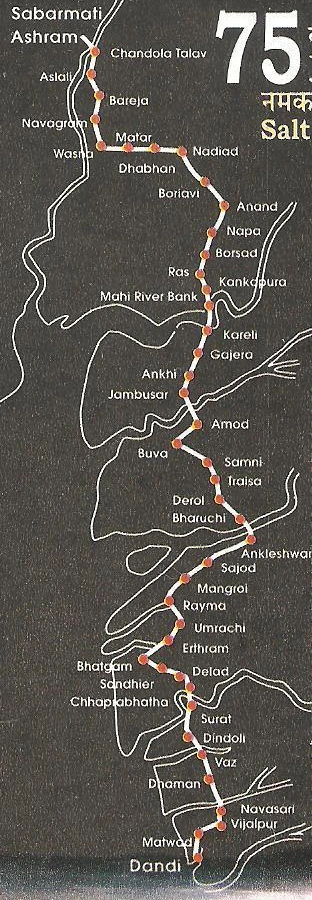
Map study
India Post commemorative route map of the 1930 Salt March from Sabarmati Ashram to Dandi, showing intermediate settlements and river crossings. A schematic historical route, not navigation guidance.
- Follow the route south from Sabarmati through Nadiad, Anand, Borsad, Bharuch, Surat and Navsari to Dandi.
- Observe crossings near the Mahi, Narmada and Tapi river systems. The march began on 12 March 1930; Gandhi broke the salt law at Dandi on 6 April.
- The source is a narrow commemorative map extract; enlarge to inspect its settlement labels.
Credit: India Post, Government of India · Government Open Data License – India · sourceConverted source extract to WebP without further cropping or altering labels.
Background: from constitutional disappointment to Purna Swaraj
The Civil Disobedience Movement emerged from the political impasse of the late 1920s. The all-British Simon Commission, appointed in 1927 and arriving in India in 1928, provoked widespread protest because it excluded Indians. The Nehru Report of 1928 proposed dominion status, but constitutional negotiations failed to secure agreement among major political interests or a satisfactory British commitment. The Calcutta Congress of December 1928 gave the government one year to accept dominion status, failing which Congress would pursue independence.
At Lahore in December 1929, Congress adopted Purna Swaraj and authorised a campaign of civil disobedience. People across India took an independence pledge on 26 January 1930. The Great Depression reinforced political dissatisfaction: falling agricultural prices and persistent revenue demands burdened cultivators, while economic insecurity affected trade and employment. Nevertheless, participants entered the movement with differing expectations, ranging from national freedom to relief from taxation and local exploitation.
Before launching the campaign, Gandhi presented eleven demands covering economic and political issues, including abolition of the salt tax, reduction of land revenue and military expenditure, prohibition, protection for Indian textiles and release of political prisoners. His letter to Viceroy Lord Irwin on 2 March 1930 warned of civil disobedience. Salt offered a particularly effective starting point because it was an everyday necessity and its taxation symbolised colonial interference in ordinary life.
Timeline
December 1929
Lahore Congress adopts Purna Swaraj as its goal.
26 January 1930
Independence Day is observed through meetings and pledges.
12 March–6 April 1930
Dandi March culminates in Gandhi breaking the salt law.
21 May 1930
Non-violent volunteers face police violence at Dharasana salt works.
5 March 1931
Gandhi–Irwin Pact suspends civil disobedience.
September–December 1931
Gandhi attends the Second Round Table Conference.
January 1932–April 1934
Movement resumes, faces severe repression and is eventually withdrawn.
Dandi and the repertoire of civil disobedience
On 12 March 1930, Gandhi left Sabarmati Ashram with 78 selected volunteers. After walking approximately 240 miles, or 385 kilometres, through Gujarat, he reached Dandi on 5 April and broke the salt law on 6 April. Meetings along the route linked the campaign to village society. The act challenged the colonial salt monopoly and encouraged people elsewhere to manufacture, collect or sell illicit salt.
Civil disobedience meant openly and non-violently breaking specific laws considered unjust and accepting the consequences. This distinguished its central method from the Non-Cooperation Movement of 1920–1922, which primarily stressed withdrawal from colonial institutions, although boycotts and non-cooperation continued in 1930. Foreign-cloth boycotts, picketing of liquor shops, resignation of village officials and refusal of selected taxes accompanied salt satyagraha. Revenue resistance was not uniformly adopted everywhere.
The campaign spread beyond coastal salt-making. In Gujarat, cultivators participated in revenue resistance; in the Central Provinces and elsewhere, forest satyagrahas challenged restrictions on access to forest resources. Women organised picketing, processed salt and courted arrest. The government responded through arrests, ordinances, censorship, confiscations and police violence. Gandhi was arrested in early May 1930 before the planned action at Dharasana salt works.
How salt became an instrument of mobilisation
- 1. Choose an everyday necessity affected by colonial taxation
- 2. Publicise demands and announce non-violent resistance
- 3. Mobilise villages through the Dandi March
- 4. Break the salt law and encourage regional replication
- 5. Extend protest through boycotts and selected revenue and forest campaigns
- 6. Convert repression and public attention into political pressure
Regional spread, participation and limits
Regional leadership adapted the national programme to local circumstances. C. Rajagopalachari led the Vedaranyam Salt March in the Madras Presidency in April 1930. K. Kelappan led salt satyagraha at Payyanur in Malabar. In the North-West Frontier Province, Khan Abdul Ghaffar Khan’s Khudai Khidmatgars combined social reform with disciplined non-violent mobilisation. During the Peshawar disturbances, soldiers of the Garhwal Rifles refused orders to fire on demonstrators, exposing strains within colonial coercive authority.
Participation was broad but socially uneven. Prosperous peasants were attracted by demands for lower revenue, while poorer peasants and tenants often sought rent relief that Congress did not consistently endorse. Business groups supported boycotts and greater economic autonomy, but some became uneasy about prolonged disruption and radicalisation. Workers participated in particular centres, although industrial working-class mobilisation was not uniformly integrated into the Congress campaign.
Women entered public protest in significant numbers, including Sarojini Naidu, Kamaladevi Chattopadhyay and numerous locally organised volunteers. However, participation did not immediately overturn patriarchal limits within nationalist politics. Muslim participation varied considerably: the strong Frontier mobilisation contrasts with weaker participation in many other regions. Dalit political aspirations also could not simply be subsumed within Congress nationalism; B. R. Ambedkar emphasised independent safeguards and political representation. These differences show why mass participation should not be mistaken for uniform interests.
| Aspect | Non-Cooperation Movement | Civil Disobedience Movement |
|---|---|---|
| Principal period | 1920–1922 | 1930–1934, with a suspension in 1931 |
| Immediate setting | Punjab wrongs, Khilafat issue and demand for Swaraj | Purna Swaraj resolution and failure of constitutional negotiations |
| Central method | Withdrawal from colonial institutions and boycott | Deliberate breach of selected laws, alongside boycott |
| Major symbol | Renunciation of titles and boycott of institutions and foreign cloth | Salt-law violation |
| Conclusion | Suspended after Chauri Chaura in February 1922 | Suspended by pact in 1931; resumed in 1932; withdrawn in 1934 |
Truce, constitutional negotiations and the second phase
Congress did not attend the First Round Table Conference, held in London from November 1930 to January 1931. After Gandhi’s release, negotiations produced the Gandhi–Irwin Pact on 5 March 1931. Congress agreed to suspend civil disobedience and participate in the next conference. The government agreed to release prisoners detained for offences not involving violence, restore confiscated property not already disposed of, permit peaceful picketing and allow limited salt collection or manufacture by coastal inhabitants.
The pact neither conceded independence nor abolished the salt tax. It did not secure commutation of the sentences of Bhagat Singh, Rajguru and Sukhdev, who were executed on 23 March 1931. The Karachi Congress later that month endorsed the pact and adopted resolutions on Fundamental Rights and a National Economic Programme. Gandhi attended the Second Round Table Conference, from September to December 1931, as the sole Congress representative, but negotiations failed to produce an acceptable settlement.
Civil disobedience resumed in January 1932 under Viceroy Lord Willingdon, whose administration acted swiftly against Congress through arrests, bans and seizure of property. The movement struggled without much of its leadership. The Communal Award and the Poona Pact of 1932 formed an important parallel debate over representation, not a negotiated settlement of civil disobedience. Mass action weakened during 1933, when individual civil disobedience was attempted, and Gandhi formally withdrew the movement in April 1934.
Historical significance and examination distinctions
The movement did not immediately achieve independence or fundamental constitutional change. Its importance lay in expanding the practice of mass politics, questioning the legitimacy of colonial law and demonstrating the power of disciplined symbolic action. Salt connected an abstract constitutional demand with household experience. Repression at places such as Dharasana attracted international attention, while negotiations between Gandhi and the viceroy strengthened Congress’s standing as an indispensable political interlocutor.
For examination purposes, distinguish the Lahore resolution, the January independence pledge and the April breach of the salt law. Also distinguish the suspension under the Gandhi–Irwin Pact in 1931 from final withdrawal in 1934. Civil disobedience was more than the Dandi March: its regional tax, forest and boycott campaigns explain its national reach. At the same time, divergent class interests, unequal regional mobilisation and unresolved questions of minority and Dalit representation qualify any claim that it united all Indians equally.
Real-world case studies
Dharasana: non-violence under repression
After Gandhi’s arrest, Abbas Tyabji initially assumed leadership of the planned Dharasana action. Following his arrest, volunteers led by Sarojini Naidu and others advanced on the salt works on 21 May 1930. Journalist Webb Miller reported the severe beatings inflicted on non-resisting protesters. International reporting highlighted the contrast between satyagraha and colonial coercion.
Vedaranyam: regional adaptation
C. Rajagopalachari led volunteers from Tiruchirappalli to Vedaranyam on the Tamil coast in April 1930. Local networks provided support despite official pressure, and participants violated the salt law. The march illustrates how regional leaders replicated Gandhi’s strategy without merely joining the original Dandi procession.
Previous year questions
No source-linked PYQ is available here yet. Use the practice questions below.
Practice questions
Practice MCQ 1
Consider the following events: 1. Gandhi–Irwin Pact 2. Lahore Congress adoption of Purna Swaraj 3. Gandhi’s participation in the Second Round Table Conference 4. Dandi salt-law violation. What is their correct chronological sequence?
- A. 2–4–1–3
- B. 4–2–1–3
- C. 2–1–4–3
- D. 2–4–3–1
Practice MCQ 2
Which of the following formed part of the Gandhi–Irwin Pact? 1. Release of political prisoners whose offences did not involve violence 2. Complete abolition of the salt tax 3. Congress participation in the Second Round Table Conference. Select the correct answer.
- A. 1 and 2 only
- B. 2 and 3 only
- C. 1 and 3 only
- D. 1, 2 and 3
Practice MCQ 3
Which pair is incorrectly matched?
- A. C. Rajagopalachari — Vedaranyam Salt March
- B. K. Kelappan — Payyanur salt satyagraha
- C. Khan Abdul Ghaffar Khan — Khudai Khidmatgars
- D. Lord Willingdon — Signatory to the March 1931 pact with Gandhi
Mains practice · How did the Civil Disobedience Movement translate the demand for Purna Swaraj into mass politics? Discuss its methods, social reach and limitations. Answer in 250 words.
- Connect the Lahore resolution and independence pledge with the choice of salt.
- Explain non-violent law-breaking, boycott, revenue resistance and forest satyagraha.
- Illustrate regional adaptation through Vedaranyam, Payyanur and the North-West Frontier Province.
- Discuss women, peasants, business groups and uneven worker participation.
- Assess repression, divergent social interests and questions of minority and Dalit representation.
- Conclude with expanded political mobilisation despite the absence of immediate independence.
Further reading
- NCERT, India and the Contemporary World–II, chapter: Nationalism in India.
- NCERT, Themes in Indian History, Part III, chapter: Mahatma Gandhi and the Nationalist Movement.
- Bipan Chandra and others, India’s Struggle for Independence.
- Collected Works of Mahatma Gandhi, especially the letter to Lord Irwin dated 2 March 1930; Gandhi Heritage Portal.
- National Archives of India, records and digital collections on the freedom struggle.
Preparing for UPSC Civil Services? Get classroom teaching, answer-writing evaluation and mentorship at Pragnya IAS Academy, Ashok Nagar — see why aspirants choose us for IAS coaching in Hyderabad.