

Gandhi during the Salt March, March 1930.
Credit: Yann (talk) · Public domain · source

Saifee Villa Gandhi memorial museum, Dandi
Credit: Snehrashmi · CC BY-SA 4.0 · source
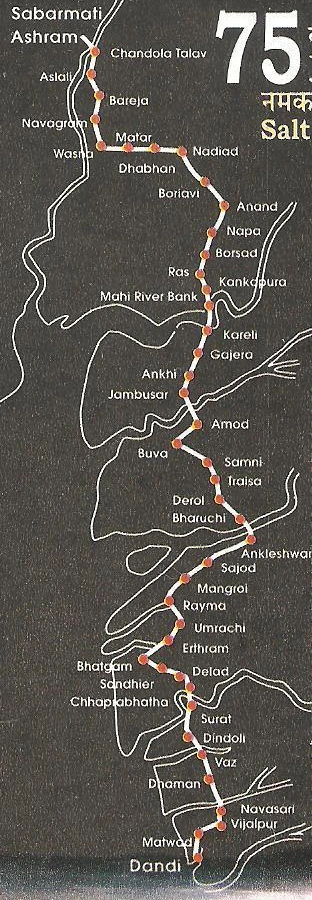
Map study
India Post commemorative route map of the 1930 Salt March from Sabarmati Ashram to Dandi, showing intermediate settlements and river crossings. A schematic historical route, not navigation guidance.
- Follow the route south from Sabarmati through Nadiad, Anand, Borsad, Bharuch, Surat and Navsari to Dandi.
- Observe crossings near the Mahi, Narmada and Tapi river systems. The march began on 12 March 1930; Gandhi broke the salt law at Dandi on 6 April.
- The source is a narrow commemorative map extract; enlarge to inspect its settlement labels.
Credit: India Post, Government of India · Government Open Data License – India · sourceConverted source extract to WebP without further cropping or altering labels.
1. Political background and the choice of salt
The Dandi March emerged from the Congress decision to make complete independence the goal of the national movement. At its Lahore session in December 1929, presided over by Jawaharlal Nehru, the Indian National Congress adopted the Purna Swaraj objective. On 26 January 1930, people across India observed Independence Day and took an independence pledge. The Congress subsequently authorised Gandhi to organise civil disobedience. The campaign therefore translated a constitutional demand into direct action against colonial authority.
Before beginning the march, Gandhi presented eleven demands covering economic, administrative and political grievances. These included abolition of the salt tax, reduction of land revenue and military expenditure, prohibition, protection for Indian textiles and release of political prisoners. In a letter to Viceroy Lord Irwin dated 2 March 1930, Gandhi explained his objections to British rule and announced his intention to break the salt laws if no settlement followed.
Salt was a strategically effective choice because it was consumed by virtually everyone, including the poorest households. The colonial monopoly and taxation system restricted lawful manufacture and sale, making an essential commodity a source of government revenue. A seemingly modest issue thus connected the demand for independence with daily life. Salt also enabled participation without requiring sophisticated political knowledge or substantial financial resources.
Timeline
December 1929
The Lahore Congress adopts complete independence as its objective.
26 January 1930
Independence Day is observed and the independence pledge is taken.
2 March 1930
Gandhi writes to Lord Irwin before launching civil disobedience.
12 March–6 April 1930
Gandhi marches from Sabarmati to Dandi and breaks the salt law on 6 April.
Night of 4–5 May 1930
Gandhi is arrested before the planned Dharasana action.
21 May 1930
Police assault non-violent volunteers at Dharasana Salt Works.
5 March 1931
The Gandhi–Irwin Pact establishes a truce and provides for Congress participation in the Second Round Table Conference.
2. Route, organisation and the act of defiance
On 12 March 1930, Gandhi left Sabarmati Ashram with 78 selected satyagrahis. The original marching group consisted of men, although women subsequently became prominent in the wider movement. The march passed through numerous Gujarat villages, including settlements in the Kheda region, before reaching Dandi, a coastal village in present-day Navsari district. The distance is usually given as approximately 385 kilometres; accounts often round it to 390 kilometres or about 240 miles.
The journey was deliberately slow and public. Village meetings, prayers and speeches made the route a moving platform for political education. Gandhi explained the salt issue, urged non-violence and linked political freedom with khadi, social reform and the removal of untouchability. Local volunteers organised accommodation and public meetings. Growing crowds and extensive press coverage ensured that the march reached audiences far beyond those physically accompanying Gandhi.
The marchers reached Dandi on 5 April. On the morning of 6 April 1930, Gandhi picked up salt-bearing material from the seashore, symbolically breaking the salt law. This distinction between arrival and law-breaking is important for factual questions. The action challenged the government’s authority over salt production and invited people elsewhere to repeat the breach peacefully. Dandi was therefore the opening act of a broader struggle, not the geographical limit of the campaign.
How the salt campaign generated mass mobilisation
- 1. Complete independence becomes the declared objective.
- 2. Salt taxation links colonial rule with everyday hardship.
- 3. The public march builds awareness and volunteer networks.
- 4. Breaking the salt law provides a replicable act of resistance.
- 5. Regional campaigns expand civil disobedience.
- 6. Repression and publicity increase pressure for negotiations.
3. From the march to nationwide civil disobedience
After Dandi, illegal salt manufacture and distribution spread along several coastal regions. Inland areas adopted other forms of civil disobedience according to local conditions. These included boycotting foreign cloth, picketing liquor shops, violating forest restrictions and refusing selected taxes. Such campaigns were not identical everywhere: local leadership, economic grievances and organisational capacity shaped participation. The nationwide movement should therefore be understood as a collection of connected regional struggles rather than a uniform salt campaign.
In the Madras Presidency, C. Rajagopalachari led a march from Tiruchirappalli to Vedaranyam in April 1930. K. Kelappan led salt satyagraha at Payyannur in Malabar. In the North-West Frontier Province, Khan Abdul Ghaffar Khan’s Khudai Khidmatgars participated in non-violent resistance. The firing at Peshawar’s Qissa Khwani Bazaar in April demonstrated the severity of colonial repression and the movement’s reach beyond coastal India.
Women participated in salt-making, picketing and public demonstrations, despite their exclusion from the original group of 78 marchers. Sarojini Naidu and Kamaladevi Chattopadhyay were notable participants in the wider campaign. Peasants, students, traders and sections of business supported the movement in varying ways. Participation nevertheless remained uneven across regions and social groups. For examination purposes, distinguish the Dandi March itself from the larger Civil Disobedience Movement that it inaugurated.
| Place or campaign | Associated leader | Key distinction |
|---|---|---|
| Dandi, Gujarat | Mahatma Gandhi | Salt law broken on 6 April 1930 after the march from Sabarmati. |
| Dharasana, Gujarat | Abbas Tyabji and Sarojini Naidu | Subsequent salt-works campaign; police assault on 21 May received international coverage. |
| Vedaranyam, present-day Tamil Nadu | C. Rajagopalachari | Regional salt march from Tiruchirappalli in April 1930. |
| Payyannur, present-day Kerala | K. Kelappan | Important centre of salt satyagraha in Malabar. |
4. Repression, Dharasana and negotiations
The colonial government responded with arrests, restrictions on meetings, confiscation of property and coercive policing. Gandhi was arrested during the night of 4–5 May 1930, before he could lead a planned action against the Dharasana Salt Works. Leadership continued despite his detention. Abbas Tyabji initially took charge of the proposed campaign; after his arrest, Sarojini Naidu and other leaders guided the volunteers.
On 21 May 1930, non-violent volunteers attempting to approach the Dharasana Salt Works were severely beaten by police. American journalist Webb Miller’s reports circulated internationally and exposed the contrast between disciplined protesters and state violence. Dharasana was distinct from the Dandi March, but it extended the salt campaign and strengthened its international impact. The episode demonstrates why non-violent resistance relied on organisation, endurance and public communication, rather than merely the absence of weapons.
Negotiations eventually produced the Gandhi–Irwin Pact on 5 March 1931. Congress agreed to discontinue civil disobedience and participate in the Second Round Table Conference. The government agreed to release prisoners detained for participation in the movement who were not convicted of violence and made other concessions. Limited manufacture or collection of salt by coastal residents was permitted under specified conditions; the salt tax itself was not abolished. The pact was consequently a negotiated truce, not the achievement of independence.
5. Historical significance and examination distinctions
The march’s major achievement was the conversion of an ordinary commodity into a symbol of sovereignty. By breaking an identifiable law, Gandhi made colonial power visible and gave individuals a practical means of challenging it. The campaign combined symbolic leadership with reproducible local action: people who could not travel to Dandi could make salt, sell contraband salt or join related protests. Its carefully staged publicity helped bring Indian nationalism to an international audience.
Civil disobedience went beyond the withdrawal of cooperation associated with the Non-Cooperation Movement of 1920–22. It involved openly and peacefully violating selected laws regarded as unjust and accepting the resulting punishment. The two movements nevertheless shared methods such as boycott and mass mobilisation. Satyagraha supplied the ethical framework: insistence on truth, non-violence, self-discipline and willingness to suffer rather than retaliate.
The immediate results were limited: British rule continued, the salt tax survived and the government retained substantial coercive capacity. Yet the campaign broadened political participation, enhanced Congress’s claim to represent Indian opinion and demonstrated the potential of decentralised protest. Its significance cannot be judged only by immediate policy concessions. For Prelims, retain the sequence Lahore resolution, Independence Day pledge, Dandi March, Dharasana action and Gandhi–Irwin Pact; do not confuse the march with Gandhi’s earlier Champaran or Kheda satyagrahas.
Real-world case studies
Vedaranyam: adapting a national strategy regionally
C. Rajagopalachari began the Vedaranyam march from Tiruchirappalli on 13 April 1930 and broke the salt law at the coast on 30 April. Despite official attempts to obstruct support, local networks sustained the volunteers. The campaign illustrates how a national political programme could be adapted to regional geography and leadership.
Dharasana: non-violence and international reporting
Webb Miller witnessed the police assault on satyagrahis at Dharasana on 21 May 1930. His reporting carried the incident to international readers. Although the volunteers did not seize the salt works, their disciplined response made colonial repression a subject of wider scrutiny, showing that political effects could extend beyond immediate operational success.
Previous year questions
No source-linked PYQ is available here yet. Use the practice questions below.
Practice questions
Practice MCQ 1
With reference to the Dandi March, consider the following statements: 1. It began after the observance of Independence Day on 26 January 1930. 2. Gandhi broke the salt law on the same day that the marchers reached Dandi. 3. Lord Irwin was the Viceroy during the march. Which of the statements given above are correct?
- A. 1 and 2 only
- B. 1 and 3 only
- C. 2 and 3 only
- D. 1, 2 and 3
Practice MCQ 2
Which of the following pairs is incorrectly matched?
- A. Vedaranyam salt march — C. Rajagopalachari
- B. Payyannur salt satyagraha — K. Kelappan
- C. Khudai Khidmatgars — Khan Abdul Ghaffar Khan
- D. Original Dandi marching contingent — Led by Sarojini Naidu
Practice MCQ 3
Which statement best describes the treatment of salt under the Gandhi–Irwin Pact?
- A. The salt tax was abolished throughout British India.
- B. Unrestricted commercial salt manufacture was permitted to everyone.
- C. Limited manufacture or collection of salt by coastal residents was permitted under specified conditions.
- D. The government transferred its entire salt monopoly to the Congress.
Mains practice · How did the Dandi March transform a grievance over an everyday commodity into a nationwide challenge to colonial authority? Discuss its achievements and limitations. Answer in 250 words.
- Locate the march within the Purna Swaraj resolution and the January 1930 independence pledge.
- Explain salt’s universal consumption, regressive taxation and symbolic connection with colonial control.
- Discuss village mobilisation, disciplined law-breaking and press coverage.
- Use Vedaranyam, Payyannur and Dharasana to show replication and expansion.
- Assess increased participation, international visibility and negotiations.
- Balance these achievements against uneven mobilisation, repression and the survival of the salt tax and colonial rule.
Further reading
- NCERT, Themes in Indian History, Part III: Mahatma Gandhi and the Nationalist Movement.
- Bipan Chandra and others, India’s Struggle for Independence: chapters on civil disobedience.
- Collected Works of Mahatma Gandhi, Gandhi Heritage Portal: letter to the Viceroy dated 2 March 1930 and writings on the salt campaign.
- National Salt Satyagraha Memorial, Dandi: official historical and visitor resources.
- Sabarmati Ashram Preservation and Memorial Trust: resources on Gandhi and the Dandi March.
Preparing for UPSC Civil Services? Get classroom teaching, answer-writing evaluation and mentorship at Pragnya IAS Academy, Ashok Nagar — see why aspirants choose us for IAS coaching in Hyderabad.