

Illustrative rendering of “Dhamma,” identified in the source metadata as Prakrit.
Credit: User:Ne0Freedom · CC BY-SA 3.0 · sourceResized and converted to WebP; uncropped.
Map study
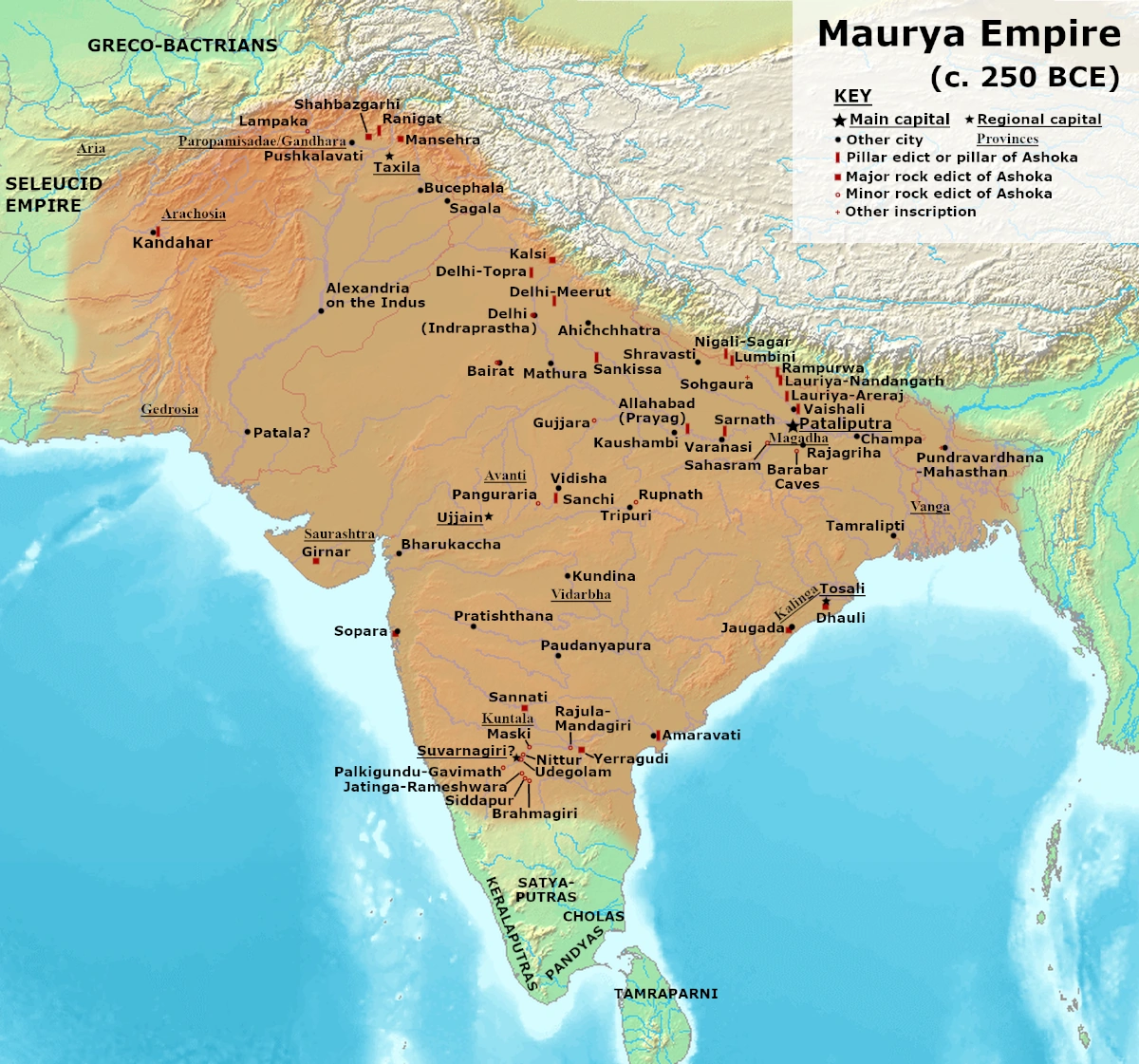
Mauryan Empire around 250 BCE during Ashoka’s reign: a date-specific historical reconstruction.
- Read the source date and legend before interpreting territorial extent.
- Compare core regions, neighbouring powers and geographic barriers; historical borders and influence are approximate and changed over time.
Credit: Avantiputra7 · CC BY-SA 3.0 · sourceConverted to WebP on an opaque white background; proportionally resized without cropping. Original cartography and legend retained.
Historical setting and sources
The Mauryan Empire brought extensive territories and diverse populations under a common political authority. Its inhabitants followed different religious traditions, spoke different languages and maintained varied local customs. Ashoka inherited this setting and sought to establish shared standards of conduct without prescribing a single religious affiliation. Dhamma should therefore be studied simultaneously as an ethical teaching, an instrument of communication and an aspect of imperial governance.
The most important evidence comes from Ashoka’s own rock and pillar inscriptions. Usually identifying the ruler as Devanampiya Piyadasi, or Beloved of the Gods, King Piyadasi, they communicate instructions, aspirations and administrative measures. Most are in Prakrit using Brahmi script; northwestern inscriptions also use Kharoshthi, while Greek and Aramaic texts reflect the empire’s wider cultural setting. Their content varies by location and category, so not every inscription presents the same message.
Major Rock Edict XIII states that Kalinga was conquered eight years after Ashoka’s consecration. It records 150,000 people deported, 100,000 killed and many more dead from other causes. These are figures claimed by the inscription, not independently verified statistics. The suffering of families, religious persons and communities becomes the basis for royal remorse. However, the edict does not establish that Ashoka first became Buddhist immediately after the war.
- Read inscriptions as contemporary royal statements, but not as neutral records of all social conditions.
- Later Buddhist narratives are valuable, but their conversion stories should not replace inscriptional evidence.
Timeline
Approximately 268 BCE
Conventional beginning of Ashoka’s reign; precise accession and consecration chronologies vary.
Eighth year after consecration, approximately 261 BCE
Conquest of Kalinga, subsequently discussed with remorse in Major Rock Edict XIII.
Tenth regnal year
Visit to Sambodhi, generally identified with Bodh Gaya, mentioned in Major Rock Edict VIII in connection with Dhamma tours.
Thirteenth regnal year
Appointment of Dhamma-mahamattas, recorded in Major Rock Edict V.
Twentieth regnal year
Royal visit to Lumbini, recorded in its pillar inscription.
Twenty-seventh regnal year
Pillar Edict VII reviews measures undertaken to promote Dhamma.
Meaning and principal teachings
Dhamma was not a rigid legal code or a systematic philosophical doctrine. Ashoka explained it through practical virtues: limited wrongdoing, many good deeds, compassion, generosity, truthfulness and purity. Respect for parents and elders, proper behaviour towards friends and relatives, generosity towards Brahmanas and Shramanas, and considerate treatment of servants and slaves recur in the inscriptions. Pillar Edict III also encourages awareness of faults such as anger, cruelty, pride and envy.
Its concern with non-injury extended to animals, but it should not be confused with an immediate, universal prohibition of killing. Major Rock Edict I restricted animal sacrifice and described reductions in slaughter for the royal kitchen. Pillar Edict V protected specified animals and imposed restrictions on killing at particular times. These differentiated provisions show a programme of restraint rather than the abolition of every form of animal use.
Concord among religious communities was another central concern. Major Rock Edict XII urges restraint in praising one’s own community and condemning others. Ashoka argued that listening to other teachings could strengthen understanding and benefit one’s own tradition. His position is better described as ethical pluralism than modern constitutional secularism. Major Rock Edict IX similarly contrasts ceremonies of uncertain value with useful conduct, especially respectful and generous behaviour.
- Core social virtues: obedience, generosity, truthfulness, compassion and self-control.
- Core public objective: reduce hostility without erasing differences among communities.
How Dhamma was intended to operate
- 1. Identify harmful behaviour and social discord
- 2. Define shared ethical duties
- 3. Communicate through inscriptions, tours and public instruction
- 4. Deploy officials and welfare measures
- 5. Encourage restraint, concord and responsible conduct
Dhamma and Ashoka’s Buddhism
Ashoka’s Buddhist commitment is supported by evidence distinct from the general Dhamma edicts. Minor Rock Edict I identifies him as a lay follower and describes increasing religious exertion after closer association with the Sangha. The Bairat or Bhabru inscription expresses reverence for the Buddha, Dhamma and Sangha and recommends particular teachings. The Lumbini pillar inscription records his visit to the Buddha’s birthplace and the privileges granted there.
Nevertheless, the public programme of Dhamma does not systematically explain the Four Noble Truths, the Noble Eightfold Path or nirvana. Its language was accessible to people outside Buddhism, including Brahmanas, Jainas, Ajivikas and others. Buddhist influence and a broadly shared moral vocabulary are therefore compatible explanations. Treating Dhamma either as entirely unrelated to Buddhism or simply as compulsory Buddhism obscures this distinction.
Ashoka also intervened in Buddhist institutional affairs. The so-called Schism Edicts sought to prevent division within the Sangha. These targeted instructions must be distinguished from his general ethical appeals to the population. Sri Lankan Buddhist chronicles associate his reign with the Third Buddhist Council and missions involving Mahinda and Sanghamitta, but these accounts are later traditions rather than identical in evidentiary status to contemporary edicts.
- Personal faith, patronage of a religious institution and empire-wide ethical policy are related but separate analytical categories.
| Inscription | Principal theme | Prelims distinction |
|---|---|---|
| Major Rock Edict II | Treatment for humans and animals; plants, wells and trees | Welfare measures, not appointment of Dhamma-mahamattas |
| Major Rock Edict V | Appointment and work of Dhamma-mahamattas | Appointment in the thirteenth regnal year |
| Major Rock Edict IX | Criticism of fruitless ceremonies | Preference for ethical conduct |
| Major Rock Edict XII | Concord among religious communities | Restraint in speech and respect for others |
| Major Rock Edict XIII | Kalinga suffering and Dhamma-vijaya | Moral conquest distinguished from military conquest |
| Pillar Edict VII | Review of Dhamma measures | Moral persuasion given greater importance than regulation |
Administration, welfare and communication
Dhamma acquired an administrative framework. Major Rock Edict V records the creation of Dhamma-mahamattas thirteen years after Ashoka’s consecration. Their responsibilities included promoting Dhamma, attending to the welfare of different social and religious groups, and dealing with specified concerns involving prisoners. Major Rock Edict III directed Yuktas, Rajukas and Pradesikas to undertake five-yearly tours that included instruction in Dhamma alongside other duties.
Royal behaviour was also recast. Major Rock Edict VIII contrasts earlier pleasure tours with Dhamma tours involving visits to religious persons and elders, gifts and moral discussion. Major Rock Edict VI stresses the king’s accessibility to reports of public business. In the Separate Kalinga Edicts, the declaration that all people are his children presents kingship as a paternal obligation and accompanies instructions for fair and humane administration.
Welfare measures reinforced this ideal. Major Rock Edict II refers to medical treatment for humans and animals, medicinal plants, wells and trees. Pillar Edict VII describes roadside banyan trees, mango groves, watering facilities and rest houses, while treating moral advancement as more important than material amenities alone. Pillar Edict IV gives Rajukas judicial responsibilities and provides a three-day respite for condemned prisoners, illustrating an effort to moderate punishment without abolishing it.
- Dissemination combined inscriptions, officials, royal tours and opportunities for public hearing of instructions.
- The edicts reveal policy intentions more clearly than they reveal the actual extent of implementation.
Dhamma-vijaya, interpretation and limits
Major Rock Edict XIII presents Dhamma-vijaya, conquest through Dhamma, as superior to military conquest. Its geographical horizon includes southern polities and Hellenistic rulers, notably Antiochus and other named kings. These references demonstrate knowledge of a wider political world and claims of moral influence. They do not prove Mauryan territorial control over Mediterranean kingdoms or the successful conversion of their populations.
Ashoka’s renunciation of aggressive conquest did not mean dismantling coercive authority. The same edict warns forest peoples that the king retains the power to punish. Capital punishment also continued, despite procedural concessions. Thus, describing Dhamma as absolute pacifism is inaccurate: it combined restraint and compassion with the continued existence of an imperial state.
Historians have interpreted Dhamma as a personal ethical project, a Buddhist-influenced social teaching and an attempt to integrate a heterogeneous empire. These explanations need not be mutually exclusive. Nor is there sufficient evidence to attribute Mauryan decline simply to Ashoka’s non-violence. Succession problems, regional pressures and difficulties in maintaining imperial administration require consideration. For Prelims, the safest approach is to connect each policy with its inscription and distinguish explicit evidence from later interpretation.
- Do not equate Dhamma-vijaya with territorial annexation.
- Do not infer universal vegetarianism, compulsory conversion or abolition of punishment from the edicts.
Dhamma: Ethical Conduct and Mauryan Kingship
The image’s metadata identifies its subject as “Dhamma” in Prakrit, making it a terminology aid rather than evidence of a particular Ashokan inscription. Although the description glosses Dhamma as “Laws of Religion,” that translation is too narrow for Ashoka’s public programme. Related to Sanskrit dharma, the term here concerns ethical conduct: respect for parents and elders, generosity, humane treatment of servants, restraint in harming living beings and consideration for different religious communities.
Ashoka’s inscriptions provide the principal evidence for understanding this programme. They connect personal morality with royal responsibility through measures concerning welfare, communication with subjects and officials such as dhamma-mahamattas. Ashoka’s Buddhist commitments should not be confused with the full content of his public Dhamma, which did not require all subjects to adopt Buddhist doctrine. Nor should its advocacy of concord be equated automatically with modern secularism. The inscriptions communicate royal ideals and initiatives; they cannot, by themselves, establish uniform implementation or popular acceptance across the empire.
- Distinguish language from script: Prakrit is a language designation; Brahmi and Kharoshthi are scripts used in Ashokan epigraphy.
- For Prelims, separate Dhamma’s broadly shared ethical injunctions from specifically Buddhist teachings such as the Four Noble Truths.
- For Mains, analyse Dhamma as both moral kingship and imperial communication, while distinguishing proclaimed policy from demonstrated social outcomes.
Real-world case studies
Dhauli and Jaugada: governing conquered Kalinga
The Separate Kalinga Edicts at Dhauli and Jaugada in present-day Odisha emphasise humane administration and the welfare of subjects. Major Rock Edicts XI–XIII are absent from these local series, while the separate instructions address regional concerns. This variation illustrates that Ashoka’s communication was adapted to particular administrative settings rather than mechanically reproduced everywhere.
Kandahar: ethical communication across languages
Ashokan Greek and Aramaic inscriptions from Kandahar, in present-day Afghanistan, demonstrate engagement with culturally diverse populations. The Greek rendering uses the ethical term eusebeia, commonly translated as piety, to convey Dhamma. The evidence highlights translation and adaptation of royal ideas, not uniform use of Prakrit and Brahmi throughout the empire.
Previous year questions
No source-linked PYQ is available here yet. Use the practice questions below.
Practice questions
Practice MCQ 1
Consider the following statements about Ashoka’s Dhamma: 1. It required all imperial subjects to join the Buddhist Sangha. 2. It encouraged considerate treatment of servants and slaves. 3. It advocated restraint in criticising other religious communities. Which statements are correct?
- A. 1 and 2 only
- B. 2 and 3 only
- C. 1 and 3 only
- D. 1, 2 and 3
Practice MCQ 2
Which of the following pairs is incorrectly matched?
- A. Major Rock Edict V — Appointment of Dhamma-mahamattas
- B. Major Rock Edict XII — Concord among religious communities
- C. Major Rock Edict XIII — Kalinga war and Dhamma-vijaya
- D. Major Rock Edict II — Prevention of schism in the Buddhist Sangha
Practice MCQ 3
Which statement best describes the relationship between Dhamma and coercive authority under Ashoka?
- A. Dhamma abolished capital punishment throughout the empire.
- B. Dhamma required the immediate disbanding of the army.
- C. Dhamma encouraged restraint while retaining punitive authority.
- D. Dhamma prohibited officials from exercising judicial functions.
Mains practice · Ashoka’s Dhamma was neither merely a religious doctrine nor a policy of absolute pacifism. Discuss with reference to inscriptional evidence. Answer in 250 words.
- Define Dhamma as a public ethical programme in a diverse empire.
- Distinguish personal Buddhist commitment from broadly applicable social duties.
- Use Major Rock Edict XII for religious concord and Edict V for administrative machinery.
- Discuss welfare and paternal kingship through Edict II and the Separate Kalinga Edicts.
- Explain Dhamma-vijaya alongside retained punitive authority in Edict XIII.
- Conclude that ethical restraint modified imperial governance without replacing the state.
Further reading
- NCERT, Themes in Indian History, Part I: Kings, Farmers and Towns.
- R. S. Sharma, India’s Ancient Past: chapters on the Mauryan Empire.
- Romila Thapar, Aśoka and the Decline of the Mauryas.
- Upinder Singh, A History of Ancient and Early Medieval India: Mauryan Empire chapter.
- Archaeological Survey of India: resources on Ashokan inscriptions and protected monuments, asi.nic.in.
- https://commons.wikimedia.org/wiki/File:Dhamma_1Prakrit-HI.png
Preparing for UPSC Civil Services? Get classroom teaching, answer-writing evaluation and mentorship at Pragnya IAS Academy, Ashok Nagar — see why aspirants choose us for IAS coaching in Hyderabad.