
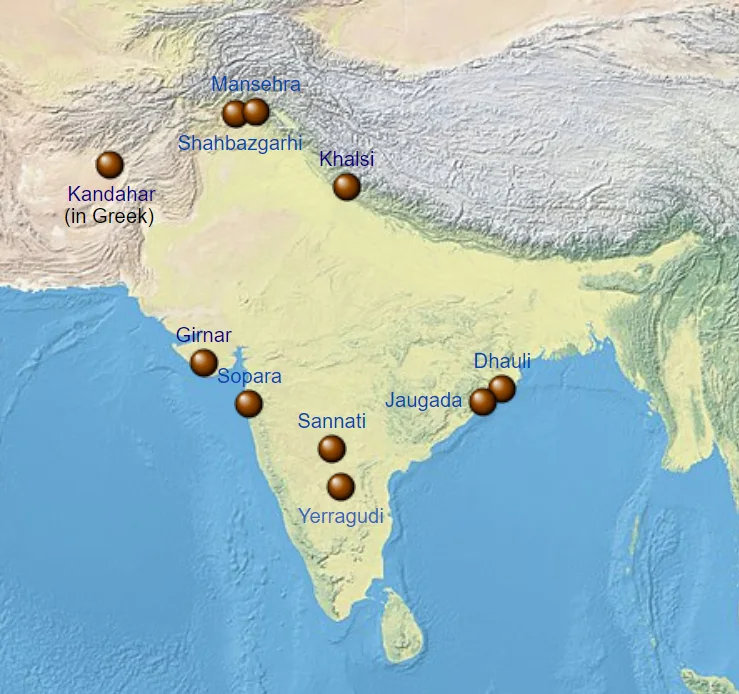
Map of Ashoka’s Major Rock Edicts, illustrating their geographical distribution.
Credit: Natural Earth. Free vector and raster map data @ naturalearthdata.com · CC BY-SA 3.0 · sourceResized and converted to WebP; uncropped.
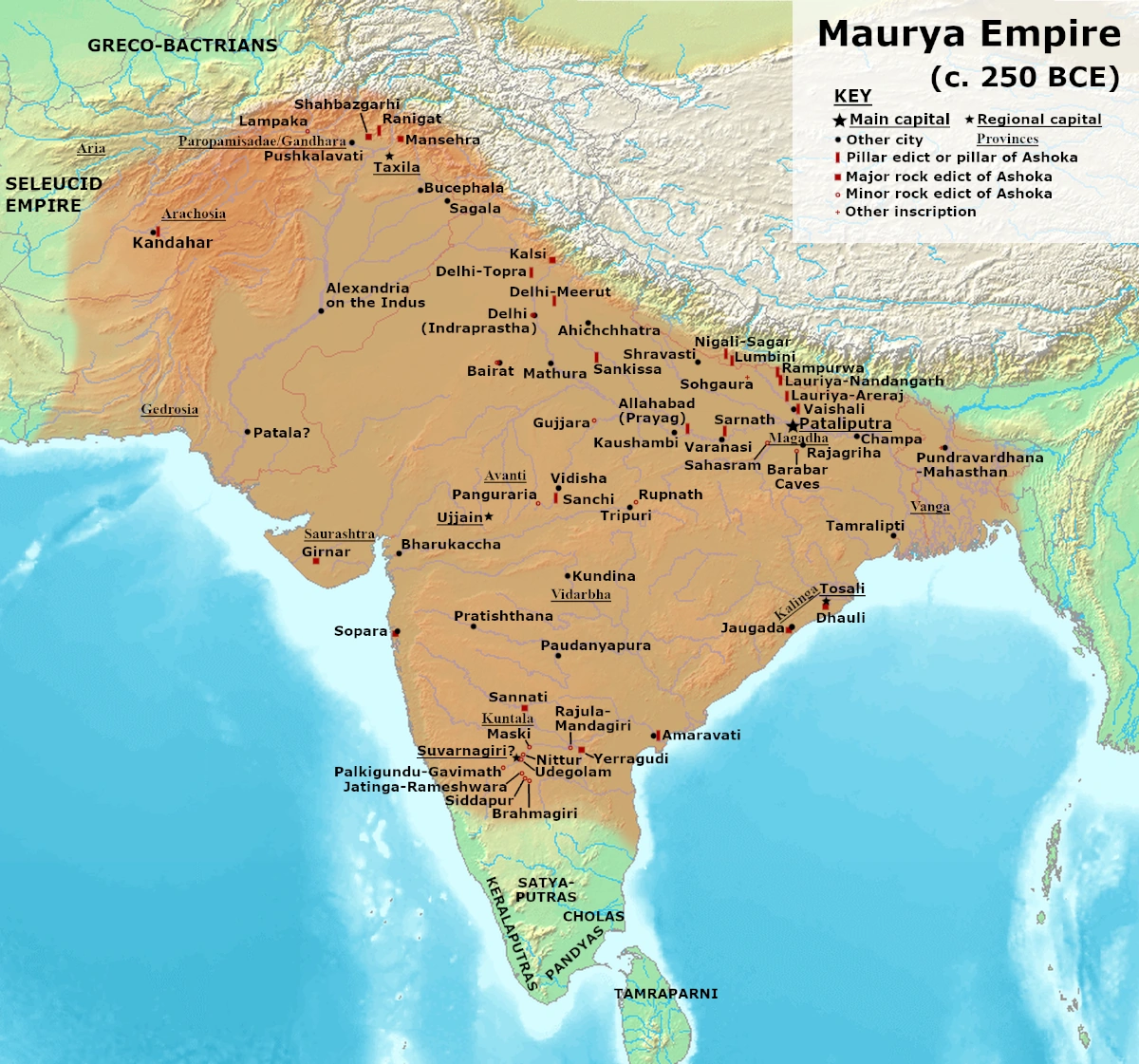
Map study
Mauryan Empire around 250 BCE during Ashoka’s reign: a date-specific historical reconstruction.
- Read the source date and legend before interpreting territorial extent.
- Compare core regions, neighbouring powers and geographic barriers; historical borders and influence are approximate and changed over time.
Credit: Avantiputra7 · CC BY-SA 3.0 · sourceConverted to WebP on an opaque white background; proportionally resized without cropping. Original cartography and legend retained.
1. Nature, discovery and historical importance
Ashokan rock edicts are royal communications incised on exposed rocks and boulders, rather than on freestanding pillars. Their distribution extends from the north-western subcontinent to Odisha and southern India. They communicated ethical instructions, administrative expectations and selected royal decisions. As contemporary records issued under the king’s authority, they provide firmer evidence for Ashoka’s policies than much later Buddhist literary traditions, although both categories of sources are historically valuable.
The inscriptions commonly call the ruler Devanampiya Piyadasi, broadly meaning ‘Beloved of the Gods, He of Gracious Appearance’. James Prinsep’s work on Brahmi in 1837, combined with comparisons with Sri Lankan chronicles, helped identify Piyadasi with Ashoka. The Maski inscription subsequently provided explicit epigraphic confirmation through the personal name Ashoka. Gujarra also preserves his name.
The edicts illuminate royal ideology, officials, religious communities, diplomatic horizons and communication networks. Nevertheless, they are selective statements of what the king wished to proclaim, not neutral descriptions of everyday conditions. Welfare announcements demonstrate governmental intentions but do not, by themselves, prove uniform implementation. Similarly, inscription sites help reconstruct imperial reach, but cannot independently establish every boundary of the Mauryan Empire.
Timeline
Around 268 BCE
Approximate beginning of Ashoka’s reign; precise chronology varies across reconstructions.
Around 261 BCE
Kalinga conquered in the eighth year after consecration, according to Major Rock Edict XIII.
Thirteenth year after consecration
Appointment of dhamma-mahamattas, recorded in Major Rock Edict V.
1837
James Prinsep’s decipherment of Brahmi opens Ashokan inscriptions to systematic historical study.
1915
Discovery of the Maski inscription provides explicit evidence linking the name Ashoka with Devanampiya.
2. Classification, languages and scripts
The fourteen Major Rock Edicts constitute an extended series addressing dhamma, welfare, administration and relations with other peoples. Important sites include Girnar in Gujarat, Kalsi in Uttarakhand, Shahbazgarhi and Mansehra in present-day Pakistan, and Erragudi in Andhra Pradesh. Versions show omissions and variations: Major Rock Edict XIV itself explains that proclamations differed in length and that not everything appeared everywhere.
Minor Rock Edicts are shorter proclamations found at numerous sites, including Maski, Brahmagiri and other locations in the Deccan. Minor Rock Edict I describes Ashoka’s development as a Buddhist lay follower and urges effort in religious or moral advancement. The Bhabru or Bairat edict is especially explicit about his Buddhist commitment: it expresses reverence for the Buddha, dhamma and sangha and recommends selected teachings.
At Dhauli and Jaugada in Odisha, the local versions omit Major Rock Edicts XI–XIII and include two Separate Kalinga Edicts. These emphasise humane administration, impartial justice and reassurance to frontier populations. They should not be confused with Major Rock Edict XIII, which records the Kalinga war.
Most Ashokan inscriptions are in forms of Prakrit written in Brahmi, normally read from left to right. Shahbazgarhi and Mansehra use Kharoshthi, written from right to left. Greek and Aramaic inscriptions from the Afghan region demonstrate adaptation to multilingual audiences. Sanskrit was not the usual language of Ashoka’s proclamations. Language and script must be distinguished: Prakrit is a language category, while Brahmi is a writing system.
How to interpret an Ashokan rock inscription
- 1. Identify the site and physical medium
- 2. Determine language and script
- 3. Classify the edict series
- 4. Locate its administrative or ethical message
- 5. Compare regional versions and assess evidentiary limits
3. Major Rock Edicts: essential themes
The Major Rock Edicts are frequently tested through matches between edict numbers and themes. Their concerns overlap, so a single-word label is a revision aid rather than a complete summary. Together they show Ashoka connecting personal conduct, official accountability, public welfare and restraint in relations between religious communities.
- I: Restricts animal slaughter and certain festive gatherings; records reductions in animals killed for the royal kitchen.
- II: Announces medical arrangements for humans and animals, medicinal plants, roadside trees and wells; names southern kingdoms and external rulers.
- III: Directs yuktas, rajukas and pradesikas to undertake tours every five years, including instruction in dhamma.
- IV: Contrasts earlier harmful practices with the progress of dhamma, using the celebrated contrast between the sound of the drum and the sound of dhamma.
- V: Records the appointment of dhamma-mahamattas thirteen years after consecration, with responsibilities involving different communities and vulnerable groups.
- VI: Stresses the king’s availability for official reports and prompt attention to public business.
- VII: Advocates the coexistence of religious sects, self-control and purity of mind.
- VIII: Describes dhamma tours replacing pleasure excursions and mentions Ashoka’s visit to Sambodhi, generally identified with Bodh Gaya.
- IX: Questions the value of conventional ceremonies and commends ceremonies of dhamma, including respectful and generous conduct.
- X: Subordinates fame and glory to the advancement of dhamma.
- XI: Praises the gift of dhamma and ethical behaviour towards relatives, servants, religious persons and living beings.
- XII: Advocates restraint in speech, respect for other sects and willingness to hear their teachings.
- XIII: Describes the Kalinga war, remorse, dhamma-vijaya and the wider geographical reach claimed for dhamma.
- XIV: Explains the differing length, distribution and repetition of the proclamations.
| Site | Present location | Distinguishing feature |
|---|---|---|
| Girnar | Gujarat | Major Rock Edicts; later inscriptions of Rudradaman and Skandagupta on the same rock |
| Kalsi | Uttarakhand | Major Rock Edicts in Prakrit and Brahmi |
| Shahbazgarhi and Mansehra | Pakistan | Major Rock Edicts in Prakrit and Kharoshthi |
| Dhauli and Jaugada | Odisha | Separate Kalinga Edicts; Major Rock Edicts XI–XIII omitted |
| Maski | Karnataka | Minor Rock Edict explicitly naming Ashoka |
| Kandahar | Afghanistan | Greek and Aramaic evidence of multilingual royal communication |
4. Kalinga, dhamma and Mauryan governance
Major Rock Edict XIII places the conquest of Kalinga in Ashoka’s eighth regnal year after consecration, conventionally dated around 261 BCE. It states that 150,000 people were deported, 100,000 killed and many more died. These are figures reported by the royal inscription, not independently verified casualty statistics. Its distinctive feature is the ruler’s expressed sorrow over suffering, including the disruption of families and religious communities.
Ashoka presented dhamma-vijaya, conquest through dhamma, as preferable to military victory. Yet this did not mean that he abolished coercive authority: the same edict warns forest peoples that the king retained the power to punish. His policy is therefore better understood as an ethical reorientation of kingship than as absolute pacifism or the dismantling of imperial government.
Dhamma emphasised obedience to parents, generosity, humane treatment of servants, restraint in killing and respect for religious communities. Although Ashoka personally supported Buddhism, the public programme was broader than the propagation of specifically Buddhist doctrines. Major Rock Edict XII’s insistence on religious restraint should also not be equated mechanically with modern constitutional secularism.
The Separate Kalinga Edicts declare that all people are the king’s children and instruct officials against unjust imprisonment and harsh treatment. References to administrative tours, reporting arrangements and dhamma-mahamattas reveal attempts to make moral supervision part of governance. Such provisions show the relationship between ethical persuasion and the practical maintenance of imperial authority.
5. Geographical evidence and examination cautions
Major Rock Edicts II and XIII mention peoples and rulers beyond the Mauryan heartland. The Cholas, Pandyas, Satiyaputras, Keralaputras and Tamraparni appear in this wider geographical horizon. Major Rock Edict XIII also names Hellenistic rulers, beginning with Antiochus. These references support the study of diplomatic awareness and cross-regional contacts; they do not establish Mauryan political control over all the named territories.
For examination purposes, distinguish the inscribed object, ruler, script and subject. Not every ancient inscription on a rock is Ashokan. Girnar also carries Rudradaman’s Sanskrit inscription of approximately 150 CE and a later inscription of Skandagupta. Likewise, the Rummindei inscription recording Ashoka’s visit to the Buddha’s birthplace is on a pillar, not a Major Rock Edict. The Barabar cave dedications form another distinct inscriptional category.
Major Rock Edicts: Geography, Communication and Evidence
A map of the Major Rock Edicts helps connect Ashoka’s proclamations with the geography of Mauryan communication. Engraving messages on natural rock surfaces gave royal statements a durable public form. Their distribution should not, however, be read as a precise political boundary: surviving inscriptions reflect choices of location, preservation and discovery, rather than a complete register of imperial territory. The supplied metadata identifies this as a map of Major Rock Edicts; it does not establish which sites or boundaries the map includes.
The Major Rock Edicts discuss dhamma, administrative responsibilities, welfare and relations among religious communities. Major Rock Edict XIII is especially important for Ashoka’s account of the Kalinga conquest, his remorse and his preference for conquest through dhamma. Regional variation matters: at Dhauli and Jaugada, Major Rock Edicts XI–XIII are absent, while the Separate Kalinga Edicts occur. Language and script must also be distinguished. Most versions use Prakrit in Brahmi, whereas Shahbazgarhi and Mansehra use Kharoshthi. These inscriptions provide evidence of royal policy and intended communication, not automatic proof of uniform implementation or popular acceptance.
- Classification: Major Rock Edicts, Minor Rock Edicts, Separate Kalinga Edicts and Pillar Edicts are distinct groups; a map of one should not stand for all Ashokan inscriptions.
- Geographical caution: associate sites with regional communication contexts, but avoid inferring exact imperial borders or administrative divisions from inscription locations alone.
- Prelims/Mains distinction: Prakrit is a language; Brahmi and Kharoshthi are scripts. Dhamma promoted ethical conduct and cannot simply be equated with Buddhist doctrine.
Real-world case studies
Dhauli and Jaugada: governing conquered Kalinga
The Separate Kalinga Edicts stress impartial justice and reassurance rather than reproducing the account of war in Major Rock Edict XIII. Their regional adaptation demonstrates that Ashokan communication was not simply a uniform text mechanically repeated throughout the empire.
Girnar: a layered historical record
Ashoka’s Prakrit proclamations, Rudradaman’s Sanskrit record and Skandagupta’s later inscription survive on the same rock. The site illustrates both continuity in the public use of monumental inscriptions and changes in political authority and inscriptional language.
Previous year questions
No source-linked PYQ is available here yet. Use the practice questions below.
Practice questions
Practice MCQ 1
Which Major Rock Edict records both the suffering caused by the Kalinga war and Ashoka’s preference for dhamma-vijaya?
- A. Major Rock Edict V
- B. Major Rock Edict VIII
- C. Major Rock Edict XII
- D. Major Rock Edict XIII
Practice MCQ 2
Consider the following pairs: 1. Shahbazgarhi — Kharoshthi script; 2. Maski — explicit occurrence of Ashoka’s name; 3. Dhauli — complete series of all fourteen Major Rock Edicts. Which pairs are correctly matched?
- A. 1 and 2 only
- B. 2 and 3 only
- C. 1 and 3 only
- D. 1, 2 and 3
Practice MCQ 3
Which statement about Ashokan rock edicts is correct?
- A. They were uniformly composed in Sanskrit.
- B. Every kingdom named in them was a Mauryan province.
- C. Major Rock Edict XII advocates restraint in criticism of other religious sects.
- D. Major Rock Edict XIII declares the abolition of all punitive authority.
Mains practice · Ashoka’s rock edicts reveal both an ethical conception of kingship and the practical concerns of imperial government. Discuss with examples. (250 words)
- Introduce the edicts as contemporary but selective royal sources.
- Explain remorse and dhamma-vijaya through Edict XIII.
- Use Edicts V and VI for officials and royal accessibility.
- Discuss religious restraint in Edict XII and welfare in Edict II.
- Illustrate regional administrative adaptation through the Separate Kalinga Edicts.
- Conclude with the coexistence of persuasion, paternalism and coercive authority.
Further reading
- NCERT, Themes in Indian History, Part I: Bricks, Beads and Bones; Kings, Farmers and Towns.
- Upinder Singh, A History of Ancient and Early Medieval India: From the Stone Age to the 12th Century.
- Romila Thapar, Ashoka and the Decline of the Mauryas.
- E. Hultzsch, Corpus Inscriptionum Indicarum, Volume I: Inscriptions of Asoka.
- Archaeological Survey of India: official monument information on Ashokan inscription sites.
- https://commons.wikimedia.org/wiki/File:Map_of_the_Major_Rock_Edicts.jpg
Preparing for UPSC Civil Services? Get classroom teaching, answer-writing evaluation and mentorship at Pragnya IAS Academy, Ashok Nagar — see why aspirants choose us for IAS coaching in Hyderabad.