
Map study
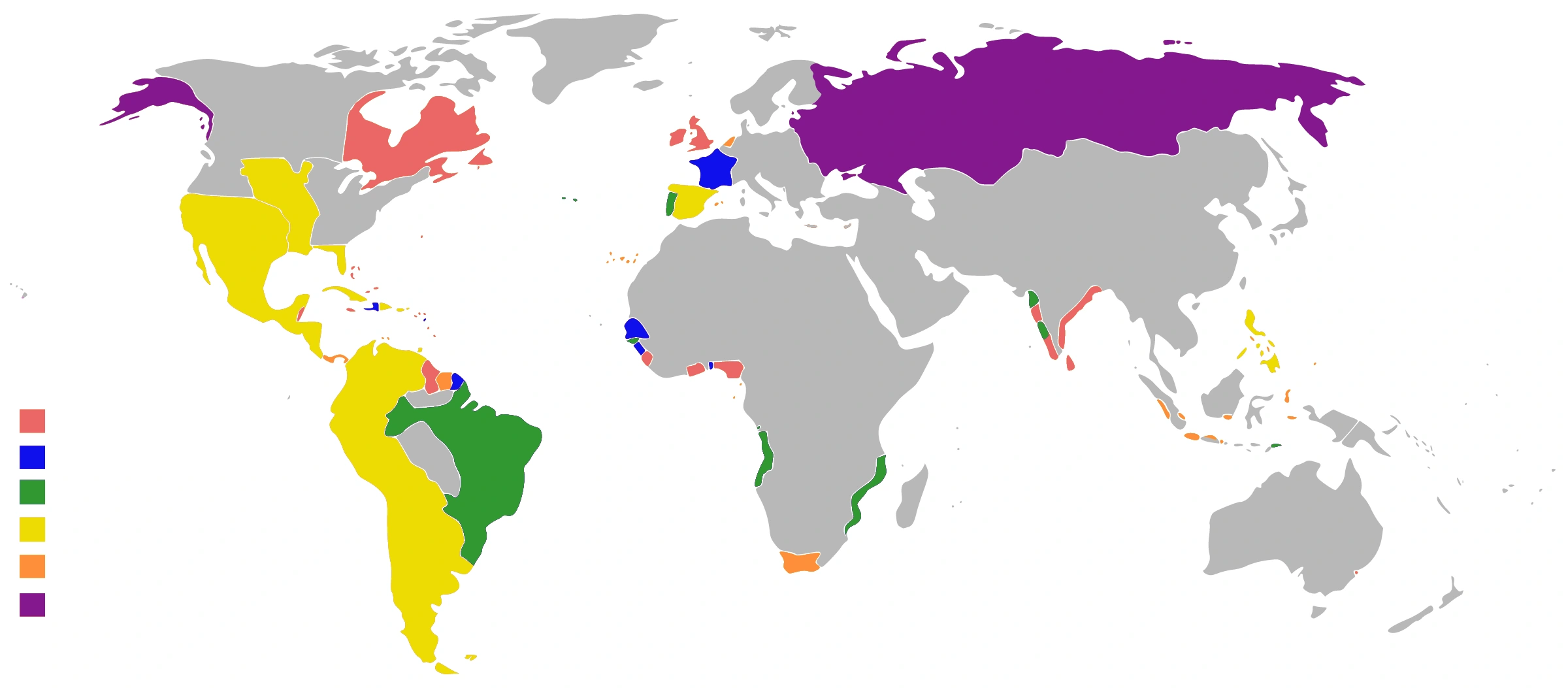
Colonial empires in 1800: global context for European expansion. A date-specific map, not the maximum territorial extent of every colonial power.
- Read the legend and reference date before interpreting regional patterns.
- Relate the map to the article’s topic; verify current administrative boundaries or data separately.
Credit: George Tsiagalakis · CC BY-SA 4.0 · sourceConverted to WebP on an opaque white background; proportionally resized without cropping. Original cartography and legend retained.
1. Origins and the search for a commercial foothold
The English entered Asian commerce relatively late, after the Portuguese had established a maritime network around the Indian Ocean. Demand for spices and competition for eastern trade encouraged English merchants to organise a chartered company. On 31 December 1600, Queen Elizabeth I incorporated the Governor and Company of Merchants of London trading into the East Indies. Its charter conferred exclusive English trading privileges in a defined eastern region; it did not grant sovereignty over Indian territory.
The Company's early voyages sought access to the spice trade, but Dutch competition in Southeast Asia encouraged greater attention to India. Indian cotton textiles, indigo, silk and saltpetre became important exports. The Company initially paid for much of its Asian purchasing with imported bullion. Its operations depended on Indian merchants, brokers, bankers, artisans, shipowners and political authorities.
Captain William Hawkins reached Surat in 1608 and visited Jahangir's court, but did not secure the durable privileges he sought. The English naval success against the Portuguese at Swally, near Surat, in 1612 strengthened their standing. An English factory was established at Surat in 1613. Sir Thomas Roe, ambassador of James I at Jahangir's court from 1615 to 1619, helped secure commercial concessions. These developments represented negotiated access under Mughal authority, not an immediate English conquest.
Timeline
1600
Elizabeth I grants the East India Company its founding charter.
1612–1619
Swally naval encounter, establishment of the Surat factory and Thomas Roe's embassy strengthen English access to Mughal markets.
1639–1698
Madras, Bombay and the Calcutta settlements develop as major Company bases.
1746–1763
The Carnatic Wars establish English ascendancy over the French in the contest for political influence.
1757–1765
Plassey, Buxar and the Diwani grant establish the foundations of Company territorial power.
1773–1833
Parliamentary legislation progressively regulates Company government and ends its commercial functions.
1858
Government passes from the Company to the British Crown.
2. Factories, coastal settlements and commercial privileges
A factory was a commercial establishment managed by factors, or Company agents, and usually included warehouses, offices and accommodation. English merchants established an early presence at Masulipatnam on the Coromandel Coast in 1611. In 1639, Francis Day obtained a grant for the Madras settlement from a local Nayak authority; Fort St George developed from 1640. Coromandel textiles were valuable both for European markets and for exchange elsewhere in Asia.
Bombay passed from Portugal to the English Crown under the marriage arrangements of Charles II and Catherine of Braganza in 1661. The Crown leased it to the Company in 1668. Its harbour and defensible location helped it surpass Surat as the Company's western headquarters. These circumstances distinguish Bombay from settlements obtained through grants from Indian rulers.
In Bengal, an English factory was established at Hugli in 1651. Job Charnock's arrival at Sutanuti in 1690 was an important stage in the growth of the Calcutta settlement, but the area already contained inhabited settlements. In 1698, the Company acquired zamindari rights over Sutanuti, Kalikata and Govindpur. Fort William became its fortified base. Farrukhsiyar's farman of 1717 granted important commercial privileges, including customs concessions in Bengal against a stipulated annual payment. Company-issued dastaks certified privileged consignments; their misuse, particularly in private trade, later intensified conflict with Bengal's rulers.
Commercial entry to colonial government
- 1. Royal charter organises English overseas commerce
- 2. Indian authorities grant trading access and settlement rights
- 3. Factories develop into fortified presidency centres
- 4. European rivalry and Indian political conflicts encourage military intervention
- 5. Bengal victories yield revenue rights and resources for further expansion
- 6. Territorial administration comes under parliamentary supervision
- 7. Crown government replaces Company rule in 1858
3. European rivalry and the acquisition of Bengal
English expansion was neither uninterrupted nor inevitable. During the Anglo-Mughal conflict commonly called Child's War, 1686–1690, the Company failed against Aurangzeb's government and had to seek restoration of trading privileges. This episode demonstrates the strength of the Mughal state before its eighteenth-century fragmentation. Subsequently, regional succession disputes created opportunities for European companies to combine military support with political bargaining.
The three Carnatic Wars, fought between 1746 and 1763, connected European conflicts with struggles in southern India. English and French companies supported rival claimants in the Carnatic and Hyderabad. Robert Clive's capture and defence of Arcot in 1751 enhanced English prestige. At Wandiwash in 1760, forces under Eyre Coote defeated the French army commanded by the Comte de Lally. The Treaty of Paris in 1763 restored some French settlements, but French prospects of establishing a rival territorial empire in India were sharply reduced.
Bengal provided the decisive financial breakthrough. Siraj-ud-Daulah opposed unauthorised fortification and abuses of trading privileges. At Plassey on 23 June 1757, Clive defeated him with crucial assistance from conspirators, including Mir Jafar. Plassey was therefore as much a political betrayal as a battlefield victory. Buxar, fought on 22 October 1764, was a more conclusive military success against the combined forces of Mir Qasim, Shuja-ud-Daula and Shah Alam II. Under the Allahabad arrangements of 1765, Shah Alam II granted the Company the Diwani of Bengal, Bihar and Orissa.
| Settlement | Key date | Basis of establishment | Significance |
|---|---|---|---|
| Surat | 1613 | Factory established under Mughal authority | Early western trading base |
| Madras | 1639 | Grant obtained from local Nayak authority | Fort St George and Coromandel textile trade |
| Bombay | 1668 | Leased by the English Crown to the Company | Major western harbour and presidency centre |
| Calcutta | 1690 and 1698 | Settlement at Sutanuti followed by acquisition of rights over three villages | Fort William and the Bengal presidency |
4. From regional power to territorial supremacy
Bengal's revenues allowed the Company to finance armies and purchase export goods without relying as heavily on imported bullion. Its Bengal administration initially separated revenue authority from nominal responsibility for government, an arrangement usually called dual government. The Company possessed decisive power while the nawab retained formal administrative functions. Warren Hastings ended this arrangement in 1772 by bringing revenue administration under more direct Company control.
Expansion proceeded through wars, treaties, annexations and indirect rule. Four Anglo-Mysore Wars, between 1767 and 1799, ended with Tipu Sultan's death at Seringapatam. Three Anglo-Maratha Wars, between 1775 and 1818, dismantled the main Maratha challenge. Sind was annexed in 1843, while Punjab was annexed in 1849 after the Second Anglo-Sikh War. These victories gave the Company extensive territorial control, although many princely states remained under their own rulers subject to British paramountcy.
Lord Wellesley systematically extended subsidiary alliances: Indian rulers accepted a Company force, financed its maintenance and restricted their independent diplomacy. Hyderabad entered such an arrangement in 1798. Lord Dalhousie's Doctrine of Lapse denied recognition of an adopted successor for sovereignty in selected dependent states lacking an accepted natural heir. Satara, Jhansi and Nagpur were annexed through this policy. Awadh was annexed in 1856 on the stated ground of misgovernment, not lapse. Military organisation, naval support, access to credit, Indian sepoy recruitment and divisions among opponents together explain Company success.
5. Parliamentary control and the end of Company government
Territorial acquisitions transformed a commercial corporation into a governing authority, producing financial crises and controversy in Britain. The Regulating Act of 1773 created the office of Governor-General of Bengal and provided for a Supreme Court at Calcutta, established in 1774. Pitt's India Act of 1784 introduced a Board of Control to supervise political affairs while retaining the Company's Court of Directors. This created shared oversight in Britain, distinct from Bengal's earlier dual government.
The Charter Act of 1813 ended the Company's monopoly over trade with India, while retaining its monopoly over tea and trade with China. The Charter Act of 1833 ended its remaining commercial activities and designated the Governor-General of Bengal as Governor-General of India. The Company thereafter functioned principally as an administrative agency.
The Revolt of 1857 exposed the tensions generated by annexations, military grievances and colonial intervention. The Government of India Act 1858 transferred government to the British Crown and replaced Company oversight with a Secretary of State for India assisted by a council. For examination purposes, distinguish the Company's origins as an English trading body from its later role within the British imperial state, and distinguish the end of its commercial role in 1833 from the end of its government in 1858.
Real-world case studies
Bengal: trading privileges become a political dispute
Company servants' misuse of privileged trading passes disadvantaged other merchants and reduced the nawab's customs receipts. Mir Qasim abolished internal duties to place traders on a more equal footing, provoking Company opposition. The resulting conflict illustrates how private commercial interests, fiscal sovereignty and armed power became intertwined before Buxar.
Hyderabad: expansion through indirect control
Under Wellesley, Hyderabad accepted a subsidiary alliance in 1798 and disbanded its French-trained corps. Subsequent arrangements strengthened Company influence and provided territorial resources for maintaining the subsidiary force. Hyderabad retained its dynasty but lost substantial strategic autonomy, showing that imperial expansion did not always require direct annexation.
Previous year questions
No source-linked PYQ is available here yet. Use the practice questions below.
Practice questions
Practice MCQ 1
Consider the following pairs: 1. Bombay — leased to the Company by the English Crown 2. Madras — acquired through the Diwani grant 3. Calcutta — developed around Sutanuti, Kalikata and Govindpur. Which pairs are correctly matched?
- A. 1 and 2 only
- B. 1 and 3 only
- C. 2 and 3 only
- D. 1, 2 and 3
Practice MCQ 2
Which sequence is chronologically correct?
- A. Plassey → Wandiwash → Buxar → Diwani grant
- B. Wandiwash → Plassey → Diwani grant → Buxar
- C. Plassey → Buxar → Wandiwash → Diwani grant
- D. Buxar → Plassey → Wandiwash → Diwani grant
Practice MCQ 3
With reference to the East India Company, consider the following statements: 1. The Charter Act of 1813 ended its monopoly over tea and trade with China. 2. The Charter Act of 1833 ended its remaining commercial activities. 3. The Government of India Act 1858 transferred its governing responsibilities to the Crown. Which statements are correct?
- A. 1 and 2 only
- B. 2 and 3 only
- C. 1 and 3 only
- D. 1, 2 and 3
Mains practice · The English East India Company's transformation from merchant to ruler depended on Indian revenues and political alliances as much as military victories. Discuss. Answer in 250 words.
- Begin with chartered commerce and negotiated access under Indian authorities.
- Explain the role of Indian merchants, bankers, brokers and sepoys.
- Connect European rivalry and regional succession disputes with military intervention.
- Distinguish the political conspiracy at Plassey from the military significance of Buxar.
- Show how Diwani revenues financed armies and commercial purchases.
- Explain subsidiary alliances and selective annexation as complementary methods.
- Conclude that commercial, fiscal, military and political advantages reinforced one another.
Further reading
- NCERT, Our Pasts III: From Trade to Territory—The Company Establishes Power.
- Bipan Chandra, History of Modern India.
- Sekhar Bandyopadhyay, From Plassey to Partition and After.
- British Library, India Office Records and East India Company collection guides.
- UK Parliament website: historical resources on the East India Company and government of India.
Preparing for UPSC Civil Services? Get classroom teaching, answer-writing evaluation and mentorship at Pragnya IAS Academy, Ashok Nagar — see why aspirants choose us for IAS coaching in Hyderabad.