
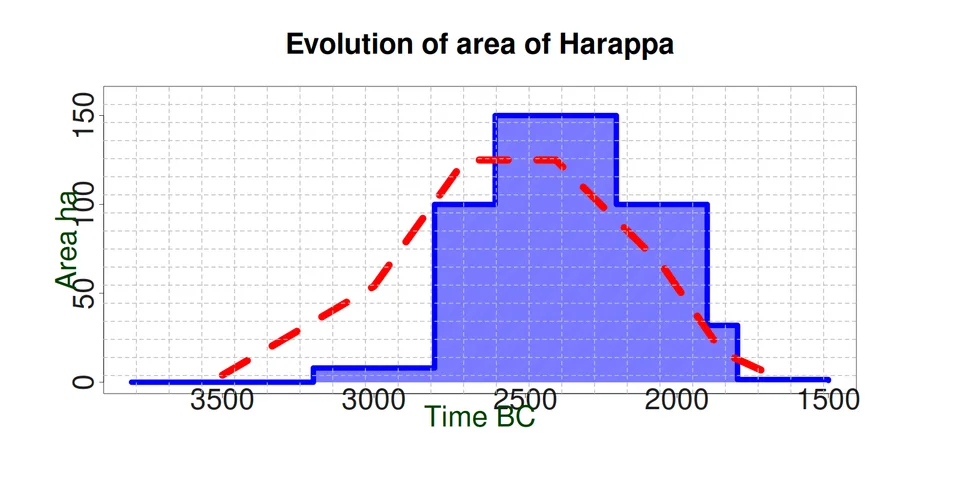
Diagram described as showing changes in the settlement area of Harappa.
Credit: Merikanto · CC BY 4.0 · sourceResized and converted to WebP; uncropped.
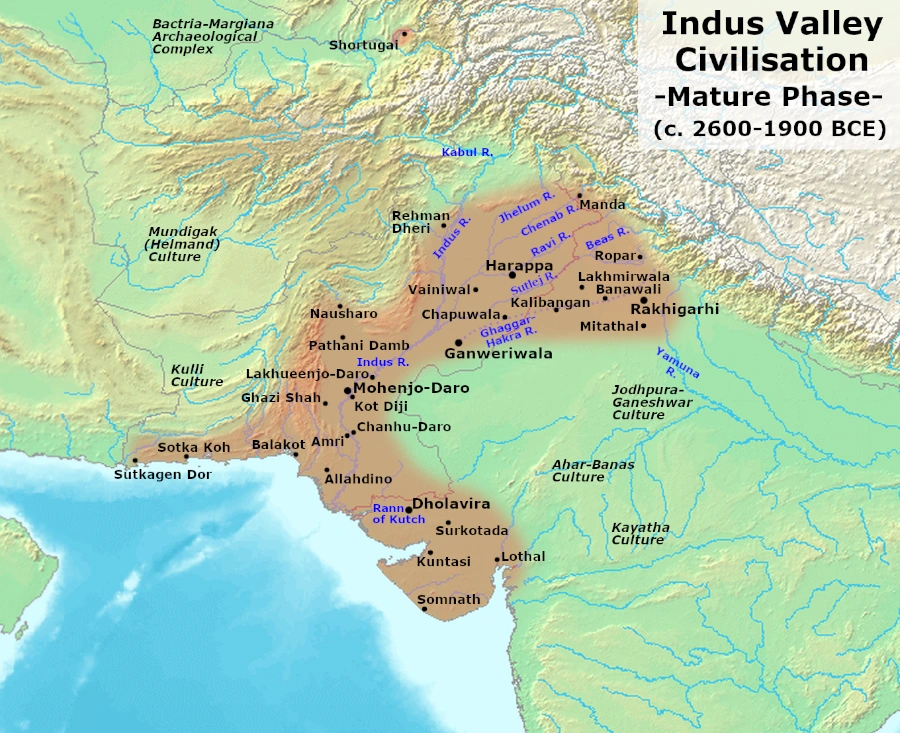
Map study
Mature Harappan civilisation, c. 2600–1900 BCE: settlement distribution, not the territory of a single empire.
- Read the source date and legend before interpreting territorial extent.
- Compare core regions, neighbouring powers and geographic barriers; historical borders and influence are approximate and changed over time.
Credit: Avantiputra7 · CC BY-SA 3.0 · sourceConverted to WebP on an opaque white background; proportionally resized without cropping. Original cartography and legend retained.
1. Location, discovery and historical significance
Harappa lies in the Punjab plain near the modern village of Harappa in Sahiwal district, Pakistan. Its location beside an old course of the Ravi, a tributary of the Indus system, connected it with fertile alluvial land and routes extending towards the Himalayan foothills, Baluchistan and the wider Indus region. For map-based questions, associate Harappa with the Ravi and Pakistani Punjab, not with the Indus River in Sindh, where Mohenjo-daro is located.
Charles Masson described the ruins in the nineteenth century, and Alexander Cunningham later investigated the site and published a Harappan seal. However, the antiquity and significance of these remains were not then understood. Extensive removal of ancient bricks, including for railway construction during the nineteenth century, damaged the site and reduced the architectural evidence available to archaeologists.
Systematic excavations under Daya Ram Sahni in 1920–21 established Harappa as a major archaeological site. Discoveries at Harappa and Mohenjo-daro enabled John Marshall, Director-General of the Archaeological Survey of India, to announce the existence of the Indus Civilization in 1924. Subsequent work by M. S. Vats, Mortimer Wheeler and later research teams refined its chronology and settlement history.
Harappa is called the type-site because its name identifies the archaeological culture. This does not establish it as the civilization’s capital or earliest city. No deciphered contemporary text identifies a Harappan capital, and the political relationship between the major cities remains debated.
Timeline
Approximately 3300–2800 BCE
Ravi-phase occupation marks an early stage of settlement at Harappa.
Approximately 2800–2600 BCE
Kot Diji-phase development precedes Mature Harappan urbanism.
Approximately 2600–1900 BCE
Harappa flourishes within the Mature Harappan urban network.
After approximately 1900 BCE
Urban transformation and later occupation include the Cemetery H cultural horizon.
1920–21
Daya Ram Sahni begins systematic excavations.
1924
John Marshall announces the discovery of the Indus Civilization.
2. Settlement sequence and urban organisation
Harappa developed through several phases rather than appearing suddenly as a fully formed city. Excavators distinguish an early Ravi phase, approximately 3300–2800 BCE, followed by a Kot Diji phase, approximately 2800–2600 BCE. These were followed by Mature Harappan urbanism around 2600–1900 BCE and subsequent transitional and Late Harappan occupation. These dates are approximate archaeological ranges, not precisely dated political periods.
The settlement comprised several mounds and walled sectors, including Mound AB, Mound E and Mound F. The familiar textbook division into a raised citadel and a lower town is useful as an introduction but simplifies Harappa’s more complex, changing layout. Substantial walls and gateways regulated movement and may have served defensive, flood-management or administrative purposes. Their presence alone does not prove a militarised state.
Buildings used mud bricks and baked bricks, with a recurrent brick proportion of 1:2:4 in thickness, width and length. Streets, lanes, bathing areas and drainage arrangements indicate investment in urban infrastructure. Nevertheless, preservation is uneven, and the exceptionally well-known drainage features of Mohenjo-daro should not automatically be attributed in identical form to Harappa.
Mound F contains brick foundations traditionally identified as a granary. Nearby circular brick platforms were interpreted as grain-processing installations, while rows of small buildings were labelled workers’ quarters. These identifications remain uncertain: neither the storage function nor the social identity of the occupants has been conclusively demonstrated. UPSC answers should distinguish the excavated structures from explanations proposed for them.
How archaeologists reconstruct Harappa’s past
- 1. Record structures and objects in their stratigraphic contexts.
- 2. Establish relative sequences and obtain scientific dates where possible.
- 3. Analyse pottery, tools, plant remains, animal bones and human burials.
- 4. Compare evidence across settlement sectors and other sites.
- 5. Develop interpretations while separating direct evidence from hypotheses.
3. Subsistence, crafts and exchange
Harappa’s urban economy rested on agricultural production and animal husbandry in its hinterland. Wheat, barley and pulses were important crops in the northwestern Harappan world, while cattle, sheep and goats contributed to subsistence. Plant and animal remains help reconstruct diet and production, but preservation and sampling affect what archaeologists can identify. It is unsafe to assume that every crop documented at another Harappan site was equally important at Harappa.
Excavations reveal specialised manufacture involving beads, shell objects, pottery, faience and metals. Craftspeople worked materials such as carnelian, steatite, copper and shell, some obtained from distant regions. Evidence from production debris, unfinished objects and tools is especially important because it establishes local manufacture more securely than finished objects alone. Standardised techniques coexisted with variations in workshop organisation and product quality.
Cubical stone weights and recurring weight ratios suggest shared conventions for measuring commodities. Stamp seals, often made of steatite and bearing animal motifs and short inscriptions, may have helped identify persons, institutions or consignments. The frequently represented unicorn is a conventional single-horned animal motif; it should not be treated as proof that such an animal actually existed.
Harappa participated in networks linking cities, smaller settlements and resource zones. At the civilization-wide scale, finds and Mesopotamian texts indicate interaction with the Gulf and a region called Meluhha, widely associated with the Indus world. However, evidence of overseas exchange across the civilization does not establish that Harappa itself was a seaport. Its geographical importance lay principally in inland riverine and overland connections.
| Feature | Established association | Caution |
|---|---|---|
| Mound F brick foundations | Traditionally called a granary | The precise function remains disputed. |
| Cemetery R-37 | Mature Harappan burials | Grave goods alone cannot fully reconstruct social hierarchy. |
| Cemetery H | Later funerary traditions | Material change does not by itself establish ethnic identity. |
| Seals and weights | Shared administrative and exchange conventions | They do not prove a single centralised empire. |
| Inscriptions | Examples of the undeciphered Harappan script | Language and royal identities remain uncertain. |
4. Society, beliefs, writing and burial evidence
Differences in houses, possessions and access to resources suggest social differentiation, while common weights, brick proportions and craft conventions indicate extensive coordination. Yet Harappa has not yielded an unmistakable royal palace or a securely identified monumental temple. Archaeologists therefore debate whether authority was concentrated in rulers, corporate groups, merchants, ritual specialists or combinations of these. Standardisation is evidence of shared practices, not automatic proof of a single empire.
The Harappan script occurs on seals and other small objects and remains undeciphered. Inscriptions are generally short, limiting secure interpretation. Neither the language nor the identity of rulers can presently be established from these signs. Terracotta figurines, animal imagery and other objects offer clues to symbolic life, but identifying every female figurine as a mother goddess or assigning later Hindu names to Harappan figures goes beyond the evidence.
Cemetery R-37 is associated with the Mature Harappan population. It includes extended inhumation burials, commonly with pottery and occasional ornaments. Such graves provide evidence concerning mortuary customs, health and selected aspects of social identity. Burial goods were generally not comparable to the spectacular royal tomb wealth known from some contemporary civilizations, but this does not establish an entirely egalitarian society.
Cemetery H represents later mortuary practices at Harappa and gave its name to the Cemetery H culture. Painted pottery and urn-associated deposits mark changes in funerary traditions. These changes should not be equated mechanically with the arrival of a particular ethnic or linguistic population. Archaeological cultures describe recurring material patterns; they are not straightforward substitutes for named peoples.
5. Urban transformation and examination relevance
After about 1900 BCE, the integrated Mature Harappan urban system weakened, but occupation at Harappa did not immediately cease. Changes in settlement organisation, crafts, exchange and burial practices accompanied wider regionalisation. Explanations for this transformation include climatic stress, changing river conditions, altered trade networks and shifts in production and population distribution. Their importance varied between regions; a single universal cause is inadequate.
Earlier accounts often connected the civilization’s decline with a destructive Aryan invasion. Archaeological evidence does not support this as a sufficient general explanation. Nor should debates about skeletal remains at Mohenjo-daro be transferred to Harappa. The more useful distinction is between the decline of large, integrated urban institutions and the continuation or adaptation of communities and cultural practices.
For Prelims, organise facts through site-feature pairs: Harappa with the Ravi, Daya Ram Sahni and Cemeteries R-37 and H; Mohenjo-daro with the Great Bath; Dholavira with extensive reservoirs and its distinctive urban divisions; and Lothal with the basin conventionally interpreted as a dockyard. Avoid assigning every famous Harappan artefact or structure to Harappa merely because the civilization bears its name.
Harappa: Settlement Growth and Urban Change
The supplied metadata identifies this diagram as an account of changes in Harappa’s area, making it relevant to the settlement history of this particular site. Harappa, near the Ravi River in present-day Pakistan’s Punjab, gave its name to the wider Harappan Civilization. Studying changes in its occupied area helps explain urbanisation as a process rather than a single event: settlements developed, expanded, reorganised and sometimes contracted. However, the metadata alone does not establish the diagram’s chronological divisions, measurements or underlying archaeological sources.
Settlement area is an important archaeological indicator, but it is not a direct measure of population or political power. Archaeologists interpret spatial change alongside stratigraphy, pottery sequences, buildings, craft remains and burial evidence. Different sectors may have been occupied at different times, so the total archaeological footprint need not represent one simultaneously inhabited city. For ancient Indian history, Harappa belongs to the shared archaeological heritage of northwestern South Asia, despite lying outside modern India. Its local trajectory should not automatically be applied to every Harappan settlement.
- Prelims distinction: Harappa is a specific archaeological site; “Harappan Civilization” denotes a much wider cultural and settlement network.
- Evidence limit: An area-change diagram cannot, by itself, establish population totals, causes of decline or the existence of a centralised empire.
- Mains approach: Connect spatial growth with craft production, exchange and civic organisation, while separating supported associations from claims of causation.
Real-world case studies
The granary: revisiting an inherited interpretation
The brick foundations on Harappa’s Mound F became widely known as a granary, encouraging reconstructions of centralised collection and redistribution of agricultural surplus. Later scrutiny highlighted the absence of conclusive evidence for that function. The case demonstrates why archaeological labels must not be treated as facts merely because they recur in textbooks.
Railway construction and archaeological loss
During the nineteenth century, ancient bricks were removed from Harappa for modern construction, including railway works. This damaged structures before systematic archaeological recording began. The episode illustrates how infrastructure development can destroy non-renewable historical evidence and why protection must extend beyond visibly impressive monuments.
Previous year questions
Source-linked detailed analyses are available above.
Practice questions
Practice MCQ 1
With reference to Harappa, consider the following statements: 1. It is located near an old course of the Ravi River. 2. Daya Ram Sahni was associated with its early systematic excavation. 3. Its identification as the capital of a unified Harappan empire is confirmed by deciphered inscriptions. Which of the statements given above are correct?
- A. 1 and 2 only
- B. 2 and 3 only
- C. 1 and 3 only
- D. 1, 2 and 3
Practice MCQ 2
Which one of the following pairs is correctly matched?
- A. Cemetery R-37 — Mature Harappan burials at Harappa
- B. Great Bath — Harappa
- C. Cemetery H — A securely identified royal palace
- D. Harappa — A coastal port on the Gulf of Khambhat
Practice MCQ 3
The standardisation of weights and brick proportions at Harappan sites most directly supports which inference?
- A. Every settlement was governed by an identical hereditary monarchy.
- B. Shared technical and economic conventions existed across settlements.
- C. All production was controlled by temple authorities.
- D. Every household enjoyed equal wealth.
Mains practice · Harappa reveals both the achievements of early urbanism and the limits of archaeological interpretation. Discuss with reference to its settlement, economy and funerary evidence. Answer in 250 words.
- Introduce Harappa as the type-site, situated near the Ravi, with Mature Harappan occupation around 2600–1900 BCE.
- Explain walled sectors, brick conventions and urban infrastructure without assuming a single rigid city plan.
- Discuss craft specialisation, weights, seals and inland exchange networks.
- Use the disputed granary identification to distinguish evidence from interpretation.
- Compare Cemetery R-37 with later Cemetery H practices without equating material cultures with ethnic groups.
- Note that the undeciphered script limits conclusions about rulers, language and religion.
- Conclude with urban transformation and cultural continuity rather than a simplistic sudden-collapse narrative.
Further reading
- NCERT, Themes in Indian History, Part I: Bricks, Beads and Bones — The Harappan Civilisation.
- NCERT, Our Pasts I: In the Earliest Cities.
- Archaeological Survey of India: official publications and historical accounts of Harappan discoveries.
- Jonathan Mark Kenoyer, Ancient Cities of the Indus Valley Civilization.
- Rita P. Wright, The Ancient Indus: Urbanism, Economy, and Society.
- UNESCO World Heritage Centre, Tentative Lists: Archaeological Site of Harappa.
- https://commons.wikimedia.org/wiki/File:Evolution_of_area_of_harappa_1_1_1_1.png
Preparing for UPSC Civil Services? Get classroom teaching, answer-writing evaluation and mentorship at Pragnya IAS Academy, Ashok Nagar — see why aspirants choose us for IAS coaching in Hyderabad.