
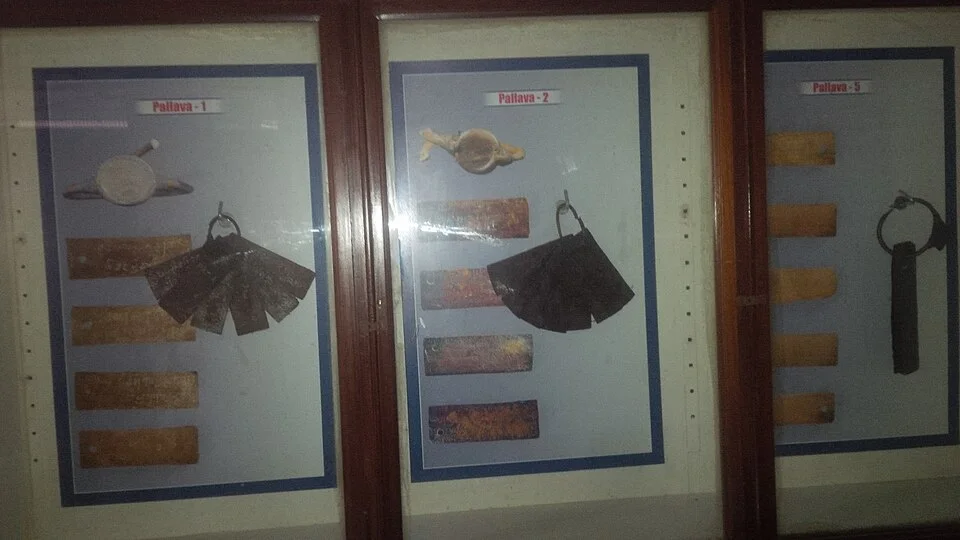
Copper-plate writings attributed to the Pallava dynasty in the supplied metadata.
Credit: https://www.tn.gov.in/ · CC BY-SA 4.0 · sourceResized and converted to WebP; uncropped.
1. Sources, origins and historical setting
Pallava history connects the political landscape of the post-Satavahana Deccan with the emergence of early medieval Tamil kingdoms. The dynasty’s origins remain debated: historians have proposed different regional and lineage affiliations, but no single ethnic-origin theory is securely established. Similarity between the names Pallava and Pahlava does not by itself prove descent from the Parthians. Their early records indicate connections with southern Andhra and Kanchipuram.
Inscriptions are the principal evidence. Early copper-plate grants use Prakrit, while Sanskrit became increasingly important in royal genealogies and eulogies. Later records also employ Tamil, especially for local transactions. The Mayidavolu and Hirahadagalli plates are important early records associated with Sivaskandavarman. Copper plates commonly record land grants, privileges and royal claims; these claims require comparison with other evidence.
An external chronological anchor is Samudragupta’s fourth-century Prayaga Prashasti, composed by Harishena. It mentions Vishnugopa of Kanchi among the southern rulers subdued during the Gupta expedition. This establishes contact with Gupta expansion but does not demonstrate lasting Gupta administration over Pallava territory. The later Pallavas became especially prominent from the sixth century, with Kanchipuram as a political, religious and educational centre.
- Use inscriptions, monuments, literary works and travellers’ accounts together rather than treating royal praise as a literal record.
- Pallava history belongs primarily to South India; the dynasty was not a branch of the Gupta ruling house.
Timeline
Fourth century CE
Vishnugopa of Kanchi appears in Samudragupta’s Prayaga Prashasti.
Later sixth century
Simhavishnu establishes the ascendancy of the later Pallavas.
Approximately 600–630 CE
Mahendravarman I patronises rock-cut temples and faces Chalukya invasion.
Around 642 CE
Narasimhavarman I captures Vatapi.
Approximately 700–728 CE
Rajasimha’s reign marks major structural-temple patronage.
Late ninth century
Aditya I defeats Aparajita; Chola control expands into Tondaimandalam.
2. Political expansion and inter-dynastic warfare
Simhavishnu, ruling in the later sixth century, strengthened Pallava power and extended its influence southwards. His reign marks the beginning of the best-documented period of Pallava ascendancy. His successor Mahendravarman I, approximately 600–630 CE, was both a ruler and a cultural patron. During his reign, the Chalukya ruler Pulakeshin II invaded Pallava territory. The struggle reflected competition over frontier regions, resources and political supremacy between the Deccan and the Tamil country.
Narasimhavarman I, approximately 630–668 CE, reversed the military balance. He defeated Pulakeshin II’s forces and captured the Chalukya capital Vatapi, modern Badami, around 642 CE, earning the title Vatapikonda. His title Mamalla, meaning great wrestler, is associated with the name Mamallapuram. The Chinese Buddhist traveller Xuanzang visited Kanchipuram during this period. Sri Lankan chronicles also associate Pallava assistance with the claimant Manavamma, indicating intervention across the Palk Strait.
The capture of Vatapi did not permanently end Chalukya power. Conflict resumed under subsequent rulers. Narasimhavarman II, or Rajasimha, around 700–728 CE, is particularly remembered for temple patronage. Under Nandivarman II Pallavamalla, who came from a collateral branch, the dynasty faced renewed pressure. Chalukya Vikramaditya II entered Kanchipuram in the eighth century; records also associate him with gifts to its Kailasanatha temple.
Pallava authority weakened amid competition involving the Pandyas, Rashtrakutas and rising Cholas. Towards the end of the ninth century, Aditya I defeated the Pallava ruler Aparajita and brought Tondaimandalam under Chola control. Political decline did not erase Pallava influence: their temple forms, inscriptions and institutions remained important foundations for later South Indian states.
- Distinguish Narasimhavarman I, the conqueror of Vatapi, from Narasimhavarman II, the major structural-temple patron.
- Pallava–Chalukya rivalry was recurrent, not a single war with a permanent victor.
Broad development of Pallava temple architecture
- 1. Excavated pillared cave shrines under Mahendravarman I
- 2. Expanded cave sculpture and monolithic shrine experiments at Mamallapuram
- 3. Major structural temples under Rajasimha
- 4. Further architectural and narrative elaboration under later Pallavas
3. Administration, agrarian expansion and maritime connections
Pallava kingship used royal titles, genealogies and religious patronage to legitimise authority. Inscriptions refer to territorial units such as rashtra, kottam and nadu, although their use and relationships varied across time and locality. The state depended on officers, local elites and village institutions rather than a uniformly centralised bureaucracy. Taxation drew substantially on agriculture, with additional dues connected to occupations and exchange.
Brahmadeya grants assigned land or villages to Brahmanas, frequently with specified fiscal privileges. Devadana grants supported temples. Such endowments helped extend cultivation and connect settlements with religious and political networks, while also redistributing rights over revenue and resources. Irrigation tanks, channels and wells were crucial in the region’s agrarian economy. Temples gradually became landholders, employers and centres of redistribution.
Village institutions included the ur and assemblies associated with Brahmana settlements, commonly called sabhas. These developments formed part of the background to later Chola local institutions. However, the detailed Uttaramerur inscriptions describing committee selection through kudavolai belong to the reign of Chola Parantaka I in the tenth century, not to Pallava rule.
Mamallapuram was a coastal centre linked to maritime exchange in the Bay of Bengal. Pallava-period contacts involved Sri Lanka and the wider Southeast Asian world. South Indian writing traditions, often described as Pallava-derived scripts, influenced the development of several Southeast Asian scripts. Cultural transmission through merchants, religious specialists and courts should not be confused with proof of Pallava territorial rule over those regions.
- Brahmadeya: endowment to Brahmanas; devadana: endowment to a deity or temple.
- Avoid projecting fully developed Chola administrative arrangements backwards onto all Pallava settlements.
| Ruler | Identification | Major association |
|---|---|---|
| Mahendravarman I | Vichitrachitta | Mandagapattu cave; Mattavilasa Prahasana |
| Narasimhavarman I | Mamalla; Vatapikonda | Capture of Vatapi; Mamallapuram monolithic monuments |
| Narasimhavarman II | Rajasimha | Kailasanatha temple; Shore Temple |
| Nandivarman II | Pallavamalla | Vaikuntha Perumal temple, Kanchipuram |
4. Religion, literature and intellectual life
The Pallava period overlapped with the expansion of Tamil bhakti associated with the Shaiva Nayanars and Vaishnava Alvars. Their devotional hymns emphasised personal attachment to Shiva or Vishnu and sacred places. Saints such as Appar, Sambandar and Sundarar belong to this wider religious milieu. Royal and elite temple patronage interacted with these movements, but bhakti cannot be explained simply as a programme imposed by kings.
Mahendravarman I is traditionally associated with conversion from Jainism to Shaivism through Appar’s influence. This account comes from later devotional tradition and should be distinguished from contemporary inscriptional evidence. His Sanskrit farce Mattavilasa Prahasana satirises religious practitioners, particularly Kapalika and Buddhist figures. It provides a literary glimpse of competing urban religious communities rather than a straightforward administrative description.
Kanchipuram accommodated Shaiva, Vaishnava, Buddhist and Jain traditions. Xuanzang’s account is important for its Buddhist establishments and intellectual reputation. Ghatikas were centres of Brahmanical learning and appear in the Pallava historical setting. Sanskrit enjoyed courtly prestige, while Tamil devotional literature expanded substantially. Grantha writing was used for Sanskrit in the Tamil region; Tamil inscriptions followed their own developing script traditions. Language and script must therefore be distinguished in inscription-based questions.
- Nayanars are associated with Shaivism; Alvars with Vaishnavism.
- Religious plurality continued despite strong royal patronage of particular deities.
5. Architecture and sculptural identification
Pallava monuments illustrate an important transition from excavated rock-cut shrines to monolithic experiments and masonry-built temples. These categories describe different construction techniques, not a rigid sequence without overlap. Mahendravarman I is associated especially with pillared cave temples. The Mandagapattu inscription celebrates a shrine for Brahma, Ishvara and Vishnu made without brick, timber, metal or mortar, highlighting the deliberate adoption of rock as the medium.
Mamallapuram contains cave mandapas, monolithic rathas, open-air reliefs and structural temples. The Pancha Rathas are conventionally associated with Narasimhavarman I’s period, though individual monument chronology can be debated. Carved from living rock, they explore different shrine forms. Their names derive from the Pandavas and Draupadi, but they were not built by those epic figures and are not functional wheeled chariots.
The great open-air relief is commonly called Arjuna’s Penance or the Descent of the Ganges. Its cleft, ascetic figure, celestial beings, nagas and animals support interpretations connected with both penance and the sacred river. The Mahishasuramardini cave depicts Durga fighting the buffalo demon, while the Varaha cave includes Vishnu’s boar incarnation. These narrative panels are useful visual identifiers for Prelims.
Under Rajasimha, structural architecture reached a major stage. The sandstone Kailasanatha temple at Kanchipuram is dedicated to Shiva; Mamallapuram’s Shore Temple complex combines Shiva shrines with a reclining Vishnu shrine. The Vaikuntha Perumal temple at Kanchipuram, associated with Nandivarman II, contains important dynastic narrative reliefs. Pallava temples helped establish features of Dravida architecture, including the pyramidal vimana. Monumental gateway towers dominating vast temple enclosures are more characteristic of later developments.
- Cave temple: excavated into rock; monolithic ratha: carved from a single rock mass; structural temple: assembled from masonry.
- Do not confuse Kanchipuram’s Pallava Kailasanatha temple with the Rashtrakuta Kailasa temple at Ellora.
Pallava Copper Plates as Historical Evidence
Copper-plate charters are important sources for studying Pallava rule beyond its celebrated temples. The supplied title identifies this object with Pallava writings, making it relevant to the dynasty, but the minimal description does not establish its issuing ruler, date, findspot or contents. Pallava copper-plate records commonly documented grants and privileges, often combining royal genealogies and praise with operative details concerning beneficiaries, land and fiscal rights. They therefore illuminate both claims to sovereignty and the practical organisation of patronage.
For early medieval South India, such records help explain connections among kingship, Brahmanical institutions, agrarian expansion and local society. Land grants could assign specified revenues or exemptions rather than transfer every conceivable right over territory; the wording of each charter matters. Pallava epigraphy also reflects changing linguistic practices: early records include Prakrit, while later charters used Sanskrit and Tamil in different combinations. Language and script must be distinguished, and neither alone securely identifies a ruler. Genealogical praise requires comparison with other inscriptions and material evidence, rather than acceptance as a literal political narrative.
- Source criticism: distinguish eulogistic sections from grant provisions; neither royal claims nor prescribed privileges automatically demonstrate conditions on the ground.
- Prelims distinction: copper plates are an inscriptional medium, not a language or script; Sanskrit, Tamil and Grantha are not interchangeable categories.
- Mains linkage: use Pallava grants to discuss agrarian and institutional change, but avoid treating every grant as proof of uniform ‘feudalism’ or projecting later Chola arrangements backwards.
Real-world case studies
Mandagapattu: inscription and material innovation
The Mandagapattu cave in present-day Tamil Nadu combines a physical monument with an inscription explicitly contrasting its construction with brick, timber, metal and mortar. It demonstrates how epigraphy helps interpret architectural change. It does not establish that Mahendravarman invented rock-cut architecture across India, where earlier Buddhist and Jain examples already existed.
Mamallapuram: heritage on an exposed coast
The UNESCO-listed Group of Monuments at Mahabalipuram preserves multiple construction techniques within one coastal landscape. The Shore Temple’s exposure to salt-laden winds makes conservation especially important. The site provides a practical example of how archaeological protection must address both visitor pressure and environmental weathering.
Previous year questions
No source-linked PYQ is available here yet. Use the practice questions below.
Practice questions
Practice MCQ 1
Consider the following pairs: 1. Mahendravarman I — Mattavilasa Prahasana; 2. Narasimhavarman I — Capture of Vatapi; 3. Narasimhavarman II — Kailasanatha temple at Kanchipuram. How many pairs are correctly matched?
- A. Only one
- B. Only two
- C. All three
- D. None
Practice MCQ 2
With reference to Pallava monuments, consider the following statements: 1. The Pancha Rathas are monolithic monuments. 2. The Shore Temple is a structural temple complex. 3. The Kailasanatha temple at Kanchipuram was excavated from a single rock mass. Which statements are correct?
- A. 1 and 2 only
- B. 2 and 3 only
- C. 1 and 3 only
- D. 1, 2 and 3
Practice MCQ 3
Which statement most accurately describes Pallava-period historical evidence?
- A. Vishnugopa’s mention in the Prayaga Prashasti proves permanent Gupta administration at Kanchi.
- B. The detailed Uttaramerur kudavolai inscriptions belong to Mahendravarman I’s reign.
- C. Southeast Asian use of Pallava-derived scripts proves direct Pallava territorial rule.
- D. Pallava records used different languages, including Prakrit, Sanskrit and Tamil, across their history.
Mains practice · Assess the Pallava contribution to the formation of early medieval South Indian political institutions and temple culture. Answer in 250 words.
- Locate Pallava power in Tondaimandalam with Kanchipuram as its centre.
- Discuss inter-dynastic warfare and connections between the Deccan, Tamil country and Sri Lanka.
- Explain land grants, irrigation, local assemblies and temple-centred economic activity.
- Trace rock-cut, monolithic and structural architecture with named examples.
- Connect Sanskrit patronage, Tamil bhakti and religious plurality.
- Conclude with Pallava legacies under the Cholas while avoiding backward projection of later institutions.
Further reading
- NCERT, Our Pasts–I, New Empires and Kingdoms.
- NCERT, An Introduction to Indian Art, Part 1, Temple Architecture and Sculpture.
- Upinder Singh, A History of Ancient and Early Medieval India.
- K. A. Nilakanta Sastri, A History of South India.
- Archaeological Survey of India: information on Mamallapuram and Kanchipuram monuments, asi.nic.in.
- UNESCO World Heritage Centre: Group of Monuments at Mahabalipuram, whc.unesco.org.
- https://commons.wikimedia.org/wiki/File:Pallava_Dynasty_writings_on_copper_plate.jpg
Preparing for UPSC Civil Services? Get classroom teaching, answer-writing evaluation and mentorship at Pragnya IAS Academy, Ashok Nagar — see why aspirants choose us for IAS coaching in Hyderabad.