
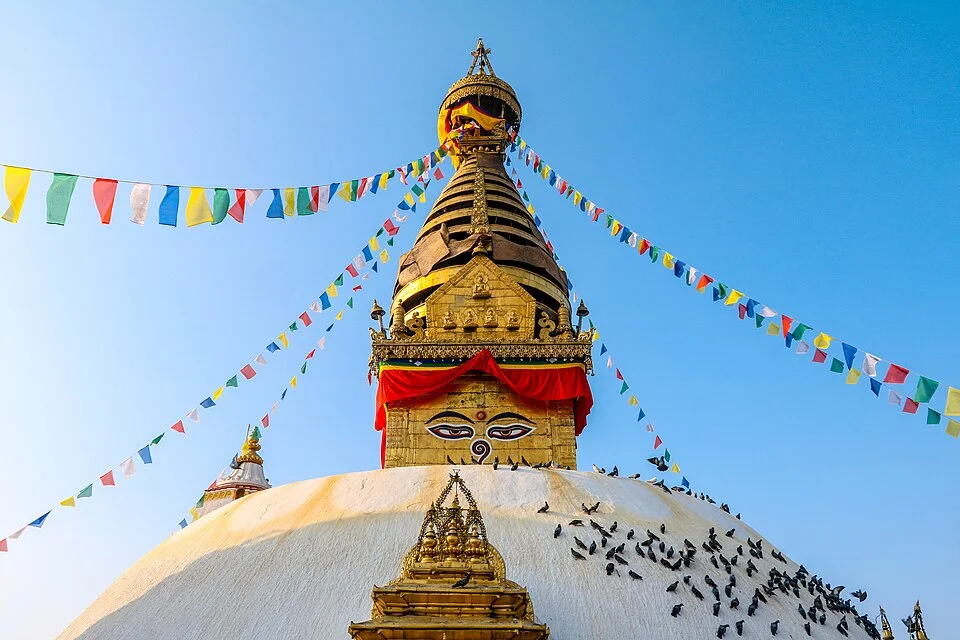
Swayambhunath, Nepal: a comparative example for studying the Buddhist stupa tradition.
Credit: Nirmal Dulal · CC BY-SA 4.0 · sourceResized and converted to WebP; uncropped.
Origins, religious meaning and classification
The stupa developed from the practice of raising a mound over bodily remains or objects associated with the dead. Buddhism transformed this memorial form into a sacred focus for remembering the Buddha, venerating relics and accumulating religious merit. It should not be understood merely as a tomb: stupas could commemorate events, preserve objects associated with revered teachers, or express a donor’s devotion.
The Mahaparinibbana Sutta describes the division of the Buddha’s bodily relics among eight claimants after his cremation. Separate monuments were associated with the relic vessel and cremation embers. This is a textual account of the origins of Buddhist relic worship, not a directly verified archaeological record of every monument. Later Buddhist traditions credit Ashoka with redistributing relics and creating 84,000 stupas; this number is a religious tradition rather than an established archaeological total.
Stupas helped make the Buddha’s presence accessible after his death. Visiting them, making offerings and walking around them were devotional acts. They frequently stood within larger monastic landscapes containing monasteries, shrines, inscriptions and smaller votive monuments. Their continued importance across Buddhist traditions makes it misleading to associate stupa worship exclusively with one sect.
- Relic or sharirika stupas contain bodily remains attributed to the Buddha or other revered individuals.
- Paribhogika stupas are associated with objects used by a revered person.
- Commemorative or uddeshika monuments recall sacred events or places; terminology varies across textual and scholarly classifications.
- Votive stupas are usually smaller monuments erected as acts of devotion or merit-making.
Timeline
Third century BCE
Ashokan patronage advances Buddhist monumental activity; the original Great Stupa at Sanchi is attributed to this period.
Second century BCE
Major post-Mauryan enlargement at Sanchi and the principal surviving sculptural phase at Bharhut.
Approximately first century BCE–first century CE
Sanchi’s Great Stupa receives its elaborately carved gateways.
Early centuries CE
Amaravati experiences major sculptural elaboration; Buddha images gain prominence across Buddhist artistic centres.
Third–fourth centuries CE
Nagarjunakonda flourishes under Ikshvaku patronage.
Architecture, symbolism and ritual movement
The most familiar structural form consists of a hemispherical mound, or anda, resting on a base. A relic deposit could be enclosed within the structure, but devotees ordinarily worshipped outside rather than entering the mound. The dome is frequently interpreted through cosmological symbolism, while also retaining its basic association with the funerary mound. Architectural features and their meanings evolved, so a single symbolic interpretation should not be imposed on every site.
A harmika, usually a small square enclosure, crowns the dome. A central shaft, the yashti, supports one or more umbrellas, together forming a chhatravali. Umbrellas signify honour and elevated sacred status. The medhi is a raised drum or terrace; some stupas possess an elevated circumambulatory passage reached by steps. A vedika is the enclosing railing, and toranas are gateways that mark access to the sacred enclosure.
The pradakshinapatha directs clockwise movement around the monument. At Sanchi, movement through gateways and along passages brings worshippers into contact with sculpted narratives and auspicious symbols. Railings and gateways translated elements of timber construction into stone, demonstrating continuity between earlier building traditions and durable monumental architecture.
A stupa must be distinguished from a chaitya-griha and a vihara. A chaitya-griha is a worship hall, often apsidal, that may contain a stupa at its far end, as at Bhaja and Karle. A vihara principally provides monastic accommodation. Thus, a rock-cut chaitya hall and a freestanding structural stupa are different architectural settings, even when both support stupa-centred worship.
- Anda: mound or dome; harmika: crowning enclosure; yashti: central shaft.
- Chhatravali: umbrella arrangement; vedika: railing; torana: gateway.
- Not every stupa has four gateways, elaborate sculpture or an elevated circumambulatory terrace.
Reading a stupa as a historical source
- 1. Identify the site, landscape and construction material.
- 2. Separate the original mound from later additions.
- 3. Recognise architectural components and ritual pathways.
- 4. Read inscriptions for donors, scripts and chronology.
- 5. Interpret reliefs alongside texts and archaeological context.
Mauryan beginnings and post-Mauryan regional centres
Ashoka’s patronage linked Buddhist sacred places with imperial resources and communication networks. At Sanchi in Madhya Pradesh, the original brick nucleus of the Great Stupa is conventionally attributed to his reign. The site lies near ancient Vidisha, an important settlement connected with trade routes. Ashokan pillars and stupas are distinct monument types, although they can occur within the same sacred complex.
The Great Stupa was enlarged and encased in stone during the post-Mauryan period, generally associated with the Shunga age. Its four elaborately carved gateways belong mainly to around the first century BCE–first century CE. A southern gateway inscription mentions a donation connected with the artisans of King Satakarni. This illustrates why the surviving monument cannot be assigned in its entirety to Ashoka or to one dynasty.
Bharhut, also in Madhya Pradesh, is especially important for its surviving railing and gateway sculptures, predominantly dated to the second century BCE. Label inscriptions identify several figures and stories, making the site valuable for interpreting early Buddhist narrative art. Much of its surviving sculpture is preserved in the Indian Museum, Kolkata, rather than standing in its original architectural arrangement.
Amaravati, on the Krishna River in Andhra Pradesh, developed from the early historic period into a major Buddhist centre. Its Great Stupa underwent successive phases of construction and embellishment, with especially rich sculptural production during the Satavahana and subsequent periods. Nagarjunakonda, farther upstream in the Krishna valley, flourished particularly under the Ikshvakus in the third–fourth centuries CE. Together, these sites demonstrate that stupa architecture was regionally diverse, not simply an imitation of Sanchi.
- Sanchi: Mauryan foundation, post-Mauryan enlargement, sandstone gateways and surviving monastic landscape.
- Bharhut: early narrative reliefs, extensive inscriptions and prominently depicted nature-associated divinities.
- Amaravati: limestone reliefs, dynamic compositions and multiple construction phases.
| Site | Present location | Exam-relevant association |
|---|---|---|
| Sanchi | Madhya Pradesh | Ashokan nucleus; later enlargement and four carved gateways |
| Bharhut | Madhya Pradesh | Labelled narrative reliefs; sculptures in Indian Museum, Kolkata |
| Amaravati | Andhra Pradesh, Krishna River | Limestone reliefs; major Satavahana-period development |
| Nagarjunakonda | Andhra Pradesh, Krishna valley | Ikshvaku patronage and extensive Buddhist remains |
| Sarnath | Uttar Pradesh, near Varanasi | First sermon tradition; Dhamekh and Dharmarajika stupas |
Sculpture, inscriptions and social patronage
Early Buddhist reliefs often evoke the Buddha through symbols rather than depicting him in human form. The Bodhi tree recalls enlightenment, the wheel evokes the teaching of dhamma, an empty throne signifies sacred presence, and footprints mark the Buddha’s association with a place. Such representation is conventionally called aniconic. It should not automatically be explained as evidence of a universally enforced prohibition on Buddha images.
Jataka stories narrate the Buddha’s previous births and convey virtues such as generosity, compassion and self-sacrifice. Reliefs also depict events from his final life, processions, settlements, animals, vegetation and worshippers. Artists could show several episodes within one composition, sometimes repeating the same character. Yakshas, yakshis, lotuses and other auspicious motifs connected Buddhist monuments with wider Indian visual and religious traditions.
Donative inscriptions reveal participation by monks, nuns, merchants, artisans, women and householders, alongside rulers. Many are written in Prakrit using Brahmi script. Their references to donors’ occupations and places of origin help reconstruct social networks and mobility. Royal patronage mattered, but monuments were also products of numerous smaller donations rather than exclusively state-funded projects.
Buddhist establishments often developed near routes and settlements where trade generated resources and travelling communities. The association should not be reduced to commerce alone: ritual prestige, access to sacred places, local political support and the institutional needs of monastic communities also shaped their locations. In the early centuries CE, anthropomorphic Buddha images became increasingly prominent, especially in Gandhara and Mathura, without eliminating stupa worship.
- For image identification, distinguish narrative subject, architectural component, material and regional style.
- Avoid treating every symbolic scene as a Jataka: some depict the Buddha’s final life or acts of worship.
Historical interpretation and conservation
Stupas are layered archaeological records. Construction materials, relic deposits, inscriptions and sculptural styles may belong to different centuries within one monument. Consequently, questions asking who built a stupa require attention to whether they concern its foundation, enlargement, gateways or later restoration. Dynasty-based labels provide chronological context but do not establish that every component received direct royal sponsorship.
The Buddhist Monuments at Sanchi were inscribed on the UNESCO World Heritage List in 1989. Their importance lies in the ensemble of stupas, pillars, temples and monasteries, not only the Great Stupa. Archaeological Survey of India documentation is a key source for site history. Modern conservation must protect structural stability and sculptural surfaces while balancing tourism, worship and the integrity of the archaeological setting.
For Prelims, prioritise site–state–river associations, structural terminology, chronology, donor inscriptions and distinctions between stupas, chaitya halls and viharas. Compare textual traditions with archaeological findings rather than treating legendary numbers as historical statistics. Remember also that the Buddhist predominance of surviving examples does not make the stupa an exclusively Buddhist monument type; Jain remains at Kankali Tila, Mathura, provide an important corrective.
Stupas: Relics, Ritual and Regional Traditions
The metadata identifies Swayambhunath in Nepal, a Buddhist sacred complex associated with a stupa. It offers a comparative example of the stupa tradition beyond India, not archaeological evidence for Mauryan or post-Mauryan Indian construction. The supplied description provides no building chronology or architectural inventory; it therefore cannot establish which features belong to an early phase or to later rebuilding.
For ancient India, a stupa is best understood as a sacred monument associated with relics, commemoration and devotional practice, rather than simply as a temple containing an image. Ashoka’s patronage helped expand Buddhist sacred landscapes, while subsequent centuries brought enlargement, stone railings, gateways and sculptural programmes at important sites. Sanchi illustrates why construction phases matter: an early foundation and later architectural elaboration should not automatically be assigned to the same ruler or dynasty. Movement around a stupa through circumambulation made architecture integral to worship, while inscriptions and reliefs provide different kinds of evidence about patronage and religious communication.
- Architectural vocabulary: anda denotes the mound or dome; harmika is the enclosure above it; chhatras are parasols. Do not assume every regional stupa has an identical arrangement.
- Evidence limits: donor inscriptions can identify particular gifts and patrons, but a monument’s overall form alone cannot establish its date or builder.
- Exam distinction: a stupa is a sacred monument, a chaitya hall is a worship space often containing a stupa, and a vihara is principally a monastic residence.
Real-world case studies
Sanchi: artisans as patrons
An inscription on the southern gateway of the Great Stupa records work associated with ivory workers from Vidisha. It links a nearby urban craft community with Buddhist monumental production. Alongside other donor records, it shows why Sanchi should be studied as a collective social undertaking rather than only an imperial monument.
Nagarjunakonda: salvage archaeology
Before the Nagarjuna Sagar reservoir submerged much of the archaeological valley, excavations documented Buddhist and other ancient remains. Selected structures were relocated or reconstructed, and an island museum preserves important finds. The project illustrates both the value and limitations of salvage archaeology: objects can be preserved, but their original landscape relationships cannot be fully reproduced.
Previous year questions
UPSC Prelims 2023
With reference to ancient India, consider the statements: 1. The concept of Stupa is Buddhist in origin. 2. Stupa was generally a repository of relics. 3. Stupa was a votive and commemorative structure in Buddhist tradition. How many statements are correct?
- A. Only one
- B. Only two
- C. All three
- D. None
Practice questions
Practice MCQ 1
Which pair of stupa components and descriptions is incorrectly matched?
- A. Harmika — Small crowning enclosure
- B. Vedika — Enclosing railing
- C. Torana — Gateway
- D. Anda — Monastic residential cell
Practice MCQ 2
Consider the statements: 1. All surviving parts of Sanchi’s Great Stupa were built under Ashoka. 2. Bharhut sculptures include inscriptions identifying narrative subjects. 3. Amaravati is associated with the Krishna River. Which statements are correct?
- A. 1 and 2 only
- B. 2 and 3 only
- C. 1 and 3 only
- D. 1, 2 and 3
Practice MCQ 3
Which inference is best supported by donative inscriptions recording contributions from monks, nuns, merchants and artisans at Buddhist monuments?
- A. Royal patronage was entirely absent.
- B. Buddhist monuments depended exclusively on merchant guilds.
- C. Monumental patronage extended across several social groups.
- D. Every donor belonged to the same monastic order.
Mains practice · Stupas are sources for reconstructing religious practices, artistic developments and social relations in ancient India. Discuss with reference to Sanchi, Bharhut and Amaravati. Answer in 250 words.
- Introduce the stupa as a reliquary, commemorative and devotional monument.
- Explain circumambulation and the functions of key architectural components.
- Trace Mauryan foundations and post-Mauryan elaboration without attributing all phases to one ruler.
- Discuss symbolic representation, Jataka narratives and regional sculptural variation.
- Use donor inscriptions to highlight women, religious communities, merchants and artisans.
- Conclude with the need to combine archaeology, inscriptions and texts.
Further reading
- NCERT, Themes in Indian History, Part I: Thinkers, Beliefs and Buildings.
- NCERT, An Introduction to Indian Art, Part I: Arts of the Mauryan Period; Post-Mauryan Trends in Indian Art and Architecture.
- Archaeological Survey of India: Sanchi monument information and Nagarjunakonda museum resources.
- UNESCO World Heritage Centre: Buddhist Monuments at Sanchi.
- Indian Museum, Kolkata: Bharhut gallery and archaeological collections.
- Upinder Singh, A History of Ancient and Early Medieval India.
- https://commons.wikimedia.org/wiki/File:Swayambhunath_temple_-_an_ancient_religious_architecture_of_Nepal.jpg
Preparing for UPSC Civil Services? Get classroom teaching, answer-writing evaluation and mentorship at Pragnya IAS Academy, Ashok Nagar — see why aspirants choose us for IAS coaching in Hyderabad.