
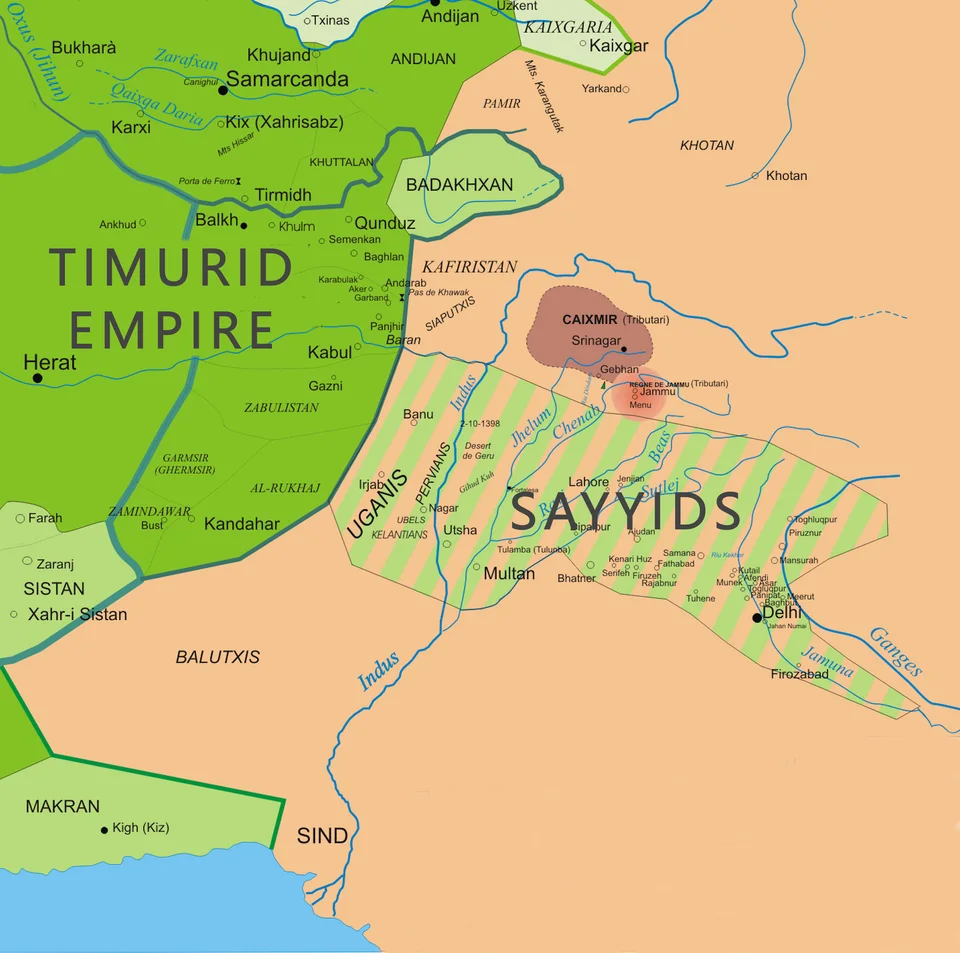
Illustration of the Delhi Sayyids in relation to Timurid overlordship.
Credit: Jaume Ollé Casals · CC BY-SA 4.0 · sourceResized and converted to WebP; uncropped.
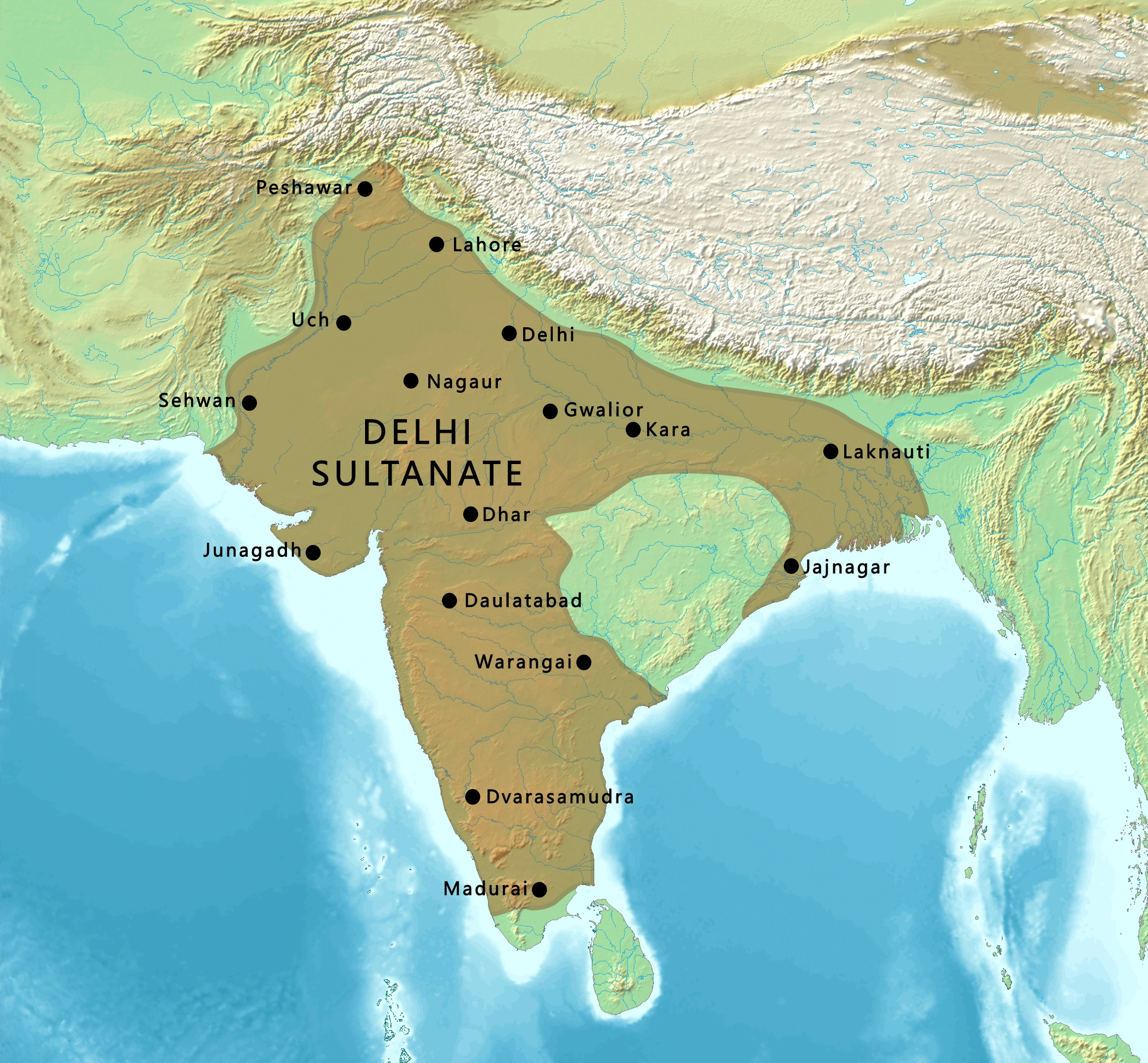
Map study
Delhi Sultanate territorial overview: regional orientation, not the exact boundary of every Sultan’s reign.
- Read the source date and legend before interpreting territorial extent.
- Compare core regions, neighbouring powers and geographic barriers; historical borders and influence are approximate and changed over time.
Credit: Koba-chan; DEMIS base map · CC BY-SA 3.0 · sourceConverted to WebP on an opaque white background; proportionally resized without cropping. Original cartography and legend retained.
1. Historical setting and the rise of Khizr Khan
The Sayyids emerged from the political disintegration of the later Tughlaq period. Following Firuz Shah Tughlaq’s death in 1388, succession struggles, noble rivalries and provincial assertions of independence weakened Delhi. Timur’s invasion and sack of Delhi in 1398 intensified this crisis through destruction, plunder and disruption of urban life. However, regional fragmentation had begun before Timur’s invasion; it should not be explained as the consequence of one event alone.
Timur did not establish a durable administration across northern India. After his withdrawal, Delhi remained contested while Gujarat, Malwa and Jaunpur developed as major regional powers. Bengal was already independent. The last major Tughlaq claimant, Nasiruddin Mahmud, died in 1413. Daulat Khan Lodi then briefly controlled Delhi before Khizr Khan defeated him in 1414.
Khizr Khan had been associated with the government of Multan and emerged as Timur’s representative in the north-western territories. His occupation of Delhi founded the Sayyid dynasty. The dynastic name reflected a claim to descent from the Prophet Muhammad, but aspirants should distinguish this claim of ancestry from independently established genealogy. Khizr Khan’s authority rested practically on military support, control over revenue and his connection with Timurid power.
- Prelims distinction: Timur invaded during the Tughlaq period, not during Sayyid rule.
- Daulat Khan Lodi, displaced in 1414, was not the founder of the Lodi dynasty; that distinction belongs to Bahlul Lodi.
Timeline
1398
Timur invaded and sacked Delhi during the later Tughlaq period.
1414
Khizr Khan captured Delhi and founded Sayyid rule.
1421
Mubarak Shah succeeded Khizr Khan.
1434
Mubarak Shah was assassinated; Muhammad Shah succeeded him.
1445–1448
Alam Shah became ruler in 1445 and withdrew to Badaun in 1448.
1451
Bahlul Lodi became sultan, ending Sayyid rule.
2. The four rulers and their political challenges
Khizr Khan ruled from 1414 to 1421. He avoided formally assuming the title of sultan and used Rayat-i-Ala, usually translated as the exalted standard. He acknowledged Timurid overlordship, including that of Timur’s successor Shah Rukh. This expressed a claim to legitimacy rather than effective Timurid administration of Delhi. Khizr Khan also continued earlier Tughlaq coinage conventions rather than establishing an unequivocally independent royal coinage.
His son Mubarak Shah, who ruled from 1421 to 1434, adopted the title of sultan and asserted a more independent kingship. His reign involved repeated expeditions against local chiefs and challenges in Punjab and the Doab. Jasrath, a Khokhar leader, was a particularly significant opponent in the north-west. These campaigns reveal the monarchy’s military activity, but repeated resistance also shows how difficult it was to turn temporary submission into stable administration.
Mubarak Shah was assassinated in 1434 in a conspiracy associated with his minister Sarwar-ul-Mulk. His successor, Muhammad Shah, ruled until 1445. Court factions and external threats continued, while the Afghan chief Bahlul Lodi increased his influence in Punjab. Delhi increasingly depended on powerful regional commanders whose military resources exceeded the centre’s ability to control them.
The final ruler, Alauddin Alam Shah, reigned from 1445 to 1451. He withdrew to Badaun in 1448, leaving Delhi’s affairs increasingly in the hands of competing nobles. Bahlul Lodi occupied the throne in 1451 without a major confrontation with Alam Shah, who remained at Badaun. The transfer marked the establishment of an Afghan dynasty rather than the restoration of the earlier Tughlaq imperial structure.
From Tughlaq fragmentation to Lodi accession
- 1. Later Tughlaq succession struggles weaken central authority
- 2. Timur’s invasion intensifies disruption
- 3. Khizr Khan captures Delhi in 1414
- 4. Sayyid rulers struggle to secure revenue and regional obedience
- 5. Afghan chiefs, especially Bahlul Lodi, gain influence
- 6. Bahlul establishes Lodi rule in 1451
3. Territorial control, administration and regionalisation
The Sayyid kingdom was far smaller than the Sultanate at its fourteenth-century height. Its effective core lay around Delhi, with fluctuating influence over neighbouring districts, parts of the upper Ganga-Yamuna Doab and territories towards Punjab. It is misleading either to imagine uninterrupted control over northern India or to assume that every Sayyid ruler governed only the city of Delhi. Authority varied by ruler, locality and military circumstances.
The rulers inherited the Sultanate’s Persianate court culture, administrative offices and practices of assigning revenue to support military service. They did not create an entirely new administrative system. Their central difficulty was making inherited institutions function with a narrow and contested revenue base. Campaigns often aimed to obtain tribute or arrears from local chiefs rather than annex extensive new territories.
Local resistance should not always be labelled a nationalist or religious rebellion. Chiefs, landed intermediaries and military commanders pursued control over revenue, forts and hereditary influence. Their relationships with Delhi could alternate between submission, tribute payments and open conflict. Powerful neighbours, especially Jaunpur and Malwa, further restricted the room available for Sayyid expansion.
For historical analysis, the period illustrates regionalisation rather than a complete disappearance of government. Delhi’s monarchy survived, but sovereignty was negotiated among the court, provincial commanders and local powers. The rise of Bahlul Lodi demonstrates how a regional military leader could convert service to a weakened centre into a claim to the throne.
| Ruler | Reign | Distinctive association |
|---|---|---|
| Khizr Khan | 1414–1421 | Founder; acknowledged Timurid overlordship |
| Mubarak Shah | 1421–1434 | Assumed sultanic title; patron of Yahya Sirhindi |
| Muhammad Shah | 1434–1445 | Growing influence of Bahlul Lodi; tomb in Lodi Gardens |
| Alam Shah | 1445–1451 | Withdrew to Badaun; last Sayyid ruler |
4. Historical sources, urban patronage and architecture
The principal contemporary narrative is the Tarikh-i Mubarak Shahi by Yahya bin Ahmad Sirhindi, dedicated to Mubarak Shah. It is valuable for the later Tughlaq and early Sayyid periods. Like other court-oriented chronicles, it gives greater attention to rulers, campaigns and elite politics than to everyday social life. Its evidence should therefore be read alongside inscriptions, coins and surviving monuments.
Mubarak Shah founded Mubarakabad beside the Yamuna in 1433. Such urban foundations demonstrate that even a financially constrained monarchy could use construction and ceremonial space to advertise royal authority. They do not, by themselves, prove economic prosperity across the kingdom.
The tombs of Mubarak Shah at Kotla Mubarakpur and Muhammad Shah in present-day Lodi Gardens are important surviving monuments in Delhi. Their octagonal plans, surrounding verandahs, domes and roof-level chhatris belong to the architectural development linking late Tughlaq and Lodi funerary traditions. Muhammad Shah’s tomb is especially useful for visual identification in examinations.
These buildings should not be confused with the later monumental garden-tomb tradition represented by Humayun’s Tomb. Equally, location within Lodi Gardens does not make every monument there a Lodi construction: Muhammad Shah was a Sayyid ruler.
5. Historical significance and examination approach
The Sayyids preserved the political importance of Delhi during a period when its material power had sharply contracted. Their history connects the aftermath of Timur’s invasion with the emergence of Afghan kingship under the Lodis. The most useful themes are limited centralisation, contested revenue collection, factional politics, regional state formation and the use of architecture to express legitimacy.
For Prelims, prioritise dynastic order, ruler chronology, Khizr Khan’s unusual titulature, the contemporary chronicle and tomb identification. For analytical answers, avoid presenting the period as merely a list of ineffective kings: weakened institutions and a changed regional balance also shaped political outcomes.
- Muhammad Shah Sayyid must not be confused with Muhammad bin Tughlaq or the later Mughal emperor Muhammad Shah.
- Alam Shah Sayyid must not be confused with Alauddin Khalji.
- The Sayyids preceded the Lodis; they did not immediately precede the Mughals.
Sayyid Rule: Timurid Legitimacy and Limited Power
The supplied title presents the Sayyids as vassals of the Timurid Empire, making this illustration relevant to their political origins. Khizr Khan established Sayyid rule at Delhi in 1414, in the aftermath of Timur’s invasion and the disintegration of Tughlaq authority. He acknowledged Timurid supremacy rather than immediately asserting fully independent kingship. This relationship helped legitimise his position, but it should not be confused with continuous, direct Timurid administration of Delhi. His successor, Mubarak Shah, adopted the title of Shah, signalling a stronger assertion of sovereign status.
The dynasty’s central problem was the gap between claims to sovereignty and effective territorial control. Delhi’s rulers depended on campaigns, tribute and negotiations with local chiefs to maintain revenue and authority. Regional kingdoms and powerful intermediaries constrained their reach. Consequently, describing the entire dynasty simply as a Timurid dependency obscures changes across its four reigns. The metadata provides no date, territorial key or supporting references for the illustration; it cannot independently establish precise boundaries or the practical extent of Timurid influence.
- Prelims distinction: the sequence is Tughlaq–Sayyid–Lodi; Khizr Khan, Mubarak Shah, Muhammad Shah and Alam Shah were the four Sayyid rulers.
- Mains distinction: symbolic overlordship, tributary relationships and direct provincial administration represent different degrees of political dependence.
- Transition: Alam Shah’s withdrawal from Delhi preceded Bahlul Lodi’s accession in 1451, marking the replacement of Sayyid rule by an Afghan dynasty.
Real-world case studies
Muhammad Shah’s tomb: a monument-identification lesson
Muhammad Shah’s octagonal tomb stands in Delhi’s Lodi Gardens. Its verandah, central dome and chhatris illustrate architectural continuity across dynastic boundaries. The site provides a useful examination lesson: a modern park name is not reliable evidence of a monument’s dynastic attribution.
Previous year questions
No source-linked PYQ is available here yet. Use the practice questions below.
Practice questions
Practice MCQ 1
Which Sayyid ruler captured Delhi in 1414 but did not formally assume the title of sultan?
- A. Mubarak Shah
- B. Khizr Khan
- C. Muhammad Shah
- D. Alam Shah
Practice MCQ 2
Consider the following pairs: 1. Tarikh-i Mubarak Shahi — Yahya bin Ahmad Sirhindi; 2. Muhammad Shah’s tomb — Lodi Gardens; 3. Alam Shah’s retirement — Badaun. How many pairs are correctly matched?
- A. Only one
- B. Only two
- C. All three
- D. None
Practice MCQ 3
Which sequence correctly represents the succession of Sayyid rulers?
- A. Khizr Khan → Muhammad Shah → Mubarak Shah → Alam Shah
- B. Mubarak Shah → Khizr Khan → Alam Shah → Muhammad Shah
- C. Khizr Khan → Mubarak Shah → Muhammad Shah → Alam Shah
- D. Khizr Khan → Mubarak Shah → Alam Shah → Muhammad Shah
Mains practice · The Sayyid period represented the survival of Delhi’s monarchy without the restoration of its earlier imperial authority. Discuss. Answer in 150 words.
- Introduce the dynasty and the background of later Tughlaq fragmentation.
- Explain the narrow revenue base and fluctuating territorial control.
- Discuss repeated tribute-collection campaigns and powerful regional neighbours.
- Note continuity in court institutions and architectural patronage.
- Conclude with Afghan ascendancy and Bahlul Lodi’s accession in 1451.
Further reading
- Satish Chandra, Medieval India: From Sultanat to the Mughals, Part One.
- NCERT, Our Pasts II, chapter on the Delhi Sultans.
- Yahya bin Ahmad Sirhindi, Tarikh-i Mubarak Shahi, English translation by K. K. Basu.
- Archaeological Survey of India: information on Delhi monuments and Lodi Gardens, asi.nic.in.
- https://commons.wikimedia.org/wiki/File:The_Sayyids,_as_vassals_of_the_Timurid_Empire.png
Preparing for UPSC Civil Services? Get classroom teaching, answer-writing evaluation and mentorship at Pragnya IAS Academy, Ashok Nagar — see why aspirants choose us for IAS coaching in Hyderabad.