

Illustrative flag attributed to Firuz Shah Tughlaq in the supplied metadata; not an authenticated surviving banner.
Credit: ImperialAficionado · CC0 · sourceResized and converted to WebP; uncropped.
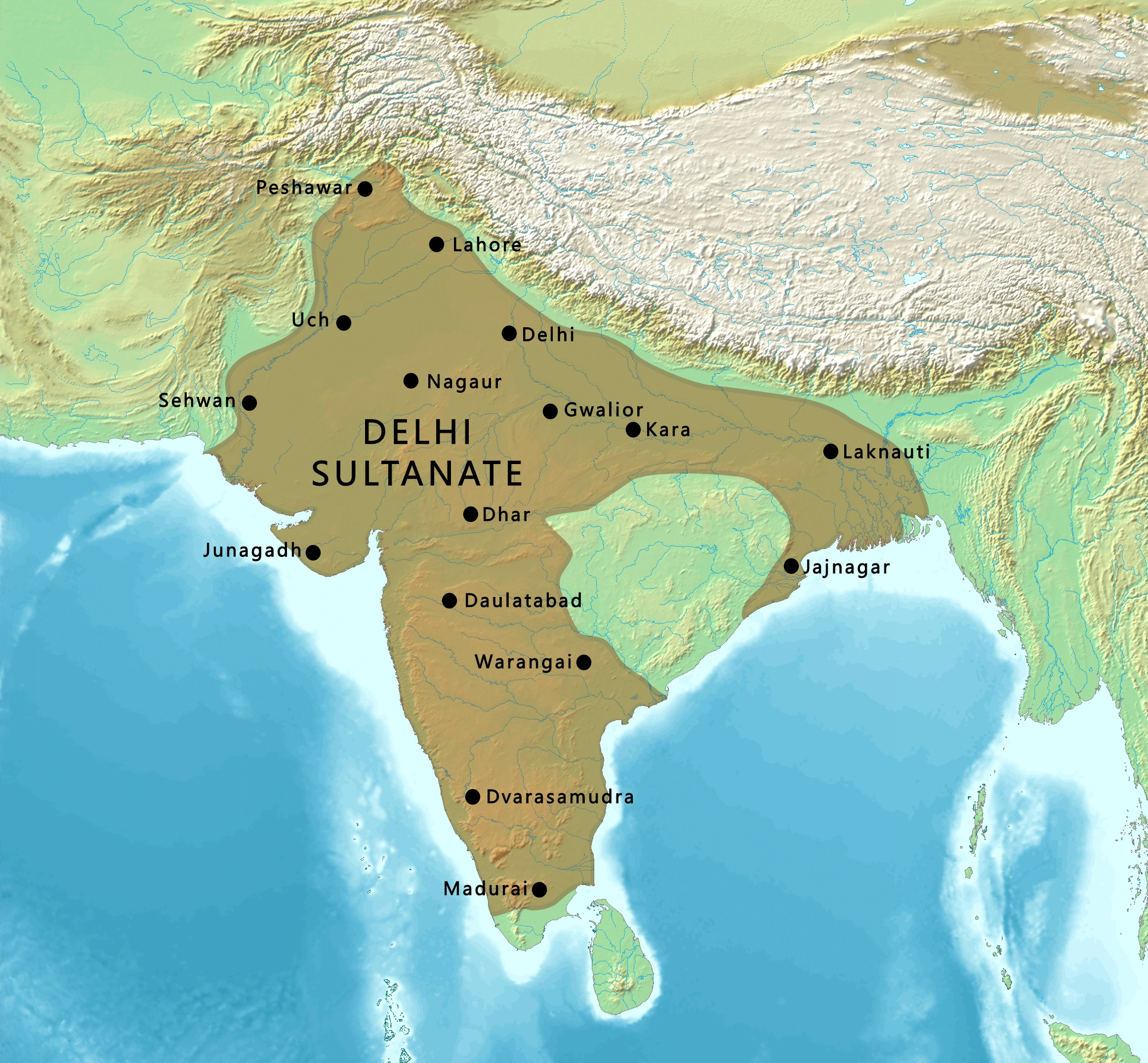
Map study
Delhi Sultanate territorial overview: regional orientation, not the exact boundary of every Sultan’s reign.
- Read the source date and legend before interpreting territorial extent.
- Compare core regions, neighbouring powers and geographic barriers; historical borders and influence are approximate and changed over time.
Credit: Koba-chan; DEMIS base map · CC BY-SA 3.0 · sourceConverted to WebP on an opaque white background; proportionally resized without cropping. Original cartography and legend retained.
1. Foundation, expansion and historical sources
Ghazi Malik, a military commander associated with the north-western frontier, overthrew Khusrau Khan in 1320 and assumed the title Ghiyasuddin Tughlaq. He sought to restore political order after the final Khalji succession crisis. His government combined military consolidation with efforts to improve revenue administration and cultivation. Tughlaq authority remained dependent on provincial commanders, revenue assignments and the capacity of the centre to enforce obedience.
His son Ulugh Khan, the future Muhammad bin Tughlaq, conquered Warangal in 1323, ending Kakatiya rule and extending direct Sultanate control in the Deccan. Ghiyasuddin also intervened in Bengal. He died in 1325 when a wooden pavilion collapsed near Delhi; allegations of his son’s complicity occur in historical accounts but should not be presented as established fact.
Ziauddin Barani’s Tarikh-i-Firuz Shahi, Ibn Battuta’s Rihla, Isami’s Futuh-us-Salatin and Shams-i-Siraj Afif’s Tarikh-i-Firuz Shahi are major sources. Ibn Battuta reached India during Muhammad’s reign and served as a qazi. These writers provide valuable observations but had different political, religious and personal perspectives. Their judgments, especially about royal cruelty or ideal government, require critical reading.
Timeline
1320
Ghiyasuddin Tughlaq establishes the dynasty.
1323
Ulugh Khan conquers Warangal.
1325–1351
Muhammad bin Tughlaq rules; major administrative experiments and regional rebellions occur.
1336 and 1347
Vijayanagara and the Bahmani Sultanate respectively emerge.
1351–1388
Firuz Shah rules, emphasising public works and political accommodation.
1398
Timur invades and sacks Delhi.
1414
Khizr Khan captures Delhi and establishes Sayyid rule.
2. Muhammad bin Tughlaq: ambition and administrative experiments
Muhammad bin Tughlaq inherited a vast empire whose distant provinces were difficult to supervise. Educated and intellectually curious, he pursued policies intended to strengthen central authority, improve strategic coordination and increase resources. Their objectives were not necessarily irrational, but coercive execution, inadequate preparation and simultaneous pressures repeatedly undermined them.
Around 1327, he ordered the transfer of the court and a substantial section of Delhi’s population to Devagiri, renamed Daulatabad. Its location offered advantages for supervising the Deccan. The long, compulsory journey caused hardship, while Delhi’s continuing strategic importance made a complete shift impractical. Permission to return followed. Claims that every inhabitant left Delhi should be treated cautiously; nevertheless, the movement helped expand cultural and administrative connections between northern India and the Deccan.
Around 1329–1330, he introduced base-metal token coins intended to circulate at the value of silver currency. The innovation had precedents elsewhere, but the Sultanate failed to prevent widespread counterfeiting. Confidence collapsed, and the state withdrew the currency and exchanged tokens for precious-metal money, imposing a fiscal burden.
His attempt to increase revenue demands in the Ganga–Yamuna Doab coincided with agrarian distress and famine. Harsh collection aggravated resistance and flight from cultivation. Later relief measures and agricultural loans could not immediately reverse the damage. Diwan-i-Kohi, an agricultural department, sought to expand cultivation and improve crops through state support, but corruption, weak supervision and a short implementation period limited results.
He also prepared a large army for a projected Khurasan campaign, which was abandoned. The Qarachil expedition into the Himalayan region suffered severe losses. It should not be simplified into a successful conquest of China. Together, these ventures demonstrate the gap between imperial ambition and available administrative capacity.
Failure of the token-currency experiment
- 1. Base-metal coins receive a high official monetary value
- 2. Inadequate safeguards allow extensive counterfeiting
- 3. Trust in circulating coins deteriorates
- 4. Government withdraws token currency
- 5. Redemption creates losses for the treasury
3. Firuz Shah Tughlaq: public works and political accommodation
Firuz Shah succeeded Muhammad in 1351 while the latter’s army was campaigning in Sindh. Rather than recovering every lost province, he generally prioritised stability in the remaining Sultanate. He cultivated the support of nobles and the ulema, relaxed some coercive practices and expanded public works. However, accommodation also strengthened intermediaries and reduced the centre’s freedom to reorganise offices and assignments.
Canals drawing on rivers such as the Yamuna and Sutlej supported cultivation and settlements, including the Hisar region. He promoted gardens, reservoirs, rest houses and towns such as Firuzabad at Delhi, Hisar and Jaunpur. Irrigation increased the productive base, while an irrigation levy helped finance the state. These works distinguish his reign from Muhammad’s more disruptive experiments, although their reach was regionally uneven.
Diwan-i-Khairat provided charitable assistance, including support for marriages of poor Muslim women. Diwan-i-Bandagan administered the large royal slave establishment, whose members performed domestic, military and artisanal functions. Firuz also supported hospitals and educational institutions. Such measures should be understood within medieval patronage and social hierarchy, rather than equated with a universal modern welfare state.
He placed greater emphasis on Islamic legal prescriptions, abolished several taxes considered unlawful and explicitly subjected Brahmanas to jizya. His own account records acts of religious intolerance. He made military service and revenue assignments more hereditary in practice, helping secure immediate loyalty but weakening administrative flexibility. Thus, public welfare and religious exclusion coexisted within his government.
| Feature | Ghiyasuddin | Muhammad bin Tughlaq | Firuz Shah |
|---|---|---|---|
| Reign | 1320–1325 | 1325–1351 | 1351–1388 |
| Political emphasis | Restoration and consolidation | Centralisation and ambitious experimentation | Accommodation and stability |
| Key association | Warangal conquest under Ulugh Khan | Daulatabad and token currency | Canals and charitable departments |
| Architecture | Tughlaqabad | Jahanpanah | Firuz Shah Kotla |
| Institutional marker | Reorganisation after Khalji collapse | Diwan-i-Kohi | Diwan-i-Khairat and Diwan-i-Bandagan |
4. Architecture, technology and cultural connections
Tughlaq architecture is generally associated with massive construction, sloping or battered walls, restrained decoration and extensive use of rubble masonry. These are broad tendencies, not uniform rules. Fortifications and royal complexes expressed military concerns, while tombs, mosques, waterworks and educational buildings reflected expanding urban institutions.
Tughlaqabad and Ghiyasuddin’s tomb are major early examples. Muhammad is associated with Jahanpanah, intended to connect and protect existing settlements around Delhi. Firuz Shah built Firuz Shah Kotla and developed the Hauz Khas madrasa complex, where his tomb stands. Hauz Khas itself originated as Alauddin Khalji’s reservoir; Firuz restored it rather than creating it initially.
Firuz transported Ashokan pillars from Topra and Meerut to Delhi, an important example of engineering and the reuse of ancient monuments. Their Brahmi inscriptions were not deciphered in his time. Persian historical writing flourished, while population movements and regional contacts helped circulate administrative practices and Indo-Islamic cultural traditions beyond Delhi.
5. Regional breakaways and the end of Tughlaq rule
Regional fragmentation began before the dynasty’s final decades. Distance, costly campaigns, provincial ambitions and resistance to revenue extraction weakened Delhi’s hold. The establishment of Vijayanagara in 1336 and the Bahmani Sultanate in 1347 marked major changes in the Deccan political order. Bengal also consolidated independence during Muhammad’s reign. These developments were not simply consequences of one ruler’s personality.
After Firuz’s death in 1388, succession struggles and competing noble factions accelerated disintegration. Hereditary claims and powerful military groups complicated central control. Timur invaded in 1398, defeated the forces defending Delhi and subjected the city to devastating violence and plunder. His invasion severely damaged an already weakened Sultanate; it did not immediately install the Sayyid dynasty.
The last Tughlaq sultan, Nasiruddin Mahmud, died in 1413. Khizr Khan took Delhi in 1414 and founded the Sayyid dynasty. For examination answers, distinguish long-term structural weaknesses from the immediate shock of Timur’s invasion. The decline of Delhi’s central power also enabled regional states to develop their own political institutions, architecture and cultural patronage.
Firuz Shah Tughlaq: Kingship, Policy and Historical Evidence
The supplied metadata attributes this flag design to Firuz Shah Tughlaq and cites Shams-i-Siraj Afif’s Tarikh-i-Firuz Shahi. This makes it relevant to Tughlaq political history, but the attribution requires caution: a modern illustration based on a textual reference is not equivalent to a surviving medieval object. Without checking the cited passage and its interpretation, the design should not be treated as an established flag for the entire dynasty. Court chronicles illuminate royal ceremony and ideals of sovereignty, while also reflecting their authors’ perspectives.
For UPSC, Firuz Shah is better understood through his governing priorities than through an emblem alone. His reign is associated with canals, public buildings, charitable institutions and efforts to conciliate influential groups. Yet welfare measures coexisted with religious discrimination and concessions that could weaken central control. His approach differed from Muhammad bin Tughlaq’s ambitious fiscal and monetary experiments. The dynasty’s subsequent fragmentation should therefore be explained through succession struggles, provincial assertion and institutional weaknesses rather than reduced to one ruler’s personality.
- Distinguish rulers: token currency belongs to Muhammad bin Tughlaq; extensive canal construction is especially associated with Firuz Shah.
- Separate evidence types: a chronicle’s description, an illustrator’s reconstruction and an authenticated artefact support different historical claims.
- For Mains, assess accommodation critically: concessions to nobles and hereditary claims could secure cooperation while constraining central authority.
Real-world case studies
Daulatabad: strategic logic versus implementation
The move towards Daulatabad sought closer supervision of the Deccan, but compulsory migration imposed severe human and logistical costs. Its reversal demonstrates that a strategically attractive location cannot substitute for transport capacity, consent and sustained administrative support.
Topra pillar at Firuz Shah Kotla
Firuz Shah moved an Ashokan pillar from Topra, in present-day Haryana, to Delhi in 1356. Afif describes elaborate arrangements for cushioning, wheeled transport and river carriage. The surviving pillar illustrates medieval engineering and royal appropriation of ancient prestige, not contemporary knowledge of its inscription.
Previous year questions
No source-linked PYQ is available here yet. Use the practice questions below.
Practice questions
Practice MCQ 1
Consider the following pairs: 1. Diwan-i-Kohi — Agricultural development; 2. Diwan-i-Khairat — Charitable assistance; 3. Diwan-i-Bandagan — Administration of royal slaves. How many pairs are correctly matched?
- A. Only one
- B. Only two
- C. All three
- D. None
Practice MCQ 2
With reference to Tughlaq monuments, consider the following statements: 1. Firuz Shah originally excavated the Hauz Khas reservoir. 2. Firuz Shah transported an Ashokan pillar from Topra to Delhi. 3. Tughlaq architecture frequently used battered walls. Which statements are correct?
- A. 1 and 2 only
- B. 2 and 3 only
- C. 1 and 3 only
- D. 1, 2 and 3
Practice MCQ 3
Which sequence is chronologically correct?
- A. Bahmani foundation → Warangal conquest → Timur’s invasion → Sayyid foundation
- B. Warangal conquest → Timur’s invasion → Bahmani foundation → Sayyid foundation
- C. Warangal conquest → Bahmani foundation → Timur’s invasion → Sayyid foundation
- D. Warangal conquest → Bahmani foundation → Sayyid foundation → Timur’s invasion
Mains practice · The policies of Muhammad bin Tughlaq and Firuz Shah Tughlaq represented contrasting responses to the problems of imperial governance. Discuss. (250 words)
- Introduce the problems of distance, revenue collection and elite control.
- Explain Muhammad’s centralising experiments and their implementation failures.
- Contrast Firuz’s public works, charitable institutions and accommodation of nobles.
- Assess the long-term effects of hereditary service and assignments.
- Avoid reducing either reign to a simple success-or-failure label.
Further reading
- NCERT, Our Pasts–II, chapter on the Delhi Sultans.
- Satish Chandra, Medieval India: From Sultanat to the Mughals, Part One.
- Archaeological Survey of India: monument information on Tughlaqabad and Firuz Shah Kotla.
- Ziauddin Barani and Shams-i-Siraj Afif, their respective Tarikh-i-Firuz Shahi accounts, read critically in translation.
- https://commons.wikimedia.org/wiki/File:Flag_of_Firuz_Shah_Tughlaq.jpg
Preparing for UPSC Civil Services? Get classroom teaching, answer-writing evaluation and mentorship at Pragnya IAS Academy, Ashok Nagar — see why aspirants choose us for IAS coaching in Hyderabad.