
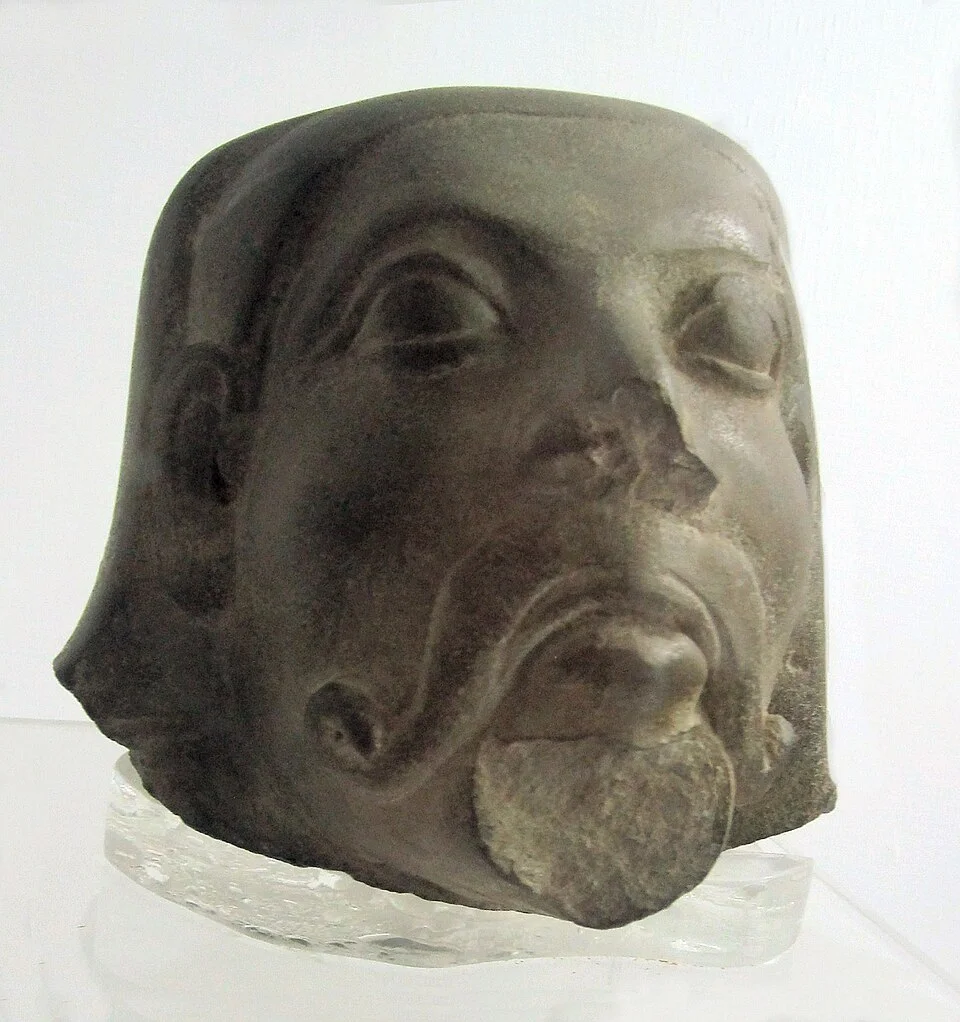
Head identified as Mauryan in the supplied metadata; attribution details are unspecified.
Credit: Jen · CC BY 3.0 · sourceResized and converted to WebP; uncropped.
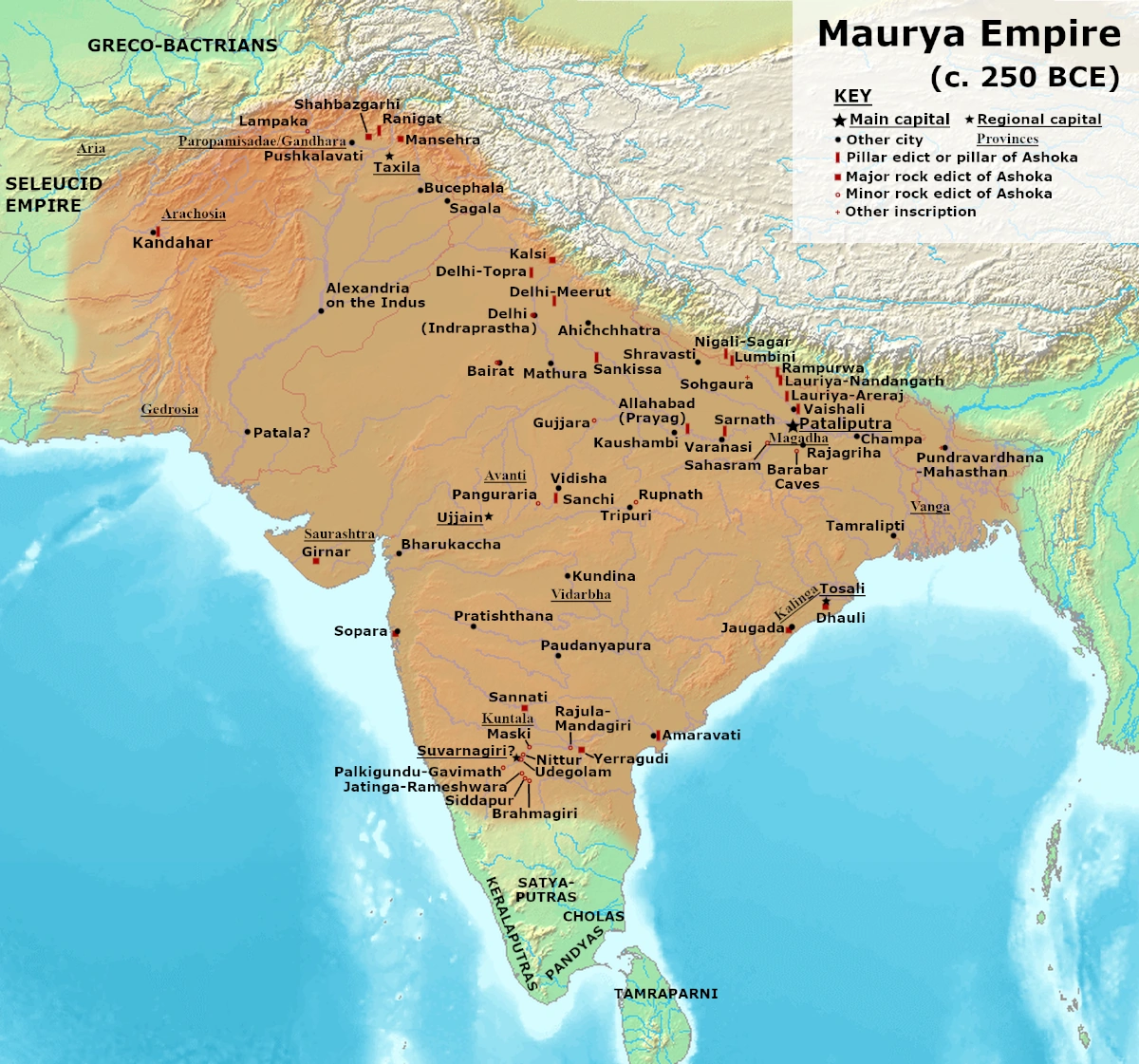
Map study
Mauryan Empire around 250 BCE during Ashoka’s reign: a date-specific historical reconstruction.
- Read the source date and legend before interpreting territorial extent.
- Compare core regions, neighbouring powers and geographic barriers; historical borders and influence are approximate and changed over time.
Credit: Avantiputra7 · CC BY-SA 3.0 · sourceConverted to WebP on an opaque white background; proportionally resized without cropping. Original cartography and legend retained.
1. Historical setting and defining features
Mauryan political consolidation created conditions for artistic production on a scale rarely seen earlier in the subcontinent. Imperial resources supported the quarrying, transport and installation of large stone monuments across widely separated regions. The richest surviving evidence belongs to Ashoka's reign, although archaeological remains at Pataliputra also illuminate the broader Mauryan architectural tradition. Art served several overlapping purposes: royal representation, the communication of dhamma, religious donation and the marking of sacred places.
A standard textbook distinction separates court art, such as pillars, capitals and palace architecture, from popular or local traditions represented by yaksha–yakshi sculptures and terracotta objects. This is a useful framework rather than a rigid classification: workshops, patrons and visual traditions could overlap. Dating is equally important. Some sculptures traditionally labelled Mauryan are now assigned by scholars to later centuries, so stylistic resemblance or a polished surface alone cannot establish a secure date.
The period did not witness the complete replacement of timber and brick by stone. Instead, these materials continued alongside ambitious stone construction. Several stone forms preserve features associated with wooden building traditions. Mauryan art thus combines technological innovation with continuity, while also showing selective connections with the wider artistic world of West and Central Asia.
Timeline
c. 322 BCE
Establishment of Mauryan rule under Chandragupta Maurya.
c. 268–232 BCE
Ashoka's reign: major expansion of pillar monuments, inscriptions and religious architectural patronage.
Late third century BCE
Dasharatha dedicates caves in the Nagarjuni hills to the Ajivikas.
Second century BCE–first century CE
Post-Mauryan enlargement and embellishment transform monuments such as Sanchi.
26 January 1950
India adopts an adaptation of the Sarnath Lion Capital as its State Emblem.
2. Ashokan pillars and animal capitals
Ashokan pillars are freestanding monuments with tall, tapering, usually monolithic sandstone shafts. Their capitals were separately carved and mounted above the shafts. Fine-grained sandstone, prominently associated with the Chunar region near Varanasi, was finished to a lustrous surface known as Mauryan polish. Not every pillar carries an inscription, and not every Ashokan inscription occurs on a pillar: many edicts were engraved on natural rock surfaces.
Important surviving capitals include the four-lion capital from Sarnath, the bull capital from Rampurva, and the single-lion capital at Lauriya Nandangarh. A typical capital arrangement includes a bell-shaped or inverted-lotus member, an abacus and a crowning animal. Lotus forms, animal imagery and wheels acquired meanings connected with authority, auspiciousness and religious teaching, although interpretations vary with context.
The Sarnath capital shows four lions seated back to back. Its circular abacus carries an elephant, a galloping horse, a bull and a lion, separated by wheels. The sculptural group originally supported a large stone wheel, fragments of which survive. India's State Emblem adapts this capital; the motto Satyameva Jayate comes from the Mundaka Upanishad and is not an Ashokan inscription on the capital. The national flag separately incorporates the 24-spoked Ashoka Chakra.
Comparison with Achaemenid Persian art is important but should not become a claim of simple copying. Polished stone, bell-shaped elements and some decorative motifs suggest cross-cultural connections. Nevertheless, Ashokan pillars differ from the generally fluted, segmented columns used within Persian architectural complexes: their shafts are usually smooth and monolithic, and they stand independently. Indian symbolism and local craftsmanship transformed these connections into a distinctive monumental language.
How to identify a Mauryan monument in an examination
- 1. Identify the site and geographical location.
- 2. Determine the material and monument type.
- 3. Check inscriptions, named donors and religious affiliation.
- 4. Separate the original structure from later additions.
- 5. Use stylistic features cautiously where dating is disputed.
3. Rock-cut caves and religious patronage
The Barabar and Nagarjuni hills near Gaya in Bihar preserve major early examples of rock-cut architecture. Excavated into hard granite, their chambers demonstrate sophisticated cutting and polishing techniques. Interiors can have exceptionally smooth surfaces and strong acoustic resonance. Some caves combine a rectangular chamber with a rounded inner space, while vaulted roofs reproduce forms familiar from buildings constructed with perishable materials.
Ashoka's inscriptions record donations of caves at Barabar to the Ajivikas, an ascetic community associated with Makkhali Gosala. His grandson Dasharatha dedicated caves in the nearby Nagarjuni hills to the same community. These records are important evidence that Mauryan royal religious patronage was not confined to Buddhist institutions.
Lomas Rishi Cave is particularly significant for its carved entrance, with an arch resembling a timber structure and a frieze of elephants approaching stupas. Its entrance anticipates the chaitya-arch motif developed in later Buddhist rock-cut architecture. Unlike some neighbouring caves, it does not have a surviving Ashokan dedication inscription; its attribution rests principally on archaeological and stylistic grounds. It should not be confused with the later pillared chaitya halls of western India.
| Site | Present-day state | Identification | Exam caution |
|---|---|---|---|
| Sarnath | Uttar Pradesh | Four-lion capital with animals and wheels on its abacus | State Emblem is an adaptation, not a reproduction of every original component |
| Rampurva | Bihar | Bull and lion capitals associated with two pillars | Do not identify the site only with its bull capital |
| Barabar | Bihar | Polished granite rock-cut caves | Ajivika patronage; not simply Buddhist monasteries |
| Sanchi | Madhya Pradesh | Great Stupa with an early brick core | Carved gateways are post-Mauryan |
| Kumrahar | Bihar | Pillared hall remains at ancient Pataliputra | Exact function remains uncertain |
| Dhauli | Odisha | Rock-cut elephant near Ashokan edicts | Elephant is carved from rock, not a surviving pillar capital |
4. Stupas and palace architecture
A stupa is fundamentally a mound-like commemorative or reliquary monument, strongly associated with Buddhism but not exclusively confined to it. Buddhist tradition credits Ashoka with distributing the Buddha's relics and constructing numerous stupas. The traditional figure of 84,000 stupas expresses the scale of his religious merit and patronage; it is not an archaeologically verified count.
The Great Stupa at Sanchi in Madhya Pradesh originated as a smaller brick monument conventionally attributed to Ashoka. Its enlargement and stone casing are associated with the post-Mauryan period, while the richly carved gateways belong broadly to the first century BCE–first century CE. Familiar stupa components include the anda or dome, harmika or square enclosure at the summit, chhatras or umbrellas, circumambulatory paths, vedika or railing, and toranas or gateways. These features should not all be assumed to have existed in their present form during Ashoka's reign.
At Pataliputra, near modern Patna, excavations at Kumrahar revealed remains of a pillared hall conventionally reconstructed as an eighty-pillared structure. Its precise function remains debated, so identifying it confidently as Ashoka's throne room would be unwarranted. Evidence from Bulandi Bagh illustrates the extensive use of timber in urban defences. Together, these remains qualify the impression that all important Mauryan architecture was built entirely of stone.
5. Sculpture, terracottas and questions of dating
Monumental yaksha and yakshi figures represent powerful male and female beings connected with protection, prosperity and fertility. They express religious traditions that were subsequently incorporated into Buddhist, Jain and Brahmanical contexts. Their substantial bodies, frontal presentation and elaborate ornaments differ from the controlled animal modelling of many imperial capitals, although both traditions contributed to later Indian sculpture.
The Parkham Yaksha near Mathura is an important example of early monumental yaksha sculpture, but its precise date is debated and it is often assigned to the post-Mauryan period. The polished Didarganj chauri-bearer from Bihar is similarly famous but chronologically disputed: although traditionally presented as Mauryan, it has also been dated considerably later. Neither sculpture should be used as an unquestioned chronological benchmark.
Terracotta figurines, including human and animal forms, provide evidence of smaller-scale production and everyday cultural life. Their materials and techniques differ from monumental court sculpture, and archaeological context is essential for dating them. At Dhauli in Odisha, the elephant carved from living rock near Ashoka's Major Rock Edicts is a particularly useful example of sculpture associated with an inscriptional landscape.
6. Prelims identification and historical significance
Mauryan art established durable forms of royal and religious communication: the inscribed pillar, the monumental animal capital and the elaborately finished rock-cut chamber. Later dynasties and religious communities expanded these traditions, but much of the narrative relief sculpture now associated with famous Buddhist sites belongs to the post-Mauryan centuries. At Bharhut and Sanchi, the most familiar decorated railings and gateways should therefore not automatically be attributed to Ashoka.
For objective questions, use combinations of evidence rather than one visual feature. Match the site with its state, the monument with its material, and the patron with the inscription or religious community. Also distinguish the ancient location of a monument from its later relocation: the Ashokan pillars brought from Topra and Meerut to Delhi by Firuz Shah Tughlaq are Mauryan objects in medieval settings.
- Pillar capitals: Sarnath—four lions; Rampurva—bull and lion capitals from two pillars; Lauriya Nandangarh—single lion.
- Caves: Barabar—Ashokan donations to Ajivikas; Nagarjuni—Dasharatha's donations to Ajivikas.
- Architecture: Sanchi—Mauryan foundation with major later additions; Kumrahar—remains of a pillared hall.
- Dating caution: Mauryan polish is a technical and stylistic clue, not an independently conclusive date.
Human Representation and the Study of Mauryan Art
The supplied title identifies this object as a Mauryan head, making it relevant to the study of human representation alongside the period’s better-known pillars and animal capitals. However, the metadata does not specify its material, findspot, collection or basis of dating. It should therefore serve as a thematic illustration, not as independently verified evidence for a particular workshop, patron or archaeological site. Nor does the title establish that it portrays a ruler, deity or ordinary person.
Mauryan art is important for the expansion of monumental stone production and its association with imperial patronage, especially under Ashoka. Yet artistic production cannot be reduced to royal monuments alone: figurative sculpture raises questions about religious practice, social audiences and relationships between courtly and other artistic traditions. Some sculptures discussed in connection with Mauryan art have contested dates or attributions. For Indian art history, securely documented archaeological context, inscriptions and comparative stylistic analysis must be assessed together; an isolated label cannot settle chronology. This distinction is particularly useful when separating Mauryan developments from post-Mauryan continuities.
- Do not identify a sculpted head as Ashoka or another ruler without supporting evidence; period attribution is not personal identification.
- Mauryan polish is a surface treatment associated with several monuments, not an infallible dating test or proof of royal patronage.
- Distinguish an object’s proposed date from its discovery context, and a monument’s Mauryan foundation from later sculptural additions.
Real-world case studies
Sanchi: one monument, several historical phases
The Great Stupa illustrates why the date of a site's foundation is not the date of every visible feature. Its Ashokan brick core was enlarged and encased in stone in later centuries, and its narrative gateways were added subsequently. A question describing the present monument as wholly Mauryan therefore overlooks its layered construction history.
Barabar and Nagarjuni: inscriptions correct visual assumptions
Rock-cut architecture is often associated with Buddhist chaityas and viharas. However, inscriptions at Barabar and Nagarjuni record royal donations to the Ajivikas. These sites demonstrate the importance of epigraphy in identifying patronage and show that an emperor's Buddhist commitments did not exclude support for other ascetic communities.
Previous year questions
No source-linked PYQ is available here yet. Use the practice questions below.
Practice questions
Practice MCQ 1
Consider the following pairs: 1. Sarnath—Four-lion capital 2. Rampurva—Bull capital 3. Dhauli—Rock-cut elephant. How many of the above pairs are correctly matched?
- A. Only one
- B. Only two
- C. All three
- D. None
Practice MCQ 2
With reference to early Indian rock-cut architecture, consider the following statements: 1. Some Barabar caves were dedicated by Ashoka to the Ajivikas. 2. Dasharatha's inscriptions record cave donations in the Nagarjuni hills. 3. Lomas Rishi is a large pillared Buddhist chaitya hall of the same type as Karla. Which statements are correct?
- A. 1 and 2 only
- B. 2 and 3 only
- C. 1 and 3 only
- D. 1, 2 and 3
Practice MCQ 3
Which of the following is the most accurate statement about Mauryan art?
- A. Every polished stone sculpture can securely be dated to the Mauryan period.
- B. The carved gateways of Sanchi's Great Stupa were all erected during Ashoka's reign.
- C. Ashokan pillar shafts were generally monolithic, while their capitals were separately carved.
- D. Mauryan monumental architecture completely abandoned timber.
Mains practice · Mauryan art combined imperial authority, religious patronage and diverse artistic traditions. Discuss with reference to pillars, caves and stupas. Answer in 250 words.
- Introduce the scale of Mauryan political consolidation and monumental patronage.
- Explain pillars as expressions of authority and, where inscribed, media for communicating dhamma.
- Discuss Sarnath's animal symbolism, polished stone and selective Achaemenid connections.
- Use Barabar and Nagarjuni to demonstrate technical achievement and Ajivika patronage.
- Explain Ashoka's association with stupa building while separating Sanchi's foundation from later embellishments.
- Mention continued timber construction and the limits of rigid court-versus-popular classifications.
- Conclude with the enduring influence of Mauryan forms without attributing later monuments entirely to the Mauryas.
Further reading
- NCERT, An Introduction to Indian Art, Part 1: Arts of the Mauryan Period.
- NCERT, Themes in Indian History, Part I: Thinkers, Beliefs and Buildings.
- Archaeological Survey of India: official information on Sarnath, Sanchi and the Barabar caves.
- UNESCO World Heritage Centre: Buddhist Monuments at Sanchi.
- National Portal of India: National Identity Elements—State Emblem and National Flag.
- Upinder Singh, A History of Ancient and Early Medieval India: From the Stone Age to the 12th Century.
- https://commons.wikimedia.org/wiki/File:Mauryan_head.jpg
Preparing for UPSC Civil Services? Get classroom teaching, answer-writing evaluation and mentorship at Pragnya IAS Academy, Ashok Nagar — see why aspirants choose us for IAS coaching in Hyderabad.