
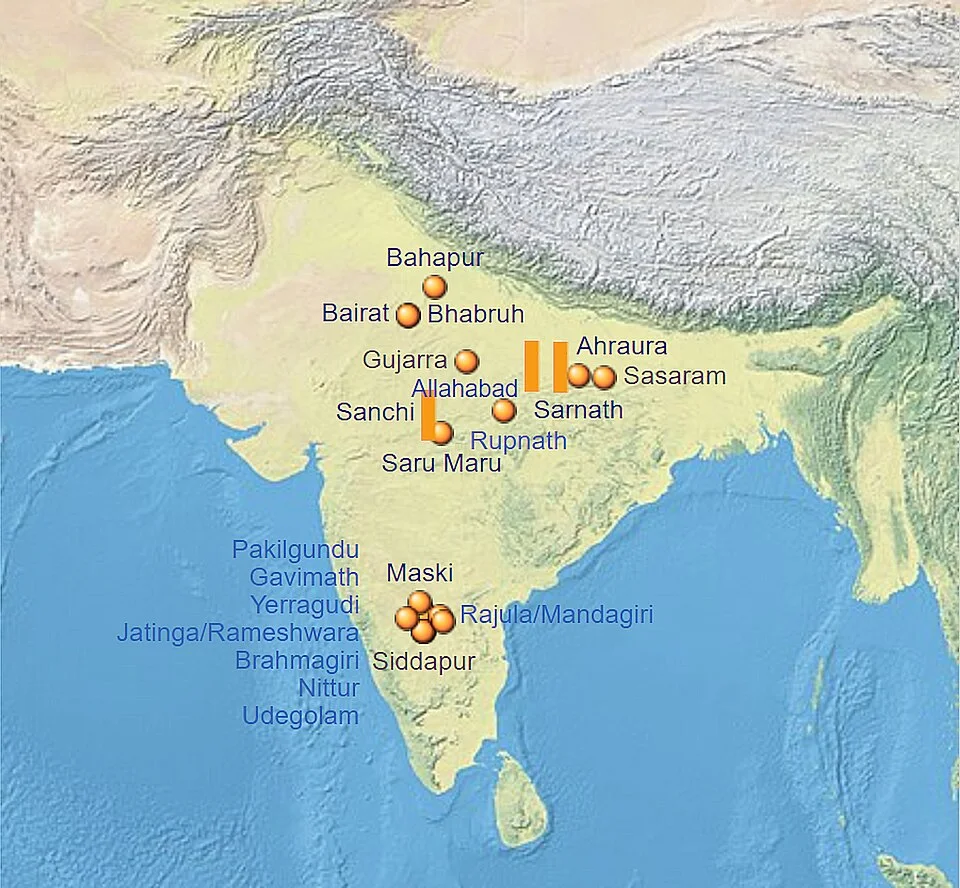
Illustrative reference to Ashoka’s Minor Rock Edicts and Minor Pillar Edicts.
Credit: Natural Earth. Free vector and raster map data @ naturalearthdata.com Own work · CC BY-SA 3.0 · sourceResized and converted to WebP; uncropped.
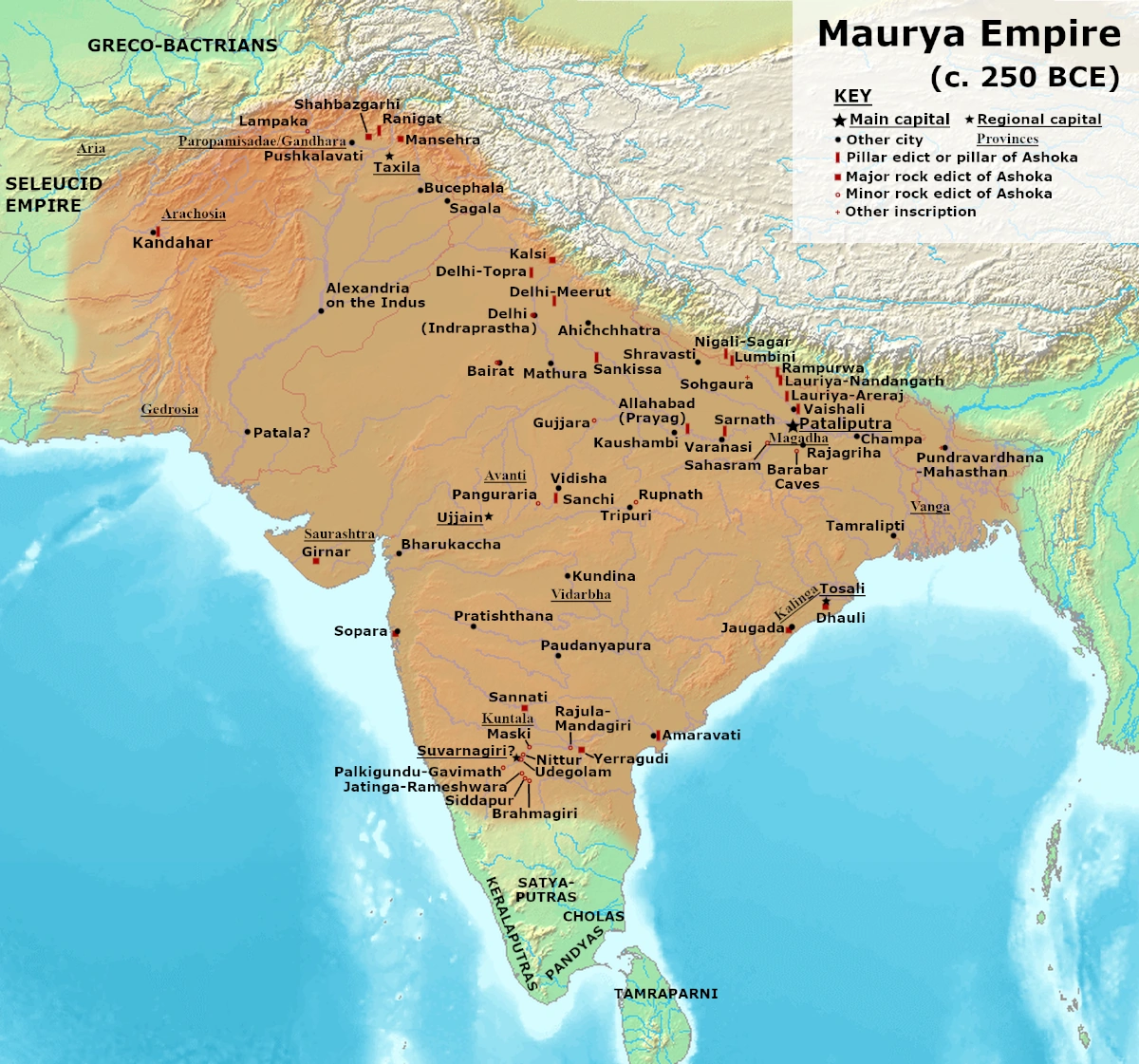
Map study
Mauryan Empire around 250 BCE during Ashoka’s reign: a date-specific historical reconstruction.
- Read the source date and legend before interpreting territorial extent.
- Compare core regions, neighbouring powers and geographic barriers; historical borders and influence are approximate and changed over time.
Credit: Avantiputra7 · CC BY-SA 3.0 · sourceConverted to WebP on an opaque white background; proportionally resized without cropping. Original cartography and legend retained.
1. Historical context and classification
Ashoka’s inscriptions are among the earliest extensive, securely dated written records of the Indian subcontinent. Unlike later literary accounts, they preserve royal statements issued during his lifetime. The pillar edicts belong to the Mauryan imperial practice of communicating policies through durable inscriptions placed along routes and at important settlements or religious locations. Their language reveals a ruler concerned with moral conduct, administrative accountability and the welfare of his subjects.
A pillar edict is defined by its inscriptional support: a stone column. It must not be confused with a rock edict, which was engraved on a natural rock surface. Modern scholars distinguish seven Major Pillar Edicts from shorter inscriptions conventionally grouped as Minor Pillar Edicts or minor pillar inscriptions. The latter include orders against divisions in the Buddhist Sangha, the Queen’s Edict and records associated with Buddhist sacred places.
Not every Ashokan pillar carries an edict, and not every surviving capital can be linked to a complete surviving inscribed shaft. Similarly, an Ashokan pillar may bear inscriptions added centuries later. Its architecture, Ashokan text and subsequent inscriptions must therefore be studied separately. The pillars demonstrate imperial communication, but their distribution alone cannot establish precise administrative boundaries.
- Major Pillar Edicts: a numbered series, I–VII, largely concerned with Dhamma and governance.
- Minor pillar inscriptions: shorter, context-specific records concerning the Sangha, donations or Buddhist commemorative visits.
- Rock edicts: a separate inscriptional category; the famous account of the Kalinga war occurs in Major Rock Edict XIII, not a pillar edict.
Timeline
Approximately 268 BCE
Beginning of Ashoka’s reign under a widely used chronology; exact accession and consecration dates vary between reconstructions.
14th and 20th regnal years
Nigali Sagar records enlargement of Konakamana’s stupa and a subsequent royal visit.
20th regnal year
Ashoka visits Lumbini; the Rummindei pillar inscription records the visit and fiscal concessions.
26th–27th regnal years
The Major Pillar Edicts record Ashoka’s mature policies concerning Dhamma and administration.
Fourteenth century CE
Firuz Shah Tughlaq relocates the Topra and Meerut pillars to Delhi.
1837
James Prinsep deciphers Brahmi.
2. Material, language, script and distribution
Ashokan pillars typically have tall, tapering, monolithic sandstone shafts with a highly finished surface associated with Mauryan polish. Many are linked to the sandstone resources and workshops of the Chunar region near Varanasi, although identical sourcing should not be assumed for every specimen. Capitals were separately fashioned and placed above the shaft. Their animal figures include lions and bulls; sculptural motifs and inscriptions are related but distinct sources of evidence.
The major pillar inscriptions use Prakrit and Brahmi. Prakrit is the language and Brahmi the script: confusing the two is a common examination error. Ashoka’s wider inscriptional corpus also includes Kharoshthi in the north-west and Greek and Aramaic texts in the Afghan region, but these features should not be indiscriminately attributed to the principal pillar-edict series.
The six principal surviving witnesses to the Major Pillar Edicts are Delhi–Topra, Delhi–Meerut, the Prayagraj or Allahabad pillar, Lauriya-Araraj, Lauriya-Nandangarh and Rampurva. The last three are in Bihar. Edicts I–VI occur across this principal group, while Edict VII is found only on Delhi–Topra. The Prayagraj pillar is often associated with an original location at Kaushambi, but its early location and movement remain debated.
Present location is not always original location. Firuz Shah Tughlaq transported the Topra and Meerut pillars to Delhi in the fourteenth century. Consequently, a modern map of surviving pillars combines Mauryan placement with later relocation. In 1837, James Prinsep deciphered Brahmi through comparative study of inscriptions, providing a foundation for reconstructing Mauryan history from contemporary records.
How to identify a pillar-edict question
- 1. Identify the inscriptional support: pillar or natural rock.
- 2. Separate Major Pillar Edicts from shorter pillar inscriptions.
- 3. Match the distinctive content with its site.
- 4. Check whether the pillar was relocated.
- 5. Separate Ashokan inscriptions from later additions.
3. What the seven Major Pillar Edicts say
The Major Pillar Edicts develop Ashoka’s understanding of Dhamma as ethical governance and responsible social behaviour. Edict I stresses rule through Dhamma and the obligations of officials. Edict II describes Dhamma through restraint from wrongdoing, good deeds, compassion, generosity, truthfulness and purity. Edict III calls for self-examination, warning that people readily notice their good actions but overlook faults such as cruelty, anger, pride and envy.
Edict IV is especially important for administrative history. It addresses the rajukas, officers placed over large populations, and gives them authority in matters of rewards and punishments. Ashoka seeks consistency in judicial procedure and punishment. It also provides a three-day respite for those sentenced to death, allowing an opportunity for appeals or religious preparation. This is evidence of an attempt to moderate punishment, not of the abolition of capital punishment.
Edict V lists protected animals and imposes restrictions on killing, mutilation and related activities on specified occasions. It also mentions releases of prisoners. Its detailed provisions demonstrate selective animal protection rather than an absolute ban on all slaughter. Edict VI reviews the emperor’s commitment to his subjects’ welfare and the communication of Dhamma.
Edict VII, the longest and latest in the series, gives a retrospective account of Dhamma measures. It discusses officials, moral instruction, attention to religious communities and welfare facilities such as shade trees, wells and resting places. Ashoka distinguishes regulation from persuasion and considers persuasion more effective in promoting Dhamma. The text thus connects moral reform with administration while recognising the limits of commands alone.
- Edicts I–VI are associated with the 26th regnal year; Edict VII records the 27th year after consecration.
- Dhamma was not simply a code of Buddhist doctrine, although Ashoka’s personal Buddhist affiliation is clear from other inscriptions.
- Rajukas and Dhamma-mahamatras should not be treated as interchangeable official categories.
| Pillar or site | Distinctive association | Examination caution |
|---|---|---|
| Delhi–Topra | Major Pillar Edicts I–VII | Originally from Topra in present-day Haryana |
| Prayagraj | Major Pillar Edicts I–VI and Queen’s Edict | Also bears later inscriptions, including Samudragupta’s prashasti |
| Sarnath | Sangha schism inscription and Lion Capital | Not the location of all seven Major Pillar Edicts |
| Lumbini or Rummindei | Buddha’s birthplace and fiscal concessions | Located in present-day Nepal |
| Nigali Sagar | Stupa of Konakamana Buddha | Distinct from the Lumbini birthplace inscription |
4. Minor pillar inscriptions and Buddhist connections
The schism-related pillar inscriptions at Sarnath, Sanchi and Kaushambi concern the unity of the Buddhist Sangha. They prescribe exclusion from the monastic community for monks or nuns who cause a schism. These records provide more explicitly Buddhist evidence than the broadly ethical language of the Major Pillar Edicts. They show royal intervention in institutional discipline, but should not be read as a comprehensive account of relations between the state and every monastery.
The Rummindei inscription at Lumbini, in present-day Nepal, records Ashoka’s visit in his twentieth regnal year because the Buddha Shakyamuni was born there. It also records fiscal concessions to the village, commonly understood as exemption from bali and reduction of the produce share to one-eighth. It is a crucial source for identifying the Buddha’s birthplace and for studying royal patronage of sacred geography.
The Nigali Sagar inscription, also in Nepal, records Ashoka’s enlargement of the stupa of the earlier Buddha Konakamana in his fourteenth regnal year and a personal visit in his twentieth. The Queen’s Edict, on the Prayagraj pillar, directs that donations made by the second queen, Karuvaki, mother of Tivara, be credited to her. It offers rare direct evidence about a named Mauryan queen and the administrative recognition of her charitable gifts.
5. Historical interpretation and Prelims distinctions
Pillar edicts reveal how Ashoka represented legitimate kingship: the ruler should be accessible, supervise officials, encourage ethical conduct and provide welfare. Their attention to judicial restraint, animal protection and religious communities makes them essential evidence for Mauryan political ideas. However, royal declarations establish intentions and prescribed measures more clearly than actual implementation. Historians must compare them with archaeology and other sources rather than assume universal compliance.
The subsequent history of the pillars is equally significant. The Prayagraj pillar carries Ashokan inscriptions, Samudragupta’s fourth-century CE prashasti and a later inscription of Jahangir. These belong to different historical periods and cannot be attributed to one ruler. At Sarnath, the Lion Capital belongs to Mauryan art, whereas the short inscription on the associated shaft concerns the Sangha. The capital does not carry the complete series of seven Major Pillar Edicts.
For revision, connect each inscription to its distinctive information rather than memorising locations alone. Delhi–Topra indicates the seventh Major Pillar Edict; Lumbini indicates birthplace and fiscal concession; Nigali Sagar indicates Konakamana’s stupa; and the Queen’s Edict indicates Karuvaki. Keep the Kalinga-war narrative and the explicit occurrence of the name Ashoka at Maski within the rock-inscription category.
Pillar Edicts: Classification and Historical Evidence
The supplied metadata identifies both Minor Rock Edicts and Minor Pillar Edicts, making this a supplementary reference rather than an illustration exclusively of pillar inscriptions. For Ashokan epigraphy, the inscribed surface and the textual category must be distinguished: a rock edict is not a pillar edict simply because both communicate royal policy. Likewise, “minor” denotes a conventional classification, not historical insignificance. Short pillar inscriptions can provide specific evidence about Buddhist institutions, sacred places and royal intervention.
The seven Major Pillar Edicts address themes including Dhamma, ethical conduct, judicial responsibility and welfare. Shorter pillar inscriptions have more particular purposes: the Lumbini inscription records Ashoka’s visit to the Buddha’s birthplace and fiscal concessions, while the schism-related inscriptions concern unity within the Buddhist Sangha. These texts help distinguish Ashoka’s broadly framed public ethic from his specific relationship with Buddhism. As royal statements, however, they establish what the ruler proclaimed or ordered more securely than how uniformly those instructions were implemented across the Mauryan realm.
- Prelims distinction: Major Pillar Edicts form a numbered series; shorter pillar inscriptions should not automatically be counted within those seven.
- Context matters: distinguish an inscription’s original setting, a pillar’s later relocation and its capital; these are related but separate evidence.
- Mains approach: use edicts to analyse kingship and governance, while testing claims about social outcomes against other literary and archaeological evidence.
Real-world case studies
Delhi–Topra: relocation and historical memory
Firuz Shah Tughlaq moved the Topra pillar to Delhi in 1356 and installed it at his palace complex, now known as Feroz Shah Kotla. Its preservation illustrates how later rulers reused ancient monuments. Its present location must not be mistaken for its original Mauryan setting.
Lumbini: epigraphy and sacred geography
The inscription on the Lumbini pillar, brought to scholarly attention in 1896, explicitly associates the place with the birth of Buddha Shakyamuni. Together with archaeological remains, it provides unusually direct evidence linking an ancient place-name, royal pilgrimage and a surviving sacred site.
Previous year questions
No source-linked PYQ is available here yet. Use the practice questions below.
Practice questions
Practice MCQ 1
Consider the following statements: 1. Major Pillar Edict VII survives only on the Delhi–Topra pillar. 2. The Sarnath pillar carries all seven Major Pillar Edicts. 3. The principal Major Pillar Edicts are in Prakrit written in Brahmi. Which statements are correct?
- A. 1 and 2 only
- B. 1 and 3 only
- C. 2 and 3 only
- D. 1, 2 and 3
Practice MCQ 2
Which of the following pairs is incorrectly matched?
- A. Rummindei inscription — Buddha’s birthplace
- B. Nigali Sagar inscription — Konakamana Buddha’s stupa
- C. Queen’s Edict — Donations of Karuvaki
- D. Major Pillar Edict IV — Narrative of the Kalinga war
Practice MCQ 3
With reference to Ashoka’s pillar inscriptions, consider the following statements: 1. They demonstrate that capital punishment was abolished. 2. Some pillars bear inscriptions added by later rulers. 3. Their animal-protection provisions necessarily imply a complete prohibition on every form of animal slaughter. Which statements are correct?
- A. 1 only
- B. 2 only
- C. 1 and 3 only
- D. 2 and 3 only
Mains practice · How do Ashoka’s pillar edicts illuminate the relationship between ethical kingship and imperial administration? Discuss their limitations as historical sources. Answer in 250 words.
- Introduce pillar edicts as contemporary royal inscriptions, distinguishing major and minor records.
- Explain Dhamma through compassion, self-restraint, truthfulness and welfare.
- Use Edict IV for rajukas, judicial consistency and the respite for condemned prisoners.
- Use Edicts V and VII for animal protection, welfare and persuasion.
- Discuss Buddhist institutional connections through schism inscriptions and pilgrimage records.
- Note their normative royal perspective, uneven survival, relocation and limited evidence of implementation.
Further reading
- NCERT, Themes in Indian History, Part I: Kings, Farmers and Towns.
- Upinder Singh, A History of Ancient and Early Medieval India: From the Stone Age to the 12th Century.
- Romila Thapar, Asoka and the Decline of the Mauryas.
- E. Hultzsch, Inscriptions of Asoka, Corpus Inscriptionum Indicarum, Volume I.
- Archaeological Survey of India: Sarnath Museum and Feroz Shah Kotla resources.
- UNESCO World Heritage Centre: Lumbini, the Birthplace of the Lord Buddha.
- https://commons.wikimedia.org/wiki/File:Minor_Rock_Edicts_and_Minor_Pillar_Edicts_of_Ashoka.jpg
Preparing for UPSC Civil Services? Get classroom teaching, answer-writing evaluation and mentorship at Pragnya IAS Academy, Ashok Nagar — see why aspirants choose us for IAS coaching in Hyderabad.