
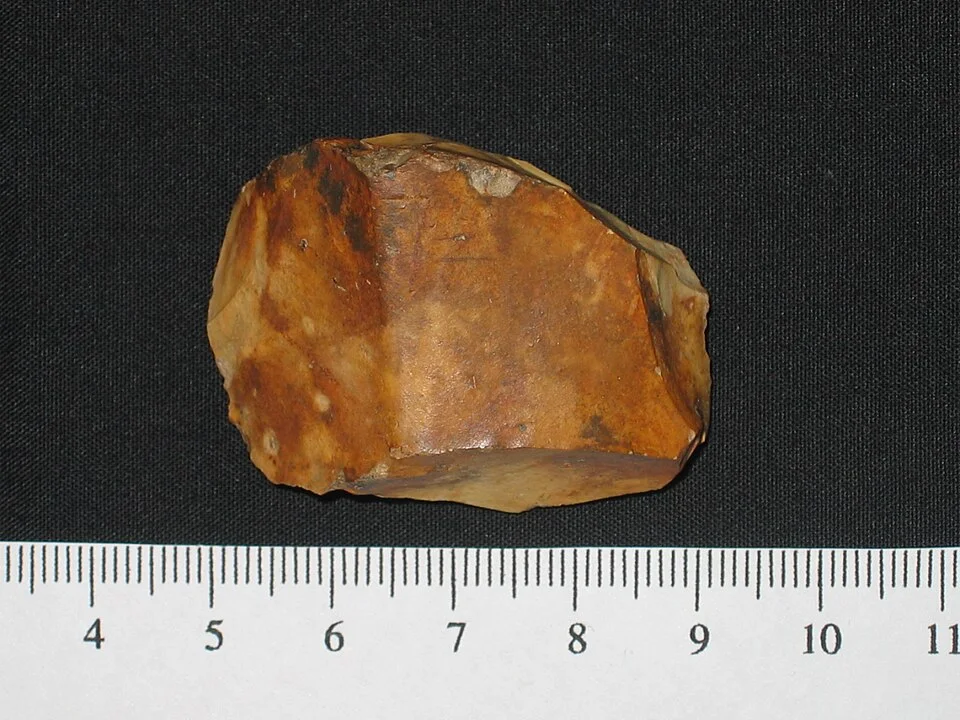
Stone axe fragment catalogued as Neolithic; a comparative illustration, not evidence from an identified Indian site.
Credit: Bristol City Council, Kurt Adams, 2005-12-02 16:40:55 · CC BY-SA 2.0 · sourceResized and converted to WebP; uncropped.
1. Meaning, chronology and archaeological identification
The Neolithic is an archaeological designation for communities commonly associated with food production and ground or polished stone tools. Its broader significance lies in changing relationships between humans, plants, animals and landscapes. The expression Neolithic Revolution, popularised by V. Gordon Childe, highlights the importance of these changes. However, archaeology shows that they usually unfolded gradually rather than through one sudden event.
There is no single beginning or ending date for the Neolithic across the Indian subcontinent. Mehrgarh’s early farming settlement began around the seventh millennium BCE, whereas many well-known Neolithic settlements in Kashmir and peninsular India developed several millennia later. Neolithic practices also overlapped with Chalcolithic cultures, which used copper alongside stone. Consequently, a date assigned to one region should not be applied automatically to another.
Identification depends on a combination of evidence: plant remains, animal bones, grinding equipment, stone tools, houses, storage facilities and settlement patterns. Pottery is frequent but not essential, as aceramic Neolithic settlements demonstrate. Similarly, polished axes alone cannot establish that a community practised agriculture. Microliths and other chipped-stone implements continued alongside newer tool forms, making the transition from Mesolithic lifeways a complex process.
- Relative chronology uses stratigraphy and artefact sequences; radiocarbon dating helps establish calendar chronologies.
- Dates vary between excavations and publications; broad regional sequences are generally more useful for Prelims than disputed first-occurrence claims.
Timeline
Around 7000 BCE
Early agricultural occupation at Mehrgarh begins, including an aceramic phase.
From around 3000 BCE
Neolithic occupation develops at major Kashmir sites such as Burzahom; site chronologies vary.
Broadly 3000–1200 BCE
Southern Neolithic traditions develop and change, including cattle keeping, cultivation and ash-mound formation.
Second millennium BCE onward, varying regionally
Many regional sequences show increasing interaction with metal-using traditions; there is no uniform subcontinental end to the Neolithic.
2. North-western and Kashmir cultures
Mehrgarh lies near the Bolan Pass on the Kachi Plain in present-day Pakistan. Excavations revealed mud-brick buildings, storage arrangements, burials and evidence of early farming and herding. Wheat and barley formed important components of cultivation, while sheep, goats and cattle became central to animal management. Its earliest phase lacked pottery. Later phases show pottery production and expanding craft activities, illustrating change within a long-lived settlement rather than an unchanging Neolithic village.
Mehrgarh is important for understanding the background to agricultural village life in the north-west and, ultimately, the wider setting in which the Indus civilisation emerged. Yet the mature Harappan urban system should not be treated as an immediate or inevitable outcome of this settlement. Beads and non-local materials indicate exchange connections, while burial practices provide evidence for ritual life and differences between individuals.
In Kashmir, Burzahom and Gufkral represent adaptations to a temperate valley environment. Burzahom, near Srinagar, is known for subterranean or semi-subterranean dwelling pits, followed by above-ground structures in later phases. Stone and bone tools, cultivation, animal husbandry, hunting and fishing formed parts of its archaeological record. Some burials show associations between humans and animals, including dogs; this does not mean that every individual was buried with a dog. Gufkral also yielded evidence of pit occupation and food-producing activities.
- Mehrgarh: Balochistan; early farming, mud-brick structures and an aceramic phase.
- Burzahom: Kashmir; pit dwellings, bone tools and distinctive burial practices.
How archaeologists investigate Neolithic livelihoods
- 1. Establish stratigraphy and recover material from secure contexts.
- 2. Date occupation using suitable samples and chronological methods.
- 3. Identify crops, wild plants and animal species.
- 4. Examine domestication indicators, tools, houses and storage features.
- 5. Reconstruct regional livelihoods while testing alternative interpretations.
3. Ganga Valley, eastern India and the north-east
The middle Ganga region and adjoining Vindhyan landscapes supported a varied transition towards food production. Koldihwa and Mahagara, in the Belan Valley of Uttar Pradesh, are important for studying cultivation and cattle keeping. Mahagara has yielded evidence interpreted as a cattle enclosure. Chirand, near the confluence of the Ghaghara and Ganga in Bihar, is associated with Neolithic occupation, abundant bone tools and a subsistence economy drawing on both cultivated and wild resources.
Rice is particularly important in discussions of this region. Early rice remains have been reported from Koldihwa and Lahuradewa, the latter in Uttar Pradesh. However, the chronology of rice use and the identification of fully domesticated rice require caution. The presence of rice grains or impressions does not automatically demonstrate domestication: archaeologists consider plant morphology, archaeological context and direct dating. Claims identifying the earliest rice cultivation should therefore be distinguished from securely established regional patterns.
Eastern and north-eastern evidence further challenges the idea of a uniform Neolithic package. Daojali Hading in Assam is noted for shouldered stone tools and cord-impressed pottery. Sarutaru is another important Assam site. These assemblages invite comparison with neighbouring regions, including Southeast Asia, but similarities alone do not prove a particular migration. Agricultural systems, mobility and chronology must be assessed through local evidence rather than inferred solely from tool shapes.
- Chirand is in Bihar; Koldihwa and Mahagara are in Uttar Pradesh.
- Daojali Hading is in Assam, not in the Kashmir Valley or the southern ash-mound zone.
| Region | Representative sites | Distinctive evidence |
|---|---|---|
| North-west | Mehrgarh | Early wheat–barley farming, herding, mud-brick buildings, aceramic phase |
| Kashmir | Burzahom, Gufkral | Pit dwellings, bone tools, mixed subsistence |
| Belan and middle Ganga regions | Koldihwa, Mahagara, Chirand | Rice-related evidence, cattle keeping, bone tools at Chirand |
| North-east | Daojali Hading, Sarutaru | Shouldered tools and cord-impressed pottery in regional assemblages |
| Southern plateau | Utnur, Budihal, Sanganakallu-Kupgal | Cattle management, ash mounds at selected sites, stone-tool production |
4. Southern Neolithic and the ash-mound tradition
The southern Neolithic developed prominently during the third and second millennia BCE across parts of present-day Karnataka, Telangana and Andhra Pradesh. Important sites include Sanganakallu-Kupgal, Piklihal, Tekkalakota, Budihal and Utnur. Settlements occupied diverse settings, including granite hills and nearby plains. Archaeological remains include polished stone axes, grinding stones, handmade pottery, houses and evidence of cattle keeping.
Ash mounds are a distinctive feature of parts of this cultural landscape. Sites such as Utnur in Telangana and Budihal in Karnataka contain large accumulations associated with repeated burning of cattle dung. Their formation indicates intensive cattle management and organised use of particular locations. Whether burning was primarily practical, ceremonial or a combination of both remains debated. Ash mounds should not be confused with volcanic deposits or automatically identified as industrial furnaces.
Southern communities combined herding with cultivation and the collection of wild resources. Archaeobotanical evidence from different sites includes small millets and pulses, though crop combinations changed across locations and periods. They should not be imagined as exclusively pastoral. At Sanganakallu-Kupgal, evidence of stone-tool production illustrates craft organisation and movement of materials. Connections between settlements, grazing grounds and production areas reveal a landscape shaped by both mobility and increasingly durable occupation.
- Cattle, polished axes and ash mounds are high-value associations for southern Neolithic questions.
- Do not project every crop known from later peninsular agriculture into the earliest Neolithic layers.
5. Economy, society and historical significance
Food production could support population growth, longer occupation of settlements and greater investment in houses, storage and equipment. Grinding stones and sickle-related implements illuminate food processing and harvesting, while pottery could serve cooking and storage needs. Nevertheless, settled residence sometimes preceded full agricultural dependence, and cultivators often continued hunting, fishing and gathering. Farming and sedentism are related developments, not interchangeable terms.
House plans, burials and craft remains help reconstruct social organisation, but they rarely justify confident claims about political institutions or religious doctrines. Figurines cannot automatically be labelled mother goddesses, and grave goods alone do not establish a rigid class system. Labour coordination, household production, exchange and ritual activity are more defensible interpretations when supported by several kinds of evidence.
The Neolithic helped establish durable village economies and transformed human environments through clearance, cultivation and grazing. Its historical importance lies in these cumulative changes, not in a predetermined march towards cities. For examination purposes, compare regional combinations of livelihood, technology and settlement. Avoid absolute statements that all Neolithic people used pottery, lived permanently in villages, cultivated identical crops or stopped exploiting wild foods.
- Aceramic does not mean pre-agricultural.
- Neolithic does not mean urban; Chalcolithic does not mean stone tools disappeared.
Polished Stone Axes: Technology and Evidence
The supplied metadata identifies this object as a Neolithic polished stone axe fragment. It provides a relevant comparative example of a technology commonly associated with Neolithic cultures, but does not establish an Indian provenance. Grinding and polishing could shape durable working edges, while axes were potentially useful for woodworking and vegetation clearance. However, a fragment’s classification alone cannot establish its particular use: functional interpretation requires evidence such as microscopic wear, residues and archaeological context.
In the Indian subcontinent, ground and polished stone tools belong within a broader, regionally variable record of cultivation, animal husbandry and settlement. Kashmir’s pit dwellings and southern India’s cattle-related ash mounds illustrate why Neolithic cultures should not be reduced to a single tool type or uniform lifestyle. The metadata also lists objects assigned to several periods, from the Mesolithic to the Bronze Age. Such a catalogue grouping does not demonstrate that all the implements were made or used together. Secure stratigraphy, associated finds and independent dating are essential for reconstructing chronology.
- Prelims distinction: polished axes are characteristic Neolithic artefacts, but their presence alone does not prove agriculture, pottery production or permanent settlement.
- Evidence limit: a mixed-period assemblage cannot automatically be treated as one contemporary occupation or a continuous cultural sequence.
- Mains application: explain Indian Neolithisation through regional combinations of subsistence, technology and settlement; use this fragment only as a technological comparison, not Indian archaeological evidence.
Real-world case studies
Mehrgarh: farming without pottery
Mehrgarh’s earliest occupation combines evidence of farming and herding with mud-brick construction but lacks pottery. It demonstrates why a checklist approach is misleading: ceramic technology was not a prerequisite for agricultural village life. Later developments at the site also show that technological and economic changes occurred at different rates.
Budihal: interpreting an ash-mound landscape
Excavations at Budihal in Karnataka linked an ash mound with settlement and cattle-related activities. Burnt dung deposits help reconstruct livestock management and repeated use of space. Their precise social meaning remains interpretive, illustrating the distinction between identifying archaeological material and explaining the intentions behind its deposition.
Previous year questions
No source-linked PYQ is available here yet. Use the practice questions below.
Practice questions
Practice MCQ 1
Consider the following pairs: 1. Mehrgarh — Aceramic early farming settlement 2. Burzahom — Pit dwellings 3. Daojali Hading — Southern Indian cattle-dung ash mounds. How many pairs are correctly matched?
- A. Only one
- B. Only two
- C. All three
- D. None
Practice MCQ 2
With reference to Neolithic cultures, consider the following statements: 1. Pottery was indispensable to the earliest farming communities. 2. Hunting and gathering could continue alongside cultivation. 3. Ground and polished stone tools could coexist with chipped-stone tools. Which statements are correct?
- A. 1 and 2 only
- B. 2 and 3 only
- C. 1 and 3 only
- D. 1, 2 and 3
Practice MCQ 3
Which statement best explains the significance of ash mounds at several southern Neolithic sites?
- A. They establish widespread iron smelting during the earliest Neolithic phase.
- B. They are natural volcanic deposits used to date all peninsular settlements.
- C. They are associated with repeated burning of cattle dung and illuminate livestock management.
- D. They prove that their inhabitants neither cultivated plants nor gathered wild foods.
Mains practice · The Neolithic in the Indian subcontinent was a mosaic of regional adaptations rather than a uniform revolution. Discuss with archaeological examples. (250 words)
- Define the Neolithic through a combination of livelihood, technology and settlement evidence.
- Contrast Mehrgarh’s early farming with Kashmir’s pit-dwelling settlements.
- Discuss the Belan–Ganga region, rice-related evidence and the caution required in identifying domestication.
- Use Daojali Hading to illustrate north-eastern distinctiveness.
- Explain southern cattle keeping, cultivation and ash mounds.
- Conclude with chronological variation, continuing wild-resource use and overlap with metal-using cultures.
Further reading
- NCERT, Our Pasts–I, chapter From Hunting–Gathering to Growing Food.
- R. S. Sharma, India’s Ancient Past, chapters on the Stone Age and early farming cultures.
- Upinder Singh, A History of Ancient and Early Medieval India, chapters on prehistoric cultures and the transition to food production.
- Archaeological Survey of India, Indian Archaeology—A Review, relevant excavation reports.
- UNESCO World Heritage Centre, tentative-list documentation for The Neolithic Settlement of Burzahom.
- https://commons.wikimedia.org/wiki/File:773_Neolithic_polished_stone_axe_fragment_(FindID_114972).jpg
Preparing for UPSC Civil Services? Get classroom teaching, answer-writing evaluation and mentorship at Pragnya IAS Academy, Ashok Nagar — see why aspirants choose us for IAS coaching in Hyderabad.