
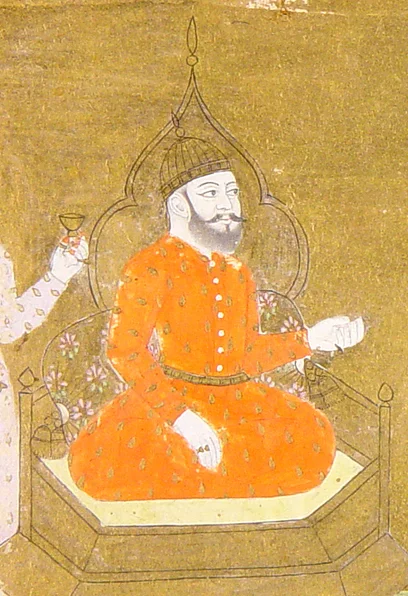
Portrait identified as Muhammad bin Tughlaq; metadata describes an Early Mughal-style painting.
Credit: Unknown authorUnknown author · Public domain · sourceResized and converted to WebP; uncropped.
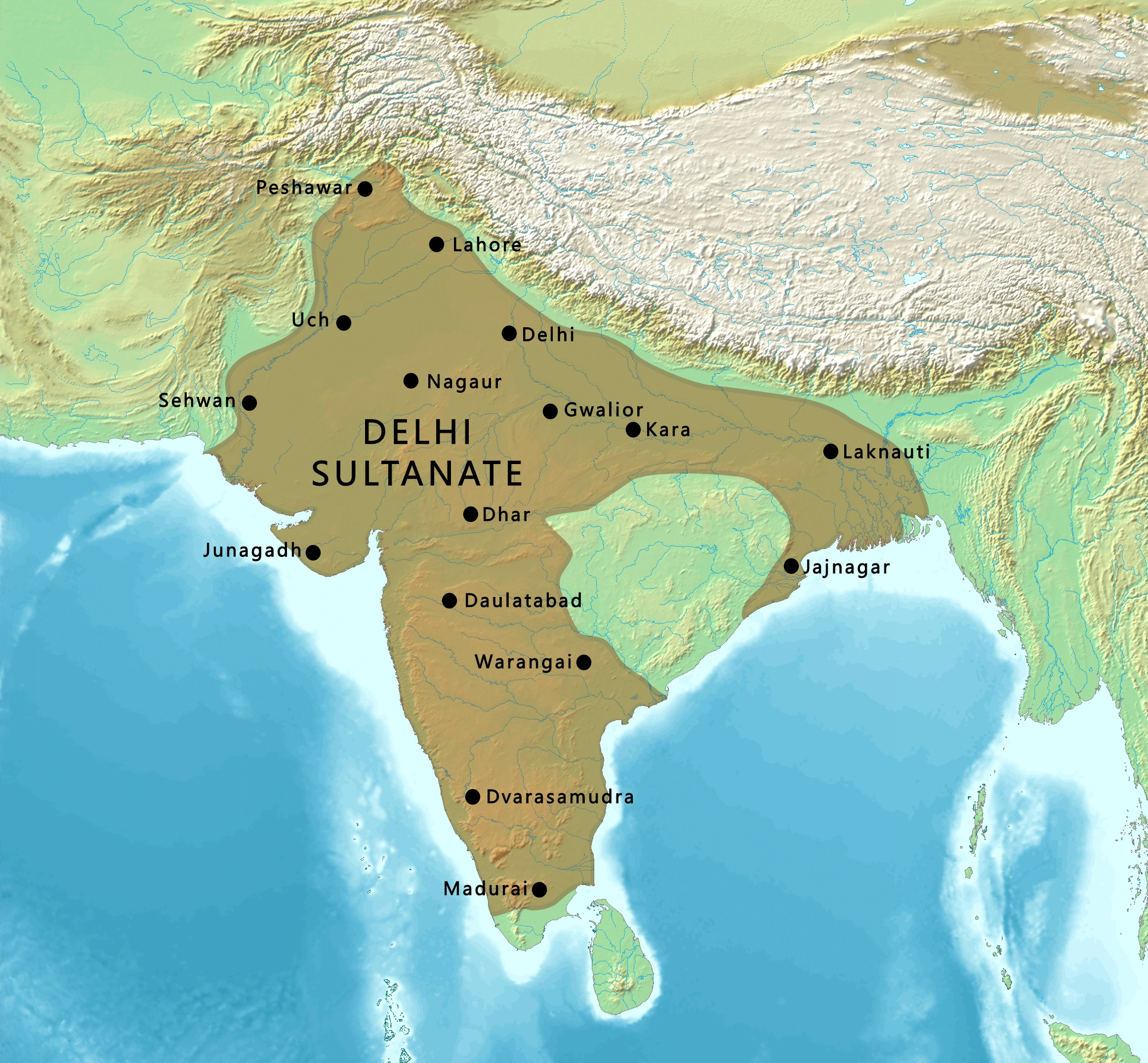
Map study
Delhi Sultanate territorial overview: regional orientation, not the exact boundary of every Sultan’s reign.
- Read the source date and legend before interpreting territorial extent.
- Compare core regions, neighbouring powers and geographic barriers; historical borders and influence are approximate and changed over time.
Credit: Koba-chan; DEMIS base map · CC BY-SA 3.0 · sourceConverted to WebP on an opaque white background; proportionally resized without cropping. Original cartography and legend retained.
1. Accession, territory and historical sources
Muhammad bin Tughlaq succeeded his father, Ghiyasuddin Tughlaq, in 1325. Before accession, as Ulugh Khan, he had led campaigns in the Deccan, including the conquest of Warangal in 1323. His father died when a wooden pavilion collapsed at Afghanpur near Delhi. Some contemporary narratives insinuate the prince’s involvement, but this is not established beyond dispute. An examination answer should distinguish reported suspicion from demonstrated historical fact.
The Sultan inherited an extensive empire linking northern India with territories in the Deccan. Maintaining this territorial reach required reliable communications, revenue collection and the cooperation of provincial governors. Long distances, uneven agrarian resources and the costs of military occupation created structural difficulties. His reign should therefore be studied as an effort to govern an overstretched empire, rather than merely as a catalogue of eccentric decisions.
Ziyauddin Barani’s Tarikh-i-Firuz Shahi provides important accounts of the reign but reflects the author’s aristocratic and moral concerns. Isami’s Futuh-us-Salatin is particularly critical of the Sultan and records the hardships associated with migration to the Deccan. Ibn Battuta, who reached India in 1333–34 and served as a qazi, describes court life in the Rihla. These sources are invaluable but differ in proximity, perspective and reliability.
- Muhammad bin Tughlaq was the second Tughlaq ruler; he did not found the dynasty.
- His learning included interests in philosophy, logic and mathematics, but intellectual ability did not ensure administrative success.
Timeline
1323
Ulugh Khan, the future Muhammad bin Tughlaq, conquers Warangal.
1325
Muhammad bin Tughlaq succeeds Ghiyasuddin Tughlaq.
Around 1327
Transfer of the court and sections of Delhi’s population towards Daulatabad.
Around 1329–30
Introduction of copper or brass token currency.
1333–34
Ibn Battuta reaches India and subsequently enters the Sultan’s service.
1336 and 1347
Emergence of Vijayanagara and foundation of the Bahmani kingdom respectively.
1351
Death near Thatta; accession of Firuz Shah Tughlaq.
2. Capital transfer: Delhi and Daulatabad
Around 1327, Muhammad bin Tughlaq ordered the movement of the court and a substantial section of Delhi’s elite to Devagiri, renamed Daulatabad. Its position in the Deccan offered a base for supervising southern territories and integrating them more closely with the Sultanate. Greater distance from the north-western frontier also offered a strategic advantage, although no single explanation fully accounts for the policy.
The Sultan developed facilities along the route, but the compulsory movement imposed severe hardship. Travelling a long distance disrupted households, livelihoods and established urban institutions. Daulatabad’s location helped southern administration but made direct supervision of northern India more difficult. The experience demonstrated that a geographically attractive centre was not necessarily the best administrative capital for every region of a large empire.
The policy was modified, and people were eventually permitted to return to Delhi. It is misleading to imagine that Delhi permanently ceased to function or that every inhabitant was successfully removed. Nevertheless, the migration had lasting consequences: scholars, administrators and Sufis strengthened connections between northern India and the Deccan. Thus, immediate administrative failure coexisted with longer-term cultural and institutional exchange.
- Prelims distinction: Devagiri and Daulatabad refer to the same place in this context.
- Avoid treating the capital transfer as either wholly irrational or an unqualified success.
How the token-currency experiment broke down
- 1. Base-metal tokens assigned the legal value of silver currency
- 2. Inadequate control enables counterfeiting
- 3. Unauthorised coins enter payments and revenue collection
- 4. Confidence declines and precious-metal money is withheld
- 5. Withdrawal and redemption impose costs on the treasury
3. Token currency and the problem of public confidence
Around 1329–30, the Sultan introduced copper or brass token coins intended to circulate at the value of silver currency. Their legal value exceeded their intrinsic metal value. The experiment is often connected with fiscal pressure and the need to expand monetary resources, although historians debate the relative importance of these motives. Earlier experiments with non-precious currency in China and Iran provide a comparative background, not proof of an identical design.
Token money depends on acceptance of the issuing authority and effective control over production. According to contemporary accounts, widespread counterfeiting undermined the experiment. Unauthorised coins could be used in transactions and revenue payments, while valuable metal coins tended to disappear from circulation. The administration lacked sufficiently effective safeguards to distinguish and suppress counterfeit issues on the required scale.
The Sultan withdrew the token currency and offered redemption in precious-metal money, imposing a substantial fiscal burden. The episode illustrates a monetary principle: money need not derive its value from its metal content, but fiduciary currency requires credible institutions. The failure therefore does not show that token currency was inherently impossible; it shows that the institutional conditions supporting it were inadequate.
- Do not describe this as the introduction of paper currency in India.
- Muhammad bin Tughlaq also issued sophisticated gold and silver coinage; the failed token issue was only one part of his monetary activity.
| Policy | Principal objective | Major limitation |
|---|---|---|
| Daulatabad transfer | Closer supervision of the Deccan | Coercive migration and difficulties in governing the north |
| Token currency | Expand monetary resources | Counterfeiting and loss of confidence |
| Doab taxation | Increase revenue | Harsh collection during agrarian distress |
| Diwan-i-Kohi | Extend and improve cultivation | Weak supervision and poor investment outcomes |
| Khurasan preparations | Projected territorial expansion | Costly mobilisation followed by abandonment |
4. Doab taxation and agricultural development
The Ganga–Yamuna Doab was a fertile and strategically important revenue region. Muhammad bin Tughlaq increased fiscal demands there, but assessment and collection became particularly oppressive during scarcity and famine. Harsh enforcement, the flight of cultivators and rural resistance damaged cultivation and ultimately reduced the state’s ability to obtain revenue. Precise numerical claims about the tax increase should be treated cautiously because the surviving narratives do not support a universally accepted rate.
The Sultan also attempted relief and agrarian rehabilitation through loans, assistance for cultivation and measures to improve water availability. His government created the Diwan-i-Kohi, a department intended to extend cultivation and improve agricultural production. The programme sought to bring land under cultivation and encourage better crops through state investment. It reveals an interventionist conception of government extending beyond the simple extraction of land revenue.
Results fell short of expectations because of unsuitable selections, weak supervision, corruption and the limited time available for returns on investment. These policies should be assessed separately: heavier taxation in the Doab was a revenue-extraction measure, whereas Diwan-i-Kohi represented agricultural development. Together they expose the tension between immediate fiscal needs and the long-term productive capacity of the countryside.
- Key term: Doab means land between two rivers; here it denotes the Ganga–Yamuna interfluve.
- Do not confuse Muhammad bin Tughlaq’s agricultural department with Firuz Shah Tughlaq’s better-known canal-building works.
5. Military ambitions, rebellions and historical assessment
The Sultan prepared a large army for a projected expedition to Khurasan, but the plan was abandoned as political circumstances changed. Maintaining troops for an unrealised campaign strained resources. The Qarachil expedition, usually placed in the Himalayan region, suffered disastrous losses during withdrawal. Its precise geographical identification is debated; it should not simply be labelled a successful invasion of China.
Provincial rebellions progressively weakened central authority. Bengal escaped effective Delhi control during his reign, while southern resistance undermined Sultanate rule in the peninsula. Vijayanagara emerged in 1336, and the Bahmani kingdom was founded in 1347. These developments reflected local political consolidation as well as Delhi’s difficulties in maintaining distant conquests. Muhammad died near Thatta in 1351 and was succeeded by Firuz Shah Tughlaq.
A balanced assessment avoids both the label of a purely irrational ruler and the claim that all his projects were sound ideas defeated only by bad luck. Several objectives were intelligible: improving imperial integration, enlarging monetary resources and extending cultivation. Yet coercion, unrealistic assessments, simultaneous commitments and inadequate administrative safeguards repeatedly undermined them. His reign is a strong example of the relationship between policy design, implementation capacity and political legitimacy.
- UPSC focus: match each experiment with its objective, implementation problem and consequence.
- The Delhi Sultanate contracted during his reign, but it did not end in 1351.
Muhammad bin Tughlaq: Representation and Historical Evidence
The supplied metadata identifies this painting as a portrait of Muhammad bin Tughlaq and assigns it an Early Mughal style. That attribution places its artistic context after his fourteenth-century reign, so it should be treated as a retrospective representation rather than a verified contemporary likeness. Its described courtly setting cannot independently establish the Sultan’s appearance, personal habits or actual court arrangements. It illustrates his later representation, not direct evidence for his administrative experiments.
For understanding his rule, distinguish policy objectives from implementation and outcomes. Daulatabad offered a strategic location for closer engagement with the Deccan, while token currency sought to make base-metal coins circulate at an officially assigned value. Neither experiment is adequately explained by simply labelling the ruler irrational. Their difficulties reveal the importance of administrative capacity, enforceability and public acceptance. Written accounts also require scrutiny: authors’ positions, purposes and access to information shaped their assessments. A later portrait and a narrative chronicle therefore answer different historical questions.
- Prelims distinction: Muhammad bin Tughlaq introduced token currency; do not confuse his experiments with Alauddin Khalji’s market regulations.
- Mains approach: assess strategic rationale, implementation and consequences separately; ambitious objectives do not establish successful governance.
- Evidence limit: a later artistic attribution supports discussion of historical memory, not conclusions about religious practice, court demographics or policy outcomes.
Real-world case studies
Daulatabad: policy reversal with lasting consequences
Although compulsory migration failed to establish a satisfactory replacement for Delhi, the movement of administrators, scholars and Sufis strengthened Indo-Islamic networks in the Deccan. The episode shows why administrative outcomes and long-term cultural effects must be evaluated separately.
Ibn Battuta: an eyewitness inside the court
The Moroccan traveller served as a qazi and was later appointed to an embassy intended for China. His Rihla records the Sultan’s generosity alongside severe punishments. It is an important corrective to one-dimensional portrayals, but personal experiences and reported anecdotes still require corroboration.
Previous year questions
No source-linked PYQ is available here yet. Use the practice questions below.
Practice questions
Practice MCQ 1
With reference to Muhammad bin Tughlaq, consider the following statements: 1. Diwan-i-Kohi was associated with agricultural development. 2. His token-currency experiment involved paper notes. 3. Ibn Battuta served as a qazi under him. Which of the statements given above are correct?
- A. 1 and 2 only
- B. 1 and 3 only
- C. 2 and 3 only
- D. 1, 2 and 3
Practice MCQ 2
Which one of the following best explains the failure of Muhammad bin Tughlaq’s token currency?
- A. Token money cannot function without full intrinsic metal value.
- B. The Sultan prohibited its use for all state payments.
- C. Counterfeiting and inadequate issuing controls undermined acceptance.
- D. India had no monetary transactions before his reign.
Practice MCQ 3
Which of the following occurred during Muhammad bin Tughlaq’s reign? 1. Foundation of the Bahmani kingdom 2. Emergence of Vijayanagara 3. First Battle of Panipat Select the correct answer.
- A. 1 only
- B. 2 and 3 only
- C. 1 and 2 only
- D. 1, 2 and 3
Mains practice · Muhammad bin Tughlaq’s experiments reveal both ambitious statecraft and the limitations of medieval administrative capacity. Discuss. (250 words)
- Introduce the territorial scale and fiscal demands of his empire.
- Explain the strategic reasoning behind Daulatabad and the institutional requirements of token currency.
- Distinguish Doab revenue extraction from agricultural development under Diwan-i-Kohi.
- Assess coercion, weak supervision, counterfeiting, famine and excessive commitments.
- Discuss provincial resistance and enduring north–Deccan connections.
- Conclude with a balanced judgement on policy objectives, design and implementation.
Further reading
- NCERT, Our Pasts–II, chapter on the Delhi Sultans.
- Satish Chandra, Medieval India: From Sultanat to the Mughals, Part One.
- Peter Jackson, The Delhi Sultanate: A Political and Military History.
- Ibn Battuta, The Travels of Ibn Battuta, translated by H. A. R. Gibb.
- Archaeological Survey of India: information on Daulatabad Fort.
- https://commons.wikimedia.org/wiki/File:Muhammad_bin_Tughlaq_crop.jpg
Preparing for UPSC Civil Services? Get classroom teaching, answer-writing evaluation and mentorship at Pragnya IAS Academy, Ashok Nagar — see why aspirants choose us for IAS coaching in Hyderabad.