
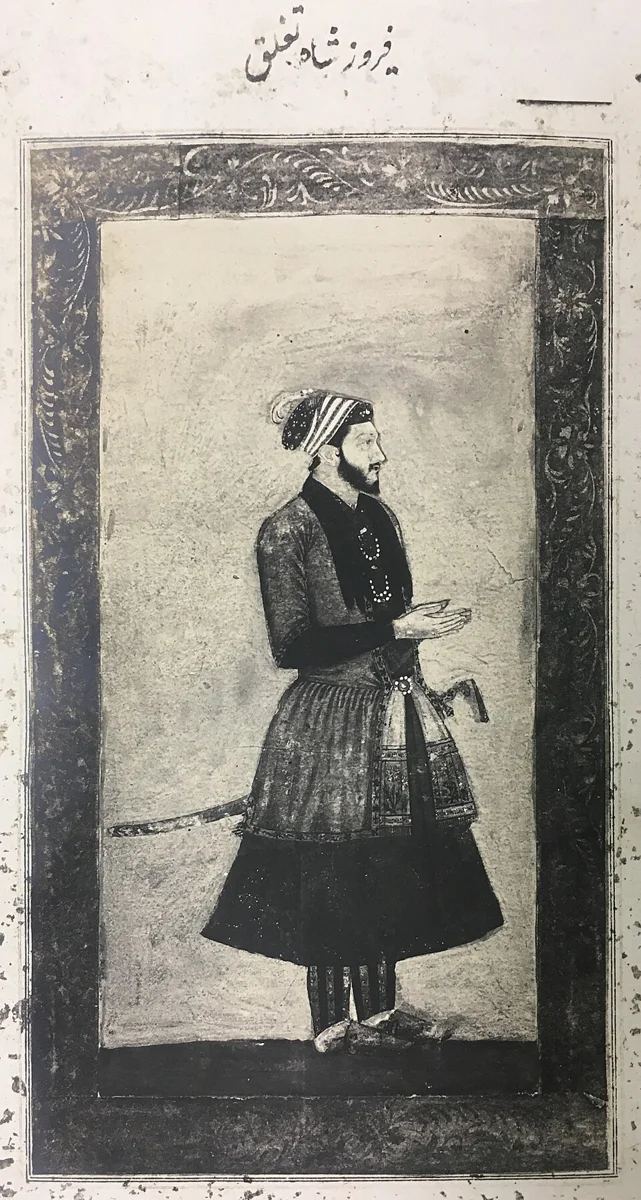
Representation identified in the supplied metadata as Firoz Shah Tughlaq, Sultan of Delhi.
Credit: Unknown authorUnknown author · Public domain · sourceResized and converted to WebP; uncropped.
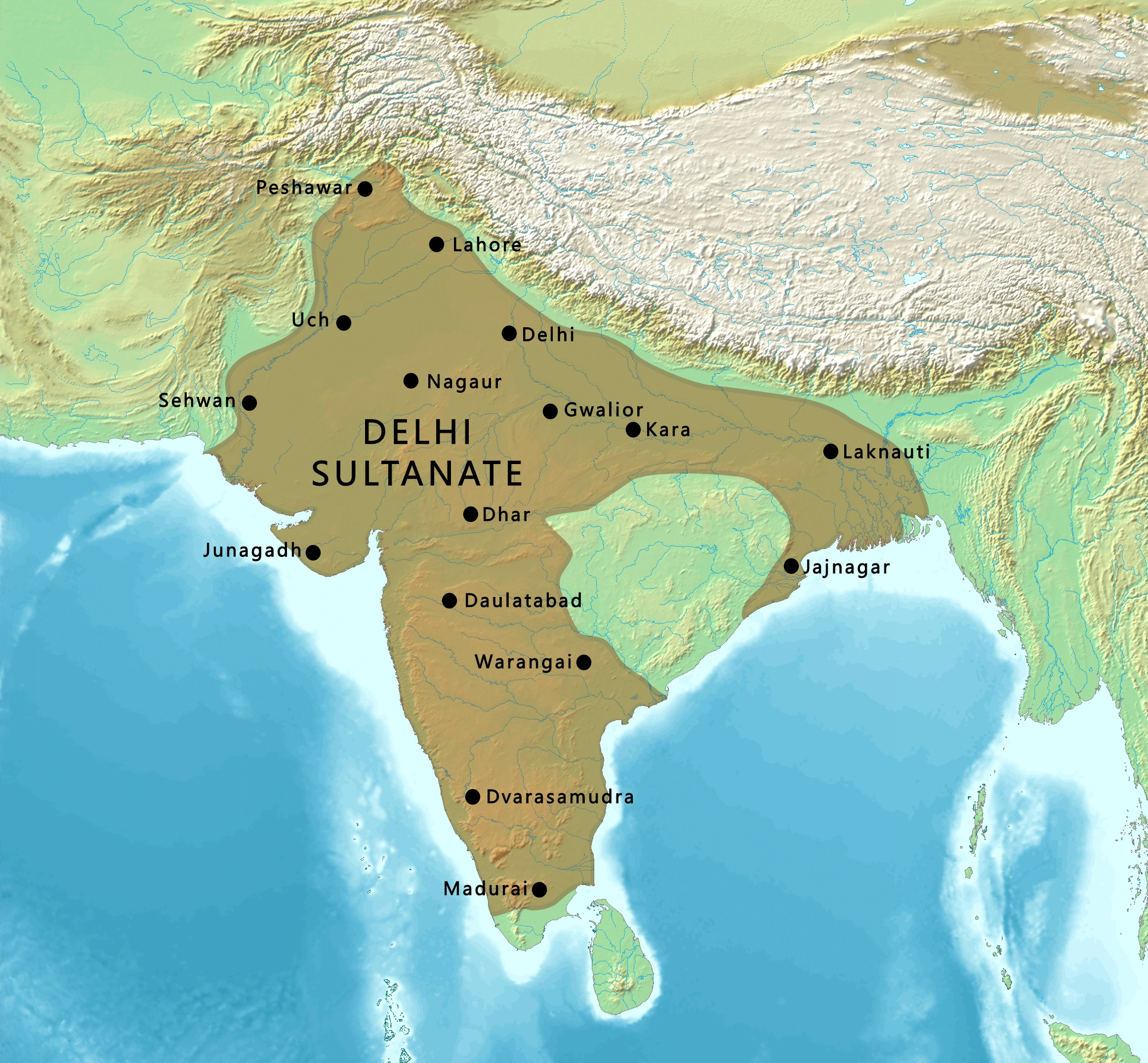
Map study
Delhi Sultanate territorial overview: regional orientation, not the exact boundary of every Sultan’s reign.
- Read the source date and legend before interpreting territorial extent.
- Compare core regions, neighbouring powers and geographic barriers; historical borders and influence are approximate and changed over time.
Credit: Koba-chan; DEMIS base map · CC BY-SA 3.0 · sourceConverted to WebP on an opaque white background; proportionally resized without cropping. Original cartography and legend retained.
1. Accession and political setting
Firoz Shah Tughlaq became sultan in 1351 after Muhammad bin Tughlaq died during a campaign in Sindh, near Thatta. Firoz was Muhammad’s cousin and a grandson of Ghiyasuddin Tughlaq’s brother. His accession took place amid military uncertainty and a wider crisis of imperial authority. The Delhi Sultanate had already lost effective control over important regions: the Vijayanagara kingdom emerged in 1336, the Bahmani Sultanate in 1347, and Bengal operated independently. Firoz therefore inherited a weakened empire rather than the extensive, centrally ambitious state associated with Muhammad bin Tughlaq.
His political approach emphasised accommodation of nobles, soldiers and the religious establishment. He sought to relieve grievances arising from earlier revenue demands and to distance his government from his predecessor’s unpopular experiments. This did not mean that his reign was uniformly peaceful or benevolent. Military expeditions, forced labour through slavery and discriminatory religious measures coexisted with public works and charitable spending. The distinction between administrative conciliation and coercive authority is essential for evaluating his rule.
Firoz attempted to recover Bengal in campaigns beginning in 1353 and 1359, but could not permanently restore Delhi’s authority there. His expeditions also reached Jajnagar in Odisha, Nagarkot in the Himalayan foothills and Thatta in Sindh. These operations brought varying degrees of submission, tribute or plunder rather than durable imperial integration. Unlike Muhammad bin Tughlaq, he did not seriously attempt to reconquer the independent Deccan.
- Prelims distinction: Muhammad bin Tughlaq is associated with token currency and the attempted capital transfer to Daulatabad; Firoz is associated with canals, charitable departments and Ashokan pillar relocation.
- Bengal’s continued independence illustrates the limits of Firoz’s military achievements.
Timeline
1351
Firoz Shah succeeds Muhammad bin Tughlaq.
1353 and 1359
Campaigns against Bengal fail to secure permanent annexation.
1356
Ashokan pillars from Topra and Meerut are transported to Delhi.
1388
Firoz dies; succession struggles intensify.
1398
Timur invades northern India and sacks Delhi after Firoz’s reign.
2. Administration, nobles, army and slavery
Firoz strengthened his relationship with established elites by making offices and assignments increasingly hereditary. Sons or other dependants could succeed to a deceased official’s position, while military service and revenue assignments also acquired hereditary features. This reduced immediate insecurity among officeholders but weakened the ruler’s ability to select, transfer and discipline personnel solely on administrative or military grounds. These arrangements should not be confused with the Mughal mansabdari system, which developed much later.
The iqta remained a central institution: an assignment of revenue from a territory supported an officer and his responsibilities. Under Firoz, concessions to holders of offices and assignments strengthened their local interests. Soldiers were often supported through revenue assignments rather than exclusively through centrally paid cash salaries. Contemporary accounts describe laxity and corruption in military inspection. Accommodation thus helped stabilise his reign while potentially reducing the effectiveness of the army and the central treasury.
Slavery became exceptionally prominent. Afif reports approximately 180,000 slaves under Firoz, a figure best treated as a chronicler’s estimate rather than a modern census. The Diwan-i-Bandagan supervised this large establishment. Slaves served in the palace, workshops, military and other occupations, and some received training in crafts. Their recruitment included war captives and people supplied by provincial authorities. Administrative organisation and training did not remove the fundamentally coercive character of this institution.
The reign benefited from powerful ministers, especially Khan-i-Jahan Maqbul, a converted former official from the Telangana region who became wazir. His career illustrates that administrative recruitment could involve substantial social and regional mobility even within an increasingly orthodox political order. After Firoz’s death, struggles among princes, nobles and other court interests revealed the fragility of the political balance he had maintained.
Intended economic effect of irrigation works
- 1. Royal investment in canals and waterworks
- 2. Improved water availability
- 3. Expansion or stabilisation of cultivation
- 4. Agricultural support for settlements
- 5. Land revenue and irrigation-levy receipts
3. Revenue, irrigation and welfare
Firoz presented fiscal policy as a return to taxes sanctioned by Islamic law. Accounts credit him with abolishing numerous miscellaneous cesses, conventionally numbered at twenty-four. The principal recognised levies are commonly listed as kharaj, a land-revenue demand; khams, the state’s share of war booty; zakat, a religious levy on eligible Muslim wealth; and jizya, a levy on non-Muslim subjects. This classification expresses his declared fiscal framework, not proof that all local extraction became uniform.
With religious approval, he levied sharb on land benefiting from state-provided irrigation, generally described as one-tenth of the produce of such irrigated cultivation. Canal construction and restoration were intended to expand agriculture, support settlements and strengthen revenue. Works associated with his reign drew water from rivers including the Yamuna and Sutlej; the canal supplying the Hisar region is particularly important. Wells, reservoirs and gardens complemented these projects. Afif’s account also attributes extensive orchards around Delhi to the sultan.
The Diwan-i-Khairat provided charitable assistance, notably marriage grants for poor Muslim women and support for vulnerable beneficiaries. A charitable hospital at Delhi, commonly called the Dar-ul-Shifa, offered treatment and medicines. These institutions demonstrate organised royal patronage of relief and medical care, but should not be equated with a modern universal welfare system. Access and objectives reflected the religious and hierarchical society of the period.
- Diwan-i-Khairat: charity; Diwan-i-Bandagan: slaves; Dar-ul-Shifa: medical care.
- Diwan-i-Kohi, the agricultural department, belongs to Muhammad bin Tughlaq’s reign, not Firoz’s.
| Term | Association | Exam caution |
|---|---|---|
| Diwan-i-Khairat | Charitable assistance under Firoz | Not the slave department |
| Diwan-i-Bandagan | Management of slaves under Firoz | Training did not imply freedom |
| Dar-ul-Shifa | Charitable medical institution | Not a revenue department |
| Sharb | Irrigation levy | Distinct from jizya |
| Diwan-i-Kohi | Muhammad bin Tughlaq’s agricultural department | Not established by Firoz |
4. Religion, learning and historical sources
Firoz cultivated the ulema and emphasised Sunni orthodoxy. A frequently tested measure is his insistence that Brahmans pay jizya, withdrawing the exemption they had enjoyed. Jizya was not introduced into India by Firoz; the important distinction is its explicit application to Brahmans. His own account records action against religious practices and groups he considered unacceptable. Accounts of campaigns also describe temple desecration. Consequently, his reputation for charity must be assessed alongside evidence of religious coercion.
Firoz also supported learning and the translation of selected Sanskrit knowledge into Persian. Accounts associate manuscripts obtained at Nagarkot with a Persian work known as Dalail-i-Firoz Shahi. Such patronage shows that cultural appropriation and intellectual exchange could coexist with political conquest and religious intolerance. The Hauz Khas madrasa in Delhi formed another important centre of learning under his patronage.
Futuhat-i-Firoz Shahi records the sultan’s account of his policies and achievements and must be read as royal self-presentation. Shams-i Siraj Afif’s Tarikh-i-Firoz Shahi provides extensive information about his administration and public works. Ziauddin Barani also wrote a work titled Tarikh-i-Firoz Shahi, covering earlier sultans and the opening years of Firoz’s reign. The identical titles make author identification a useful Prelims distinction.
5. Architecture, urbanisation and legacy
Firoz founded or developed several urban centres, notably Firozabad at Delhi, Hisar-i-Firoza, Fatehabad and Jaunpur. Firoz Shah Kotla was the fortified palace complex of Firozabad. Jaunpur was named in memory of Muhammad bin Tughlaq, also known as Jauna Khan. His architecture generally used rubble masonry, plastered surfaces and restrained ornament, extending the practical, monumental character associated with Tughlaq construction.
His best-known antiquarian enterprise was transporting two Ashokan pillars to Delhi, one from Topra in present-day Haryana and another from Meerut. The Topra pillar was installed at Firoz Shah Kotla; the Meerut pillar was erected on Delhi’s northern ridge. Their movement involved elaborate engineering, including specially prepared transport and river passage. Firoz did not decipher their Brahmi inscriptions: that breakthrough is associated with James Prinsep in 1837.
He repaired earlier monuments and hydraulic works, including the Qutb Minar and the reservoir at Hauz Khas. His tomb stands beside the Hauz Khas complex. Following his death in 1388, succession disputes and provincial fragmentation accelerated. Hereditary privileges and reduced central discipline contributed to this vulnerability, but the decline also reflected problems inherited from earlier reigns. Timur’s invasion in 1398 occurred a decade after Firoz’s death, not during his rule.
Firoz Shah Tughlaq: Welfare, Orthodoxy and Administrative Compromise
Firoz Shah Tughlaq ruled from 1351 to 1388, following Muhammad bin Tughlaq. His policies emphasised agricultural recovery, irrigation and accommodation of influential groups. Canal construction and repairs supported cultivation, while new settlements and public institutions projected the ruler as a benefactor. The Diwan-i-Khairat provided charitable assistance, including support for marriages of poor Muslim women. These initiatives should be understood within a medieval monarchy, not equated with a modern, universal welfare state.
His reign also combined religious orthodoxy with concessions that could weaken central control. He enforced jizya on Brahmans, who had previously enjoyed exemption, and strengthened hereditary tendencies in military service and revenue assignments. The Diwan-i-Bandagan administered a large slave establishment. His relocation of Ashokan pillars to Delhi illustrates royal appropriation of older monuments; it does not make those pillars Sultanate inscriptions. The supplied metadata identifies the subject but gives no information about the image’s maker, date or historical basis. It therefore supports illustrative use, not conclusions about his appearance or contemporary portraiture.
- Distinguish rulers: token currency and the attempted capital transfer to Daulatabad belong to Muhammad bin Tughlaq, not Firoz Shah.
- Separate institutions: Diwan-i-Khairat concerned charity; Diwan-i-Bandagan concerned slaves. Neither was simply an irrigation department.
- For Mains, balance productive public works against religious exclusion and hereditary privileges; avoid treating either welfare or orthodoxy as the sole defining feature.
Real-world case studies
Topra pillar at Firoz Shah Kotla
The relocation of an Ashokan pillar from Topra to Delhi demonstrates Sultanate engineering and royal interest in prestigious antiquities. Its original Mauryan inscription and its medieval architectural setting belong to different periods. It is therefore a useful example of a monument with layered historical contexts.
Hauz Khas: reuse of an earlier urban landscape
The reservoir originated under Alauddin Khalji as Hauz-i-Alai. Firoz restored it and developed the adjoining madrasa complex, where his tomb also stands. The site illustrates the distinction between original construction, later repair and architectural expansion.
Previous year questions
No source-linked PYQ is available here yet. Use the practice questions below.
Practice questions
Practice MCQ 1
Which of the following pairs is incorrectly matched?
- A. Diwan-i-Khairat — Charitable assistance
- B. Diwan-i-Bandagan — Management of slaves
- C. Dar-ul-Shifa — Medical treatment
- D. Diwan-i-Kohi — Slave training under Firoz Shah
Practice MCQ 2
Consider the following statements about Firoz Shah Tughlaq: 1. He transported Ashokan pillars to Delhi. 2. He deciphered the Brahmi inscriptions on those pillars. 3. He explicitly imposed jizya on Brahmans. Which statements are correct?
- A. 1 and 2 only
- B. 1 and 3 only
- C. 2 and 3 only
- D. 1, 2 and 3
Practice MCQ 3
Which statement best describes the relationship between Firoz Shah Tughlaq’s policies and central authority?
- A. Hereditary offices increased the unrestricted transferability of officials.
- B. Concessions to nobles and soldiers reduced immediate discontent but could weaken central control.
- C. His Bengal campaigns permanently eliminated regional independence.
- D. His reign abolished revenue assignments and introduced Mughal mansabdari.
Mains practice · Firoz Shah Tughlaq’s reign combined public works and administrative conciliation with religious orthodoxy and structural weaknesses. Discuss. Answer in 250 words.
- Introduce the fragmented political situation inherited in 1351.
- Explain irrigation projects, urban foundations, charitable assistance and medical care.
- Analyse hereditary offices, revenue assignments and accommodation of influential groups.
- Discuss jizya on Brahmans, religious coercion and the extensive slave establishment.
- Distinguish immediate stability from longer-term weakening of central authority.
- Conclude with a balanced assessment, avoiding attribution of the entire Sultanate decline to one ruler.
Further reading
- Satish Chandra, History of Medieval India, Orient BlackSwan.
- Satish Chandra, Medieval India: From Sultanat to the Mughals, Part One.
- NCERT, Our Pasts–II, chapter on the Delhi Sultans.
- Archaeological Survey of India: information on Firoz Shah Kotla and Hauz Khas monuments, asi.nic.in.
- Shams-i Siraj Afif, Tarikh-i-Firoz Shahi, translated extracts; read critically as a court-centred historical account.
- https://commons.wikimedia.org/wiki/File:Firoz_Shah_Taghlak.jpg
Preparing for UPSC Civil Services? Get classroom teaching, answer-writing evaluation and mentorship at Pragnya IAS Academy, Ashok Nagar — see why aspirants choose us for IAS coaching in Hyderabad.