
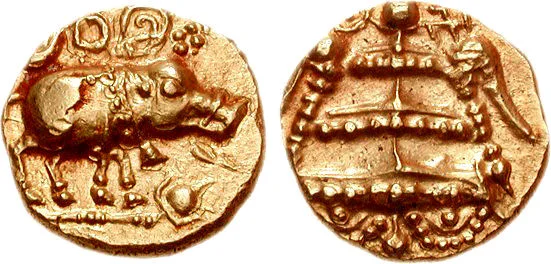
Gold coin attributed to the Chalukyas of Kalyani; the issuing ruler is uncertain.
Credit: CNG Coins · CC BY-SA 3.0 · sourceResized and converted to WebP; uncropped.
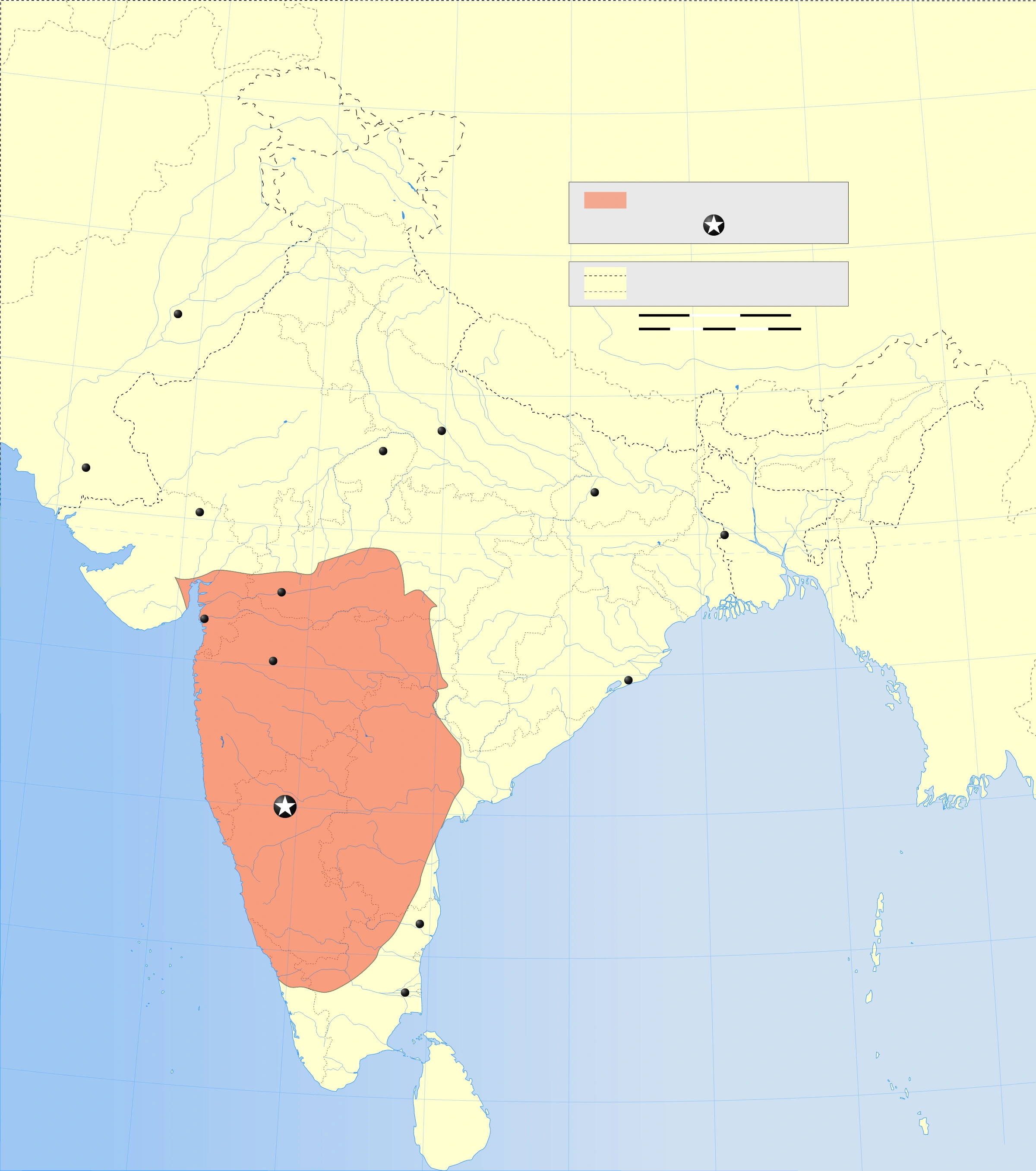
Map study
Chalukya Empire: territorial context for Deccan history; read the source date and legend.
- Read the source date and legend; distinguish territory, influence and geographic location.
- Historical boundaries and reference memberships are not live political or operational data.
Credit: Nikel3012 · CC0 · sourceConverted to WebP on an opaque white background; proportionally resized without cropping. Original cartography and legend retained.
1. Dynastic identity, geography and historical sources
The name Chalukya covers several royal houses rather than one continuously ruling empire. The Early Western Chalukyas established their centre at Vatapi in the Malaprabha valley of northern Karnataka. Nearby Aihole and Pattadakal became important sacred and architectural centres. Their position connected the western coast, the Karnataka plateau and routes towards the Krishna–Godavari region. Control over this geography brought access to agricultural resources, trade routes and competing regional powers.
Pulakeshin I is generally regarded as the founder of the Badami kingdom, with his rule conventionally beginning around 543 CE. Kirtivarman I expanded its influence, while Mangalesha ruled before Pulakeshin II secured the throne following a succession conflict. Court traditions supplied prestigious genealogies, but these should not be treated as reliable proof of the dynasty's remote origins. Political history is reconstructed chiefly through inscriptions, copper-plate grants, coins, monuments and external accounts.
The most celebrated source is the Sanskrit Aihole inscription composed by Ravikirti, a Jain poet, in 634–635 CE. Inscribed at the Meguti Jain temple, it gives a genealogy and celebrates Pulakeshin II's achievements. As a prashasti, it is valuable but deliberately laudatory. Xuanzang's account of Maharashtra also provides an external description associated with Pulakeshin II's realm. Inscriptions should therefore be compared with rival dynastic records and material evidence.
- Badami or Vatapi: capital of the Early Western Chalukyas.
- Vengi: Eastern Chalukya kingdom in coastal Andhra.
- Kalyani or Basavakalyan: principal capital of the Later Western Chalukyas.
Timeline
Around 543 CE
Conventional beginning of Pulakeshin I's rule and the Badami Chalukya kingdom.
Around 610–642 CE
Reign of Pulakeshin II.
Around 624 CE
Conventional foundation date of the Eastern Chalukya line under Vishnuvardhana.
634–635 CE
Ravikirti's Aihole inscription records Pulakeshin II's achievements.
Around 642 CE
Narasimhavarman I captures Vatapi.
Around 753 CE
Dantidurga displaces the Badami Chalukyas.
973 CE
Tailapa II establishes Later Western Chalukya power.
1076 CE
Vikramaditya VI begins his reign and inaugurates the Chalukya-Vikrama era.
2. Pulakeshin II and the struggle for Deccan supremacy
Pulakeshin II, who ruled approximately from 610 to 642 CE, brought the Badami kingdom to its greatest prominence. He consolidated authority over neighbouring rulers and extended Chalukya influence across substantial parts of the Deccan. His encounter with Harshavardhana is especially important: Harsha's southward advance was checked near the Narmada, conventionally understood as a major boundary between their spheres of influence. The precise year of the confrontation remains debated and should not be confused with the date of the Aihole inscription.
In the eastern Deccan, Pulakeshin installed his brother Vishnuvardhana as a governor after extending power into the Andhra region. Vishnuvardhana subsequently established the Eastern Chalukya line, conventionally dated from about 624 CE. This branch endured long after the fall of Badami. Its location in the fertile Krishna–Godavari region later made Vengi a crucial arena of conflict and marriage alliances involving the Cholas and the Western Chalukyas.
The struggle with the Pallavas of Kanchipuram was the other defining conflict. Pulakeshin initially gained advantages against Mahendravarman I, but Narasimhavarman I reversed the situation and captured Vatapi around 642 CE. Pulakeshin probably died during this crisis. Vikramaditya I later restored Chalukya authority. Vikramaditya II campaigned successfully against Kanchipuram in the eighth century, but the dynasty eventually lost power to the Rashtrakuta ruler Dantidurga, who displaced Kirtivarman II around 753 CE.
- Do not confuse Pulakeshin II's contemporary Harsha with later north Indian rulers.
- Vatapikonda, meaning conqueror of Vatapi, was a title of the Pallava Narasimhavarman I.
Reading a Chalukya inscription critically
- 1. Identify its findspot, language, script and date.
- 2. Separate genealogy and praise from specific recorded events.
- 3. Identify grants, officials, places and political relationships.
- 4. Compare claims with rival inscriptions and archaeological evidence.
- 5. Draw conclusions while acknowledging uncertainty.
3. Administration, economy, religion and literary culture
Chalukya rule combined royal authority with provincial officers, local elites and subordinate chiefs. Administrative terms such as rashtra and vishaya occur in inscriptions, although territorial arrangements varied across periods and regions. Samantas supplied military support and acknowledged overlordship, but could become rivals when central power weakened. The rise of the Rashtrakutas illustrates how a subordinate political formation could replace an established dynasty.
Agriculture formed the principal economic base, supported by irrigation tanks, wells and local water-management systems. Copper-plate grants record gifts of land or revenue rights to Brahmanas and religious institutions, often with specified exemptions. Such grants helped expand cultivation and consolidate local authority. Temples could become centres of employment, redistribution and economic activity. However, land grants alone do not prove a uniform system of Indian feudalism; regional evidence requires careful interpretation.
Royal patronage supported Brahmanical traditions, especially Shaivism and Vaishnavism, while Jain institutions also flourished. Badami's caves and Aihole's Meguti temple illustrate this plurality. Sanskrit remained important for prestigious inscriptions, alongside growing use of regional languages. In the wider Chalukya age, Kannada literary production expanded, including works supported by regional feudatories. Under the Eastern Chalukyas, Nannaya began the Telugu rendering of the Mahabharata in the eleventh century under Rajaraja Narendra.
- Distinguish a dynasty's political territory from the wider cultural networks associated with its feudatories.
- Religious diversity did not mean every ruler patronised every tradition equally.
| Dynasty | Period | Core region and centre | High-yield association |
|---|---|---|---|
| Early Western Chalukyas | Approximately 543–753 CE | Northern Karnataka; Badami | Pulakeshin II; Aihole inscription; Pattadakal temples |
| Eastern Chalukyas | Approximately seventh to eleventh centuries; subsequent Chola-linked continuity | Coastal Andhra; Vengi region | Vishnuvardhana; Rajaraja Narendra; Nannaya |
| Later Western Chalukyas | 973 to late twelfth century | Western Deccan; Kalyani | Tailapa II; Vikramaditya VI; Mitakshara; Itagi temples |
4. Badami, Aihole and Pattadakal: architectural experiments
Early Chalukya architecture is notable for experimentation in both rock-cut and structural temples. Badami's principal cave temples, dating mainly to the sixth century, include Shaiva, Vaishnava and Jain monuments. Cave 3 has a dated inscription of Mangalesha from 578 CE. Sculptures of Vishnu as Varaha and Trivikrama and the many-armed dancing Shiva are especially important. These caves demonstrate sophisticated carving within excavated architectural spaces.
Aihole preserves varied temple plans rather than a single fixed model. The Durga temple is particularly recognisable for its apsidal plan and surrounding colonnade. Its conventional name derives from an association with a fort, or durg, and is not sufficient evidence of dedication to Goddess Durga. The Lad Khan temple is another prominent structural monument. Calling Aihole a centre of architectural experimentation is useful, but it should not imply that all Indian temple forms originated there.
Pattadakal presents northern curvilinear superstructures alongside southern tiered vimanas. Virupaksha and Mallikarjuna are major southern-style temples commissioned by royal women, while Papanatha combines features that resist a simple binary classification. The term Vesara is often used for Deccan architectural synthesis, but scholars differ over its definition. For examination purposes, identify actual structural features rather than automatically labelling every Chalukya temple a hybrid.
- Virupaksha temple, Pattadakal: Queen Lokamahadevi; reign of Vikramaditya II.
- Mallikarjuna temple, Pattadakal: Queen Trailokyamahadevi.
- Do not confuse Pattadakal's Virupaksha temple with the Virupaksha temple at Hampi.
5. Later Western Chalukyas and early medieval continuities
Tailapa II established the Later Western Chalukya kingdom after overthrowing Rashtrakuta authority in 973 CE. Its principal centre eventually became Kalyani. Although this dynasty claimed continuity with the earlier Chalukyas, the precise genealogical relationship remains uncertain. Its long rivalry with the Cholas centred partly on Vengi and the Tungabhadra region. These conflicts involved shifting alliances, subordinate rulers and strategic marriage ties rather than an unchanging political frontier.
Vikramaditya VI, ruling from 1076 to 1126 CE, inaugurated the Chalukya-Vikrama era in 1076. Bilhana composed the Vikramankadevacharita in his honour. Vijnaneshvara's Mitakshara, an influential commentary on the Yajnavalkya Smriti, is associated with his court. Later Western Chalukya temples at Lakkundi, Dambal, Gadag and Itagi developed elaborate pillars, wall articulation and sculptural decoration. Their architectural traditions formed an important background to Hoysala building, though neither tradition should be reduced to a simple copy of the other.
- Someshvara III composed the Sanskrit encyclopaedic work Manasollasa in the twelfth century.
- Later Western Chalukya power declined during the twelfth century amid Kalachuri intervention and the rise of regional successor states.
Kalyani Chalukya Coinage: Authority and Evidence
The supplied metadata identifies this gold coin as a Kalyani Chalukya issue, broadly dated circa 973–1068, with an uncertain issuing ruler. It describes a boar motif on one side and a decorated structure interpreted as either a triple-tiered parasol or a temple on the other. This makes the coin directly relevant to the Later Western Chalukyas, but not interchangeable with evidence from the earlier Badami dynasty. The Kalyani line emerged after Rashtrakuta power declined and became an important political force in the western Deccan.
Coins supplement inscriptions and monuments by documenting monetary forms, symbols and claims to authority. The boar motif can be studied in relation to Varaha and Chalukya dynastic symbolism, while the described sun, moon and parasol invite discussion of sovereignty and auspiciousness. Such interpretations require comparison with securely attributed issues: a motif alone cannot establish a ruler’s identity, personal religious affiliation or territorial control. Likewise, a gold denomination indicates high-value coinage, not the extent of everyday monetisation. The metadata’s alternative reading of the reverse as a parasol or temple must remain explicit rather than becoming a firm architectural identification.
- Dynastic distinction: Badami, Vengi and Kalyani denote separate Chalukya lines; do not transfer Pulakeshin II or the Aihole inscription to Kalyani.
- Evidence limits: the supplied attribution names no ruler or findspot, so it cannot independently establish an exact reign or circulation area.
- Mains application: combine numismatic evidence with inscriptions, temple patronage and settlement evidence to assess Deccan state formation and economic networks.
Real-world case studies
Pattadakal: royal women and architectural exchange
Lokamahadevi and Trailokyamahadevi commissioned the Virupaksha and Mallikarjuna temples during Vikramaditya II's reign. These monuments linked royal victories with religious patronage and demonstrate women's role as major architectural patrons. The Virupaksha temple also shows affinities with the Kailasanatha temple at Kanchipuram, illustrating how political rivalry could coexist with artistic exchange.
Itagi Mahadeva temple: patronage beyond the king
The Mahadeva temple at Itagi in Karnataka was built in 1112 CE by Mahadeva, a commander serving Vikramaditya VI. Its elaborate pillars and sculptural treatment exemplify Later Western Chalukya craftsmanship. The inscription's description of the monument as an emperor among temples also shows how non-royal patrons used monumental building to express status and devotion.
Previous year questions
No source-linked PYQ is available here yet. Use the practice questions below.
Practice questions
Practice MCQ 1
With reference to the Aihole inscription, consider the following statements: 1. It was composed by Ravikirti. 2. It praises Pulakeshin II. 3. It records the foundation of the Kalyani Chalukya kingdom by Tailapa II. Which of the statements given above are correct?
- A. 1 and 2 only
- B. 2 and 3 only
- C. 1 and 3 only
- D. 1, 2 and 3
Practice MCQ 2
Which one of the following pairs is correctly matched?
- A. Virupaksha temple at Pattadakal — Lokamahadevi
- B. Meguti Jain temple inscription — Bilhana
- C. Capture of Vatapi around 642 CE — Mahendravarman I
- D. Foundation of the Eastern Chalukya line — Dantidurga
Practice MCQ 3
Consider the following statements: 1. Pattadakal contains examples of both northern and southern temple forms. 2. The conventional name of Aihole's Durga temple conclusively establishes its dedication to Goddess Durga. 3. Itagi's Mahadeva temple belongs to the Later Western Chalukya architectural tradition. Which of the statements given above are correct?
- A. 1 only
- B. 1 and 2 only
- C. 1 and 3 only
- D. 2 and 3 only
Mains practice · The Chalukyas were agents of both political integration and cultural exchange in early medieval peninsular India. Discuss with reference to their major branches. Answer in 250 words.
- Distinguish Badami, Vengi and Kalyani geographically and chronologically.
- Explain Pulakeshin II's expansion, resistance to Harsha and rivalry with the Pallavas.
- Discuss Vengi as a link between the Deccan and the Tamil region.
- Connect administration and land grants with regional elites and religious institutions.
- Use Badami, Aihole and Pattadakal to illustrate architectural experimentation.
- Mention Nannaya, Bilhana and Vijnaneshvara to show linguistic and intellectual contributions.
- Conclude with regional state formation and artistic exchange, while avoiding claims of uninterrupted dynastic unity.
Further reading
- NCERT, Our Pasts–I, chapter New Empires and Kingdoms.
- NCERT, An Introduction to Indian Art, Part I, chapter Temple Architecture and Sculpture.
- UNESCO World Heritage Centre, Group of Monuments at Pattadakal.
- Archaeological Survey of India, official monument information on Badami, Aihole and Pattadakal.
- Upinder Singh, A History of Ancient and Early Medieval India.
- https://commons.wikimedia.org/wiki/File:Chalukyas_of_Kalyana.jpg
Preparing for UPSC Civil Services? Get classroom teaching, answer-writing evaluation and mentorship at Pragnya IAS Academy, Ashok Nagar — see why aspirants choose us for IAS coaching in Hyderabad.