

Micaceous red ware (MRW) sites at south Harappan culture area. Backdound map is soil moisture.
Credit: Merikanto · CC BY 4.0 · source

Harappan burial from Rakhigarhi A skeleton excavated from Rakhigarhi (in present day Haryana) is on display in the gallery. Objects placed with this skeleton in the burial indicate that the Harappans
Credit: juggadery · CC BY-SA 2.0 · source
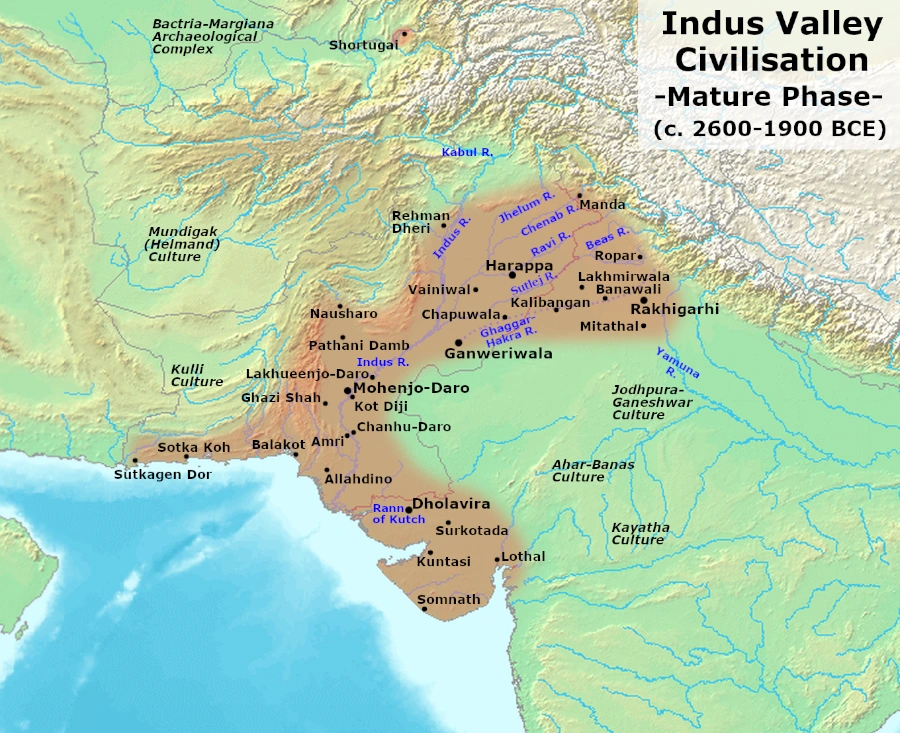
Map study
Mature Harappan civilisation, c. 2600–1900 BCE: settlement distribution, not the territory of a single empire.
- Read the source date and legend before interpreting territorial extent.
- Compare core regions, neighbouring powers and geographic barriers; historical borders and influence are approximate and changed over time.
Credit: Avantiputra7 · CC BY-SA 3.0 · sourceConverted to WebP on an opaque white background; proportionally resized without cropping. Original cartography and legend retained.
Location, extent and archaeological identity
Rakhigarhi lies in the Hisar district of Haryana, in the eastern part of the geographical distribution of the Harappan civilisation. The archaeological landscape overlaps the present-day villages of Rakhi Khas and Rakhi Shahpur. Unlike Harappa on the Ravi and Mohenjo-daro near the Indus, Rakhigarhi belongs to the plains associated with the Ghaggar-Hakra palaeodrainage region. This makes it especially important for studying how Harappan settlement adapted to different ecological settings rather than depending on a single river valley.
The site consists of several archaeological mounds, conventionally identified by RGR numbers. Early accounts focused on seven mounds, while subsequent surveys expanded the recognised archaeological footprint. Estimates of about 350 hectares place it among the largest known Harappan complexes. Nevertheless, statements that it was unequivocally the largest Harappan city should be treated cautiously: site boundaries, buried deposits, modern occupation and the contemporaneity of different sectors affect comparisons.
Rakhigarhi is sometimes linked to the ancient Drishadvati and to the broader Sarasvati debate. For examination purposes, distinguish archaeological location from historical river identification. Palaeochannels provide evidence of former drainage, but identifying a channel with a river named in a literary text requires separate geological, chronological and textual arguments.
Timeline
c. 2600–1900 BCE
Conventional Mature Harappan period, relevant to Rakhigarhi’s major urban occupation.
1997–2000
Major ASI excavation campaign under Amarendra Nath.
2010s
Further settlement and cemetery investigations involving Deccan College and collaborating institutions.
2019
Publication of genome-wide ancient-DNA results from the Rakhigarhi individual I6113.
2020
Union Budget proposal included Rakhigarhi among five iconic archaeological sites to be developed with on-site museums.
Excavation history and cultural sequence
Rakhigarhi entered archaeological literature through surveys during the twentieth century. Major ASI excavations under Amarendra Nath took place between 1997 and 2000. Later research associated with Deccan College, Pune, under Vasant Shinde, included settlement and cemetery investigations. Renewed ASI excavations have added information on habitation, streets, drainage and craft-related activity. These investigations illustrate how knowledge of a major settlement develops through multiple field seasons rather than a single discovery.
The site contains evidence of Early Harappan and Mature Harappan occupation. The Mature Harappan period, conventionally dated to around 2600–1900 BCE, represents the civilisation’s most extensive urban integration. Broad regional dates should not automatically be assigned to every excavated structure: individual deposits require dating through stratigraphy, associated artefacts and scientific methods.
The importance of the sequence lies in the opportunity to examine the emergence of urban life from earlier settlement traditions. Rakhigarhi can help explain how population concentration, agricultural surplus, specialised crafts and wider exchange developed together. It should not, however, be presented as the single birthplace of Harappan civilisation. Urbanisation was a regional process involving several interacting centres across present-day India and Pakistan.
How evidence from Rakhigarhi becomes historical knowledge
- 1. Survey and map mounds, buried remains and modern land use.
- 2. Excavate stratigraphically and record the context of each find.
- 3. Date deposits and analyse artefacts, plant remains, animal bones and burials.
- 4. Apply specialised methods such as ancient-DNA analysis where preservation permits.
- 5. Compare results with other sites and frame conclusions with clear limitations.
Town planning, economy and material culture
Excavations have revealed streets, residential structures and drainage arrangements, showing organised management of built space. Mud bricks and fired bricks were used in Harappan construction, with their distribution varying by structure and function. Such evidence supports an interpretation of planned urban life, but it does not justify assuming that every sector followed a perfectly uniform grid or that all Harappan cities had identical administrative institutions.
Pottery, terracotta objects, beads, bangles and metal objects connect Rakhigarhi with the wider Harappan material-cultural tradition. Evidence associated with bead and ornament production suggests craft specialisation. Materials such as carnelian, shell and metals also point towards exchange, since many raw materials were not locally available. Identifying a particular source or trade route, however, requires analysis beyond the mere presence of an object.
Agriculture and animal husbandry supported the settlement and its hinterland. Plant remains, animal bones and tools are essential for reconstructing subsistence; general Harappan crop lists should not be substituted for a site-specific inventory. The larger historical argument is that urban centres depended on rural producers while offering markets, craft goods and services in return.
Streets, drainage and specialised production imply coordination, but the nature of political authority remains debated. Archaeologists cannot securely identify a king, dynasty or modern-style municipal government at Rakhigarhi. Similarly, artefacts should not automatically be labelled as evidence of a particular later religion. Functional and ritual interpretations must remain tied to their archaeological context.
| Site | Present location | High-yield association |
|---|---|---|
| Rakhigarhi | Haryana, India | Large settlement complex, cemetery and ancient-DNA study |
| Dholavira | Gujarat, India | Reservoirs, distinctive urban divisions and UNESCO inscription in 2021 |
| Kalibangan | Rajasthan, India | Evidence of a ploughed field and structures interpreted as fire altars |
| Harappa | Punjab, Pakistan | Type-site after which the Harappan civilisation is named |
| Mohenjo-daro | Sindh, Pakistan | Great Bath and extensive urban remains |
Burials, ancient DNA and limits of interpretation
The cemetery at Rakhigarhi has yielded human skeletons and associated grave goods, including pottery and ornaments. Extended inhumation is represented. Burial position, treatment of the body and the selection of accompanying objects help reconstruct mortuary practices and social identities. Differences between graves may indicate variation in age, status or ritual, but a simple rich-versus-poor classification is not always justified.
In 2019, a study published in Cell reported genome-wide ancient DNA from one female individual, designated I6113, excavated at Rakhigarhi. The analysed genome showed ancestry related to ancient Iranian populations and ancestry related to indigenous South Asian hunter-gatherers. It did not show detectable Steppe pastoralist-related ancestry. Crucially, the Iranian-related ancestry was not evidence of direct descent from the sampled ancient Iranian farming populations; the study inferred a deeper divergence.
The result is significant because obtaining ancient DNA in South Asia’s climatic conditions is difficult. Yet one genome cannot represent every community across the civilisation’s enormous geographical and chronological span. The absence of detectable Steppe-related ancestry in this individual does not prove that no later migration occurred. Genetic ancestry also cannot independently identify language, religious affiliation, caste or political identity. A sound UPSC answer separates the scientific finding from sweeping claims about civilisational ownership.
Heritage conservation and examination relevance
Rakhigarhi is a living archaeological landscape: modern houses, cultivation and infrastructure coexist with ancient deposits. Conservation therefore involves both protecting evidence and addressing residents’ needs. Encroachment, construction, erosion and poorly managed tourism can damage stratigraphic information that cannot be recovered once destroyed. Documentation, community participation and careful visitor management are as important as displaying excavated objects.
The Ancient Monuments and Archaeological Sites and Remains Act, 1958, provides the principal legal framework for centrally protected archaeological heritage. The 2010 amendment strengthened regulation around protected monuments and archaeological sites, including prohibited and regulated areas. In the Union Budget 2020–21, Rakhigarhi was identified among five archaeological sites proposed for development as iconic sites with on-site museums. Such policy identification should not be confused with UNESCO World Heritage inscription.
For Prelims, prioritise state and district, cultural period, excavation evidence and the distinction between Rakhigarhi and other major Harappan sites. For Mains, use it as an example of eastern Harappan urbanism, interdisciplinary archaeology and the challenges of conserving inhabited heritage. The strongest approach combines archaeological findings with explicit awareness of evidentiary limits.
Real-world case studies
The 2019 ancient-DNA study
The I6113 genome demonstrates both the promise and limits of scientific archaeology. It provided direct evidence about one Harappan individual’s ancestry, including the absence of detectable Steppe pastoralist-related ancestry. Its appropriate use is to refine population-history models alongside other samples and archaeology, not to equate genes with a language or modern identity.
Conservation in an inhabited settlement
At Rakhigarhi, ancient deposits extend into a landscape used by present-day residents. Protecting only visibly excavated structures would leave other evidence vulnerable. The site illustrates the need for archaeological mapping, lawful development controls, consultation with residents and local benefits from museums and responsible tourism.
Previous year questions
No source-linked PYQ is available here yet. Use the practice questions below.
Practice questions
Practice MCQ 1
With reference to Rakhigarhi, consider the following statements: 1. It is located in Haryana’s Hisar district. 2. It represents exclusively Late Harappan occupation. 3. Its archaeological remains include a cemetery. Which of the statements given above are correct?
- A. 1 and 2 only
- B. 1 and 3 only
- C. 2 and 3 only
- D. 1, 2 and 3
Practice MCQ 2
Which conclusion is best supported by the ancient-DNA results published in 2019 from a Rakhigarhi individual?
- A. Every Harappan community had an identical genetic profile.
- B. The language spoken at Rakhigarhi has been identified.
- C. Detectable Steppe pastoralist-related ancestry was absent in the analysed genome.
- D. Population movement into South Asia ended before Harappan urbanisation.
Practice MCQ 3
Consider the following pairs: 1. Rakhigarhi — Haryana 2. Dholavira — Rajasthan 3. Kalibangan — Gujarat 4. Mohenjo-daro — Sindh. How many pairs are correctly matched?
- A. Only one
- B. Only two
- C. Only three
- D. All four
Mains practice · Explain the significance of Rakhigarhi for understanding Harappan urbanism and population history. What precautions are necessary when interpreting its archaeological and genetic evidence? Answer in 250 words.
- Locate the site and explain its importance in the eastern Harappan distribution.
- Discuss settlement scale, planning, drainage, crafts and connections with the agricultural hinterland.
- Use cemetery evidence to explain mortuary practices and opportunities for biological research.
- Summarise the 2019 genome findings without generalising from one individual to the whole civilisation.
- Distinguish mapped settlement extent from simultaneous occupation, and genetic ancestry from language or identity.
- Conclude with the need for interdisciplinary research and community-sensitive conservation.
Further reading
- NCERT, Themes in Indian History, Part I: Bricks, Beads and Bones.
- Archaeological Survey of India: Indian Archaeology—A Review, excavation reports and Rakhigarhi documentation.
- Shinde et al., An Ancient Harappan Genome Lacks Ancestry from Steppe Pastoralists or Iranian Farmers, Cell, 2019.
- Union Budget 2020–21, Budget Speech: proposals for iconic archaeological sites and on-site museums.
- India Code: Ancient Monuments and Archaeological Sites and Remains Act, 1958, as amended.
Preparing for UPSC Civil Services? Get classroom teaching, answer-writing evaluation and mentorship at Pragnya IAS Academy, Ashok Nagar — see why aspirants choose us for IAS coaching in Hyderabad.