
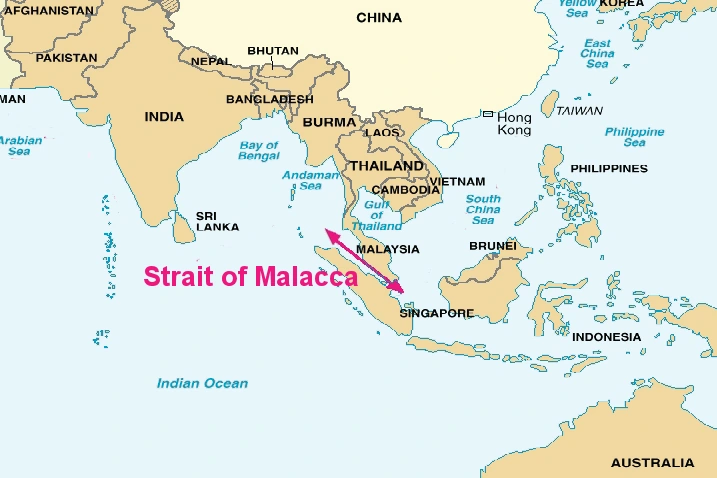
Map study
Strait of Malacca between the Malay Peninsula and Sumatra: trace the Indian Ocean–South China Sea shipping connection and its trade significance.
- Read the source legend and reference date before interpreting the map.
- Use spatial patterns to support topic revision; verify current official boundaries, designations and warnings separately.
Credit: US Department of Defense · Public domain · sourceConverted to WebP on an opaque white background; proportionally resized without cropping. Original cartography and legend retained.
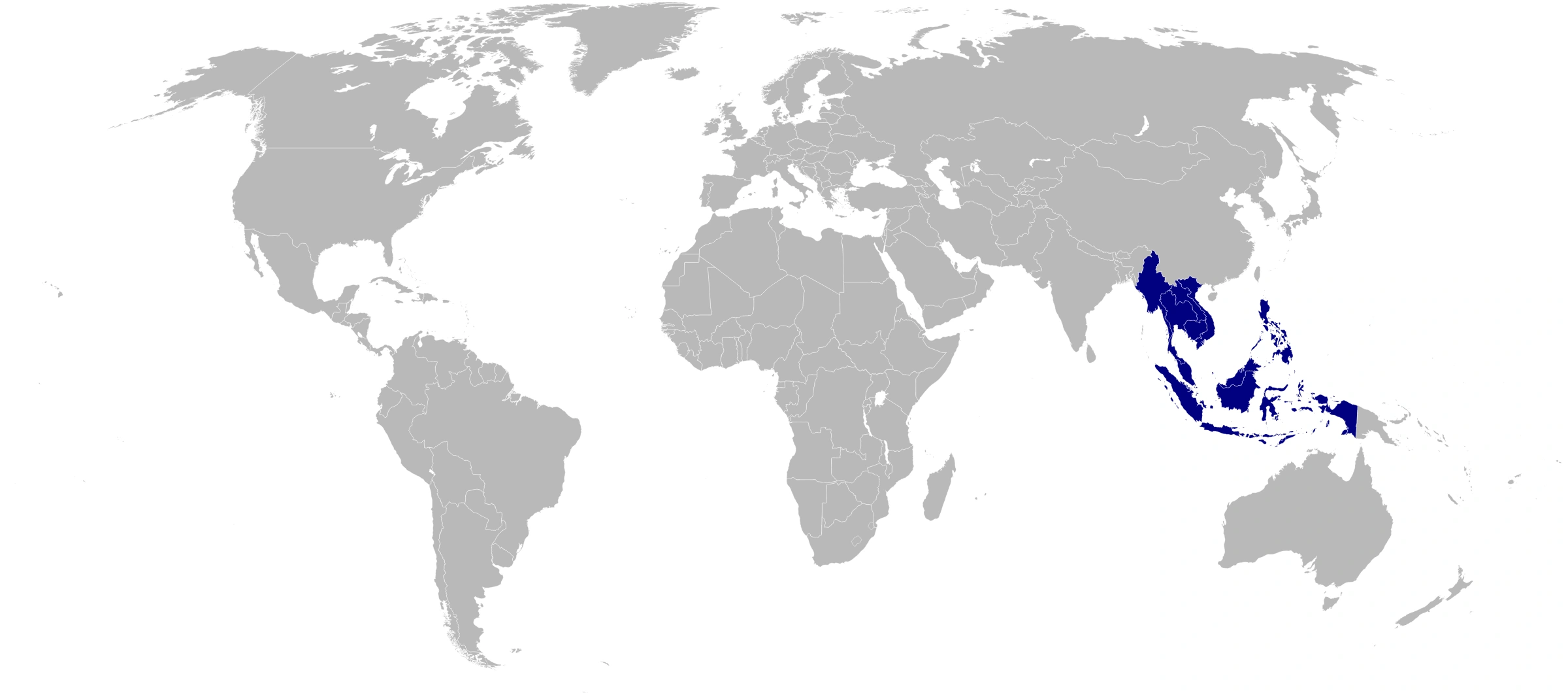
Map study
ASEAN geography as depicted in the source map: compare mainland and maritime Southeast Asia. Verify current membership separately.
- Read the source date and legend; distinguish territory, influence and geographic location.
- Historical boundaries and reference memberships are not live political or operational data.
Credit: Mangwanani · Public domain · sourceConverted to WebP on an opaque white background; proportionally resized without cropping. Original cartography and legend retained.
1. Meaning and diplomatic significance
Connectivity comprises physical infrastructure and the rules, institutions and services that make cross-border movement possible. Hard connectivity includes highways, rail tracks, ports, transmission lines and optical-fibre networks. Soft connectivity includes customs procedures, transport permits, interoperable payment systems, safety standards and mutual recognition of documents. A completed bridge produces limited benefits if restrictive transit rules prevent vehicles from crossing it.
For India, connectivity operationalises Neighbourhood First by creating tangible benefits for neighbouring populations. It also supports Act East by connecting eastern and northeastern India with Southeast Asia. Bangladesh, Nepal and Bhutan are especially important to subregional integration, while Myanmar provides the land bridge towards ASEAN. Maritime links with Sri Lanka and Maldives extend neighbourhood diplomacy into the Indian Ocean.
Its strategic significance lies in reducing economic isolation and increasing mutual stakes in stable relations. However, interdependence is not an automatic guarantee of political alignment. Smaller neighbours seek diversified partnerships and remain sensitive to sovereignty and asymmetry. India therefore gains more durable influence through reliable, locally valued public goods than through demands for exclusive strategic loyalty.
- Economic objective: reduce logistics costs, expand markets and facilitate regional production networks.
- Developmental objective: connect border districts and India’s Northeast to neighbouring economic centres.
- Diplomatic objective: build trust through visible, mutually beneficial cooperation.
2. Land transport and border infrastructure
India–Bangladesh connectivity illustrates the recovery of transport networks disrupted by Partition. Railway links such as Haldibari–Chilahati have been restored, while the Akhaura–Agartala cross-border rail link was inaugurated in November 2023. Such projects can shorten routes between Tripura and Bangladesh’s transport system, but inauguration must be distinguished from sustained commercial operation. Political conditions, customs arrangements and service availability determine actual utilisation.
With Nepal, the Jayanagar–Kurtha passenger rail service commenced in April 2022 and was subsequently extended to Bijalpura. Cross-border rail and road projects support trade, tourism and the movement of people within the distinctive India–Nepal open-border relationship. Integrated Check Posts combine customs, immigration and related facilities; the Land Ports Authority of India, constituted under a 2010 law, develops and manages designated land ports.
The BBIN Motor Vehicles Agreement seeks to facilitate passenger, personal and cargo vehicle movement among Bangladesh, Bhutan, India and Nepal. Bhutan’s non-ratification, influenced partly by environmental concerns, demonstrates the importance of domestic consent. Implementation requires agreed protocols, insurance arrangements and customs procedures; the agreement should not be treated as a fully operational four-country transport regime.
The India–Myanmar–Thailand Trilateral Highway would extend connectivity towards Southeast Asia. Yet difficult terrain, incomplete works and Myanmar’s conflict constrain its potential. This reveals a recurring diplomatic lesson: infrastructure construction and the political conditions needed for safe transit must advance together.
From infrastructure to regional integration
- 1. Identify shared demand and consult affected communities
- 2. Agree on financing, sovereignty safeguards and transit rules
- 3. Build infrastructure and last-mile connections
- 4. Harmonise customs, technical standards and documentation
- 5. Operate reliable services with maintenance and security arrangements
- 6. Measure trade, welfare and environmental outcomes
3. Waterways, maritime links and multimodal corridors
India and Bangladesh possess a natural advantage in their interconnected river systems. The 1972 Protocol on Inland Water Transit and Trade enables movement along agreed routes and through designated ports of call. Protocol routes can connect mainland India with the Northeast through Bangladesh. Operational reliability nevertheless depends on navigable depth, dredging, terminal facilities, seasonal conditions and efficient border clearance.
Access arrangements for Bangladesh’s Chattogram and Mongla ports offer additional options for northeastern India. Their significance is not merely shorter distance: predictable access can encourage warehousing, processing and cross-border value chains. Bangladesh benefits through port services, transit-related activity and stronger demand for its logistics infrastructure. Benefits must be assessed against total transport costs rather than distance alone.
The Kaladan Multi-Modal Transit Transport Project combines a sea route from Kolkata to Sittwe, inland water transport towards Paletwa, and a road connection towards Mizoram. Sittwe port was inaugurated in May 2023. However, incomplete connectivity and insecurity in Myanmar have prevented the project from functioning as a seamless, dependable corridor. Kaladan and Bangladesh routes offer alternatives to the existing dependence on the Siliguri Corridor; they do not eliminate its strategic importance.
Across the maritime neighbourhood, the Nagapattinam–Kankesanthurai ferry link, launched in October 2023, illustrates the potential of affordable passenger connectivity with Sri Lanka. India-supported bridge infrastructure in Maldives similarly links development cooperation with everyday mobility. Commercial viability, maintenance capacity and environmental safeguards remain essential.
| Initiative | Connectivity type | Strategic relevance | Key constraint |
|---|---|---|---|
| BBIN Motor Vehicles Agreement | Road transport and transit rules | Subregional movement of passengers and cargo | Bhutan’s non-ratification and implementation protocols |
| Kaladan project | Sea, river and road | Alternative access to Mizoram through Myanmar | Conflict and incomplete corridor connectivity |
| Trilateral Highway | Road | Northeast–Myanmar–Thailand linkage | Security conditions and unfinished works |
| India–Bangladesh protocol routes | Inland waterways | Trade and transit towards northeastern India | Navigability and terminal efficiency |
| Nepal–India–Bangladesh electricity trade | Power transmission | Trilateral energy interdependence | Grid capacity, approvals and commercial coordination |
4. Energy and digital connectivity
Electricity trade is an increasingly important form of regional integration. India and Bhutan have long cooperated in hydropower development and electricity exchange. Nepal’s growing exports to India create opportunities to monetise hydropower, while Bangladesh seeks additional sources of electricity. Seasonal generation patterns and differences in demand can support mutually beneficial exchange, provided transmission capacity and commercial arrangements are adequate.
India’s Ministry of Power issued guidelines for cross-border electricity trade in 2018, followed by the Central Electricity Regulatory Commission’s cross-border trade regulations in 2019. These frameworks support electricity exchange while retaining regulatory and security scrutiny. Nepal’s 40 MW export to Bangladesh through India in November 2024 demonstrated that connectivity can move beyond bilateral projects towards trilateral cooperation.
The Motihari–Amlekhgunj petroleum-products pipeline, inaugurated in September 2019, provides a different energy-connectivity model. It reduces reliance on road tankers for supplies to Nepal and can improve delivery reliability. Pipelines and power lines, however, create long-term dependence on agreed pricing, technical standards and dispute-management mechanisms.
Digital connectivity includes fibre links, electronic customs documentation and cross-border payment acceptance. UPI services were launched in Sri Lanka in February 2024. Such initiatives can facilitate tourism and small transactions, but their reach depends on participating banks, merchants and applicable rules. Cybersecurity, data protection and grievance redress must accompany interoperability.
5. Constraints and strategic risks
Political mistrust remains the largest non-physical barrier. India–Pakistan tensions restrict overland regional integration, while SAARC’s institutional stagnation limits region-wide agreements. Changes in governments and domestic political narratives elsewhere can also delay projects or portray cooperation as excessive dependence on India. Bilateral and subregional mechanisms are more workable in many cases, but cannot entirely substitute for broader political reconciliation.
Implementation difficulties include land acquisition, contractor capacity, funding coordination, difficult terrain and weak last-mile links. Ministries, state governments, customs agencies and neighbouring administrations may work on different schedules. Border procedures and non-tariff barriers can neutralise gains from better roads. Conflict in Myanmar further demonstrates how security conditions can render completed assets underused.
Strategically, Chinese infrastructure financing and the Belt and Road Initiative influence regional choices. India objects to the China–Pakistan Economic Corridor passing through territory it claims in the former princely state of Jammu and Kashmir. Nevertheless, assessing every neighbouring project only through competition with China is inadequate. India’s credibility depends on transparent terms, respect for sovereignty, timely delivery and benefits perceived by host communities.
Environmental and social risks include habitat fragmentation, river disturbance, displacement and climate vulnerability. Border communities should not bear concentrated costs while distant commercial centres capture most benefits.
6. Policy priorities and GS-II assessment
India should prioritise completion and utilisation over announcement-driven diplomacy. Corridor planning must integrate transport infrastructure with customs reform, warehousing, feeder routes and predictable transit rights. Joint monitoring mechanisms should assess cargo volumes, journey times, reliability and local employment rather than counting only sanctioned projects.
A differentiated approach is necessary: hydropower and grid links suit Himalayan partnerships; railways and waterways offer advantages with Bangladesh; maritime and digital services are important for island neighbours. Consultation with northeastern and other border states can align diplomacy with local development needs. Climate-resilient design, transparent procurement and affordable maintenance should be built into project appraisal.
For a balanced Mains answer, connectivity should be presented as both a development instrument and a strategic relationship. Its success requires the convergence of infrastructure, institutions and trust. The strongest neighbourhood policy makes India a dependable partner while preserving the agency of neighbouring countries and ensuring that integration delivers visible gains to ordinary citizens.
Real-world case studies
Motihari–Amlekhgunj pipeline: practical development diplomacy
Inaugurated in September 2019, the approximately 69-km petroleum-products pipeline connects India and Nepal. It provides an alternative to tanker-based transport, reducing handling requirements and improving supply logistics. The diplomatic lesson is that projects addressing a recurring everyday requirement can create more visible benefits than ambitious corridors without operational services.
Trilateral electricity trade: India as a regional facilitator
In November 2024, Nepal began supplying 40 MW of electricity to Bangladesh through India’s transmission network. Although modest in scale, the arrangement demonstrated the feasibility of linking a generating country, a transit country and a purchasing country. Its wider significance lies in creating a model for regional electricity cooperation rather than merely adding another bilateral supply contract.
Previous year questions
No source-linked PYQ is available here yet. Use the practice questions below.
Practice questions
Practice MCQ 1
Consider the following statements about the BBIN Motor Vehicles Agreement: 1. It was signed in 2015. 2. All four signatories have ratified it. 3. Its effective implementation requires transport and customs arrangements beyond physical road construction. Which statements are correct?
- A. 1 and 2 only
- B. 2 and 3 only
- C. 1 and 3 only
- D. 1, 2 and 3
Practice MCQ 2
Which sequence correctly represents the broad route of the Kaladan Multi-Modal Transit Transport Project from India’s eastern coast towards Mizoram?
- A. Kolkata–Sittwe–Paletwa–Mizoram
- B. Kolkata–Chattogram–Kathmandu–Mizoram
- C. Chennai–Colombo–Mae Sot–Mizoram
- D. Kolkata–Mongla–Thimphu–Mizoram
Practice MCQ 3
Which of the following are examples of soft connectivity? 1. Harmonised customs documentation 2. Mutual recognition of transport permits 3. Construction of a railway bridge 4. Interoperable digital payment standards Select the correct answer.
- A. 1 and 3 only
- B. 2 and 4 only
- C. 1, 2 and 4 only
- D. 1, 2, 3 and 4
Mains practice · Connectivity can transform India’s neighbourhood diplomacy only when infrastructure is supported by institutions and political trust. Discuss with suitable examples. Answer in 250 words.
- Define connectivity to include transport, energy, digital networks and regulatory arrangements.
- Explain benefits for trade, northeastern development, energy security and people-to-people ties.
- Use BBIN to illustrate the importance of domestic consent and operational protocols.
- Contrast Kaladan’s implementation challenges with the operational benefits of the Motihari–Amlekhgunj pipeline.
- Discuss trilateral electricity trade as an example of institutional coordination.
- Examine sovereignty concerns, political instability, environmental costs and implementation delays.
- Recommend reliable delivery, customs harmonisation, local consultation and outcome-based monitoring.
Further reading
- Ministry of External Affairs: Annual Reports and bilateral briefs on Bangladesh, Nepal, Bhutan, Myanmar, Sri Lanka and Maldives.
- Ministry of Ports, Shipping and Waterways and Inland Waterways Authority of India: material on the India–Bangladesh Protocol on Inland Water Transit and Trade.
- Ministry of Power: Guidelines for Import/Export (Cross Border) of Electricity, 2018.
- Central Electricity Regulatory Commission: Cross Border Trade of Electricity Regulations, 2019, with subsequent amendments.
- Land Ports Authority of India: annual reports and Integrated Check Post project information.
- BIMSTEC Secretariat: BIMSTEC Master Plan for Transport Connectivity.
Preparing for UPSC Civil Services? Get classroom teaching, answer-writing evaluation and mentorship at Pragnya IAS Academy, Ashok Nagar — see why aspirants choose us for IAS coaching in Hyderabad.