

Road on Farakka Barrage across the Padma river located in Farakka, Murshidabad district
Credit: Pinakpani · CC BY-SA 4.0 · source

Reflection of Bakain tree (Melia azedarach) near the pond of Kuruwapari Chaudharitol- Inaruwa, Kosi Municipality. Inaruwa इनरुवा is the headquarters of Sunsari District in Nepal. It merged with severa
Credit: Bijay Chaurasia · CC BY-SA 4.0 · source
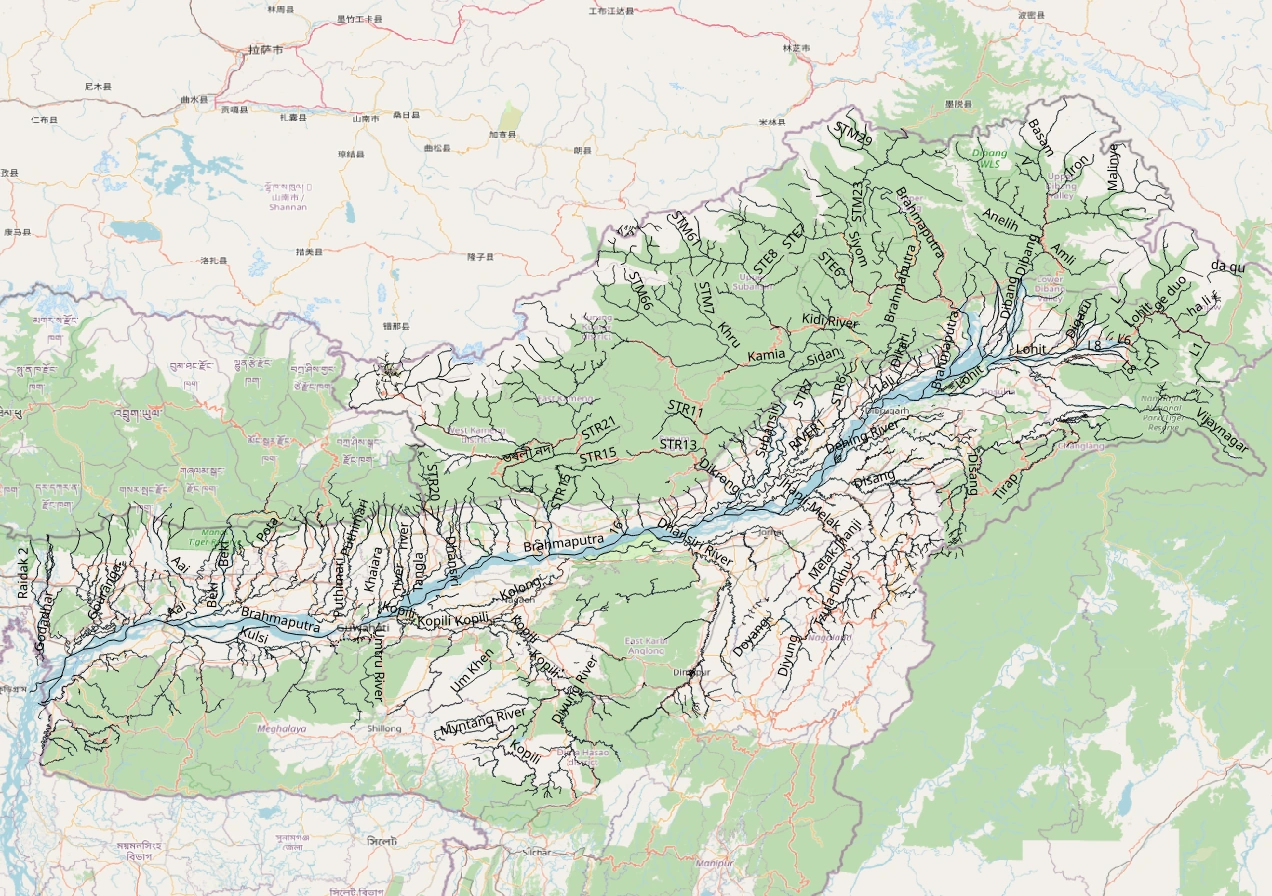
Map study
Brahmaputra basin: trace the transboundary river through Tibet, India and Bangladesh, relating mountain relief and floodplains to flood risk.
- Read the source legend, scale and reference period before comparing regions.
- Connect spatial patterns to the processes discussed in this topic; this map is a study reference, not live operational data.
Credit: Heinz OSM · ODbL · sourceConverted to WebP on an opaque white background; proportionally resized without cropping. Original cartography and legend retained.
1. Why shared rivers matter strategically
South Asia’s rivers are simultaneously economic lifelines and sources of strategic vulnerability. The Indus supports irrigated agriculture in India and Pakistan; the Ganga-Brahmaputra-Meghna system sustains densely populated plains and the Bangladesh delta. Tributaries originating in Nepal and Bhutan provide hydropower opportunities but also transmit floods across borders. Monsoon seasonality produces a recurring contradiction: destructive surpluses during the rains and politically contentious shortages during the dry season.
India cannot apply a uniform upper-riparian doctrine across its neighbourhood. It is downstream of China on the Brahmaputra and Sutlej, downstream of Nepal on several Ganga tributaries, and upstream of Bangladesh on many shared rivers. Credible diplomacy therefore requires consistency: development rights should be accompanied by information sharing, reasonable consideration of downstream interests and cooperation over transboundary risks.
Water disputes are rarely explained by scarcity alone. Historical mistrust, security crises, competing crop patterns, infrastructure choices and inadequate data can transform technical disagreements into questions of sovereignty. Conversely, river cooperation can create durable channels of communication even when broader political relations deteriorate.
Timeline
1960
India and Pakistan sign the Indus Waters Treaty.
1972
India and Bangladesh establish the Joint Rivers Commission.
1996
India signs the Mahakali Treaty with Nepal and the Ganges Water Sharing Treaty with Bangladesh.
2006
India and China establish an Expert-Level Mechanism on transborder rivers.
23 April 2025
India announces that the Indus Waters Treaty will be held in abeyance; Pakistan disputes the decision.
2. Pakistan: the Indus framework and its strategic stress
The Indus Waters Treaty was signed in Karachi on 19 September 1960 by Jawaharlal Nehru and Ayub Khan, with the World Bank also a signatory for specified purposes. It assigned the eastern rivers—Ravi, Beas and Sutlej—to India and the western rivers—Indus, Jhelum and Chenab—to Pakistan, while permitting specified Indian uses of western-river waters. These include domestic and non-consumptive uses, limited agricultural use, and hydropower subject to treaty conditions.
Its institutional architecture includes the Permanent Indus Commission and procedures for resolving questions, differences and disputes. Depending on their nature and treaty provisions, issues may go to a Neutral Expert or a Court of Arbitration. The World Bank has defined procedural responsibilities; it is not a general guarantor empowered to decide every dispute. Projects such as Kishenganga and Ratle illustrate how reservoir design, pondage and outlet specifications become politically sensitive.
Following the Pahalgam terrorist attack, India announced on 23 April 2025 that the treaty would be held in abeyance until Pakistan credibly and irrevocably abjures support for cross-border terrorism. Pakistan rejected this position. The treaty contains no express unilateral suspension clause and provides for termination through a duly ratified treaty between the governments, making the announcement legally and diplomatically contested. It should not be equated with instant physical control over all western-river flows: diversion and storage depend on infrastructure, geography and time.
Designing a durable transboundary water arrangement
- 1. Establish jointly verified basin data and seasonal water availability
- 2. Consult riparian governments, Indian states and affected communities
- 3. Assess water demand, ecological flows and disaster risks
- 4. Negotiate allocations, benefit sharing and drought procedures
- 5. Create monitoring, notification and dispute-resolution mechanisms
- 6. Review implementation against agreed scientific and social indicators
3. Bangladesh: dry-season allocation and domestic federalism
India and Bangladesh established their Joint Rivers Commission in 1972. Their principal allocation instrument is the Ganges Water Sharing Treaty, signed on 12 December 1996 for 30 years. It provides for sharing at Farakka during 1 January–31 May through ten-day periods and an availability-based formula, alongside monitoring and consultation arrangements. Its 2026 renewal horizon makes dependable flow data, changing water demands and ecological requirements especially important.
The Teesta remains the most prominent unresolved allocation issue. A proposed interim agreement was not concluded during the Indian Prime Minister’s 2011 visit to Bangladesh amid objections from West Bengal. Lean-season flows support irrigation in northern West Bengal and northwestern Bangladesh. A credible settlement requires reliable availability estimates, realistic agricultural demand management and consultation with affected communities rather than an allocation formula detached from basin conditions.
Smaller agreements demonstrate the scope for incremental cooperation. In 2019, the countries signed an MoU permitting India to withdraw 1.82 cusecs from the Feni River for drinking-water supply to Sabroom in Tripura. A 2022 MoU addressed withdrawal from the common border stretch of the Kushiyara. Within India, water is principally a State List subject, subject to Union powers over inter-state rivers, while foreign affairs and treaties are Union responsibilities. State governments do not possess a general constitutional veto over treaties, but their cooperation is often indispensable for implementation.
| Neighbour | Principal framework | Central concern |
|---|---|---|
| Pakistan | Indus Waters Treaty, 1960; subject to India's 2025 abeyance announcement | Treaty status, permitted uses and project disputes |
| Bangladesh | Joint Rivers Commission and Ganges Treaty, 1996 | Lean-season allocation, Teesta and delta ecology |
| Nepal | Kosi, Gandak and Mahakali agreements | Multipurpose projects, benefit sharing and flood management |
| Bhutan | Project-based hydropower agreements | Electricity trade, financing and ecological safeguards |
| China | Hydrological-data arrangements and expert dialogue | Upstream infrastructure, transparency and early warning |
4. Nepal, Bhutan and China: cooperation beyond allocation
India-Nepal water relations encompass the Kosi Agreement of 1954, revised in 1966; the Gandak Agreement of 1959, amended in 1964; and the Mahakali Treaty of 1996. The Mahakali framework covers the Sarada and Tanakpur barrages and the proposed Pancheshwar multipurpose project. Despite potential gains from electricity, irrigation and flood moderation, implementation has faced disagreements over benefit assessment, costs, rehabilitation and perceived asymmetry between the neighbours.
India-Bhutan cooperation is primarily organised around hydropower development and electricity trade rather than a broad volumetric allocation treaty. Projects such as Tala and Mangdechhu generate export revenue for Bhutan and supply electricity to India. Future cooperation must account for financing risks, geological uncertainty, aquatic ecology and glacial lake outburst floods, rather than treating installed capacity as the sole measure of success.
India and China have no comprehensive water-sharing treaty. Cooperation has included arrangements for flood-season hydrological information on the Brahmaputra and Sutlej and an Expert-Level Mechanism established in 2006. Chinese infrastructure on the Yarlung Tsangpo, which enters India as the Siang and later forms part of the Brahmaputra system, raises concerns about transparency, sediment, flow regulation and seismic risks. However, downstream rainfall and tributaries also contribute substantially to the basin; alarmist claims that upstream control alone can simply dry up the entire Brahmaputra are hydrologically misleading.
5. Principles and priorities for resilient water diplomacy
International water law provides useful principles: equitable and reasonable utilisation, prevention of significant transboundary harm, cooperation and information exchange. Equitable use does not mean equal division; relevant considerations include population dependence, existing uses, ecological requirements and available alternatives. India is not a party to the 1997 UN Convention on the Law of the Non-Navigational Uses of International Watercourses. Specific bilateral obligations must therefore be distinguished from convention provisions and applicable customary rules.
Climate change increases uncertainty through altered precipitation, glacier retreat, extreme floods and changing seasonal flows. Treaties based mainly on historical water volumes may inadequately address drought, groundwater-surface water interactions, sediment or environmental flows. Adaptive arrangements should use jointly verified data, periodic scientific reviews, agreed drought procedures and reliable emergency notification without automatically reopening every political bargain.
The practical way forward is to shift from dividing water alone to sharing benefits. Joint hydropower, flood forecasting, navigation, wetland protection and efficient irrigation can expand mutual gains. India should institutionalise consultation with states, strengthen basin research and include local livelihoods in project appraisal. A sound approach combines national security with technical credibility: protect essential interests while preserving channels that reduce accidental harm and sustain long-term regional trust.
Real-world case studies
Kishenganga arbitration: hydropower and downstream flows
In its 2013 awards, the Court of Arbitration permitted India's Kishenganga diversion for hydropower subject to conditions, including a minimum downstream flow of 9 cubic metres per second. The case illustrates how treaty interpretation can reconcile an upstream development entitlement with downstream requirements.
The 2008 Kosi flood: infrastructure as a shared responsibility
An embankment breach near Kusaha in Nepal in August 2008 caused the Kosi to shift into an older channel, devastating large areas of Bihar. The disaster highlighted the importance of cross-border inspection, maintenance access, forecasting and emergency coordination beyond formal allocation rules.
Previous year questions
UPSC Mains 2016 · GS-II
Present an account of the Indus Water Treaty and examine its ecological, economic and political implications in the context of changing bilateral relations.
- Explain the allocation of eastern and western rivers and specified exceptions.
- Outline the Permanent Indus Commission and dispute-resolution arrangements.
- Assess irrigation dependence, hydropower opportunities and ecological flows.
- Discuss the relationship between treaty cooperation and bilateral security tensions.
- For contemporary preparation, separately update the analysis with India's April 2025 announcement.
Practice questions
Practice MCQ 1
Which group consists exclusively of the western rivers under the Indus Waters Treaty?
- A. Ravi, Beas and Sutlej
- B. Indus, Jhelum and Chenab
- C. Indus, Ravi and Chenab
- D. Jhelum, Beas and Sutlej
Practice MCQ 2
Consider the following statements: 1. The 1996 Ganges Treaty provides for dry-season sharing at Farakka. 2. The Mahakali Treaty is an agreement between India and Bangladesh. 3. India and China have a comprehensive river-water allocation treaty. Which statements are correct?
- A. 1 only
- B. 1 and 2 only
- C. 2 and 3 only
- D. 1, 2 and 3
Practice MCQ 3
Which measure best illustrates benefit sharing rather than only volumetric water sharing?
- A. Permanently dividing annual river discharge into equal halves
- B. Restricting negotiations exclusively to irrigation withdrawals
- C. Combining electricity trade, flood moderation and navigation benefits
- D. Replacing joint monitoring with unilateral flow estimates
Mains practice · India's neighbourhood water diplomacy must move from allocation-centric agreements towards climate-resilient benefit sharing. Discuss with reference to federal constraints and regional security. Answer in 250 words.
- Introduce India's varying upper- and lower-riparian positions.
- Use the Indus, Ganges-Teesta and Nepal hydropower frameworks as contrasting examples.
- Explain state consultation, livelihood dependence and implementation constraints.
- Examine climate uncertainty, sediment, ecological flows and disaster risks.
- Recommend shared data, drought protocols, multipurpose cooperation and credible dispute settlement.
- Conclude by balancing sovereignty, security and equitable regional cooperation.
Further reading
- Ministry of External Affairs: Indus Waters Treaty text and official statements on India’s neighbourhood relations, mea.gov.in.
- Ministry of External Affairs: Foreign Secretary’s statement on the Cabinet Committee on Security decision, 23 April 2025.
- Ministry of Jal Shakti: International cooperation and transboundary river material, jalshakti-dowr.gov.in.
- World Bank: Indus Waters Treaty overview and explanation of the Bank’s role, worldbank.org.
- Permanent Court of Arbitration: Indus Waters Kishenganga Arbitration awards, pca-cpa.org.
- United Nations: Convention on the Law of the Non-Navigational Uses of International Watercourses, 1997, legal.un.org.
Preparing for UPSC Civil Services? Get classroom teaching, answer-writing evaluation and mentorship at Pragnya IAS Academy, Ashok Nagar — see why aspirants choose us for IAS coaching in Hyderabad.