
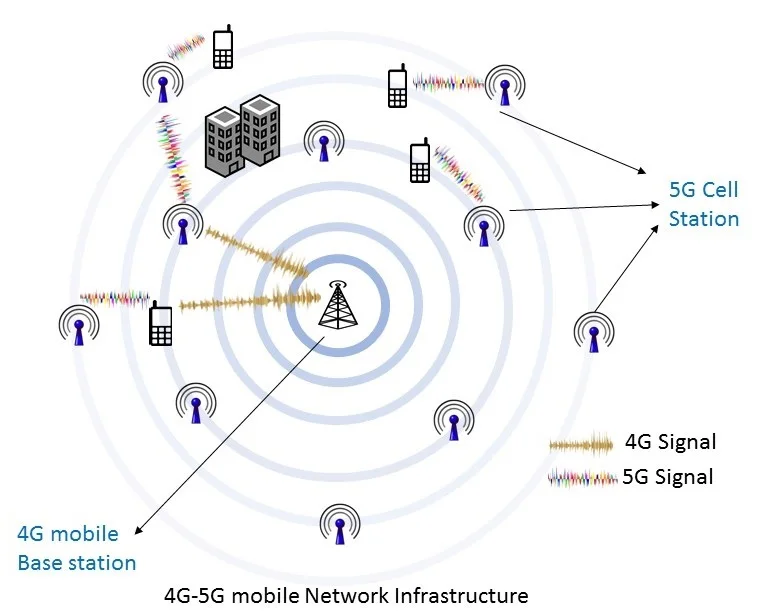
Illustrative 4G–5G mobile network design diagram.
Credit: Goodtiming8871 · CC BY-SA 4.0 · sourceResized and converted to WebP; uncropped.
1. Meaning, standards and evolution
5G is a mobile network generation rather than a single frequency, device or application. Its main radio interface is called 5G New Radio, or NR. Compared with 4G, it supports more flexible radio operation, wider channels where spectrum permits, advanced antenna systems and a network architecture designed for diverse services. A compatible handset alone is insufficient: suitable spectrum, network coverage, operator provisioning and supporting infrastructure are also necessary.
The International Telecommunication Union, particularly its Radiocommunication Sector, establishes the IMT-2020 framework and evaluates radio-interface technologies. The 3rd Generation Partnership Project, or 3GPP, develops detailed specifications through successive releases. Release 15 established the initial 5G specifications, while subsequent releases expanded industrial and other capabilities. IMT-2020 and 3GPP should therefore not be treated as competing mobile operators or interchangeable organisations.
The generational progression is broadly from analogue voice in 1G to digital voice in 2G, mobile internet in 3G and all-IP mobile broadband in 4G. 5G extends broadband while also addressing machine communications and services requiring high reliability. Its headline capabilities are not simultaneously available everywhere: performance depends on spectrum bandwidth, network design, congestion, device capability and distance from the base station.
- Throughput is the data transferred per unit time; latency is the time taken for communication or processing.
- Peak data rate, experienced user speed and end-to-end application latency are different measurements.
Timeline
2015
ITU adopted the IMT-2020 vision framework, outlining major usage scenarios for the next mobile generation.
2017–2018
3GPP completed initial non-standalone and standalone 5G specifications under Release 15.
2022
India conducted a major spectrum auction that included bands central to 5G deployment.
1 October 2022
Commercial 5G services were launched in India.
October 2023
One hundred 5G application laboratories were inaugurated in Indian educational institutions.
2. Spectrum and enabling technologies
Radio spectrum is a finite resource allocated and assigned for different uses. Low-band spectrum, generally below 1 GHz, provides broad coverage and comparatively good building penetration, but usually offers narrower available bandwidth. Mid-band spectrum, especially around 3.5 GHz, balances coverage and capacity. High-frequency bands provide wide bandwidth and high capacity, but signals are more easily blocked and typically require denser deployment.
Millimetre waves strictly correspond to frequencies of roughly 30–300 GHz. In commercial 5G terminology, nearby bands such as 26 and 28 GHz are also commonly grouped within the millimetre-wave category. This distinction is useful for Prelims: neither all 5G spectrum nor every commercially labelled 5G millimetre-wave band fits a simplistic definition. A high carrier frequency enables access to wider channels but does not itself guarantee faster service.
Massive MIMO uses large antenna arrays to transmit and receive multiple spatial streams. Beamforming adjusts antenna signals to concentrate radio energy in selected directions, improving signal quality and spectrum reuse. Small cells supplement larger base stations in crowded or coverage-constrained locations. Fibre backhaul connects radio sites to the wider network, although microwave and other wireless links can also provide backhaul. Consequently, 5G is not a completely wireless infrastructure.
- Spectrum refarming repurposes an existing band for another mobile technology.
- Dynamic spectrum sharing can allow 4G and 5G to use the same spectrum resources dynamically.
- Coverage, capacity and cost must be assessed together when selecting a spectrum band.
Simplified data path in a standalone 5G network
- 1. A compatible device sends or receives data using an assigned radio band.
- 2. A 5G base station, called a gNodeB, manages the radio connection.
- 3. Transport infrastructure carries traffic between the radio network and the 5G Core.
- 4. The core authenticates users, manages sessions and routes data.
- 5. An edge platform or external data network hosts the required application.
3. Architecture and service categories
Non-standalone, or NSA, 5G typically combines 5G radio access with an existing 4G core and a 4G control anchor. This permits faster deployment by reusing infrastructure. Standalone, or SA, 5G connects 5G radio access to a 5G Core, providing a stronger foundation for advanced functions such as flexible network slicing. NSA is nevertheless genuine 5G; the distinction concerns architecture rather than whether the radio technology qualifies as 5G.
Network slicing creates logically separated networks over shared physical infrastructure. Different slices can be configured for different performance or security requirements, such as industrial control and ordinary mobile broadband. Slicing does not necessarily mean separate physical towers or dedicated spectrum for each service. Multi-access edge computing places computation nearer users or devices, reducing transport delay and limiting the need to send every task to a distant cloud centre.
The three principal service categories describe different priorities. Enhanced Mobile Broadband, or eMBB, supports high-capacity internet access, immersive media and fixed wireless access. Ultra-Reliable and Low-Latency Communications, or URLLC, targets time-sensitive applications such as industrial control. Massive Machine-Type Communications, or mMTC, supports large populations of connected sensors. These categories are complementary design goals, not guarantees that every commercial deployment supports every capability.
- The IMT-2020 connection-density requirement is one million devices per square kilometre under specified evaluation conditions.
- The often-cited 1 millisecond latency figure concerns a defined radio-interface target for URLLC, not universal end-to-end internet delay.
| Spectrum layer | Indian example | Main advantage | Main limitation |
|---|---|---|---|
| Low band | 700 MHz | Wide coverage and comparatively good indoor penetration | Typically less available channel bandwidth |
| Mid band | 3.3–3.67 GHz | Balance between coverage and capacity | Requires more sites than low band for comparable coverage |
| High band, commonly marketed as millimetre wave | 26 GHz | Wide bandwidth and high local capacity | Shorter reach and greater sensitivity to obstruction |
4. India’s deployment and development relevance
India launched commercial 5G services on 1 October 2022 at the India Mobile Congress in New Delhi. The 2022 spectrum auction assigned spectrum across several bands, including important 5G bands at 700 MHz, 3.3–3.67 GHz and 26 GHz. Operators initially adopted differing deployment strategies: Reliance Jio emphasised standalone architecture, while Bharti Airtel initially used a non-standalone approach.
The Department of Telecommunications administers telecommunications policy, licensing and spectrum-related functions, while the Telecom Regulatory Authority of India provides regulatory recommendations and performs statutory regulatory functions. Domestic capability is being promoted through telecom research, testing facilities and manufacturing initiatives. The Telecom Technology Development Fund, launched in 2022, supports indigenous technology development, particularly for affordable broadband and mobile services in rural and remote areas.
Potential applications include connected manufacturing, logistics tracking, precision agriculture, remote equipment monitoring and augmented-reality training. Fixed wireless access can provide broadband to premises without a last-mile fibre connection. In healthcare, 5G can support high-resolution imaging and connected ambulances, but remote surgery requires much more than fast connectivity: clinical validation, dependable systems, trained personnel and clear liability arrangements are indispensable. In agriculture, inexpensive sensors and reliable power may matter more than maximum download speed.
- The Union Budget 2023–24 announced 100 laboratories in engineering institutions for developing applications using 5G services; these were inaugurated in October 2023.
- The amended BharatNet programme, approved in 2023, complements mobile connectivity through rural broadband infrastructure, but BharatNet is not itself a 5G mobile network.
5. Limitations, security and public-interest issues
Deployment requires substantial investment in spectrum, radio equipment, fibre, reliable electricity and site access. Dense urban deployment may be commercially attractive, whereas sparsely populated areas can remain underserved. Right-of-way permissions and infrastructure sharing therefore influence rollout costs. The Telecommunications (Right of Way) Rules, 2024, effective from 1 January 2025, provide a framework for establishing telecommunications infrastructure, including relevant provisions for small cells and street furniture.
Virtualised networks, software interfaces, cloud infrastructure and billions of connected devices expand the cybersecurity attack surface. Risks include insecure Internet of Things devices, supply-chain vulnerabilities, denial-of-service attacks and misconfigured network functions. Encryption and subscriber-identity protection can improve security, but no generation eliminates cyber risk. Data protection also remains essential when networks support location tracking, healthcare services or large-scale industrial monitoring.
5G radiofrequency radiation is non-ionising: it does not have enough photon energy to ionise atoms as X-rays can. This does not mean exposure is unregulated; safety standards address established effects such as heating at sufficiently high exposure levels. India monitors compliance with prescribed electromagnetic-field limits through the Department of Telecommunications. Environmental assessment must also distinguish lower energy consumption per unit of data from total energy use, which may rise as traffic, sites and connected devices increase.
- Exam caution: 5G does not automatically replace Wi-Fi, optical fibre or satellite communication.
- Technology adoption must balance innovation with affordability, cybersecurity, privacy, resilient infrastructure and electronic-waste management.
5G: Spectrum, Architecture and Applications
The metadata identifies this image as a 4G–5G mobile network design diagram, making it relevant to understanding the architectural transition. A mobile network combines radio access, which connects devices to base stations, with a core network that manages connectivity, authentication and traffic. In non-standalone deployment, 5G radio access relies on existing 4G infrastructure, including its core; standalone 5G uses a 5G core. This distinction matters because introducing a new radio interface alone does not deliver every advanced 5G capability.
5G supports three broad service categories: enhanced mobile broadband, ultra-reliable low-latency communication and massive machine-type communication. These address different requirements rather than guaranteeing maximum speed, minimum delay and enormous device density simultaneously. For India, potential applications include industrial automation, connected logistics and remote healthcare, but outcomes depend on spectrum availability, fibre or other high-capacity backhaul, compatible devices, affordability and cybersecurity. A generic network diagram illustrates concepts; it does not establish the configuration, coverage or measured performance of any Indian operator.
- Spectrum trade-off: Lower frequencies generally offer wider coverage and better building penetration; higher frequencies can provide greater bandwidth but typically require denser deployment.
- Latency distinction: Low radio-interface delay is not the same as low end-to-end application delay. Transport networks, core processing and server location also matter; edge computing can help.
- Architecture versus application: Network slicing enables logically differentiated networks over shared infrastructure. It is not simply spectrum division, and 5G availability alone does not make safety-critical services reliable.
Real-world case studies
Indigenous 5G testbed
In May 2022, India inaugurated an indigenous 5G testbed developed through a multi-institutional project led by IIT Madras. It provides a setting for testing domestic products and solutions, reducing dependence on overseas testing facilities. It demonstrates why standards compliance, interoperability and research infrastructure matter alongside commercial network rollout.
Private 5G at Bosch, Bengaluru
In 2022, Bharti Airtel announced a private 5G trial at Bosch Automotive Electronics India’s Bengaluru facility using trial spectrum allotted by DoT. The trial involved industrial use cases including automated optical inspection. It illustrates enterprise-oriented 5G applications, where consistent connectivity and integration with factory systems can be more important than consumer download speeds.
Previous year questions
No source-linked PYQ is available here yet. Use the practice questions below.
Practice questions
Practice MCQ 1
With reference to 5G spectrum, consider the following statements: 1. All 5G networks require millimetre-wave spectrum. 2. Low-band spectrum generally provides wider coverage than high-band spectrum under comparable conditions. 3. High-frequency bands can offer wide channel bandwidths. Which statements are correct?
- A. 1 and 2 only
- B. 2 and 3 only
- C. 1 and 3 only
- D. 1, 2 and 3
Practice MCQ 2
Which one of the following best describes network slicing?
- A. Physically dividing each mobile tower into independent towers
- B. Reserving all low-frequency spectrum exclusively for voice calls
- C. Creating logically separated networks with different service characteristics over shared infrastructure
- D. Replacing the mobile core network with a satellite constellation
Practice MCQ 3
Consider the following pairs: 1. Massive MIMO — Multiple antennas and spatial streams 2. Edge computing — Processing closer to users or devices 3. Standalone 5G — Mandatory dependence on a 4G core. How many pairs are correctly matched?
- A. Only one
- B. Only two
- C. All three
- D. None
Mains practice · 5G is not merely an increase in mobile internet speed but an enabling infrastructure for digital transformation. Discuss its opportunities and deployment challenges in India. Suggest measures for inclusive adoption. (250 words)
- Explain eMBB, URLLC and mMTC and distinguish capabilities from deployment-specific performance.
- Discuss manufacturing, fixed wireless access, healthcare, agriculture and logistics.
- Assess spectrum costs, fibre availability, power supply, right-of-way and rural commercial viability.
- Address cybersecurity, privacy, supply-chain dependence and environmental costs.
- Suggest infrastructure sharing, domestic research and testing, skills development and affordable access.
- Conclude that public value depends on useful applications and reliable, inclusive infrastructure rather than headline speed alone.
Further reading
- ITU-R Recommendation M.2083: IMT Vision—Framework and overall objectives of the future development of IMT for 2020 and beyond.
- ITU-R Report M.2410: Minimum requirements related to technical performance for IMT-2020 radio interfaces.
- 3GPP official website: 5G System overview and Release 15 documentation.
- Department of Telecommunications: Annual Reports, spectrum auction documents and Telecommunications (Right of Way) Rules, 2024.
- TRAI: Recommendations and consultation papers on 5G spectrum and telecom infrastructure.
- World Health Organization: Radiation—5G mobile networks and health.
- https://commons.wikimedia.org/wiki/File:5G_mobile_network_diagram.jpg
Preparing for UPSC Civil Services? Get classroom teaching, answer-writing evaluation and mentorship at Pragnya IAS Academy, Ashok Nagar — see why aspirants choose us for IAS coaching in Hyderabad.