
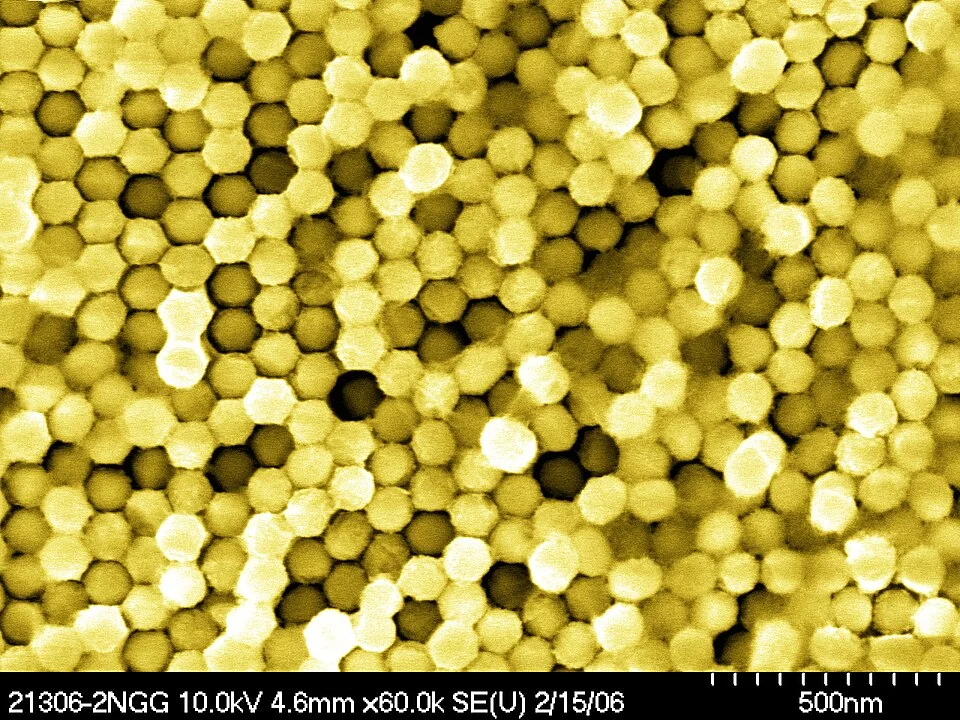
Top-view scanning electron micrograph of a gold nanowire array after removal of its hexagonal template, according to the metadata.
Credit: lacomj · CC BY-SA 2.0 · sourceResized and converted to WebP; uncropped.
1. Scientific basis and the nanoscale
Nanotechnology studies and manipulates matter at dimensions of roughly 1–100 nanometres. A human hair is generally tens of thousands of nanometres wide, while DNA’s double helix is about 2 nanometres in diameter. The range is a useful convention rather than an absolute boundary: some technologically important nanostructured systems have overall dimensions exceeding 100 nanometres. Merely being very small is insufficient; nanoscale structure or phenomena must be relevant to the material’s behaviour or application.
Two mechanisms are particularly important. First, reducing particle size increases the surface-area-to-volume ratio. A larger fraction of atoms lies at or near the surface, potentially increasing adsorption, catalytic activity and chemical reactivity. Second, quantum confinement can alter electronic and optical properties when dimensions become comparable to relevant quantum length scales. Neither mechanism affects every nanomaterial in the same way.
Consequently, nanoscale gold can display colours unlike bulk gold, and semiconductor quantum dots can emit different colours depending on their size and composition. Melting behaviour, electrical conductivity, mechanical strength and magnetic response may also change. Such properties depend not only on size but also on shape, crystal structure, surface coatings and surrounding conditions. Nanotechnology therefore does not imply that every nanosized version of a substance is automatically stronger, safer or more efficient.
- Surface effects are especially important for catalysts, adsorbents and reactive particles.
- Quantum confinement is important for the optical behaviour of semiconductor quantum dots.
- Natural nanoparticles occur in volcanic emissions and sea spray; engineered nanoparticles are deliberately designed for particular functions.
Timeline
1959
Richard Feynman delivered ‘There’s Plenty of Room at the Bottom’, discussing possibilities of manipulation at very small scales.
1974
Norio Taniguchi used the term ‘nano-technology’ in the context of precision manufacturing.
1981
Gerd Binnig and Heinrich Rohrer developed the scanning tunnelling microscope.
2001
India launched the Nano Science and Technology Initiative.
2007
India launched the Nano Mission under DST.
2019
India issued specialised guidelines for evaluating nanopharmaceuticals.
2. Materials, fabrication and characterisation
Nanomaterials are commonly classified by dimensionality. Zero-dimensional structures, such as many nanoparticles and quantum dots, are confined at the nanoscale in all three dimensions. One-dimensional structures, including nanowires and nanotubes, have two nanoscale dimensions and one extended dimension. Two-dimensional structures, such as graphene and ultrathin films, have nanoscale thickness but much larger lateral dimensions. Bulk nanostructured materials can contain nanoscale grains or pores.
Important families include carbon-based materials, metal and metal-oxide nanoparticles, semiconductor nanocrystals, and lipid- or polymer-based carriers. Graphene combines high electrical conductivity with mechanical strength, although defects and production methods affect actual performance. Carbon nanotubes have useful mechanical and electrical properties; their electronic behaviour depends on structure. Titanium dioxide and zinc oxide nanoparticles are used in some sunscreens because they attenuate ultraviolet radiation while reducing the visible whitening associated with larger particles.
Fabrication follows two broad approaches. Top-down methods reduce or pattern larger materials through techniques such as lithography, etching and mechanical milling. Bottom-up methods assemble structures from atoms, molecules or smaller building blocks through chemical synthesis, self-assembly and deposition. These approaches can be combined in manufacturing.
Characterisation establishes whether the intended nanoscale structure and performance were achieved. Electron microscopes reveal very small features; atomic force microscopy maps surfaces using a fine probe. Scanning tunnelling microscopy probes suitable conducting surfaces through quantum tunnelling. Spectroscopy, particle-size analysis and surface-area measurements provide complementary information. A microscope image alone cannot establish chemical identity, safety or suitability for a particular application.
From a nanoscale concept to a usable product
- 1. Identify the application and required properties
- 2. Select material, structure and fabrication method
- 3. Characterise size, composition, surface and stability
- 4. Test performance, toxicity and environmental behaviour
- 5. Establish reproducible production and meet applicable regulatory requirements
- 6. Monitor real-world performance and lifecycle impacts
3. Applications in health, agriculture, energy and electronics
In medicine, nanoparticles can carry drugs or nucleic acids, improve the solubility of certain compounds, protect unstable cargo and modify release or distribution. Targeting can involve biological interactions or attached ligands, but delivery exclusively to diseased cells is rarely guaranteed. Nanostructured diagnostic platforms can improve detection sensitivity, while selected nanoparticles serve as imaging agents or components of antimicrobial coatings. Each formulation requires independent evidence of efficacy and safety.
In agriculture, nanocarriers are being developed for controlled delivery of nutrients and crop-protection agents. Nanosensors may detect soil conditions, pathogens or residues. Potential benefits include improved input-use efficiency, but performance varies with soil, weather, crop and formulation. A product labelled ‘nano’ cannot be assumed to replace conventional fertiliser on an equivalent basis without field evidence and nutrient accounting.
For water treatment, nanostructured membranes and adsorbents can help remove contaminants; photocatalysts can assist degradation of some pollutants under suitable illumination. Removal is different from complete destruction, and spent media may require safe disposal. In energy systems, nanostructured electrodes offer short ion-transport paths and large reaction surfaces in batteries and supercapacitors. Nanocatalysts can improve fuel-cell reactions and hydrogen production, although cost, stability and scale remain constraints.
Electronics uses nanoscale transistor features, thin films and engineered interfaces. Quantum dots are used in display technologies for controlled colour emission. Nanocomposites can improve strength-to-weight ratios and barrier properties in selected applications. Nanotechnology should not be confused with quantum computing: the former concerns nanoscale materials and systems, whereas the latter uses quantum states to process information.
| Material | Key feature | Application or caution |
|---|---|---|
| Graphene | Single atomic layer of carbon arranged in a hexagonal lattice | Sensors, conductive components and composites |
| Carbon nanotubes | Cylindrical carbon structures with structure-dependent properties | Composites and electronics; inhalation hazards require material-specific assessment |
| Quantum dots | Semiconductor nanostructures with size-dependent optical properties | Displays and imaging; some compositions contain toxic metals |
| Silver nanoparticles | Antimicrobial effects influenced by particle properties and silver-ion release | Selected coatings and dressings; environmental release is a concern |
| Lipid nanoparticles | Lipid-based carriers capable of encapsulating biological cargo | Delivery of RNA and other therapeutic molecules |
4. India’s research and innovation ecosystem
India’s Department of Science and Technology initiated the Nano Science and Technology Initiative in 2001. It was followed by the Nano Science and Technology Mission in May 2007, with an approved outlay of ₹1,000 crore for five years. The mission emphasised basic research, infrastructure, human-resource development, application-oriented projects and international collaboration. This institutional progression is more relevant for examination purposes than memorising transient laboratory rankings.
Major participants include IITs, IISc, CSIR laboratories and specialised institutions. The Institute of Nano Science and Technology at Mohali is an autonomous institution under DST. Centres for Nano Science and Engineering provide sophisticated fabrication and characterisation infrastructure. Shared facilities matter because cleanrooms, electron microscopes and precision fabrication equipment are expensive.
India’s challenge is to translate laboratory results into reproducible, affordable products. Priorities include reliable scale-up, quality assurance, industry–academia partnerships, intellectual-property management and trained technical personnel. Claims about commercial nano-products should be evaluated against independent testing, relevant regulatory approval and performance under actual Indian conditions.
5. Safety, regulation and examination perspectives
Nanotoxicology examines the adverse effects of nanoscale materials. Exposure can occur through inhalation, ingestion, skin contact or medical administration. Behaviour depends on size distribution, shape, solubility, surface charge, coating and persistence. Some particles may cross biological barriers under particular conditions; this is not a universal property. Likewise, antimicrobial activity does not establish safety for human tissues or beneficial microorganisms.
Environmental concerns include release during manufacture, use and disposal, effects on aquatic organisms and soil communities, and accumulation of persistent materials. Nanoparticles may dissolve, aggregate or acquire coatings in the environment, changing their mobility and toxicity. Certain long, rigid and biopersistent fibres warrant particular inhalation concern, but risk cannot be generalised to all nanotubes or nanomaterials.
Governance should combine lifecycle assessment, worker protection, exposure measurement and safe-by-design development. India does not rely on one comprehensive nanotechnology statute; applicable requirements depend on the product and use, including drug, food, environmental and fertiliser regulations. The Guidelines for Evaluation of Nanopharmaceuticals in India, issued in 2019 through DBT, ICMR and CDSCO, provide a specialised evaluation framework.
For Prelims, distinguish hazard from risk: hazard is the potential to cause harm, while risk also depends on exposure. Avoid absolute statements such as ‘all nanoparticles are toxic’, ‘all nanomaterials are biodegradable’ or ‘nano-drugs act only on cancer cells’. Their correctness depends on the particular material and application.
Gold Nanowires: Nanoscale Structure and Function
A gold nanowire array illustrates how nanotechnology involves engineered geometry, not merely miniaturisation. Nanowires generally have nanoscale transverse dimensions but may be much longer than 100 nanometres; every dimension need not fall within the nanoscale range. The supplied metadata identifies a scanning electron micrograph taken from above and states that the original hexagonal template was etched away. This describes template-assisted fabrication, in which a scaffold guides material formation before being removed. However, without a scale bar or dimensional measurements, the metadata alone cannot establish wire diameter or spacing.
Gold nanostructures are studied for electrical, optical and surface-dependent behaviour, with potential uses in sensing, electrodes and biomedical research. Their properties depend on size, shape, arrangement and surface chemistry, so an array image does not by itself demonstrate a working device or a quantum effect. For India, the broader relevance lies in materials research supported through initiatives such as the Nano Mission and in translating laboratory fabrication into reliable technologies. Scalable production, reproducibility, cost and lifecycle safety remain important considerations; the metadata establishes no Indian origin or application for this particular array.
- Prelims distinction: nanowires are commonly classified as one-dimensional nanostructures because two dimensions are nanoscale while the third is extended.
- Evidence limit: electron microscopy characterises morphology; composition, conductivity, toxicity and device performance require additional measurements.
- Mains linkage: assess nanotechnology through both applications and governance, including occupational exposure, environmental release and disposal; bulk gold’s relative inertness does not establish nanoparticle safety.
Real-world case studies
Lipid nanoparticles in mRNA vaccines
The Pfizer–BioNTech and Moderna COVID-19 vaccines use lipid nanoparticles to package mRNA, protect it from degradation and facilitate delivery into cells. These carriers illustrate a clinically deployed nanotechnology application. Their success does not mean that all nanoparticle carriers are interchangeable: lipid composition, formulation stability, dose and manufacturing quality affect performance.
IFFCO Nano Urea in India
IFFCO commercially launched Nano Urea Liquid in 2021 after its inclusion under the Fertiliser Control Order framework. The foliar product illustrates attempts to use nanotechnology for nutrient-use efficiency. Its agronomic assessment must account for nutrient concentration, basal fertilisation, crop response and independent field results; a volume-based claim of equivalence with conventional urea is not a simple nitrogen-mass equivalence.
Previous year questions
UPSC Mains 2020 · General Studies III
What do you understand by nanotechnology and how is it helping in the health sector?
- Define nanoscale manipulation and explain size-dependent properties.
- Discuss drug delivery, diagnostics, imaging, antimicrobial materials and regenerative-medicine research.
- Explain the significance of protecting therapeutic cargo and improving delivery.
- Conclude with toxicity testing, affordability, manufacturing quality and regulatory oversight.
Practice questions
Practice MCQ 1
With reference to the properties of nanomaterials, consider the following statements: 1. Reducing particle size generally increases the surface-area-to-volume ratio. 2. Quantum confinement can influence the optical properties of semiconductor nanocrystals. 3. Every nanoscale material has greater electrical conductivity than its bulk counterpart. Which of the statements given above are correct?
- A. 1 and 2 only
- B. 2 and 3 only
- C. 1 and 3 only
- D. 1, 2 and 3
Practice MCQ 2
Which one of the following best illustrates a bottom-up approach in nanotechnology?
- A. Milling a bulk solid into progressively smaller particles
- B. Etching a pattern into a semiconductor wafer
- C. Assembling molecules into an organised nanoscale structure
- D. Cutting a bulk material into thin sections
Practice MCQ 3
Consider the following statements: 1. Lipid nanoparticles can protect nucleic-acid cargo and facilitate cellular delivery. 2. Antimicrobial activity alone proves that a nanoparticle is safe for humans. 3. Nanomaterial risk assessment should consider both material properties and exposure. Which of the statements given above are correct?
- A. 1 only
- B. 2 and 3 only
- C. 1 and 3 only
- D. 1, 2 and 3
Mains practice · Nanotechnology offers opportunities for public health and sustainable development, but its benefits depend on responsible innovation. Discuss with reference to India. Answer in 250 words.
- Introduce the nanoscale and its distinctive surface and quantum effects.
- Explain applications in therapeutics, diagnostics, water treatment, energy storage and agricultural inputs.
- Mention the Nano Mission, shared research infrastructure and translation challenges.
- Assess material-specific toxicity, occupational exposure, environmental release and uncertain field performance.
- Recommend independent validation, safe-by-design approaches, lifecycle assessment and proportionate sectoral regulation.
Further reading
- Department of Science and Technology: Nano Mission programme information, dst.gov.in.
- Department of Biotechnology, ICMR and CDSCO: Guidelines for Evaluation of Nanopharmaceuticals in India, 2019.
- Institute of Nano Science and Technology, Mohali: research and institutional information, inst.ac.in.
- NCERT Chemistry, Class XII: Surface Chemistry, in editions containing this chapter, for adsorption and catalysis fundamentals.
- US National Nanotechnology Initiative: Nanotechnology 101, nano.gov.
- World Health Organization: WHO Guidelines on Protecting Workers from Potential Risks of Manufactured Nanomaterials, 2017.
- https://commons.wikimedia.org/wiki/File:Gold_Nanowire_Array.jpg
Preparing for UPSC Civil Services? Get classroom teaching, answer-writing evaluation and mentorship at Pragnya IAS Academy, Ashok Nagar — see why aspirants choose us for IAS coaching in Hyderabad.