
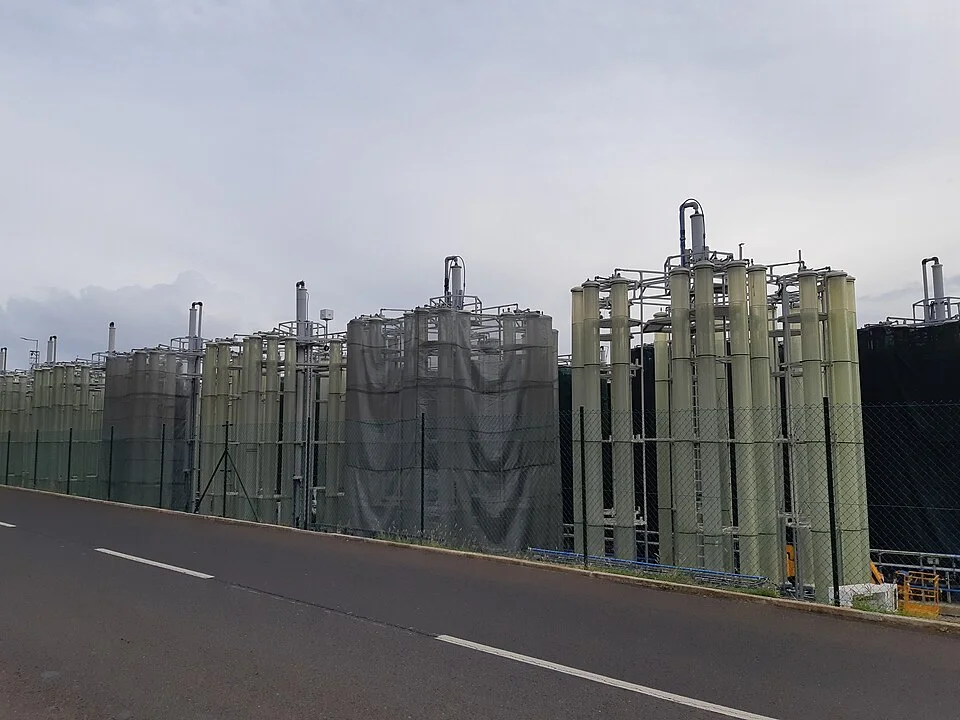
Seaweed biofuel project in Porto Santo, Portugal: a comparative example of marine biomass use.
Credit: Asurnipal · CC BY-SA 4.0 · sourceResized and converted to WebP; uncropped.
1. Meaning, classification and major fuels
Biomass is biological material derived from plants, animals and microorganisms. Biofuels convert its stored chemical energy into usable solid, liquid or gaseous fuels. Traditional firewood and dung cakes are biomass fuels, but modern biofuel programmes emphasise processed fuels with controlled quality, higher conversion efficiency and compatibility with transport or industrial systems. Renewable origin does not, by itself, establish environmental sustainability.
First-generation biofuels use readily accessible sugars, starches or oils, commonly from sugarcane, maize and vegetable oils. They rely on relatively mature technologies but may compete with food and feed. Second-generation fuels generally use lignocellulosic biomass such as rice straw, wheat straw, bagasse and woody residues. Waste oils are also commonly placed in advanced or second-generation categories, although classification differs across sources.
Third-generation biofuels are generally associated with algae, which can supply oils, carbohydrates and other fuel precursors. Fourth-generation approaches involve advanced genetic engineering, synthetic biology and, in some classifications, integrated carbon capture. These labels are not globally standardised; neither algae nor engineered organisms guarantee commercial viability.
- Bioethanol: an oxygen-containing alcohol blended with petrol; ethanol has lower energy content per litre than petrol.
- Biodiesel: fatty acid alkyl esters, usually methyl esters, produced from oils or fats.
- Biogas: a methane-rich mixture also containing carbon dioxide and impurities; upgrading produces biomethane.
- Renewable diesel: hydrocarbon fuel commonly produced by hydrotreating oils and fats; chemically distinct from ester-based biodiesel.
Timeline
2018
National Policy on Biofuels adopted; SATAT and GOBARdhan launched.
2019
PM JI-VAN Yojana approved to support advanced biofuel deployment.
2022
Biofuel policy amendment advanced the E20 target to Ethanol Supply Year 2025–26.
2023
Global Biofuels Alliance launched at the New Delhi G20 Summit.
2. Biotechnology and conversion pathways
Ethanol production from sugar-rich feedstocks uses microorganisms such as Saccharomyces cerevisiae to ferment sugars into ethanol and carbon dioxide. Starch-rich feedstocks first require liquefaction and saccharification, commonly using amylase enzymes. Distillation concentrates the fermented ethanol, while dehydration produces fuel-grade ethanol suitable for petrol blending. Fermentation alone does not yield sufficiently dry ethanol for this purpose.
Lignocellulosic biomass contains cellulose, hemicellulose and lignin. Lignin and the compact plant-cell-wall structure hinder enzyme access. Pretreatment opens this structure; cellulases and hemicellulases then release fermentable sugars. Ordinary industrial yeast efficiently ferments glucose but does not naturally use all pentose sugars effectively. Engineered yeast or bacteria can improve mixed-sugar utilisation, inhibitor tolerance and ethanol yield. Pretreatment costs, enzyme costs and biomass collection remain important commercial constraints.
Biodiesel is normally manufactured through transesterification: triglycerides react with a short-chain alcohol, usually methanol, to form fatty acid methyl esters and glycerol. Chemical catalysts dominate commercial production, though lipase enzymes can catalyse the reaction. Thus, biofuel production is not necessarily a biological process merely because its feedstock is biological.
Biogas production depends on microbial communities operating without oxygen. Hydrolysis, acidogenesis and acetogenesis generate intermediates that methanogenic archaea convert into methane. Removing carbon dioxide, hydrogen sulphide and moisture produces biomethane; compression yields compressed biogas. Gasification and pyrolysis are alternative thermochemical routes, producing synthesis gas and bio-oil respectively, rather than relying primarily on microbes.
- Metabolic engineering redirects cellular pathways towards higher fuel production and fewer unwanted by-products.
- Algal biotechnology seeks high productivity, suitable lipid composition and economical harvesting; dewatering and nutrient supply remain major challenges.
- Methanogens are archaea, not conventional bacteria, and raw biogas is not equivalent to purified compressed biogas.
Lignocellulosic ethanol production
- 1. Collect and prepare biomass
- 2. Pretreat to improve enzyme access
- 3. Hydrolyse cellulose and hemicellulose
- 4. Ferment released sugars
- 5. Distil and dehydrate ethanol
- 6. Blend after quality testing
3. India’s policy and programme framework
The National Policy on Biofuels, 2018, broadened eligible feedstocks and encouraged advanced biofuels. Its 2022 amendment advanced the 20% ethanol-blending target from 2030 to Ethanol Supply Year 2025–26 and expanded the framework for production. Under the Ethanol Blended Petrol Programme, oil marketing companies procure ethanol for petrol blending. Sugarcane-derived streams, maize and eligible damaged or surplus foodgrains can supply ethanol, subject to applicable government permissions and procurement rules.
Pradhan Mantri JI-VAN Yojana, approved in 2019 and modified in 2024, supports advanced biofuel projects using lignocellulosic and other renewable feedstocks. Its importance lies in helping technologies cross the gap between demonstration and commercial deployment. A refinery’s commissioning, however, should not be confused with continuous operation at its rated capacity.
SATAT, launched in 2018, promotes compressed biogas production and its use as a transport fuel through an offtake-oriented framework. GOBARdhan, launched in 2018, promotes conversion of cattle dung and other organic wastes into useful resources, including biogas and organic manure. These initiatives overlap in waste-to-energy objectives but are not interchangeable schemes.
India, Brazil and the United States launched the Global Biofuels Alliance during the New Delhi G20 Summit in September 2023. It promotes international cooperation, technology exchange and sustainable biofuel deployment. Biofuel expansion must be accompanied by fuel-quality standards, safe storage, suitable vehicle materials and reliable feedstock logistics.
| Fuel | Typical feedstock | Principal process |
|---|---|---|
| First-generation ethanol | Sugarcane juice, molasses, maize | Fermentation; starch requires prior hydrolysis |
| Second-generation ethanol | Rice straw, bagasse | Pretreatment, enzymatic hydrolysis and fermentation |
| Biodiesel | Vegetable oils, used cooking oil, animal fats | Transesterification |
| Compressed biogas | Dung, segregated organic waste | Anaerobic digestion, purification and compression |
| Renewable diesel | Oils and fats | Hydrotreating and further refining |
4. Environmental and economic assessment
Biofuels can diversify energy supplies, reduce petroleum import dependence and create markets for agricultural residues. Residue-based fuels can offer an alternative to open burning, while dung- and waste-based biogas can improve sanitation and capture methane that might otherwise escape during unmanaged decomposition. Digestate can return nutrients to agriculture if appropriately processed and tested.
Lifecycle assessment must include cultivation, fertilisers, irrigation, harvesting, transport, processing, distribution and final combustion. Carbon released during combustion may have been recently absorbed by plants, but fossil energy inputs, nitrous oxide emissions and land-use change can substantially reduce the climate advantage. Clearing forests or draining peatlands for energy crops can create a large carbon debt. Methane leakage can similarly undermine biogas benefits.
Food-based feedstocks can affect food and feed prices, while water-intensive cultivation can increase pressure on stressed aquifers. Agricultural residues are not entirely surplus: they also provide fodder, soil cover and organic matter. Sustainable policy therefore requires region-specific feedstock assessment, efficient water use, protection of soil carbon and transparent lifecycle accounting, rather than treating every litre of biofuel as equally beneficial.
5. Prelims distinctions and emerging applications
Ethanol raises petrol’s octane rating but its lower volumetric energy density can affect fuel economy. Blend compatibility depends on engine calibration, materials and manufacturer specifications. Biodiesel differs from straight vegetable oil, which has not undergone transesterification. Similarly, biomethane is purified biogas, whereas biohydrogen can be produced through biological or thermochemical routes.
Sustainable aviation fuel can be made from eligible oils, wastes, alcohols or synthesis gas through approved conversion pathways. It is not synonymous with ordinary biodiesel or raw ethanol. Nor is every sustainable aviation fuel necessarily biomass-derived: some pathways use renewable hydrogen and captured carbon dioxide. Sustainability certification, fuel specifications and lifecycle emissions are essential distinctions.
Seaweed as a Biofuel Feedstock
The supplied metadata identifies a seaweed biofuel project associated with Smart Fossil Free Island in Porto Santo, Portugal. It provides a comparative example of exploring marine biomass for energy, not evidence of an Indian project or proof of commercial viability. Seaweeds are macroalgae, distinct from microscopic algae frequently discussed as sources of oils for biodiesel. Their composition varies, so the appropriate fuel-production pathway depends on the species, available carbohydrates and processing requirements.
Modern biotechnology can help convert seaweed carbohydrates into fermentable sugars through suitable enzymes, followed by microbial fermentation to produce ethanol. Anaerobic digestion offers another pathway, generating biogas that can be purified into biomethane. Pretreatment, salt content and the ability of microbes to utilise particular sugars affect conversion performance. For India, marine biomass is relevant to discussions on coastal bioresources and energy diversification, but it should not be conflated with established ethanol feedstocks or treated as automatically sustainable. Cultivation, harvesting and processing must be assessed alongside coastal livelihoods and marine ecosystems.
- Classification: Algal fuels are commonly grouped as third-generation biofuels; this feedstock label does not specify whether the final product is ethanol, biodiesel or biomethane.
- Process distinction: Biogas is a methane–carbon dioxide mixture; compressed biogas requires upgrading and compression, not merely collection from a digester.
- Evidence limit: Project metadata establishes context, not fuel yield, operating scale or emissions savings. Lifecycle assessment must include energy inputs, transport, processing and ecological effects.
Real-world case studies
Panipat second-generation ethanol refinery
Indian Oil’s Panipat plant in Haryana was dedicated to the nation in August 2022. Designed to use approximately two lakh tonnes of rice straw annually to produce around three crore litres of ethanol, it illustrates residue valorisation. Seasonal collection, storage and dependable plant utilisation remain critical.
Indore Bio-CNG plant
Indore’s municipal Bio-CNG plant, inaugurated in February 2022, was designed to process 550 tonnes of wet organic waste daily. It demonstrates the link between source segregation, anaerobic digestion, urban transport fuel and manure recovery.
Previous year questions
No source-linked PYQ is available here yet. Use the practice questions below.
Practice questions
Practice MCQ 1
Which statement correctly distinguishes biodiesel from renewable diesel?
- A. Both necessarily consist of fatty acid methyl esters.
- B. Biodiesel is generally ester-based, whereas renewable diesel is hydrocarbon-based.
- C. Renewable diesel can only be produced by fermentation.
- D. Biodiesel is untreated vegetable oil.
Practice MCQ 2
Consider the statements: 1. Lignin can hinder enzymatic access to cellulose. 2. Ordinary ethanol-producing yeast naturally ferments all pentose sugars efficiently. 3. Pretreatment can improve lignocellulosic biomass conversion. Which are correct?
- A. 1 and 2 only
- B. 2 and 3 only
- C. 1 and 3 only
- D. 1, 2 and 3
Practice MCQ 3
Regarding biogas, consider: 1. Methanogenic archaea participate in its production. 2. Raw biogas and compressed biogas have identical composition. 3. Methane leakage can reduce its climate benefits. Which are correct?
- A. 1 only
- B. 2 only
- C. 1 and 3 only
- D. 1, 2 and 3
Mains practice · Biofuel expansion must reconcile energy security with ecological and food security. Discuss with reference to biotechnology and India’s policy framework. Answer in 250 words.
- Explain petroleum substitution, rural income and waste-management benefits.
- Describe enzymes, engineered fermentation and anaerobic digestion.
- Discuss E20, PM JI-VAN, SATAT and GOBARdhan.
- Assess food competition, water stress, residue removal and lifecycle emissions.
- Recommend sustainable feedstocks, methane control, quality standards and region-specific assessment.
Further reading
- NCERT Biology, Class XII: Microbes in Human Welfare; Biotechnology and its Applications.
- Ministry of Petroleum and Natural Gas: National Policy on Biofuels, 2018, and 2022 amendment.
- NITI Aayog and Ministry of Petroleum and Natural Gas: Roadmap for Ethanol Blending in India 2020–25.
- Official SATAT and GOBARdhan portals.
- Ministry of Petroleum and Natural Gas: PM JI-VAN Yojana guidelines.
- https://commons.wikimedia.org/wiki/File:Madeira-Porto_Santo-view_about_Porto_Santo-harbour-seaweed_biofuel_project-22ASD.jpg
Preparing for UPSC Civil Services? Get classroom teaching, answer-writing evaluation and mentorship at Pragnya IAS Academy, Ashok Nagar — see why aspirants choose us for IAS coaching in Hyderabad.