
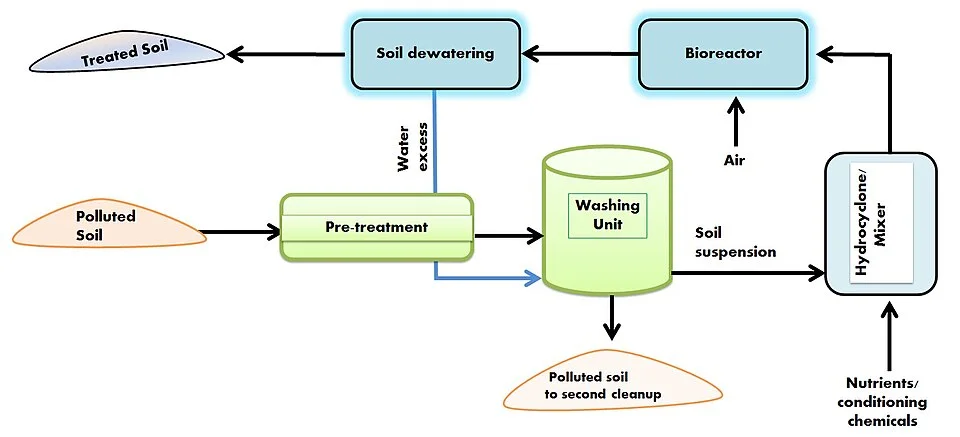
Soil bioremediation system, an illustrative environmental biotechnology application.
Credit: Vicente Neto · CC BY 4.0 · sourceResized and converted to WebP; uncropped.
1. Meaning and scientific basis
Bioremediation is the managed use of biological processes to treat contaminated environments. Bacteria, archaea, fungi and plants can transform contaminants, capture them or change their availability. Microbial bioremediation is particularly important for petroleum hydrocarbons, some pesticides, solvents and industrial organic wastes. Plant-based treatment is called phytoremediation, while treatment using fungi is commonly termed mycoremediation.
Microorganisms obtain energy and nutrients through metabolic reactions. Some use organic pollutants as sources of carbon and energy, producing enzymes that break chemical bonds. Under aerobic conditions, oxygen usually acts as the terminal electron acceptor; complete mineralisation can yield carbon dioxide, water and inorganic nutrients. Anaerobic pathways can operate using nitrate, sulphate or other electron acceptors, and may generate products such as nitrogen gas, sulphide or methane depending on the microbial community and conditions.
Not every transformation supports microbial growth. In cometabolism, an organism transforms a contaminant incidentally while metabolising another substrate. Nor is every transformation beneficial: incomplete degradation can leave toxic intermediates. Consequently, bioremediation means achieving an acceptable reduction in environmental risk, not simply showing that a microbe can alter a chemical in a laboratory.
- Biodegradation is a biological breakdown process; bioremediation is its deliberate application, or the application of other biological mechanisms, to pollution control.
- Mineralisation is more complete than partial transformation and is not synonymous with immobilisation.
- Conventional sewage treatment also uses microorganisms, but remediation generally concerns contaminated environmental media and legacy pollution.
2. Major methods and operational choices
In situ methods treat contamination at its location. Bioventing supplies controlled airflow to unsaturated soil to support aerobic degradation. Biosparging injects air below the water table, increasing oxygen availability in groundwater and the saturated zone. These methods can minimise excavation, but uneven permeability may prevent oxygen or nutrients from reaching all contaminated areas. Vapour migration must also be assessed.
Ex situ methods treat excavated soil or extracted water. Landfarming spreads contaminated soil in a managed treatment area and periodically tills it to improve aeration. Biopiles place excavated soil in engineered heaps with controlled aeration, moisture and nutrient supply. Slurry-phase bioreactors mix contaminated soil with water under controlled conditions, often improving contact between microorganisms and pollutants at the cost of additional infrastructure and handling.
Biostimulation supplies limiting nutrients, oxygen or suitable electron donors to indigenous microbes. Bioaugmentation adds selected microbial cultures when native organisms lack sufficient activity or the required metabolic capability. Introduced organisms may fail because of competition, predation or unsuitable site conditions. Monitored natural attenuation relies on demonstrated natural processes, including biodegradation, but requires monitoring and protective criteria; it is not an excuse for leaving contamination unmanaged.
- Biostimulation and bioaugmentation can be used together and can operate in either in situ or ex situ systems.
- Landfarming requires containment and runoff control; it does not mean unrestricted disposal of oily waste on agricultural land.
- Natural attenuation includes non-biological processes such as sorption and dilution, which do not necessarily destroy pollutants.
Planning a bioremediation project
- 1. Identify the source, contaminants, pathways and exposed receptors
- 2. Characterise site chemistry, hydrology and microbial activity
- 3. Conduct treatability studies and select suitable methods
- 4. Pilot the treatment and establish risk-based performance criteria
- 5. Implement with containment and operational controls
- 6. Monitor contaminants, metabolites, toxicity and long-term stability
3. Pollutants, organisms and treatment mechanisms
Petroleum contains many compounds with different biodegradabilities. Certain bacteria, including species of Pseudomonas and Rhodococcus, can degrade particular hydrocarbons. Microbial consortia often outperform single strains because different organisms carry out complementary steps. Some microbes produce biosurfactants that increase contact between cells and poorly soluble hydrocarbons, although greater mobilisation can also increase contaminant spread if poorly controlled.
White-rot fungi produce relatively broad-acting oxidative enzymes such as laccases and lignin peroxidases. These can transform some dyes, phenolic compounds and other persistent organics. Nevertheless, results depend on the compound and environmental setting: the ability to degrade one pesticide, plastic or hydrocarbon cannot be generalised to all members of that category.
Plants support treatment through several mechanisms. Phytoextraction transfers contaminants, especially certain metals, into harvestable tissues. Phytostabilisation reduces movement or exposure by retaining contaminants around roots. Rhizodegradation involves microbial breakdown stimulated within the root zone. Phytovolatilisation releases absorbed or transformed substances into the atmosphere and therefore demands careful assessment of whether pollution is merely being transferred.
Metals require a different conceptual approach because biological processes cannot destroy elements. Biosorption binds metal ions to biological surfaces, including dead biomass; bioaccumulation involves uptake into organisms. Microbial reduction can convert relatively mobile and toxic chromium(VI) into generally less mobile chromium(III). Such treatment changes chemical form rather than eliminating chromium, and altered environmental conditions may reverse immobilisation.
- Metal-rich plant biomass must be harvested and safely managed; otherwise, contaminants may return through decomposition.
- Microbial methylation can increase the hazard of mercury, illustrating that biological transformation is not automatically detoxification.
| Approach | Main intervention | Important limitation |
|---|---|---|
| Biostimulation | Improve nutrients, oxygen or electron-donor supply | Excess nutrients may cause secondary pollution |
| Bioaugmentation | Introduce selected microorganisms | Added organisms may not survive or remain active |
| Bioventing | Supply air to unsaturated soil | Air distribution depends on soil permeability |
| Phytoextraction | Transfer contaminants into harvestable plant tissues | Limited by rooting depth and biomass disposal |
| Biosorption | Bind contaminants to biological surfaces | Loaded biomass requires treatment or safe disposal |
4. Site assessment, limitations and monitoring
Treatment begins with a conceptual site model identifying pollution sources, contaminant concentrations, pathways and exposed receptors. Soil texture, groundwater flow, temperature, pH, moisture, salinity, oxygen and nutrient availability determine whether organisms can function. Bioavailability is crucial: pollutants strongly sorbed to soil particles or trapped in inaccessible pores may persist despite the presence of capable microorganisms.
Bioremediation often uses less energy and causes less disturbance than excavation followed by thermal treatment. However, it may require months or years, and very high contaminant concentrations can inhibit or kill the organisms needed for treatment. Complex mixtures, deep contamination and highly persistent substances can make biological treatment alone inadequate. Conventional bioremediation is generally poorly effective against many PFAS, whose carbon–fluorine bonds are exceptionally resistant.
Laboratory treatability studies and field pilots help establish realistic targets before full-scale application. Monitoring should track parent contaminants, metabolites, toxicity, relevant redox conditions and contaminant migration. A declining concentration may reflect dilution or transfer rather than destruction. Remediation may therefore combine biological treatment with containment, chemical treatment or physical removal, especially where drinking-water sources face immediate risk.
- Use site-specific cleanup goals and assess potential rebound after treatment stops.
- For radionuclides, biological methods may alter mobility or concentrate contamination, but cannot eliminate radioactivity.
5. Modern biotechnology and the Indian context
Modern biotechnology improves the identification and management of useful organisms. Metagenomics examines genetic material recovered directly from environmental samples, revealing communities that are difficult to culture. Molecular assays can track functional genes involved in degradation. These tools indicate biological potential, but gene detection alone does not prove that sufficient field-scale remediation is occurring.
Genetically engineered microorganisms may be designed to expand degradation pathways, while immobilised cells and enzyme preparations can improve operational control. Environmental release raises questions of ecological persistence, horizontal gene transfer, containment and accountability. In India, genetically engineered organisms are governed through the 1989 Rules notified under the Environment (Protection) Act, 1986, with oversight involving bodies such as the Review Committee on Genetic Manipulation and the Genetic Engineering Appraisal Committee.
Management of hazardous industrial residues also engages the Hazardous and Other Wastes (Management and Transboundary Movement) Rules, 2016. Bioremediation does not exempt an operator from waste-management obligations or pollution-control requirements. CPCB and State Pollution Control Boards are relevant to contaminated-site assessment and regulatory compliance. The examination takeaway is to distinguish scientifically demonstrated remediation from broad claims that a microbial product can clean every type of waste.
- Biomining of legacy municipal waste combines biological stabilisation with excavation and mechanical segregation; it is not equivalent to complete microbial destruction of all waste.
- Bioremediation complements source control: stopping fresh pollutant releases remains essential.
Soil bioremediation: mechanisms and practical limits
The supplied metadata identifies a soil bioremediation system, directly linking the image to biological treatment of contaminated soil. It does not establish the treatment design, organisms used, pollutant targeted or location. In such systems, microorganisms may transform organic contaminants through metabolic reactions, sometimes achieving mineralisation into carbon dioxide, water and inorganic products under suitable conditions. Partial degradation, however, can leave harmful intermediates; disappearance of the original pollutant alone does not prove successful detoxification.
Treatment can occur in situ, without excavating soil, or ex situ, after excavation into managed treatment units. Biostimulation improves conditions for existing organisms, for example through controlled nutrient or oxygen supply; bioaugmentation introduces selected organisms. Effectiveness depends on contaminant bioavailability, temperature, moisture, pH and appropriate electron donors or acceptors. In India, these approaches are relevant to petroleum-contaminated land and industrial sites, but suitability requires site-specific assessment rather than assuming all polluted soil is biologically treatable.
- Biodegradation is not synonymous with pollutant removal: metals cannot be biologically destroyed. Biological processes may alter their chemical form, mobility or uptake, requiring management of contaminated biomass or residual material.
- Bioremediation does not necessarily involve genetically engineered organisms. Indigenous microbes, introduced microbial cultures and plants can support remediation; phytoremediation specifically uses plants and associated processes.
- Performance must be demonstrated through contaminant and toxicity measurements, with attention to groundwater migration and treatment duration. A system photograph or its metadata cannot establish remediation efficiency, regulatory compliance or safety.
Real-world case studies
Exxon Valdez oil spill, Alaska
Following the 1989 spill, nutrient additions were used on selected contaminated shorelines to stimulate indigenous oil-degrading microorganisms. This became a prominent field example of biostimulation. Performance varied with shoreline conditions and oil accessibility, showing why successful treatment at one location cannot be assumed elsewhere.
TERI Oilzapper, India
The Energy and Resources Institute developed Oilzapper, a microbial consortium used for treating petroleum-contaminated soil and oily sludge. It illustrates the practical use of complementary hydrocarbon-degrading microorganisms. Treatment still requires suitable moisture, aeration and nutrient conditions, and does not imply removal of associated metals.
Previous year questions
No source-linked PYQ is available here yet. Use the practice questions below.
Practice questions
Practice MCQ 1
With reference to bioremediation, consider the following statements: 1. Biostimulation necessarily introduces genetically engineered microorganisms. 2. Bioaugmentation involves adding selected microbial cultures. 3. Monitored natural attenuation requires evidence and continued assessment of treatment performance. Which of the statements given above are correct?
- A. 1 and 2 only
- B. 2 and 3 only
- C. 1 and 3 only
- D. 1, 2 and 3
Practice MCQ 2
Which one of the following best describes the biological treatment of heavy-metal contamination?
- A. Microorganisms mineralise metals into carbon dioxide and water
- B. Plants destroy metal atoms during photosynthesis
- C. Biological activity can extract, immobilise or alter the chemical form of metals
- D. Microbial uptake permanently eliminates the need to manage contaminated biomass
Practice MCQ 3
Consider the following pairs: 1. Bioventing — Air supply to unsaturated soil 2. Biopiles — Treatment of excavated soil in engineered heaps 3. Phytoextraction — Retention of contaminants exclusively outside plant roots. How many pairs are correctly matched?
- A. Only one
- B. Only two
- C. All three
- D. None
Mains practice · Bioremediation is a site-specific environmental management tool rather than a universal solution to pollution. Discuss with reference to its mechanisms, advantages and limitations. Answer in 250 words.
- Define bioremediation and distinguish in situ from ex situ treatment.
- Explain biostimulation, bioaugmentation and selected plant-based mechanisms.
- Separate biodegradation of organic pollutants from transformation or immobilisation of metals.
- Highlight lower disturbance and potentially lower energy requirements.
- Discuss bioavailability, toxic intermediates, treatment time and ecological risks.
- Use Exxon Valdez or TERI Oilzapper as an example.
- Conclude with source control, site-specific trials, regulatory compliance and outcome monitoring.
Further reading
- NCERT Biology, Class XII: Microbes in Human Welfare; Biotechnology and its Applications.
- US Environmental Protection Agency: Contaminated Site Clean-Up Information, bioremediation resources.
- Central Pollution Control Board: Reference Document on Identification, Inspection and Assessment of Contaminated Sites.
- Department of Biotechnology and Ministry of Environment, Forest and Climate Change: Indian biosafety regulations and the 1989 Rules.
- The Energy and Resources Institute: Oilzapper and environmental biotechnology resources.
- https://commons.wikimedia.org/wiki/File:Soil_bioremediation_system.jpg
Preparing for UPSC Civil Services? Get classroom teaching, answer-writing evaluation and mentorship at Pragnya IAS Academy, Ashok Nagar — see why aspirants choose us for IAS coaching in Hyderabad.