

Onion Epidermis Cells W.M. OpenFlexure Microscope High-resolution microscope v7.0.0-beta1 Stack and Scan x step-size 1100 y step-size 1100 x steps 16 y steps 16 z steps 1 Autofocus Fast Scan Style Sna
Credit: loganrickert · CC BY 2.0 · source

PBCV-1 infected chlorella cells at 2 min PI. A, C. TEM micrographs highlighting the hurdles that are associated with trafficking large viral DNA genomes to the nucleus. The large chloroplast is visibl
Credit: Elad Milrot, Eyal Shimoni, Tali Dadosh, Katya Rechav, Tamar Unger, James L. Van Etten, Abraham Minsky · CC BY-SA 4.0 · source
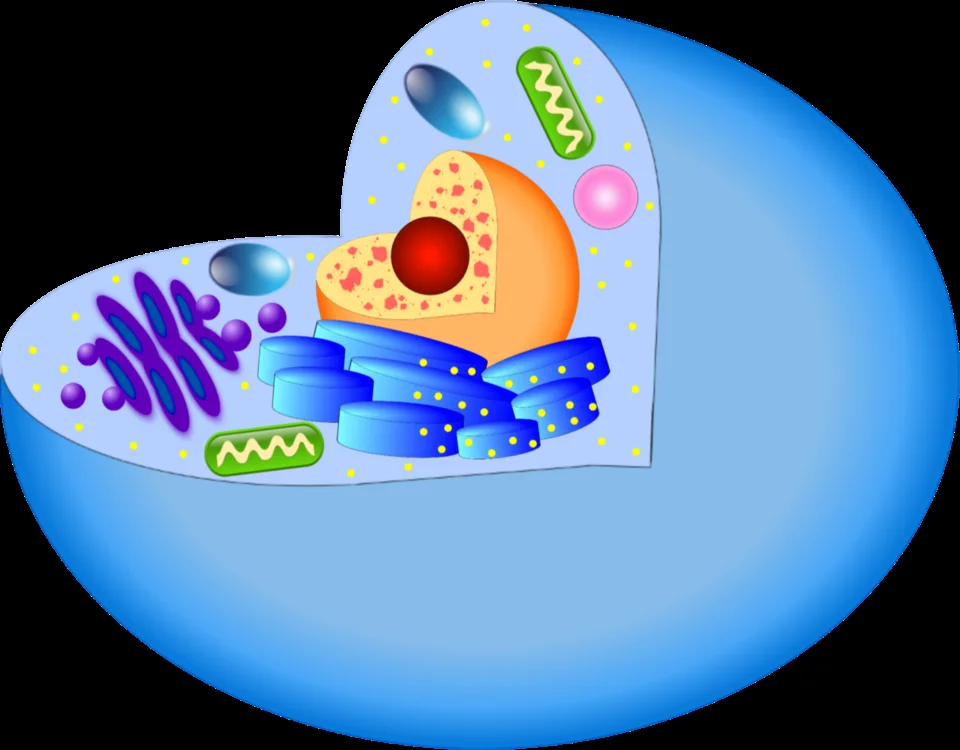
Illustrative animal-cell diagram representing major eukaryotic organelles.
Credit: Conrad 7 · CC0 · sourceResized and converted to WebP; uncropped.
1. Cell theory and the diversity of cells
A cell is the smallest organised unit capable of carrying out the essential processes of life. Organisms may be unicellular, such as bacteria, Amoeba and yeast, or multicellular, such as humans and most familiar plants. In multicellular organisms, specialised cells form tissues, which combine into organs and organ systems. Cell size and shape reflect function: neurons have long extensions for communication, while human red blood cells are biconcave, increasing their surface area relative to volume.
Robert Hooke introduced the term cell in 1665 after observing compartments in cork; he was mainly seeing the walls of dead plant cells. Antonie van Leeuwenhoek subsequently observed living microscopic organisms. Matthias Schleiden and Theodor Schwann formulated cell theory in 1838–1839. Rudolf Virchow later emphasised that cells arise from pre-existing cells. Modern cell theory also recognises that hereditary information is transmitted during cell division and that metabolism occurs within cells.
Most cells are microscopic, but size alone does not distinguish cell types. Some eggs are exceptionally large single cells. Viruses fall outside cellular organisation: they contain genetic material enclosed in a protein coat, sometimes with an additional lipid envelope, but lack ribosomes and independent metabolism. Their replication requires a suitable host cell.
- Micrometre is the usual unit for cell dimensions; one micrometre equals one-thousandth of a millimetre.
- A high surface-area-to-volume ratio supports efficient exchange of materials and helps explain why most cells remain small.
Timeline
1665
Robert Hooke described compartments in cork and used the term cell.
1670s
Antonie van Leeuwenhoek observed living microscopic organisms.
1838–1839
Schleiden and Schwann developed cell theory for plants and animals.
1855
Virchow advanced the principle that cells arise from pre-existing cells.
1972
Singer and Nicolson proposed the fluid mosaic model of membrane structure.
2. Prokaryotic, eukaryotic, plant and animal cells
Prokaryotic cells lack a membrane-bound nucleus and typical membrane-bound organelles. Their principal chromosome occupies a region called the nucleoid; many also contain plasmids, which are independently replicating DNA molecules. Bacteria commonly possess a peptidoglycan cell wall. Archaea lack peptidoglycan and differ from bacteria in membrane chemistry and several molecular processes. Prokaryotes nevertheless perform complex metabolism, using their cytoplasm and plasma membrane rather than mitochondria or chloroplasts.
Eukaryotic cells possess a membrane-bound nucleus and compartmentalised organelles. Compartmentalisation allows different biochemical reactions to occur under suitable local conditions. Their nuclear DNA is generally organised into multiple linear chromosomes associated with proteins. Cytosolic ribosomes are 80S, whereas bacterial ribosomes are 70S. The S denotes a sedimentation coefficient, so subunit values cannot be added arithmetically.
Plant and animal cells share mitochondria, endoplasmic reticulum, Golgi apparatus and ribosomes. Plant cells typically have a cellulose-rich wall, plastids and a large central vacuole. Photosynthetic cells contain chloroplasts, but many non-photosynthetic plant cells, including most root cells, do not. Animal cells lack a cell wall and plastids. Fungi are eukaryotic but are not plants: their walls generally contain chitin and glucans, and they lack chloroplasts.
- A cell wall does not automatically indicate a plant: bacteria, fungi and many algae also possess walls.
- Plasmids are useful vectors in genetic engineering, but they are not present in every bacterial cell.
- Plant cells respire as well as photosynthesise; mitochondria are not restricted to animals.
Route of a typical secreted protein
- 1. A nuclear gene is transcribed into RNA.
- 2. Processed messenger RNA exits through a nuclear pore.
- 3. Ribosomes associated with rough endoplasmic reticulum synthesise the protein.
- 4. Transport vesicles carry the protein to the Golgi apparatus for modification and sorting.
- 5. Secretory vesicles fuse with the plasma membrane and release the protein by exocytosis.
3. Organelles and division of labour within the cell
The nucleus stores most eukaryotic genetic information and regulates gene expression. Its double-membraned envelope contains nuclear pores that control exchange with the cytoplasm. The nucleolus produces ribosomal RNA and assembles ribosomal subunits. Ribosomes translate messenger RNA into proteins. Free ribosomes mainly produce proteins used within the cytosol, while ribosomes associated with rough endoplasmic reticulum commonly synthesise secreted and membrane proteins.
Rough endoplasmic reticulum supports protein synthesis and initial processing. Smooth endoplasmic reticulum participates in lipid synthesis, detoxification and calcium storage. The Golgi apparatus modifies, sorts and packages proteins and lipids. Lysosomes contain enzymes for intracellular digestion, including breakdown of worn-out components through autophagy. Plant lytic vacuoles perform many comparable functions. Peroxisomes participate in oxidative reactions and use catalase to break down hydrogen peroxide.
Mitochondria generate much of a eukaryotic cell's ATP through aerobic respiration; the inner membrane forms cristae. Chloroplasts carry out photosynthesis: light-dependent reactions occur in thylakoid membranes, while carbon fixation occurs in the stroma. Both organelles have double membranes, their own DNA and bacterial-type features, supporting the endosymbiotic explanation of their origin. They are semiautonomous, not independent organisms.
The cytoskeleton comprises protein filaments that maintain shape, move materials and assist division. Microtubules form the spindle and support eukaryotic cilia and flagella. Vacuoles store substances and maintain plant-cell turgor; contractile vacuoles in many freshwater protists expel excess water.
- ATP is an immediate energy-transfer molecule, not the cell's principal long-term energy store.
- Mitochondria are not the only site of ATP production: glycolysis produces ATP in the cytoplasm.
| Feature | Bacterial cell | Typical plant cell | Typical animal cell |
|---|---|---|---|
| Membrane-bound nucleus | Absent | Present | Present |
| Cell wall | Usually present; contains peptidoglycan | Present; cellulose-rich | Absent |
| Mitochondria | Absent | Present | Present |
| Chloroplasts | Absent, including in cyanobacteria | Present in photosynthetic cells | Absent |
| Cytosolic ribosomes | 70S | 80S | 80S |
| Usual cell division | Binary fission | Mitosis with cell-plate formation | Mitosis with cleavage-furrow formation |
4. Plasma membrane and transport
The plasma membrane is a selectively permeable boundary built primarily from a lipid bilayer and proteins. The fluid mosaic model describes its dynamic organisation. Membrane proteins act as channels, carriers, receptors and enzymes. Unlike the living plasma membrane, the plant cell wall is a relatively rigid extracellular structure that provides support and helps prevent bursting during water entry.
Simple diffusion moves substances down their concentration gradient without direct expenditure of cellular energy. Oxygen and carbon dioxide can cross membranes this way. Facilitated diffusion also follows a gradient but uses transport proteins. Osmosis is the net movement of water across a selectively permeable membrane from higher to lower water potential; in simple solutions at equal pressure, this usually means movement towards the more concentrated solution.
Active transport moves substances against their electrochemical gradient by using energy, directly or indirectly. The sodium–potassium pump directly consumes ATP. Endocytosis brings material into cells through vesicles, while exocytosis releases vesicle contents outside. In a hypertonic solution, cells lose water; plant cells may undergo plasmolysis, in which the protoplast pulls away from the wall. In a hypotonic solution, plant cells become turgid, whereas animal cells may swell and lyse.
- Isotonic conditions mean no net osmotic movement of water, not cessation of water movement.
- Phagocytosis is a form of endocytosis used by immune cells to engulf particles and microbes.
5. Cell cycle, inheritance and biomedical relevance
The cell cycle comprises interphase and the division phase. During interphase, G1 supports growth, S phase replicates DNA, and G2 prepares the cell for division. DNA replication doubles DNA quantity, but chromosome number, counted by centromeres, does not immediately double. Some differentiated cells exit the active cycle into a quiescent state called G0.
Mitosis normally preserves chromosome number and produces two genetically similar daughter nuclei, supporting growth, repair and asexual reproduction. Meiosis consists of one DNA replication followed by two divisions, usually producing haploid cells from a diploid precursor. Homologous chromosomes pair and crossing over occurs during prophase I. Homologues separate in meiosis I, whereas sister chromatids separate in meiosis II. In animals, meiosis produces gametes; in plants, it produces spores.
Cell-cycle checkpoints and programmed cell death, or apoptosis, protect tissue integrity. Cancer involves failures of growth control associated with accumulated genetic and epigenetic changes. Stem cells combine self-renewal with the capacity to differentiate. Pluripotent cells can generate almost all body-cell types, while adult stem cells usually have a more restricted range. These concepts underpin regenerative medicine, but experimental stem-cell interventions should not be confused with established treatments such as blood-forming stem-cell transplantation.
- Most bacteria reproduce by binary fission, not mitosis.
- Apoptosis is regulated cellular dismantling; necrosis typically involves damaging loss of membrane integrity and inflammation.
- Meiosis generates variation through crossing over and independent assortment of homologous chromosomes.
Animal Cells: Compartmentalisation and Organelle Functions
An animal cell illustrates eukaryotic organisation: a plasma membrane encloses cytoplasm, while a membrane-bound nucleus typically houses most genetic material. Internal compartments allow different biochemical processes to operate under suitable conditions. The supplied metadata describes an unlabeled diagram of major organelles; it supports a general conceptual illustration, not identification of particular structures, their scale or their abundance in a real cell. Animal cells lack the cellulose cell wall and chloroplasts characteristic of many plant cells.
Cell function depends on coordination rather than isolated organelle activity. Ribosomes synthesise proteins; the rough endoplasmic reticulum helps produce proteins destined for secretion or membranes, and the Golgi apparatus modifies and sorts them. Lysosomes support intracellular digestion, while mitochondria generate much of the ATP through aerobic respiration. These distinctions underpin biotechnology and health topics relevant to India, including recombinant protein production, mitochondrial disorders and cancer research. However, a generalised diagram cannot establish disease, stem-cell potential or the behaviour of a specialised cell.
- Prokaryotes lack a membrane-bound nucleus and conventional membrane-bound organelles, but possess DNA, ribosomes and a plasma membrane; absence of a nucleus does not mean absence of genetic material.
- Not every animal cell contains the full textbook organelle set: mature human red blood cells lack a nucleus and mitochondria. Cell structure reflects specialised function.
- Avoid equating all cell division with reproduction: mitosis supports growth and repair, whereas meiosis reduces chromosome number during gamete formation in humans. Uncontrolled cell proliferation is central to cancer.
Real-world case studies
Oral rehydration therapy: membrane transport saves lives
Oral rehydration solution uses intestinal sodium–glucose cotransport to support absorption of sodium and glucose, with water following. This transport pathway remains functional in cholera despite severe fluid secretion. WHO–UNICEF low-osmolarity ORS demonstrates how cellular transport principles underpin an inexpensive, lifesaving public-health intervention.
Induced pluripotent stem cells
Shinya Yamanaka's team reprogrammed mouse somatic cells into induced pluripotent stem cells in 2006, followed by human-cell work in 2007. The discovery showed that specialised cells can be returned to a pluripotent state. These cells support disease modelling and drug testing, although clinical applications require safeguards against tumour formation and genetic instability.
Previous year questions
No source-linked PYQ is available here yet. Use the practice questions below.
Practice questions
Practice MCQ 1
Consider the following statements: 1. Cyanobacteria carry out photosynthesis without chloroplasts. 2. Plant root cells necessarily lack mitochondria. 3. Fungal cells possess a membrane-bound nucleus. Which of the statements given above are correct?
- A. 1 and 2 only
- B. 1 and 3 only
- C. 2 and 3 only
- D. 1, 2 and 3
Practice MCQ 2
A living plant cell is placed in a strongly hypertonic solution. Which outcome is most likely?
- A. Water enters and the cell wall immediately ruptures.
- B. Water leaves and the protoplast pulls away from the cell wall.
- C. Solutes necessarily leave through simple diffusion, restoring turgor.
- D. Water movement stops because the cell wall is impermeable.
Practice MCQ 3
Which of the following correctly distinguishes meiosis I from mitosis?
- A. DNA replication occurs during prophase I but not before mitosis.
- B. Sister chromatids normally separate in meiosis I.
- C. Homologous chromosomes pair and subsequently separate in meiosis I.
- D. Meiosis I always produces genetically identical diploid daughter cells.
Mains practice · Explain how knowledge of cellular organisation and processes contributes to public health and modern biotechnology. Illustrate with examples. (150 words)
- Introduce the cell as the basic functional unit of organisms.
- Link membrane transport to oral rehydration therapy.
- Explain selective targeting of bacterial structures, such as peptidoglycan synthesis and ribosomes, by antibiotics.
- Connect cell-cycle regulation and apoptosis to understanding cancer.
- Mention stem-cell differentiation, disease modelling and regenerative medicine.
- Conclude with the need for clinical validation, safety assessment and ethical oversight.
Further reading
- NCERT Biology, Class XI: Cell: The Unit of Life; Biomolecules; Cell Cycle and Cell Division.
- NCERT Science, Class IX: The Fundamental Unit of Life.
- ICMR–DBT: National Guidelines for Stem Cell Research, 2017.
- WHO: Oral Rehydration Salts: Production of the New ORS.
- NobelPrize.org: The Nobel Prize in Physiology or Medicine 2012.
- https://commons.wikimedia.org/wiki/File:Animal_Cell_Diagram_Colorful.png
Preparing for UPSC Civil Services? Get classroom teaching, answer-writing evaluation and mentorship at Pragnya IAS Academy, Ashok Nagar — see why aspirants choose us for IAS coaching in Hyderabad.