

This aluminium template representing the base thymine (T) is part of Crick and Watson’s model of DNA. Bases are those groups of atoms that make up DNA's twin strands. The bases in each of the strands
Credit: Science Museum, London / Science and Society Picture Library · CC BY-SA 2.0 · source

Agarose gel electrophoresis of DNA with annotation
Credit: Ultrabem · CC0 · source
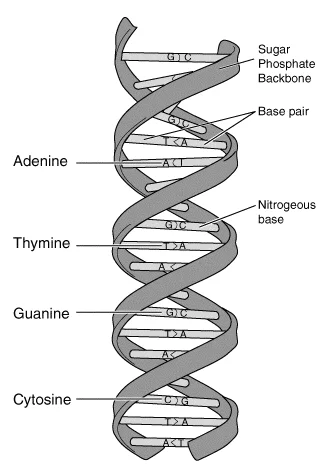
DNA double helix with a sugar–phosphate backbone and paired nitrogenous bases.
Credit: Wikimedia Commons · Public domain · sourceResized and converted to WebP; uncropped.
1. DNA as the hereditary material
DNA stores information required for the development, functioning and reproduction of organisms. A gene is a DNA sequence whose expression produces a functional product, either an RNA molecule or, through an RNA intermediate, a protein. The genome is the complete genetic material of an organism. A chromosome is an organised DNA-containing structure, while an allele is an alternative version of a gene at a particular locus.
The identification of DNA as hereditary material emerged through several experiments. Frederick Griffith demonstrated bacterial transformation in 1928 but did not identify the transforming substance. In 1944, Oswald Avery, Colin MacLeod and Maclyn McCarty identified DNA as the transforming principle. Alfred Hershey and Martha Chase strengthened the evidence in 1952 using bacteriophages labelled with radioactive phosphorus and sulphur.
DNA is the genetic material of cellular organisms, but viruses may possess either DNA or RNA genomes. Some viruses have single-stranded DNA, so the statement that DNA is always double-stranded is incorrect. Retroviruses, including HIV, possess RNA genomes and use reverse transcriptase to generate DNA during their life cycle.
Timeline
1869
Friedrich Miescher isolated the substance he called nuclein, later recognised as DNA.
1944
Avery, MacLeod and McCarty identified DNA as the bacterial transforming principle.
1953
Watson and Crick proposed the double-helix model.
1958
Meselson and Stahl demonstrated semiconservative DNA replication.
2003
The Human Genome Project was declared completed; remaining gaps were addressed by later projects.
2. Molecular structure and base pairing
DNA is a polymer of nucleotides. Each nucleotide consists of deoxyribose, a phosphate group and a nitrogenous base. A nucleoside consists only of a sugar and a base. Adenine and guanine are purines with two rings; cytosine and thymine are pyrimidines with one ring. Adjacent nucleotides are linked through phosphodiester bonds, forming the sugar-phosphate backbone.
In the usual double-helical structure, two strands run antiparallel: one runs from the 5′ end towards the 3′ end, while its partner runs in the opposite direction. Bases face inward. Adenine pairs with thymine through two hydrogen bonds, and guanine pairs with cytosine through three. Complementary pairing allows each strand to act as a template for copying the other.
Chargaff’s relationships state that, in double-stranded DNA, the amount of adenine equals thymine and guanine equals cytosine. They do not require adenine to equal guanine. DNA with greater GC content generally has a higher melting temperature under comparable conditions. Heating can separate the strands, a process called denaturation; complementary strands can reassociate through annealing. These properties underpin laboratory techniques such as PCR.
James Watson and Francis Crick proposed the double-helix model in 1953, drawing on evidence including X-ray diffraction work by Rosalind Franklin and Maurice Wilkins. The common B-DNA form is a right-handed helix; alternative conformations also exist.
PCR amplification
- 1. Prepare template DNA, two primers, nucleotides, thermostable polymerase and buffer.
- 2. Heat to separate DNA strands.
- 3. Cool to allow primers to anneal.
- 4. Extend primers to synthesise new DNA.
- 5. Repeat the cycle to amplify the selected region.
3. Organisation of DNA in cells
In eukaryotes, most DNA lies within the nucleus and is packaged with histone proteins into nucleosomes and chromatin. Nuclear chromosomes are generally linear. Most bacteria possess a circular chromosome in a nucleoid rather than a membrane-bound nucleus. However, exceptions to the single-circular-chromosome pattern occur. Bacteria may also contain plasmids: independently replicating DNA molecules often carrying traits such as antibiotic resistance.
Mitochondria possess their own DNA, and plant chloroplasts also contain DNA. These genomes support the endosymbiotic explanation for the origin of these organelles. Human mitochondrial DNA is a small circular genome containing 37 genes and is ordinarily inherited maternally. Mitochondria nevertheless depend heavily on proteins encoded by nuclear genes; they are not genetically self-sufficient.
A typical human somatic cell contains 46 nuclear chromosomes arranged in 23 pairs, while a gamete contains 23 chromosomes. Mature human red blood cells lack nuclei and mitochondria and therefore lack these DNA stores. Most nucleated somatic cells share essentially the same genome, but different patterns of gene expression generate specialised cell types.
Non-coding DNA is not automatically useless. It includes regulatory sequences, introns, repetitive sequences and genes producing functional non-coding RNAs. Some regions have well-established functions, while others remain incompletely understood.
| Feature | DNA | RNA |
|---|---|---|
| Sugar | Deoxyribose | Ribose |
| Usual bases | A, T, G, C | A, U, G, C |
| Typical structure | Double-stranded; some viral genomes are single-stranded | Single-stranded; some viral genomes are double-stranded |
| Major roles | Long-term genetic information storage | Gene expression, regulation and catalysis; genetic material in some viruses |
| Chemical stability | Generally more stable | Generally more susceptible to alkaline hydrolysis because of its 2′-OH group |
4. Replication, gene expression and mutations
Before cell division, DNA is replicated. Helicase separates the strands, primase supplies primers, and DNA polymerases extend new DNA in the 5′ to 3′ direction. One new strand is produced largely continuously, whereas the other is assembled as Okazaki fragments joined by DNA ligase. Proofreading and repair mechanisms reduce copying errors. Meselson and Stahl demonstrated semiconservative replication in bacteria in 1958.
The usual flow of sequence information is DNA to RNA to protein. Transcription produces RNA from a DNA template. Translation uses the codons of messenger RNA to specify amino acids at ribosomes. Transfer RNA delivers amino acids, while ribosomal RNA has structural and catalytic roles. Not all genes encode proteins, and reverse transcription shows that information can also flow from RNA to DNA.
A mutation is a change in genetic sequence. Mutations can arise spontaneously or follow exposure to mutagens such as ultraviolet radiation and certain chemicals. Substitutions, insertions and deletions may alter protein function, affect gene regulation or have no detectable effect. Insertions or deletions within a coding sequence can cause a frameshift when their length is not a multiple of three.
Germline mutations can pass to offspring, whereas somatic mutations usually affect only the individual and may contribute to cancer. Epigenetic changes, including DNA methylation, can influence gene activity without changing the underlying nucleotide sequence.
5. Technologies, applications and safeguards
Polymerase chain reaction amplifies a selected DNA region using primers, nucleotides and a thermostable DNA polymerase. Repeated cycles of denaturation, primer annealing and extension generate many copies. RNA targets require conversion into complementary DNA before conventional PCR amplification; this is reverse-transcription PCR. Real-time PCR monitors amplification as it occurs and should not be confused with reverse transcription.
DNA sequencing determines the order of bases. Recombinant DNA technology joins genetic material from different sources, often using vectors such as plasmids. It supports production of medicines such as human insulin. CRISPR-Cas systems enable targeted genome editing, although unintended changes and delivery limitations remain important concerns. Gene therapy aims to treat disease by introducing, modifying or regulating genetic material.
DNA profiling commonly compares short tandem repeat regions rather than reading an entire genome. It supports criminal investigation, kinship testing and identification of disaster victims. A match requires statistical interpretation and does not independently establish when or how biological material reached a location. Contamination, chain of custody, consent and genetic privacy are crucial safeguards.
Environmental DNA recovered from water, soil or other samples supports biodiversity monitoring, though detecting DNA does not necessarily prove that a living organism is currently present. In India, genetic research requires applicable ethical and biosafety oversight. The DNA Technology (Use and Application) Regulation Bill, 2019, was withdrawn in 2023 and must not be described as an enacted law.
DNA: Structure, Information and Applications
DNA consists of nucleotide chains, each nucleotide containing deoxyribose sugar, a phosphate group and a nitrogenous base. In the usual double-helical form, two antiparallel strands have sugar–phosphate backbones linked internally by complementary bases: adenine pairs with thymine, and guanine with cytosine. Covalent phosphodiester bonds connect successive nucleotides within a strand; hydrogen bonds connect paired bases across strands. Base sequence, rather than the repeating backbone, encodes biological information. The supplied title identifies a directly relevant instructional diagram, although metadata alone cannot verify its labels or scientific accuracy.
Complementarity allows each parental strand to serve as a template during semiconservative replication. Gene expression is distinct: transcription produces RNA from a DNA template, while translation uses messenger RNA to direct protein synthesis. Not all DNA encodes proteins; regulatory and other non-coding sequences also matter. In India, these concepts underpin forensic identification, molecular diagnosis, crop improvement and genome research. However, a structural diagram cannot establish an individual's identity, disease risk or ancestry; those conclusions require suitable samples, validated methods and careful interpretation.
- Location: Eukaryotic DNA occurs mainly in the nucleus, but mitochondria and plant chloroplasts also contain genomes. Mature human red blood cells lack a nucleus and mitochondria.
- Applications: PCR amplifies selected DNA regions; DNA profiling compares variable markers; genome editing alters targeted sequences. These are related but not interchangeable techniques.
- Interpretation: A mutation need not cause disease, and a genetic association does not establish causation. Mains discussions should connect genomic applications with consent, privacy and equitable access.
Real-world case studies
GenomeIndia
Supported by the Department of Biotechnology, GenomeIndia completed sequencing of 10,000 individuals from diverse Indian populations, announced in 2024. It creates a resource for studying population-specific variation and disease susceptibility; it is not a complete catalogue of every Indian community or individual.
DNA identification after the 2004 Indian Ocean tsunami
Disaster-victim identification operations used DNA alongside fingerprints and dental evidence. Comparisons with relatives or personal reference samples helped identify victims when visual recognition was unreliable, illustrating the importance of reference samples and documented handling.
Previous year questions
No source-linked PYQ is available here yet. Use the practice questions below.
Practice questions
Practice MCQ 1
A double-stranded DNA sample contains 20% adenine. What percentage of its bases is guanine?
- A. 20%
- B. 30%
- C. 40%
- D. 60%
Practice MCQ 2
Consider the following statements: 1. Human mitochondria contain DNA. 2. Mature human red blood cells contain nuclear DNA. 3. Plant chloroplasts contain DNA. Which statements are correct?
- A. 1 and 2 only
- B. 2 and 3 only
- C. 1 and 3 only
- D. 1, 2 and 3
Practice MCQ 3
Which statement correctly distinguishes PCR from DNA sequencing?
- A. PCR amplifies a selected DNA region, whereas sequencing determines base order.
- B. PCR determines amino-acid sequences, whereas sequencing copies proteins.
- C. PCR requires ribosomes, whereas sequencing requires living cells.
- D. PCR always edits DNA, whereas sequencing always introduces mutations.
Mains practice · Discuss the applications of DNA-based technologies in healthcare, criminal justice and biodiversity conservation. What safeguards should govern their use? Answer in 250 words.
- Explain sequencing, amplification and profiling.
- Discuss diagnosis, gene therapy and population genomics.
- Cover forensic identification and environmental DNA.
- Address consent, privacy, discrimination and representative datasets.
- Recommend validated methods, secure data access, chain of custody and independent oversight.
Further reading
- NCERT Biology, Class XII: Molecular Basis of Inheritance; Biotechnology: Principles and Processes.
- Department of Biotechnology, Government of India: GenomeIndia project information.
- National Human Genome Research Institute: DNA, genome and sequencing fact sheets.
- ICMR: National Ethical Guidelines for Biomedical and Health Research Involving Human Participants, 2017.
- https://commons.wikimedia.org/wiki/File:DNA-structure-and-bases.png
Preparing for UPSC Civil Services? Get classroom teaching, answer-writing evaluation and mentorship at Pragnya IAS Academy, Ashok Nagar — see why aspirants choose us for IAS coaching in Hyderabad.