
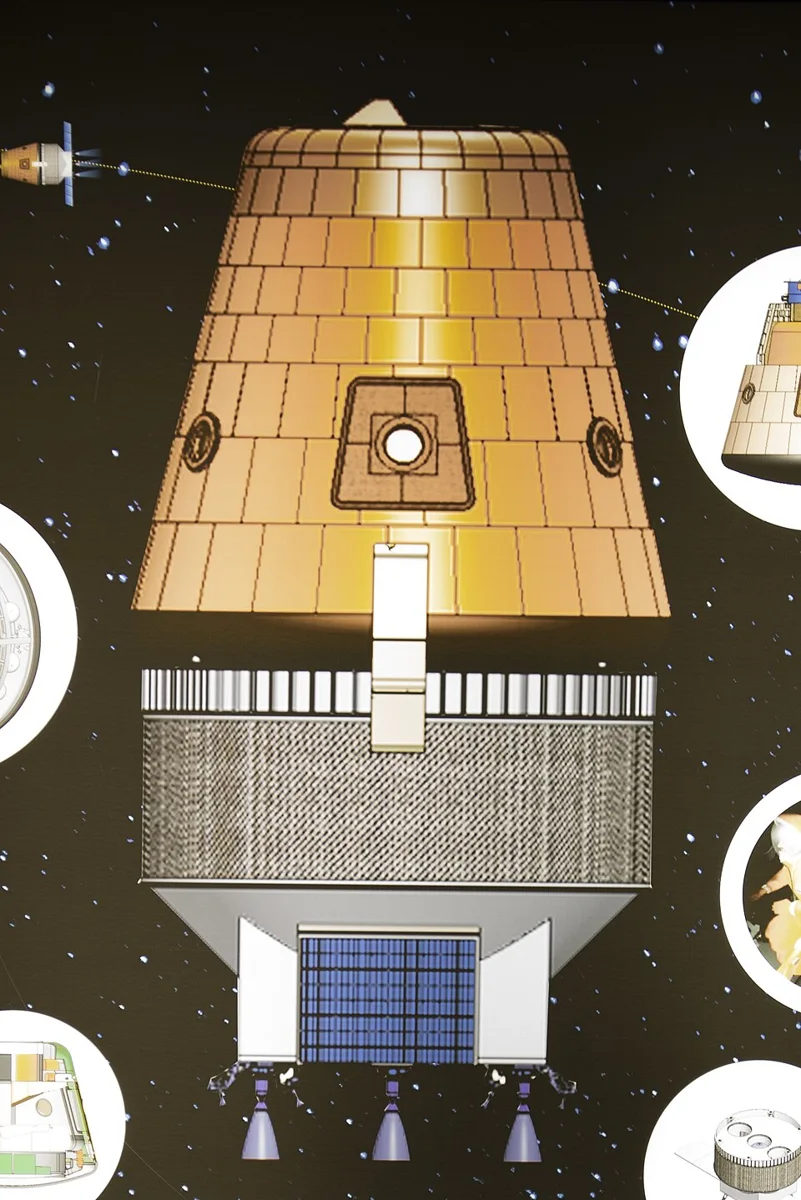
Gaganyaan crew and service module infographic displayed at Bangalore Space Expo 2018; a programme design illustration.
Credit: Dean Sumith · CC BY-SA 4.0 · sourceResized and converted to WebP; uncropped.
1. Programme objectives, institutions and strategic importance
Gaganyaan is a capability-building programme rather than merely a single rocket launch. Its defining objective is to demonstrate indigenous human spaceflight: launching astronauts, sustaining them in orbit and returning them safely to Earth. ISRO’s published reference mission envisages three crew members travelling to an orbit of approximately 400 km for about three days. This is a low Earth orbit mission, not a lunar expedition. Uncrewed demonstrations and safety tests form essential stages before crewed operations.
ISRO operates under the Department of Space. Its Human Space Flight Centre, established in Bengaluru in 2019, plays a central role in coordinating the programme. Multiple ISRO centres contribute launch vehicles, spacecraft, propulsion, tracking and recovery-related technologies. The Indian Air Force supports astronaut selection and training, while the Indian Navy contributes to recovery preparations and operations. Industry, research institutions and medical specialists support manufacturing, testing, crew health and human-factors engineering.
The programme can strengthen high-reliability manufacturing, materials science, biomedical research, environmental control, robotics and systems engineering. However, technologies suitable for satellites are not automatically safe for humans. Human spaceflight requires stringent qualification, operational discipline and contingency planning. International training and technical cooperation supplement domestic capability; they do not make Gaganyaan a foreign launch programme. India’s longer-term space-station ambitions build on these capabilities but remain distinct programme objectives.
- Gaganyaan concerns human spaceflight; Chandrayaan concerns lunar exploration, while Aditya-L1 studies the Sun.
- An Indian astronaut flying aboard a foreign spacecraft does not, by itself, demonstrate India’s indigenous crew-launch capability.
Timeline
18 December 2014
LVM3-X/CARE demonstrated Crew Module atmospheric re-entry and sea recovery.
5 July 2018
ISRO conducted the Pad Abort Test for the crew escape system.
August–December 2018
Gaganyaan was publicly announced and subsequently approved by the Union Cabinet.
21 October 2023
TV-D1 demonstrated an in-flight abort and Crew Module recovery.
27 February 2024
Four astronaut-designates were publicly introduced.
18 September 2024
The Cabinet approved expansion of Gaganyaan to include space-station precursor activities.
25 June–15 July 2025
Shubhanshu Shukla participated in Axiom Mission 4, becoming the first Indian to visit the International Space Station.
2. Launch vehicle and spacecraft architecture
Gaganyaan uses a human-rated version of LVM3, ISRO’s heavy-lift launch vehicle. LVM3 has two solid strap-on boosters, a liquid-propellant core stage and a cryogenic upper stage. Its cryogenic stage uses liquid hydrogen and liquid oxygen. Human-rating involves demonstrating the reliability and safety required for carrying people, including suitable redundancy, component qualification, health monitoring and abort provisions. It is not simply an increase in payload capacity or the addition of seats to an existing spacecraft.
The Orbital Module consists of the Crew Module and Service Module. The Crew Module provides the habitable volume for astronauts and contains crew interfaces, avionics, life-support equipment and systems needed for descent and recovery. It is designed to return through the atmosphere. The Service Module supports orbital operations through functions such as propulsion, power and thermal management. It separates before the Crew Module’s atmospheric re-entry and is not recovered as a crew-carrying capsule.
The Crew Module requires thermal protection because atmospheric entry converts a large amount of the spacecraft’s kinetic energy into heat in the surrounding flow. Its shape and protective materials limit heat transfer to the occupants and equipment. Aerodynamic drag provides the major initial deceleration; parachutes subsequently reduce descent speed for splashdown. A launch vehicle places the spacecraft in orbit, whereas the capsule’s entry, descent and recovery systems bring the crew safely home.
- Human-Rated LVM3 is an expendable launcher, not a reusable space shuttle.
- The Crew Escape System is a launch-phase safety system; it is not the main propulsion system for routine orbital manoeuvres.
Simplified nominal mission sequence
- 1. Crew boarding and final spacecraft and launch-vehicle checks
- 2. Launch aboard Human-Rated LVM3
- 3. Orbital insertion and verification of spacecraft systems
- 4. Crew operations and experiments in low Earth orbit
- 5. De-orbit manoeuvre and Service Module separation
- 6. Protected atmospheric re-entry and parachute descent
- 7. Splashdown, crew recovery and medical assessment
3. Life support, crew safety and recovery
The Environmental Control and Life Support System maintains conditions compatible with human survival. Its functions include cabin-pressure management, oxygen provision, carbon-dioxide removal, temperature and humidity control, and management of contaminants. These functions operate together: supplying oxygen alone is insufficient if carbon dioxide accumulates or cabin temperature becomes unsafe. Crew provisions must also address drinking water, food, waste, communication and medical contingencies within the spacecraft’s limited mass and volume.
Astronauts in orbit experience microgravity because they and their spacecraft are continuously falling around Earth. Gravity at about 400 km altitude remains substantial; weightlessness does not mean an absence of gravity. Human-spaceflight hazards include acceleration during launch and re-entry, motion sickness, radiation exposure, isolation and disruption of normal bodily functions. Longer missions add more severe concerns about bone and muscle loss. Crew training therefore combines physical conditioning, spacecraft operations, emergency response and survival skills.
The Crew Escape System is designed to rapidly separate the crew capsule from a malfunctioning launch vehicle during relevant phases of ascent. Abort capability is especially important when the spacecraft has not yet achieved a safe orbit. After a normal mission or certain abort scenarios, the capsule descends under parachutes and splashes down. Recovery requires locating and stabilising it, communicating with the crew, extracting astronauts and arranging medical assessment. Sea state, weather and coordination among aircraft, ships and mission control influence operational safety.
- Redundancy provides alternative components or pathways if a system fails; it does not eliminate every possible failure.
- Vyommitra is ISRO’s humanoid robotic system associated with uncrewed testing, not a human astronaut or an independent launch vehicle.
| System | Principal function | Examination distinction |
|---|---|---|
| Human-Rated LVM3 | Launches the spacecraft towards its intended orbit | Uses solid, liquid and cryogenic propulsion stages |
| Crew Module | Houses astronauts and returns them to Earth | Requires life support, thermal protection and parachutes |
| Service Module | Supports orbital propulsion, power and thermal requirements | Separates before Crew Module re-entry |
| Crew Escape System | Separates the crew capsule from a hazardous launcher | Used for launch-phase aborts, not normal orbital propulsion |
| Life-support system | Maintains a habitable cabin environment | Must remove carbon dioxide as well as provide oxygen |
4. Test programme, astronaut preparation and international exposure
Human spaceflight follows a staged verification approach. Ground tests assess engines, structures, parachutes, separation devices and spacecraft subsystems. Flight demonstrations examine behaviour under actual launch, abort and recovery conditions. The December 2014 LVM3-X/CARE experiment demonstrated Crew Module atmospheric re-entry and recovery. A Pad Abort Test in July 2018 tested escape from the launch-pad environment. These experiments addressed particular technical risks rather than constituting complete crewed orbital missions.
On 21 October 2023, the Test Vehicle Demonstration-1 mission, or TV-D1, tested an in-flight abort sequence using a test vehicle and an unpressurised Crew Module. The exercise included Crew Escape System operation, module separation, parachute deployment and recovery from the Bay of Bengal. It did not carry astronauts or place a crew spacecraft into orbit. Uncrewed orbital missions serve a broader purpose by validating integrated spacecraft performance before human exposure.
In February 2024, four Indian Air Force test pilots were publicly introduced as astronaut-designates: Prasanth Balakrishnan Nair, Ajit Krishnan, Angad Pratap and Shubhanshu Shukla. Preparation included training in Russia and India. Shukla subsequently flew to the International Space Station on Axiom Mission 4 in 2025. This offered operational experience relevant to India’s human-spaceflight efforts, but the mission used SpaceX hardware and was not a Gaganyaan launch. Mission dates should be checked against recent official announcements because qualification findings can change schedules.
- A pad-abort test, an ascent-abort test and an uncrewed orbital mission validate different flight conditions.
- Successful component tests are necessary but do not individually establish readiness for a crewed mission.
5. Governance, scientific value and examination distinctions
Human-spaceflight governance involves balancing ambition, cost, scientific returns and acceptable risk. In September 2024, the Union Cabinet approved an expanded Gaganyaan programme linked to precursor activities for the Bharatiya Antariksh Station. The approved funding for the revised programme was increased to ₹20,193 crore. This figure refers to the expanded programme, not the cost of one astronaut’s flight or a single launch. India’s announced goal of an operational space station by 2035 is a future policy objective, not an existing capability.
Scientific opportunities include studying human physiology, conducting selected microgravity experiments and developing instruments suitable for crew-tended research. Benefits depend on experiment design, access time and follow-up research; human presence does not automatically make every experiment superior to robotic alternatives. Sustainable capability also requires dependable supply chains, launch infrastructure, mission-control systems, medical support and repeated training. Safety reviews and transparent learning from tests are therefore as important as headline milestones.
For Prelims, connect Gaganyaan with orbital mechanics and launch technology. Low Earth orbit differs from geostationary orbit, which lies approximately 35,786 km above the equator. A spacecraft at 400 km does not remain fixed over one point on Earth. Also distinguish the launch escape system from the re-entry heat shield, and the Service Module from the recoverable Crew Module. Gaganyaan’s central achievement would be an integrated domestic ability to transport and sustain humans in orbit and recover them safely.
- Bharatiya Antariksh Station is India’s proposed space station; it is not another name for the Gaganyaan capsule.
- Distinguish approved objectives, demonstrated technologies and completed missions when evaluating statements.
Gaganyaan: Understanding the Orbital Module
Gaganyaan’s orbital module combines two functionally distinct elements: the crew module and the service module. The crew module provides the pressurised environment needed to carry astronauts and accommodates systems supporting their survival and safe return. The service module supports orbital operations through functions such as propulsion, electrical power and thermal management. The supplied metadata identifies an infographic of their integrated configuration, making it directly relevant to understanding the spacecraft architecture rather than the launch vehicle.
The distinction becomes crucial during return to Earth. The service module separates before atmospheric re-entry, while the crew module protects its occupants against re-entry heating and uses parachutes to slow descent before sea recovery. Safe human spaceflight therefore requires more than reaching orbit: it demands life support, reliable separation, controlled return and coordinated recovery. For India, Gaganyaan brings these capabilities together with a human-rated launcher, crew-escape arrangements and astronaut training. However, this infographic was displayed in 2018; it documents a design presentation, not proof of the final flight configuration, completed qualification or a successful crewed mission.
- Prelims distinction: the orbital module comprises crew and service modules; the Human-Rated LVM3 is the launch vehicle that carries it towards orbit.
- Safety distinction: crew escape addresses launch emergencies, whereas re-entry protection, parachutes and recovery arrangements address the return phase.
- Mains perspective: assess Gaganyaan through integrated engineering capability and risk management; an exhibition infographic cannot establish mission readiness or operational reliability.
Real-world case studies
TV-D1: testing an emergency before carrying humans
The October 2023 TV-D1 mission demonstrated an ascent-abort sequence and sea recovery. Its importance lies in validating linked safety functions under flight conditions. It illustrates why a successful abort test is a major milestone without being equivalent to a successful crewed orbital mission.
Axiom Mission 4: operational exposure through cooperation
In 2025, Shubhanshu Shukla served as pilot on Axiom Mission 4 and visited the International Space Station. The mission provided experience in crew operations and microgravity research. It complemented India’s human-spaceflight preparations but did not validate Gaganyaan’s indigenous launcher or Crew Module.
Previous year questions
No source-linked PYQ is available here yet. Use the practice questions below.
Practice questions
Practice MCQ 1
With reference to Gaganyaan, consider the following statements: 1. Its Orbital Module comprises a Crew Module and a Service Module. 2. The Service Module is intended to carry astronauts through atmospheric re-entry. 3. The Crew Escape System provides an abort capability during relevant launch phases. Which of the statements given above are correct?
- A. 1 and 2 only
- B. 1 and 3 only
- C. 2 and 3 only
- D. 1, 2 and 3
Practice MCQ 2
Astronauts aboard a spacecraft orbiting approximately 400 km above Earth experience weightlessness primarily because:
- A. Earth’s gravitational field ends below that altitude
- B. The spacecraft continuously shields them from gravity
- C. The astronauts and spacecraft are in continuous free fall around Earth
- D. Solar gravity exactly cancels Earth’s gravity
Practice MCQ 3
Which one of the following correctly describes the TV-D1 mission conducted by ISRO in October 2023?
- A. A crewed docking demonstration at the International Space Station
- B. An in-flight abort demonstration involving Crew Module recovery
- C. A lunar sample-return experiment
- D. The first deployment of an operational Indian space station
Mains practice · Gaganyaan is as much a programme of institutional and industrial capability-building as a human spaceflight mission. Discuss its technological requirements, strategic significance and safety challenges. Write in 250 words.
- Introduce the objective of indigenous crew launch, orbital operations and safe recovery.
- Explain human-rating, life support, escape systems, thermal protection and recovery.
- Discuss coordination among ISRO, industry, the armed forces and medical institutions.
- Assess scientific opportunities, industrial spillovers and foundations for future space-station operations.
- Explain the value and limits of international training and operational exposure.
- Conclude with staged validation, realistic scheduling and safety-led decision-making.
Further reading
- ISRO official website: Gaganyaan programme overview and Human Space Flight Centre.
- ISRO official website: TV-D1 mission and Crew Escape System test updates.
- Department of Space: Annual Reports, human-spaceflight programme chapters.
- Press Information Bureau: Cabinet decision on the revised Gaganyaan programme, 18 September 2024.
- NCERT Physics, Class XI: Gravitation.
- https://commons.wikimedia.org/wiki/File:Gaganyaan_module_infographic_(cropped).jpg
Preparing for UPSC Civil Services? Get classroom teaching, answer-writing evaluation and mentorship at Pragnya IAS Academy, Ashok Nagar — see why aspirants choose us for IAS coaching in Hyderabad.