
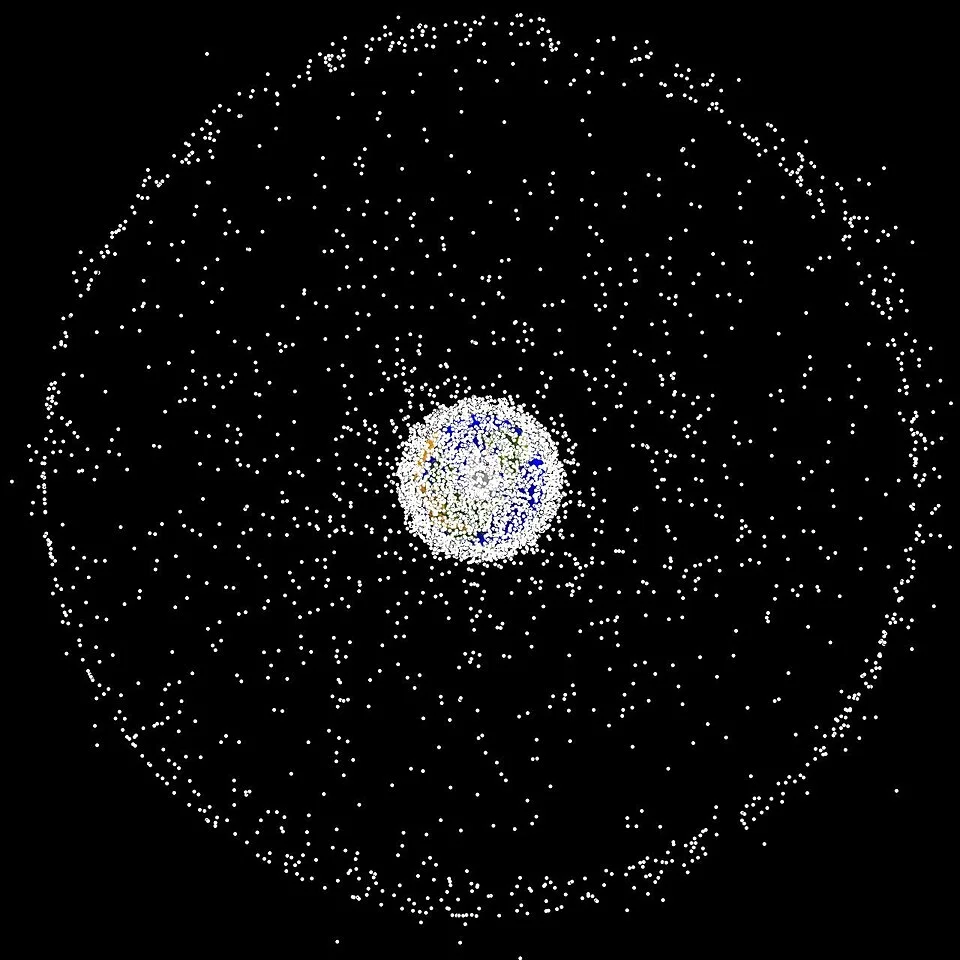
NASA computer-generated polar-view plot of tracked Earth-orbiting objects, with markers enlarged for visibility.
Credit: NASA · Public domain · sourceResized and converted to WebP; uncropped.
1. What space debris is and how it originates
Space debris, also called orbital debris or space junk, comprises human-made objects that no longer serve a useful purpose in Earth orbit or during atmospheric re-entry. It includes inactive satellites, abandoned launch-vehicle stages, mission-related objects and fragments produced by explosions or collisions. Paint flakes and solid-rocket-motor particles are also relevant. An operational satellite is not itself debris, although it can become debris when it fails or reaches the end of its useful life without safe disposal.
Debris is generated both during routine operations and through exceptional events. Residual propellants or pressurised systems can cause an abandoned stage to explode. Batteries may also contribute to fragmentation if inadequately managed. Accidental collisions and destructive anti-satellite tests can create thousands of trackable fragments and many smaller pieces. Consequently, preventing a single major fragmentation event can be more effective than removing numerous tiny particles afterwards.
Size determines both detectability and damage potential. Large objects can generally be tracked more readily, while many centimetre-scale and smaller fragments cannot be routinely catalogued. Yet these smaller objects can penetrate vulnerable components. Estimates must therefore distinguish catalogued objects from statistically modelled populations. ESA’s annual Space Environment Reports provide updated assessments; quoted debris totals should always specify the reference year and size threshold.
- Typical sources: defunct satellites, spent stages, released covers, explosion fragments and collision fragments.
- Distinction: a meteoroid is natural; orbital debris is artificial. Spacecraft protection often considers both together as micrometeoroid and orbital-debris hazards.
Timeline
1978
Kessler and Cour-Palais describe the potential for collision-driven growth of the orbital debris population.
2007
China’s destruction of Fengyun-1C generates extensive debris; UN space-debris mitigation guidelines receive General Assembly endorsement.
2009
The operational Iridium 33 satellite and defunct Cosmos 2251 satellite collide.
2019
COPUOS adopts 21 guidelines for the long-term sustainability of outer space activities.
2022
India inaugurates IS4OM.
2024
ISRO announces its Debris Free Space Missions initiative with a 2030 target.
2. Orbital persistence, collision risk and the Kessler syndrome
An object stays in orbit because its sideways velocity continuously carries it around Earth while gravity pulls it inward. Debris does not simply fall vertically after a spacecraft stops working. Its orbital lifetime depends on altitude, atmospheric density, solar activity and its area-to-mass ratio. Atmospheric drag is stronger at lower altitudes and gradually reduces orbital energy. Higher low-Earth-orbit objects can persist for decades or centuries, while objects near geostationary altitude experience negligible atmospheric drag.
Low Earth orbit, conventionally extending up to about 2,000 km, contains many Earth-observation satellites, crewed spacecraft and communication constellations. Geostationary orbit lies approximately 35,786 km above the equator; satellites there match Earth’s rotation and appear stationary to ground observers. Both regions face debris problems, but their disposal options differ. Re-entry is often appropriate in low orbit, whereas geostationary satellites are usually moved into a higher disposal or graveyard orbit.
Donald Kessler and Burton Cour-Palais described the collision-cascade problem in 1978. When orbital object density becomes sufficiently high, collisions create fragments that increase the probability of further collisions. This Kessler syndrome is a long-term environmental feedback, not a claim that every orbit immediately becomes unusable. Risks are concentrated in particular altitude bands and orbital configurations. Relative encounter speed, object size, orbital geometry and uncertainty in position all influence collision assessment.
- Consequences include spacecraft loss, astronaut danger, service disruption and higher fuel, shielding and insurance costs.
- Re-entry reduces orbital debris but can create ground-safety risks if large components survive atmospheric heating.
Managing a predicted orbital conjunction
- 1. Detect and track space objects
- 2. Determine orbits and positional uncertainty
- 3. Predict close approaches
- 4. Assess collision probability and likely consequences
- 5. Coordinate and execute avoidance if warranted
- 6. Track again and update the risk assessment
3. Tracking, mitigation and active removal
Space situational awareness involves detecting and understanding objects and conditions that can affect space operations. For debris safety, ground-based radars, optical telescopes and other sensors support orbit determination and catalogue maintenance. Radar is particularly useful for many low-orbit objects, while optical observations are important for distant objects. A conjunction assessment predicts close approaches, estimates collision probability and informs an avoidance manoeuvre. Tracking, however, does not physically eliminate debris.
Debris mitigation prevents new debris and limits future risk. Measures include reducing mission-related releases, designing against accidental break-ups, avoiding deliberate destruction and planning post-mission disposal. Passivation means removing or securing stored energy: venting residual propellants, depressurising tanks and safely managing batteries. Drag sails can accelerate orbital decay in suitable low orbits. Design for demise makes components more likely to burn up during re-entry, while controlled re-entry directs surviving material towards a designated remote area.
Active debris removal targets objects already in orbit. Proposed or demonstrated approaches include robotic capture, nets, harpoons and docking devices, followed by deorbiting or relocation. These operations are difficult because debris may tumble, lack capture interfaces and have uncertain structural integrity. Large intact rocket bodies and satellites are important targets because their fragmentation could generate extensive secondary debris. Removal technology also raises dual-use concerns because manoeuvring near or capturing another country’s satellite resembles some counter-space capabilities.
- Mitigation prevents future debris; remediation addresses the existing debris population.
- A graveyard orbit is a disposal region, not a mechanism that destroys the object.
- Shielding helps against sufficiently small particles but cannot make a spacecraft immune to all debris.
| Measure | Function | Limitation |
|---|---|---|
| Tracking and conjunction assessment | Predicts hazardous close approaches | Does not remove debris; many small fragments remain untracked |
| Collision-avoidance manoeuvre | Changes an operational spacecraft’s trajectory | Requires suitable control capability and consumes mission resources |
| Passivation | Reduces explosion risk from stored energy | Does not remove the intact object |
| Post-mission disposal | Enables re-entry or relocation away from a protected region | Depends on system reliability and orbital conditions |
| Active debris removal | Removes or relocates existing non-functional objects | Technically difficult, expensive and consent-sensitive |
4. International rules and the sustainability challenge
The 1967 Outer Space Treaty establishes state responsibility for national space activities, including those conducted by private entities, and requires authorisation and continuing supervision of non-governmental activities. Its principles include due regard for other states’ activities. The 1972 Liability Convention provides absolute liability for damage caused by space objects on Earth’s surface or to aircraft in flight, but fault-based liability for damage to another state’s space object elsewhere than on Earth’s surface.
The Inter-Agency Space Debris Coordination Committee, or IADC, develops technical coordination and mitigation guidance. The UN Committee on the Peaceful Uses of Outer Space adopted Space Debris Mitigation Guidelines in 2007, subsequently endorsed by the UN General Assembly. COPUOS adopted 21 Guidelines for the Long-term Sustainability of Outer Space Activities in 2019. These guidelines are voluntary at the international level, though national regulators can incorporate requirements into binding licences.
A commonly cited benchmark in traditional mitigation guidance is limiting post-mission presence in the low-Earth-orbit region to 25 years. It is not a universal treaty rule, and some regulators impose shorter periods. In 2022, the US Federal Communications Commission adopted a five-year post-mission disposal requirement for relevant non-geostationary satellites ending operations in or passing through low Earth orbit, subject to its jurisdiction and applicable conditions. Ownership and jurisdiction do not vanish when a satellite fails, so foreign debris cannot simply be treated as ownerless salvage.
- Governance gaps include uneven compliance, incomplete data sharing, uncertain fault attribution and the cost of removal.
- Sustainability requires safe constellation design, reliable disposal systems and coordination among states, operators and regulators.
5. India’s space-debris management
India depends on a safe orbital environment for communication, navigation, meteorology, remote sensing and future human spaceflight. ISRO’s Project NETRA, or Network for Space Object Tracking and Analysis, seeks to strengthen indigenous space-object monitoring. The ISRO System for Safe and Sustainable Space Operations Management, IS4OM, was inaugurated in July 2022. It supports activities such as conjunction analysis, collision avoidance and re-entry assessment. ISRO also publishes Indian Space Situational Assessment Reports.
In April 2024, ISRO announced the Debris Free Space Missions initiative with the goal of achieving debris-free space missions by all Indian space actors by 2030. This is a mission-safety and sustainability objective, not a claim that India will remove all existing debris from space. Important implementation needs include reliable end-of-life disposal, passivation, improved tracking, operator coordination and incorporation of sustainability considerations throughout the mission lifecycle.
India’s operational examples show how disposal can be designed into mission completion. In March 2023, ISRO conducted the controlled re-entry of the decommissioned Megha-Tropiques-1 satellite over an uninhabited Pacific Ocean region. In March 2024, the PSLV Orbital Experimental Module-3, or POEM-3, re-entered after serving as an experimental platform for the PSLV-C58 mission. These cases illustrate the use of remaining propulsion capability, orbital lowering and passivation to reduce long-term debris burdens.
- UPSC linkage: space technology, international institutions, environmental commons, national security and science-policy governance.
- Policy priority: combine launch growth and commercial participation with measurable disposal compliance and transparent safety reporting.
Orbital Debris: Distribution, Risk and Evidence Limits
This NASA-generated plot illustrates the distribution of tracked objects around Earth, including concentrations in low Earth orbit (LEO) and the geosynchronous region. It is a model-based visualisation, not a photograph. The metadata states that approximately 95% of the objects represented are debris; this figure describes the particular illustration, not a verified present-day proportion of all orbiting objects. Markers are enlarged relative to Earth, so their apparent size or crowding cannot establish debris dimensions, collision probability or the physical filling of orbital space. Smaller, untracked fragments are not comprehensively represented.
Debris risk depends on relative velocity, orbital crossings and the persistence of objects, rather than object counts alone. Collisions can generate additional fragments and increase subsequent collision risks: the cascading process associated with Kessler syndrome. Atmospheric drag gradually lowers many LEO objects, whereas debris at geosynchronous altitudes can persist much longer. For India, protecting navigation, communications and Earth-observation services requires tracking, conjunction assessment and coordination. ISRO’s space situational awareness activities, including NETRA, support this effort, but tracking does not itself remove debris.
- Mitigation prevents new debris through passivation, fragmentation avoidance and post-mission disposal; active removal targets existing objects. Collision avoidance is a separate operational response.
- Geosynchronous means an orbital period matching Earth’s rotation; geostationary additionally requires a circular, equatorial orbit. Disposal above the protected geosynchronous region is not atmospheric re-entry.
- International mitigation guidelines do not create a universal debris-clean-up authority. Ownership, jurisdiction, consent and liability complicate removal, even when an object is non-functional.
Real-world case studies
Iridium 33–Cosmos 2251 collision, 2009
On 10 February 2009, an operational US commercial satellite and a defunct Russian satellite collided at roughly 790 km altitude. The accident created thousands of trackable fragments. It demonstrated that inactive spacecraft remain hazards and strengthened the case for conjunction warnings, data sharing and post-mission disposal.
Megha-Tropiques-1 controlled re-entry, 2023
The Indo-French atmospheric research satellite was launched in 2011 into an approximately 867 km orbit. After mission completion, ISRO used remaining propellant for orbital lowering and conducted controlled re-entry on 7 March 2023 over the Pacific Ocean. The operation illustrates responsible disposal of a satellite that otherwise could have remained in orbit for a long period.
Previous year questions
No source-linked PYQ is available here yet. Use the practice questions below.
Practice questions
Practice MCQ 1
With reference to orbital debris, consider the following statements: 1. Natural meteoroids are classified as space debris. 2. Passivation reduces the risk of fragmentation caused by stored energy. 3. The Kessler syndrome involves collisions generating fragments that cause further collisions. Which statements are correct?
- A. 1 and 2 only
- B. 2 and 3 only
- C. 1 and 3 only
- D. 1, 2 and 3
Practice MCQ 2
Why are retired geostationary satellites commonly moved into a graveyard orbit rather than brought back for atmospheric re-entry?
- A. Earth’s gravity is absent at geostationary altitude.
- B. Atmospheric drag rapidly destroys objects in a graveyard orbit.
- C. Relocation above the geostationary region generally requires much less velocity change than deorbiting for re-entry.
- D. International treaties prohibit the re-entry of communication satellites.
Practice MCQ 3
Consider the following pairs: 1. Project NETRA — Space-object tracking and analysis 2. IS4OM — Safe and sustainable space-operations management 3. Active debris removal — Venting residual propellant from an otherwise unchanged abandoned stage. Which pairs are correctly matched?
- A. 1 only
- B. 1 and 2 only
- C. 2 and 3 only
- D. 1, 2 and 3
Mains practice · Space debris is both a technological hazard and a challenge to governance of the global commons. Discuss, with reference to India’s initiatives. Suggest a balanced strategy for orbital sustainability. (250 words)
- Define debris and explain collision risks, orbital persistence and the Kessler syndrome.
- Discuss threats to astronauts, satellite services and commercial space activity.
- Distinguish tracking, mitigation, post-mission disposal and active removal.
- Explain voluntary international guidelines, ownership issues, liability and dual-use concerns.
- Include NETRA, IS4OM, the 2030 initiative and Megha-Tropiques-1 disposal.
- Recommend enforceable licensing standards, reliable disposal, data sharing, international consent-based removal and protection of equitable access to space.
Further reading
- ISRO: Indian Space Situational Assessment Reports and Debris Free Space Missions initiative announcement.
- ESA: Annual Space Environment Report.
- NASA Orbital Debris Program Office: Orbital Debris Frequently Asked Questions and Orbital Debris Quarterly News.
- UNOOSA: Space Debris Mitigation Guidelines of COPUOS and Guidelines for the Long-term Sustainability of Outer Space Activities.
- IADC: Space Debris Mitigation Guidelines.
- UNOOSA: Outer Space Treaty and Convention on International Liability for Damage Caused by Space Objects.
- https://commons.wikimedia.org/wiki/File:Debris-GEO1280_p.jpg
Preparing for UPSC Civil Services? Get classroom teaching, answer-writing evaluation and mentorship at Pragnya IAS Academy, Ashok Nagar — see why aspirants choose us for IAS coaching in Hyderabad.