
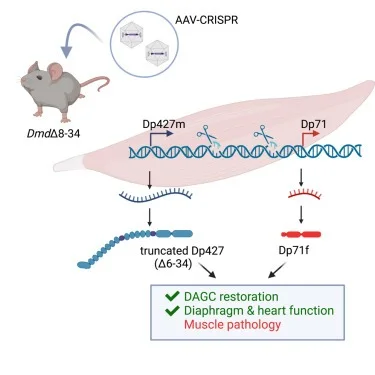
Schematic of AAV–CRISPR dystrophin gene editing in a mouse model of muscular dystrophy.
Credit: Tatiana V. Egorova · CC0 · sourceResized and converted to WebP; uncropped.
1. Meaning and scientific foundations
Gene editing, also called genome editing, is the deliberate alteration of selected sequences within an organism’s genome. Changes can range from a single nucleotide substitution to deletion or insertion of a longer DNA segment. Editing may inactivate a gene, correct a disease-associated variant or alter gene regulation. Unlike conventional selective breeding, it can directly target a chosen genomic location rather than depend on repeated crossing and selection.
Gene editing and genetic modification overlap, but they are not identical descriptions. Transgenesis generally introduces genetic material from an external source, potentially from another species. An edited organism may contain no foreign DNA in its final genome. Conversely, editing can also insert foreign DNA. Therefore, the statement that all gene-edited organisms are transgenic is incorrect, while claims that editing is categorically unrelated to genetic engineering are also misleading.
Gene therapy is defined by its therapeutic purpose, not by one particular technique. It includes adding functional genetic material, modifying gene expression and editing genes. Thus, some gene therapies use genome editing, but many do not. Likewise, gene editing in crops or laboratory organisms is not human gene therapy. These distinctions are important in statement-based Prelims questions.
- Knockout: disruption of a gene to reduce or eliminate its function.
- Knock-in: targeted introduction of a DNA sequence.
- Genotype: genetic constitution; phenotype: observable characteristics shaped by genotype and environment.
Timeline
2012
A landmark study demonstrated programmable RNA-guided DNA cleavage using CRISPR-Cas9.
2018
The announcement of gene-edited babies in China provoked international condemnation.
2020
Charpentier and Doudna received the Nobel Prize in Chemistry.
2022
India introduced a conditional regulatory exemption for SDN-1 and SDN-2 genome-edited plants.
2023
The UK authorised Casgevy, the first approved CRISPR-based medicine.
2. Tools and the editing mechanism
Major editing platforms include zinc-finger nucleases, transcription activator-like effector nucleases and CRISPR-associated systems. Zinc-finger nucleases and TALENs use engineered DNA-binding proteins linked to a DNA-cleaving enzyme. CRISPR-Cas9 commonly uses a guide RNA to recognise a complementary DNA sequence, making retargeting comparatively straightforward. CRISPR stands for Clustered Regularly Interspaced Short Palindromic Repeats; Cas denotes CRISPR-associated proteins.
In a typical CRISPR-Cas9 system, the guide RNA brings Cas9 to the intended genomic region. Recognition also requires a suitable adjacent sequence called the protospacer adjacent motif, or PAM. Cas9 cuts DNA, and cellular repair mechanisms determine the resulting edit. Non-homologous end joining often produces small insertions or deletions that can disable a gene. Homology-directed repair can use a supplied DNA template to introduce a specified change, but its efficiency depends on cell type and biological conditions.
Newer approaches broaden the toolkit. Base editors combine a targeting system with an enzyme that chemically converts certain DNA bases, generally without deliberately creating a double-strand break. Prime editing combines a modified Cas protein, reverse transcriptase and a specialised guide RNA to specify diverse small changes. Neither approach is universally applicable or error-free. Cas12 commonly targets DNA, whereas Cas13 targets RNA; RNA targeting does not itself necessarily alter the genome.
- Guide RNA provides sequence specificity; Cas9 supplies nuclease activity.
- Target selection, delivery into cells and repair outcomes all influence success.
- A targeted cut does not guarantee a precise or therapeutically useful final edit.
Typical ex vivo therapeutic editing pathway
- 1. Identify the disease mechanism and suitable genetic target
- 2. Collect the patient’s relevant cells
- 3. Deliver editing components into the collected cells
- 4. Assess editing efficiency, unintended changes and product quality
- 5. Prepare the patient and administer the edited cell product
- 6. Monitor clinical benefit and long-term safety
3. Applications in medicine, agriculture and research
Medical applications include inherited blood disorders, experimental cancer immunotherapies and investigation of rare genetic diseases. In ex vivo editing, cells are removed, edited and checked outside the body before administration to the patient. In vivo editing delivers the editing machinery directly into the body. Ex vivo approaches permit greater testing of the cell product, whereas in vivo approaches may reach tissues whose cells cannot readily be removed and replaced.
Somatic editing affects non-reproductive cells and is not intended to be inherited by offspring. Germline editing involves reproductive cells or their precursors; embryo editing can create heritable changes if an edited embryo develops into a person. This distinction is central to ethics and regulation. Editing an embryo for laboratory research is also different from using an edited embryo to establish a pregnancy, though both require stringent oversight.
Agricultural applications include resistance to pathogens, improved nutritional composition, delayed deterioration and tolerance to environmental stresses. However, drought tolerance and yield commonly involve many genes and environmental interactions; changing one gene is not a universal solution. Editing may also introduce trade-offs between resistance, growth and other traits. Field trials and assessment of agronomic performance remain necessary.
In research, editing helps establish what genes do, generate disease models and identify potential drug targets. Gene drives are a distinct application designed to bias inheritance and spread a trait through a population. Proposed mosquito-control drives could affect disease transmission, but ecological effects and cross-border spread require exceptional caution. Ordinary genome editing does not automatically create a gene drive.
| Approach | Target recognition | Core feature |
|---|---|---|
| Zinc-finger nucleases | Engineered zinc-finger proteins | Protein-guided DNA cleavage |
| TALENs | Engineered TALE DNA-binding proteins | Protein-guided DNA cleavage |
| CRISPR-Cas9 | Guide RNA and suitable PAM | Typically creates a DNA double-strand break |
| Base editing | Guide-directed modified Cas system | Converts certain bases without a deliberate double-strand break |
| Prime editing | Prime-editing guide RNA | Uses reverse transcriptase to write specified small changes |
4. Risks, ethics and public-health considerations
Off-target effects are unintended alterations away from the selected site. Unwanted on-target outcomes, including large deletions or rearrangements, can also occur at the intended location. Mosaicism arises when different cells carry different edits. Delivery remains a major bottleneck: editing components must reach the correct tissue and enter sufficient cells without unacceptable toxicity or immune reactions.
Ethical concerns extend beyond laboratory safety. Future generations cannot consent to inherited modifications; reproductive use may entrench discriminatory ideas about desirable traits. Therapeutic goals should be distinguished from enhancement, although their boundaries can be contested. The unauthorised birth of gene-edited babies announced in China in 2018 demonstrated the consequences of weak oversight and premature clinical application.
Access is another major concern. Personalised cell processing, specialised centres, intellectual-property restrictions and accompanying treatments can make therapies prohibitively expensive. A technically successful intervention may therefore have limited population-level impact. Responsible deployment requires transparent trials, long-term follow-up, informed consent, equitable access and independent review. WHO’s 2021 recommendations on human genome editing emphasise governance and oversight rather than treating scientific feasibility as sufficient justification.
5. Indian regulation and examination relevance
India regulates genetically engineered organisms through the Environment (Protection) Act, 1986 and the Rules, 1989 concerning hazardous microorganisms and genetically engineered organisms or cells. Oversight involves bodies including Institutional Biosafety Committees, the Review Committee on Genetic Manipulation under the Department of Biotechnology, and the Genetic Engineering Appraisal Committee under the environment ministry. Their roles differ according to the activity and stage of development.
In March 2022, the environment ministry exempted qualifying SDN-1 and SDN-2 genome-edited plants, free from exogenous introduced DNA, from Rules 7–11 of the Rules, 1989. DBT subsequently issued guidelines and standard operating procedures. SDN-1 usually involves repair without an externally supplied repair template; SDN-2 uses a template for a defined small alteration; SDN-3 involves targeted insertion of larger sequences. The exemption is not a blanket removal of biosafety scrutiny and does not apply automatically to SDN-3 plants, animals or human editing.
Human applications fall within medical research, clinical-trial and product-regulation frameworks. The National Guidelines for Gene Therapy Product Development and Clinical Trials, 2019, issued by ICMR and DBT, provide an important reference. Germline gene therapy is not permitted under these guidelines. For Prelims, always check the organism, editing category, presence of foreign DNA and intended use before judging a regulatory statement.
CRISPR editing: from targeted DNA changes to therapeutic evidence
The supplied metadata describes a schematic of AAV–CRISPR editing of the dystrophin gene in DmdΔ8–34 mdx mice, including restoration of specified dystrophin isoforms and functional outcomes in cardiac and diaphragm muscles. This directly illustrates a therapeutic application of gene editing. In CRISPR–Cas editing, a guide RNA directs a Cas enzyme towards a selected DNA sequence; cellular repair of the resulting break can disrupt a sequence or enable a corrective change. Adeno-associated virus (AAV) serves as a delivery vehicle, not as the DNA-editing enzyme.
Dystrophin helps maintain muscle-cell stability, and pathogenic changes in its gene cause Duchenne muscular dystrophy. Editing strategies may seek to restore production of a functional protein without recreating the complete normal gene sequence. However, a mouse-model schematic is preclinical evidence, not proof of safety or efficacy in humans. The metadata alone does not establish editing efficiency, durability, sample size or clinical benefit. Translation requires assessment of delivery to affected tissues, unintended DNA changes and immune responses. For India, this example connects rare-disease research with questions of equitable access, biosafety and ethical oversight; it does not establish availability or approval of a treatment in India.
- Gene editing changes a targeted sequence; transgenesis introduces genetic material. Editing need not leave foreign DNA in the final organism.
- Gene therapy is broader than editing: therapeutic gene addition can work without correcting the original mutation.
- Somatic editing targets the treated individual; heritable editing raises distinct intergenerational concerns. Animal therapeutic results do not justify reproductive use.
Real-world case studies
Casgevy: increasing fetal haemoglobin
Casgevy edits a regulatory region controlling BCL11A in a patient’s blood-forming stem cells, increasing fetal haemoglobin production. It does not directly repair the sickle-cell mutation. First authorised in the UK in November 2023 for eligible patients with sickle-cell disease or transfusion-dependent beta-thalassaemia, it illustrates ex vivo somatic editing. Conditioning chemotherapy, specialist infrastructure and cost remain significant challenges.
Japan’s high-GABA tomato
A CRISPR-edited tomato with elevated gamma-aminobutyric acid became commercially available in Japan in 2021. Editing altered an enzyme-regulating region involved in GABA production. It illustrates how food composition can be modified without retaining an introduced foreign gene. A compositional change, however, does not by itself establish every advertised health benefit.
Previous year questions
UPSC Prelims 2019
What is Cas9 protein, which is often mentioned in the news?
- A. A molecular scissors used in targeted gene editing
- B. A biosensor used in the accurate detection of pathogens in patients
- C. A gene that makes plants pest-resistant
- D. A herbicidal substance synthesised in genetically modified crops
Practice questions
Practice MCQ 1
Consider the following statements: 1. All genome-edited organisms necessarily retain foreign DNA. 2. CRISPR-Cas9 commonly relies on cellular DNA-repair mechanisms to generate an edit. 3. Somatic editing is intended to transmit changes to offspring. Which statements are correct?
- A. 1 and 2 only
- B. 2 only
- C. 2 and 3 only
- D. 1, 2 and 3
Practice MCQ 2
Regarding India’s 2022 regulatory decision on genome-edited plants, which statement is correct?
- A. All genome-edited plants were exempted from every biosafety requirement.
- B. The exemption also automatically covered human germline editing.
- C. Qualifying SDN-1 and SDN-2 plants free from exogenous introduced DNA were exempted from Rules 7–11 of the Rules, 1989.
- D. Only SDN-3 plants received the exemption.
Practice MCQ 3
Consider the following pairs: 1. Base editing — conversion of certain DNA bases without a deliberate double-strand break. 2. Prime editing — use of reverse transcriptase. 3. Cas13 — RNA targeting. How many pairs are correctly matched?
- A. Only one
- B. Only two
- C. All three
- D. None
Mains practice · Gene editing offers transformative opportunities, but precision at the molecular level does not eliminate societal risk. Discuss with reference to healthcare, agriculture and Indian regulation. Answer in 250 words.
- Define gene editing and distinguish it from transgenesis.
- Explain medical applications through ex vivo somatic editing and Casgevy.
- Discuss crop improvement without assuming that complex traits have single-gene solutions.
- Examine off-target changes, unintended on-target outcomes, delivery and ecological risks.
- Address germline ethics, affordability, informed consent and equitable access.
- Explain India’s conditional SDN-1/SDN-2 plant exemption and human gene-therapy guidelines.
- Conclude with proportionate, transparent and application-specific oversight.
Further reading
- NCERT Biology, Class XII: Biotechnology: Principles and Processes; Biotechnology and its Applications.
- Department of Biotechnology: Guidelines for Safety Assessment of Genome Edited Plants, 2022, and associated standard operating procedures.
- Ministry of Environment, Forest and Climate Change: March 2022 decision concerning SDN-1 and SDN-2 genome-edited plants.
- ICMR and DBT: National Guidelines for Gene Therapy Product Development and Clinical Trials, 2019.
- World Health Organization: Human Genome Editing: Recommendations, 2021.
- UK Medicines and Healthcare products Regulatory Agency: Casgevy authorisation announcement, November 2023.
- https://commons.wikimedia.org/wiki/File:Gene_Editing_in_mdx_Mouse.jpg
Preparing for UPSC Civil Services? Get classroom teaching, answer-writing evaluation and mentorship at Pragnya IAS Academy, Ashok Nagar — see why aspirants choose us for IAS coaching in Hyderabad.