
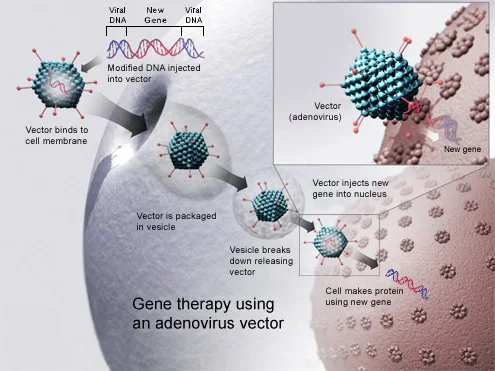
Illustrative context for gene therapy; the supplied title does not specify a technique or disease.
Credit: Wikimedia Commons · Public domain · sourceResized and converted to WebP; uncropped.
1. Meaning, biological basis and scope
Genes are DNA sequences whose expression produces functional RNA or proteins. A pathogenic genetic variant may prevent protein production, produce a defective protein or cause harmful activity. Gene therapy seeks to address disease at this molecular level by transferring or modifying genetic material. However, it is not synonymous with replacing every defective gene, and a successful intervention need not restore the original DNA sequence.
Major approaches include gene addition, gene editing and genetically engineering cells to acquire a therapeutic function. Gene addition supplies a functional genetic sequence so that the cell can produce a needed protein. Editing changes a selected DNA sequence or its regulation. Gene-based strategies may also suppress harmful expression. Many conventional antisense and small interfering RNA medicines regulate RNA without changing DNA and should not automatically be described as genome-editing therapies.
Single-gene disorders are attractive targets because their molecular causes are relatively well defined. Examples include haemophilia, beta-thalassaemia and some inherited retinal diseases. Cancer applications may instead involve engineering immune cells. Complex disorders such as diabetes and hypertension usually involve multiple genes and environmental influences, making a straightforward genetic correction much harder. Gene therapy is therefore a broad platform, not a universal cure.
- Gene addition: provide a functional genetic sequence.
- Gene editing: alter a selected sequence or regulatory region.
- Engineered-cell therapy: modify cells genetically to perform a therapeutic task.
Timeline
1990
An early landmark therapeutic gene-transfer trial treated a child with ADA deficiency using genetically modified T cells in the United States.
2012
CRISPR-Cas9 was demonstrated as a programmable DNA-cutting system, laying a foundation for modern genome editing.
2019
ICMR and DBT issued India’s national guidelines for gene therapy product development and clinical trials.
November 2023
The UK MHRA authorised Casgevy for eligible patients with sickle-cell disease or transfusion-dependent beta-thalassaemia.
2. Somatic intervention and routes of delivery
Somatic gene therapy targets cells such as blood-forming stem cells, liver cells, retinal cells or immune cells. Its intended effects are restricted to the treated individual. Germline intervention targets gametes, their precursors or embryos in ways that could produce heritable changes. It raises additional concerns because future generations cannot consent and unexpected effects may persist in a population. Established clinical gene therapies are somatic; heritable human genome editing is not routine accepted clinical practice.
In vivo treatment delivers a therapeutic vector or editing system directly into the patient. Administration may be systemic, such as an intravenous infusion, or local, such as injection beneath the retina. The delivery system must reach the intended tissue while limiting exposure elsewhere. Tissue targeting, dose, immune responses and the ability to enter the correct cells strongly influence efficacy.
Ex vivo treatment begins by collecting a patient’s cells, modifying them in a controlled laboratory and testing the resulting product before reinfusion. Haematopoietic stem cells and T cells are important examples. Patients receiving modified blood-forming stem cells often need conditioning chemotherapy to make space in the bone marrow. Ex vivo delivery permits product testing but involves complex manufacturing and does not eliminate clinical risks.
The distinction between cell therapy and gene therapy is also important. A conventional stem-cell transplant transfers cells without necessarily modifying their genes. Genetically modified stem cells fall within both categories. Similarly, conventional vaccination is not automatically gene therapy merely because a vaccine contains genetic material.
- In vivo means modification is initiated inside the body.
- Ex vivo means cells are modified outside the body and then administered.
- Somatic versus germline describes heritability, not the delivery route.
Typical ex vivo blood-forming stem-cell gene therapy
- 1. Confirm diagnosis and assess patient eligibility
- 2. Collect the patient’s blood-forming stem cells
- 3. Add a therapeutic gene or edit a selected DNA target
- 4. Test the modified cells for quality, safety and potency
- 5. Administer conditioning treatment where required
- 6. Infuse the modified cells
- 7. Monitor engraftment, therapeutic response and long-term safety
3. Vectors, CRISPR and therapeutic mechanisms
A vector carries therapeutic genetic material into cells. Viral vectors exploit the natural ability of viruses to enter cells, but are engineered to remove disease-causing functions and restrict replication. Adeno-associated virus, or AAV, is widely used for in vivo gene delivery. Its genetic cargo generally remains outside the chromosomes, although integration can occasionally occur. Its small carrying capacity and immune responses, including pre-existing antibodies, constrain its use.
Lentiviral vectors can integrate genetic material into cellular DNA and support durable expression as cells divide. They are commonly used to modify blood-forming stem cells and immune cells ex vivo. Integration creates a risk of disrupting genes or affecting growth-control mechanisms, although modern designs incorporate safeguards. Non-viral methods include lipid nanoparticles and electroporation. Electroporation temporarily increases cell-membrane permeability, allowing editing components to enter cells.
CRISPR-Cas systems combine a guide RNA with a Cas enzyme to recognise a target sequence. In conventional CRISPR-Cas9 editing, the enzyme cuts DNA and cellular repair produces the change. Repair may disrupt a gene or, under suitable conditions, introduce a designed sequence. Base editing and prime editing extend the toolkit and can make selected changes without the conventional double-strand break used by Cas9 nucleases.
Editing need not repair the disease-causing mutation itself. Casgevy modifies a regulatory region controlling BCL11A in a patient’s blood-forming stem cells, increasing fetal haemoglobin production. This compensates for defective adult haemoglobin in sickle-cell disease and transfusion-dependent beta-thalassaemia. It illustrates a central examination point: a therapeutic genetic change may bypass a disease mechanism rather than directly reverse its original mutation.
- Off-target effects are unintended changes at other genomic locations.
- Unintended on-target effects can include large deletions or rearrangements at the intended editing site.
| Approach | Defining feature | Important limitation |
|---|---|---|
| AAV vector | Usually delivers a gene without chromosomal integration | Limited cargo capacity; immune responses can hinder treatment or redosing |
| Lentiviral vector | Integrates therapeutic genetic material into cellular DNA | Insertion-related risks require safeguards and monitoring |
| Lipid nanoparticles | Non-viral carriers capable of delivering nucleic acids | Efficient delivery to many tissues remains challenging |
| Electroporation | Uses electrical pulses to introduce material into cells, commonly ex vivo | May reduce cell viability and requires process optimisation |
| CRISPR-Cas editing | Changes a selected genomic target; requires a separate delivery method | Unintended on-target and off-target changes are possible |
4. Clinical applications, benefits and limitations
Gene therapies have moved beyond experimental proof of concept. Voretigene neparvovec treats a specific inherited retinal disease associated with biallelic RPE65 mutations. Onasemnogene abeparvovec supplies a functional SMN1 gene for eligible patients with spinal muscular atrophy. Gene therapies for haemophilia aim to increase production of clotting factors. Eligibility remains product-specific and may depend on age, organ function, genetic diagnosis and antibody status.
Chimeric antigen receptor T-cell therapy, or CAR-T therapy, genetically engineers T cells to recognise selected targets on cancer cells. Approved uses include certain blood cancers. CAR-T therapy demonstrates that gene therapy is not limited to inherited disorders. Potential serious adverse effects include cytokine release syndrome and neurological toxicity, requiring specialist monitoring and treatment.
A single administration can sometimes produce sustained benefits, but one-time treatment does not guarantee a lifelong cure. Expression may decline, disease damage may already be irreversible, and repeat dosing may be difficult because of immune responses. Other risks include insertional mutagenesis, editing errors, inflammatory reactions and conditioning-related toxicity. Long-term follow-up is necessary to assess durability and delayed adverse events.
Access is constrained by high prices, specialised facilities, manufacturing capacity and the need for accurate diagnosis. Personalised ex vivo products require reliable identification and tracking of each patient’s cells. For public health, effectiveness must be assessed alongside affordability, equitable access and opportunity costs.
5. Indian regulation, ethics and examination relevance
In India, ICMR and the Department of Biotechnology issued the National Guidelines for Gene Therapy Product Development and Clinical Trials in 2019. They address preclinical assessment, product quality, clinical evaluation, ethical oversight and long-term follow-up. Gene therapy products fall within the new-drug regulatory framework under the New Drugs and Clinical Trials Rules, 2019. CDSCO is the central drug regulatory organisation; institutional ethics and applicable biosafety oversight also remain important.
Ethical evaluation centres on informed consent, realistic communication of benefits, protection of children and vulnerable patients, genetic privacy and fair participant selection. Consent is particularly challenging where families facing severe disease may mistake experimental treatment for proven care. Heritable editing adds intergenerational risks and concerns about enhancement and eugenics.
For Prelims, avoid equating gene therapy with CRISPR, all stem-cell procedures or all genetic testing. Genetic diagnosis identifies variants; it does not itself treat disease. Also distinguish regulatory approval for a defined indication from universal safety or suitability. India’s priorities include stronger rare-disease diagnosis, indigenous technology, transparent trials, pharmacovigilance and financing arrangements that improve access without weakening evidence standards.
Gene therapy: delivery, targets and limits
Gene therapy changes genetic material or its activity in a patient’s cells to achieve a therapeutic effect. Gene addition supplies a functional sequence without necessarily repairing the original mutation; gene editing makes targeted changes to DNA. Neither should be confused with every use of biotechnology in medicine: administering recombinant insulin supplies a protein, not a therapeutic genetic modification of the patient’s cells. The image title identifies gene therapy, but absent descriptive metadata, no particular vector, procedure or disease can be inferred.
Delivery determines both feasibility and risk. In vivo therapy delivers genetic material directly into the body, whereas ex vivo therapy modifies cells outside the body before returning them to the patient. Viral vectors can efficiently deliver genetic cargo, but immune reactions, cargo capacity and unwanted genomic effects require assessment. Non-viral delivery has different advantages and constraints. In India, inherited blood disorders make this field especially relevant, while affordability, specialised facilities, long-term monitoring and equitable access are important Mains concerns.
- Somatic interventions target the treated individual; germline interventions can create heritable changes. Delivery inside the body does not automatically imply germline modification.
- Genetically engineered CAR-T cells illustrate ex vivo cancer therapy. Not all cell therapies, however, involve genetic modification.
- Gene editing is not synonymous with a guaranteed cure: off-target changes, incomplete delivery and durability require disease-specific evidence and follow-up.
Real-world case studies
Casgevy: compensation rather than direct mutation repair
Casgevy uses CRISPR-Cas9 to edit a regulatory region of BCL11A in autologous blood-forming stem cells. Increased fetal haemoglobin helps counter the effects of abnormal adult haemoglobin. Its UK authorisation in November 2023 marked the first approval of a CRISPR-based medicine. Treatment still requires specialist infrastructure and conditioning chemotherapy.
NexCAR19: indigenous engineered-cell therapy
India’s CDSCO approved NexCAR19 in 2023 for specified relapsed or refractory B-cell malignancies. Developed through collaboration involving IIT Bombay, Tata Memorial Centre and ImmunoACT, it uses genetically engineered T cells targeting CD19. It illustrates indigenous biotechnology capacity, while also highlighting the need for specialist management of CAR-T-related toxicities.
Previous year questions
No source-linked PYQ is available here yet. Use the practice questions below.
Practice questions
Practice MCQ 1
With reference to gene therapy, consider the following statements: 1. Ex vivo therapy involves modification of cells outside the patient’s body. 2. Somatic gene therapy is intended to transmit therapeutic changes to offspring. 3. Gene addition can provide benefit without correcting the original mutation. Which of the statements given above are correct?
- A. 1 and 2 only
- B. 1 and 3 only
- C. 2 and 3 only
- D. 1, 2 and 3
Practice MCQ 2
Which one of the following best explains how Casgevy treats certain inherited blood disorders?
- A. It replaces all bone-marrow cells with unmodified donor cells.
- B. It edits every sickle-cell mutation directly in circulating red blood cells.
- C. It edits a regulatory region in blood-forming stem cells to increase fetal haemoglobin.
- D. It supplies antibodies that permanently eliminate abnormal haemoglobin.
Practice MCQ 3
Consider the following statements: 1. AAV-delivered genetic material generally remains outside the chromosomes. 2. Lentiviral vectors can integrate genetic material into the host-cell genome. 3. CRISPR-Cas9 itself guarantees delivery exclusively to the desired organ. Which of the statements given above are correct?
- A. 1 only
- B. 2 and 3 only
- C. 1 and 2 only
- D. 1, 2 and 3
Mains practice · Gene therapy offers transformative treatment possibilities, but scientific success alone cannot ensure public-health benefits. Discuss with reference to India. (250 words)
- Explain somatic gene therapy and distinguish gene addition from editing.
- Illustrate applications using inherited blood disorders and CAR-T therapy.
- Discuss delivery barriers, immune reactions, editing risks and long-term monitoring.
- Examine affordability, specialist infrastructure and unequal access to diagnosis.
- Refer to the 2019 ICMR-DBT guidelines and CDSCO regulation.
- Recommend indigenous research, rigorous trials, informed consent and equitable financing.
Further reading
- NCERT Biology, Class XII: Biotechnology and its Applications.
- ICMR and DBT: National Guidelines for Gene Therapy Product Development and Clinical Trials, 2019.
- CDSCO: New Drugs and Clinical Trials Rules, 2019.
- US FDA: Cellular and Gene Therapy Products.
- UK MHRA: Casgevy authorisation announcement, November 2023.
- WHO: Human Genome Editing recommendations, 2021.
- https://commons.wikimedia.org/wiki/File:Gene_therapy.jpg
Preparing for UPSC Civil Services? Get classroom teaching, answer-writing evaluation and mentorship at Pragnya IAS Academy, Ashok Nagar — see why aspirants choose us for IAS coaching in Hyderabad.