
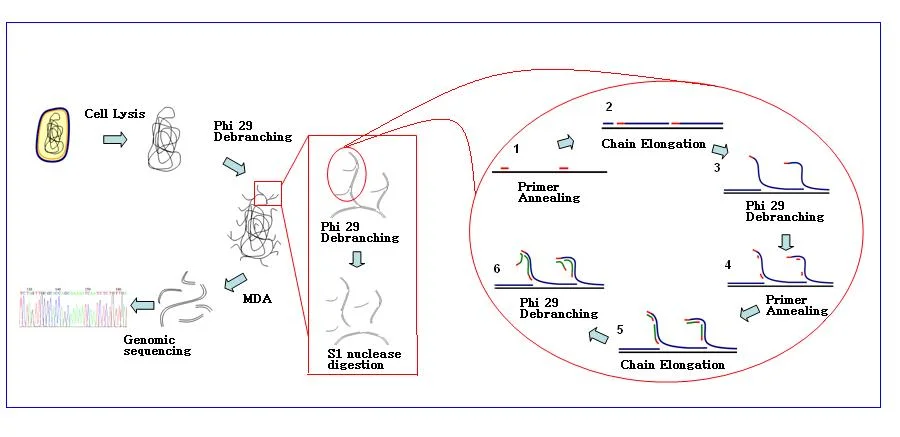
Single-cell genome sequencing: multiple displacement amplification (MDA) context.
Credit: Qianlim · Public domain · sourceResized and converted to WebP; uncropped.
1. What a genome sequence reveals
A genome is the complete genetic material of an organism or biological entity. In humans, genetic information occurs in nuclear chromosomes and mitochondrial DNA. Plants also possess chloroplast genomes. Many viruses have RNA rather than DNA genomes; sequencing workflows for these commonly involve converting RNA into complementary DNA. Genome sequencing establishes the order of bases, but interpreting that order requires additional biological and computational analysis.
A gene is a DNA sequence that contributes to a functional product, such as a protein or functional RNA. The genome also contains regulatory sequences, repetitive DNA and other non-coding regions. Protein-coding exons constitute only about 1–2% of the human genome. Therefore, the genome should not be understood merely as a collection of protein-coding genes, nor should all non-coding DNA be dismissed as functionless.
Individuals differ at many genomic positions. Differences include single-nucleotide variants, small insertions and deletions, copy-number changes and larger structural variants. Many variants are harmless; some affect disease susceptibility or biological traits. A reference genome provides a coordinate framework for comparison, not a genetically ideal individual. A pangenome incorporates sequences from multiple individuals to represent diversity more adequately.
- Genomics studies genomes collectively; genetics often focuses on individual genes and inheritance.
- A genetic association identifies a statistical relationship; it does not automatically establish causation.
Timeline
1977
Sanger’s chain-termination sequencing method was introduced.
1990–2003
The Human Genome Project developed a foundational human genome reference.
2020
GenomeIndia was initiated; INSACOG was established in December.
2022–2023
Telomere-to-telomere advances resolved major remaining gaps in human reference sequencing.
January 2025
GenomeIndia’s 10,000-genome dataset was dedicated to the nation.
2. Technologies and the sequencing workflow
Sanger sequencing, developed in 1977, uses chain-terminating nucleotides to generate DNA fragments whose lengths reveal the sequence. It remains useful for small targets and selected confirmatory tests. Next-generation sequencing, or NGS, processes large numbers of DNA fragments in parallel. This massively parallel approach sharply reduced sequencing costs and enabled population-scale studies, although equipment, interpretation and secure storage remain substantial expenses.
Short-read platforms generally sequence fragments spanning tens to hundreds of bases. They provide high throughput and strong performance for many small variants, but repetitive regions and large rearrangements can be difficult to resolve. Long-read technologies, including Pacific Biosciences and Oxford Nanopore approaches, read much longer molecules and help identify structural variants and assemble complex genomes. Accuracy depends on the platform, chemistry and analytical method.
A typical workflow begins with sample collection, extraction of genetic material and quality assessment. DNA is prepared as a sequencing library, often with adapters that allow machine recognition and sample identification. Sequencing produces reads. Bioinformatics tools assess their quality, align them against a reference or assemble them without one, identify variants and annotate their possible significance. Clinical findings require careful interpretation and, where appropriate, validation.
Coverage describes how extensively a genome is sampled; depth is the average number of reads covering a position. Higher depth generally improves confidence but cannot eliminate systematic errors, contamination or missing difficult regions. De novo assembly builds a sequence without relying on an existing reference. Reference-guided analysis is efficient but may underrepresent sequences absent from that reference.
- Some sequencing methods use amplification, while others can analyse single molecules; PCR is not mandatory for every platform.
- A sequence read is a fragment-level observation, not necessarily a complete chromosome.
From biological sample to useful genomic information
- 1. Collect samples with appropriate consent and documentation
- 2. Extract genetic material and assess quality
- 3. Prepare sequencing libraries
- 4. Generate sequence reads
- 5. Check quality and align or assemble reads
- 6. Identify and annotate variants
- 7. Validate and interpret findings in context
3. Sequencing strategies and applications
Whole-genome sequencing attempts to examine the entire genome, although practical completeness depends on the technology and analysis. Whole-exome sequencing enriches mainly protein-coding exons and is useful for investigating many Mendelian disorders. Targeted sequencing examines selected genes or regions, often at greater depth and lower cost. A negative exome result does not rule out disease caused by regulatory variants, repeat expansions or other poorly captured changes.
RNA sequencing examines RNA present in a sample and reveals gene expression and alternative splicing. It is a transcriptomic method rather than an equivalent substitute for DNA genome sequencing. Metagenomic sequencing analyses genetic material from mixed communities, such as soil, seawater or the human gut. Shotgun metagenomics can detect diverse organisms without first isolating each in culture, although contamination and incomplete databases complicate interpretation.
In healthcare, sequencing supports rare-disease diagnosis, tumour profiling and pharmacogenomics, which studies how genetic differences affect medicine response. Tumour sequencing can identify acquired, or somatic, mutations distinct from inherited germline variants. In public health, pathogen sequencing helps monitor variants, antimicrobial-resistance determinants and outbreak relationships. However, finding a resistance gene does not always replace laboratory susceptibility testing.
In agriculture, genome information supports marker-assisted selection, genomic selection and identification of traits linked to disease resistance or stress tolerance. Conservation genomics assesses genetic diversity, inbreeding and population structure. Sequencing can also assist species identification and wildlife investigations. These applications do not necessarily involve producing genetically modified organisms: observing DNA and altering DNA are separate activities.
- DNA fingerprinting usually compares selected variable markers rather than determining an entire genome.
- CRISPR-based editing changes genetic material; sequencing can help design or verify an edit.
| Approach | What it examines or does | Principal limitation |
|---|---|---|
| Whole-genome sequencing | Coding and non-coding genomic regions | Some regions remain difficult to resolve |
| Whole-exome sequencing | Primarily protein-coding exons | Misses most non-coding variation |
| Targeted sequencing | Selected genes or regions | Cannot assess unselected regions |
| RNA sequencing | RNA abundance and sequence | Depends on tissue and sampling conditions |
| Genome editing | Deliberately changes genetic material | Is not a sequencing method |
4. Major milestones and Indian initiatives
The international Human Genome Project began in 1990 and announced completion in 2003. It established a foundational human reference and accelerated genomic research, but repetitive and technically difficult regions remained unresolved. In 2022, the Telomere-to-Telomere Consortium published a substantially gapless sequence of a human genome, excluding the Y chromosome. A complete Y-chromosome sequence followed in 2023. These achievements do not mean that one sequence represents all human diversity.
India’s Department of Biotechnology initiated GenomeIndia in 2020, bringing together 20 institutions. Its 10,000-genome dataset, representing 83 population groups, was dedicated to the nation in January 2025. The project addresses the underrepresentation of Indian populations in global genomic datasets. A population reference resource can improve variant interpretation, but its existence does not automatically translate into clinically validated tests or treatments.
The Indian Biological Data Centre at the Regional Centre for Biotechnology, Faridabad, provides infrastructure for biological data storage and sharing. CSIR’s IndiGen programme generated whole-genome data from more than 1,000 Indian individuals. Separately, the Indian SARS-CoV-2 Genomics Consortium, INSACOG, was established in December 2020 to support genomic surveillance of SARS-CoV-2. Human population genomics and pathogen surveillance have different objectives and sampling requirements.
- Human Genome Project: foundational international human reference.
- GenomeIndia: understanding Indian human genomic diversity.
- INSACOG: genomic surveillance of SARS-CoV-2.
5. Interpretation, ethics and governance
Genomic predictions are probabilistic. Common diseases such as diabetes involve multiple genes interacting with diet, environment and behaviour. Even a disease-associated variant may show incomplete penetrance, meaning that not every carrier develops the condition. Polygenic risk scores can perform poorly outside the populations used to develop them. Representative datasets and independent clinical validation are therefore essential.
Genomic data can reveal information about relatives as well as the sampled individual, and removing names may not guarantee anonymity. Responsible programmes require informed consent, purpose-limited access, strong security and clear policies for incidental findings. Indian research should follow applicable law and ICMR ethical guidance. Equitable participation, genetic counselling and affordable follow-up care are important to prevent genomic advances from widening health inequalities.
- A variant of uncertain significance is not, by itself, a confirmed diagnosis.
- Population labels are imperfect proxies for genetic ancestry and should not support biological stereotyping.
- Sequencing results must be interpreted alongside clinical, epidemiological or ecological evidence.
Single-cell sequencing and the role of DNA amplification
Genome sequencing determines the order of nucleotide bases in DNA. Single-cell genome sequencing applies this approach to individual cells rather than a pooled sample, helping researchers investigate genetic differences that bulk sequencing may obscure. The supplied title identifies single-cell genome sequencing with MDA, making it relevant to this specialised workflow; the sparse description does not establish the image’s specific contents or experimental results.
Multiple displacement amplification (MDA) increases the amount of DNA available from a small starting sample, such as an individual cell. It typically uses random primers and a strand-displacing DNA polymerase under approximately constant-temperature conditions. Crucially, MDA is a sample-preparation method, not sequencing itself: amplification produces additional DNA, while sequencing reads base order. In India, single-cell genomic approaches can support research on tumour heterogeneity and microbial diversity, including organisms difficult to culture. However, amplified material may represent the original genome unevenly. Contamination, amplification bias and allelic dropout can distort interpretation, so findings require appropriate controls and, where necessary, independent validation.
- Prelims distinction: MDA is generally isothermal, unlike conventional PCR thermal cycling. Neither amplification nor sequencing is gene editing, which deliberately changes a DNA sequence.
- Coverage caution: whole-genome sequencing aims for genome-wide information but does not guarantee complete, uniform coverage; targeted sequencing examines selected regions.
- Mains perspective: single-cell DNA sequencing investigates genomic variation, whereas single-cell RNA sequencing profiles gene expression. Neither alone proves biological causation; human genomic research also raises consent and privacy concerns.
Real-world case studies
SARS-CoV-2 surveillance in India
INSACOG linked sequencing laboratories with public-health surveillance to track circulating SARS-CoV-2 lineages. Its experience illustrates that sequencing is most useful when combined with sampling dates, geography and epidemiological information. Biased sampling can distort estimates of a variant’s prevalence.
The first human pangenome draft
In 2023, the Human Pangenome Reference Consortium published a draft incorporating genome assemblies from 47 individuals. It demonstrated how multiple reference sequences can capture variation missed by a single linear reference, while also highlighting the need for broader population representation.
Previous year questions
No source-linked PYQ is available here yet. Use the practice questions below.
Practice questions
Practice MCQ 1
Consider the following statements: 1. Whole-exome sequencing covers most human non-coding DNA. 2. Genome sequencing does not itself modify the DNA sequence. 3. Long reads can help resolve repetitive genomic regions. Which statements are correct?
- A. 1 and 2 only
- B. 2 and 3 only
- C. 1 and 3 only
- D. 1, 2 and 3
Practice MCQ 2
Which one of the following best describes shotgun metagenomic sequencing?
- A. Editing several genes simultaneously
- B. Sequencing only mitochondrial DNA
- C. Analysing genetic material from a mixed biological community
- D. Measuring proteins without examining nucleic acids
Practice MCQ 3
Consider the following pairs: 1. GenomeIndia — Indian human genomic diversity 2. INSACOG — SARS-CoV-2 genomic surveillance 3. Human Genome Project — Editing every human disease-associated gene. How many pairs are correctly matched?
- A. Only one
- B. Only two
- C. All three
- D. None
Mains practice · How can population-scale genome sequencing strengthen healthcare in India? Discuss the scientific limitations and ethical safeguards necessary for its responsible use. Answer in 250 words.
- Explain improved population reference data, rare-disease diagnosis and pharmacogenomics.
- Discuss GenomeIndia and the importance of representative sampling.
- Distinguish genetic susceptibility from deterministic prediction.
- Address uncertain variants, clinical validation and population-dependent risk scores.
- Include informed consent, privacy, incidental findings and protection against discrimination.
- Conclude with counselling, secure infrastructure and equitable access.
Further reading
- NCERT Biology, Class XII: Molecular Basis of Inheritance; Biotechnology: Principles and Processes.
- Department of Biotechnology, Government of India: GenomeIndia Project information.
- Indian Biological Data Centre, Regional Centre for Biotechnology: official resources.
- National Human Genome Research Institute: Human Genome Project and DNA sequencing resources.
- ICMR: National Ethical Guidelines for Biomedical and Health Research Involving Human Participants, 2017.
- Department of Biotechnology and Ministry of Health and Family Welfare: INSACOG resources.
- https://commons.wikimedia.org/wiki/File:Single_Cell_Genome_Sequencing_%EF%BC%88MDA%EF%BC%89.JPG
Preparing for UPSC Civil Services? Get classroom teaching, answer-writing evaluation and mentorship at Pragnya IAS Academy, Ashok Nagar — see why aspirants choose us for IAS coaching in Hyderabad.