
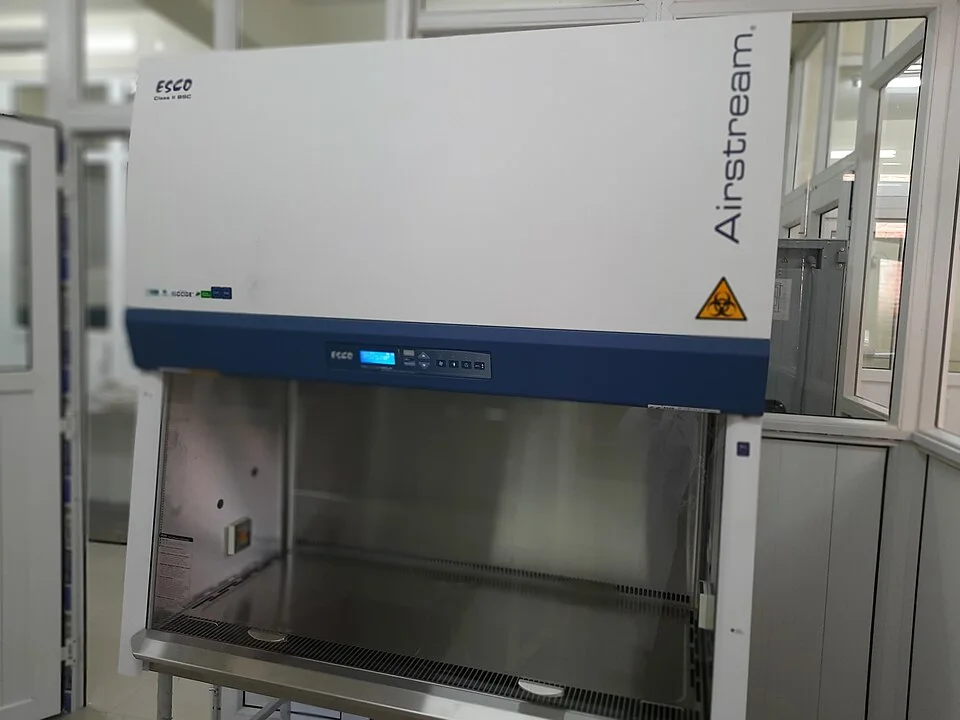
Biosafety cabinet in a molecular biology laboratory, illustrating containment within broader biological risk management.
Credit: Ajay Kumar Chaurasiya · CC BY-SA 4.0 · sourceResized and converted to WebP; uncropped.
1. Meaning and scope of biosecurity
Biosecurity has different but connected meanings across sectors. In laboratories, it concerns the protection, control and accountability of biological materials, technologies and information to prevent unauthorised access or misuse. In agriculture and environmental management, it includes measures that prevent the entry, establishment and spread of pests, pathogens and other biological hazards. These measures protect public health, food production, trade and biodiversity.
A biological threat may arise naturally, accidentally or deliberately. An emerging zoonotic infection is a natural threat; an unintended laboratory exposure is a biosafety incident; theft of a pathogen for malicious use is a biosecurity incident. Preparedness systems overlap because early detection, reliable diagnostics, trained personnel and effective communication are useful regardless of how an outbreak begins.
Biosafety, biosecurity and biocontainment should not be treated as synonyms. Biosafety reduces unintentional exposure and accidental release through safe practices and facility design. Biosecurity prevents unauthorised possession or misuse through access controls and accountability. Biocontainment uses physical barriers, equipment and operating procedures to keep biological agents within controlled environments. Together, these support biological risk management.
- Protected assets include pathogen collections, infected specimens, research animals, sensitive information and critical laboratory infrastructure.
- Biosecurity is broader than bioterrorism: farm hygiene, seed quarantine and control of invasive organisms also fall within its wider scope.
2. Modern biotechnology and dual-use risks
Modern biotechnology improves vaccine development, molecular diagnosis, crop protection and industrial production. However, some knowledge, tools and materials are dual-use: they can serve legitimate purposes but could also be misapplied. Synthetic biology, genome editing, automated experimentation and inexpensive sequencing make biological research more accessible, increasing both opportunities and the need for proportionate safeguards.
Dual-use research of concern is a narrower category than dual-use research generally. It refers to research whose results could reasonably be anticipated to be directly misapplied to create a significant threat. Assessment considers the organism, intended work, information produced, available safeguards and plausible consequences. Neither genetic engineering nor work involving pathogens is automatically prohibited or inherently malicious.
Oversight must therefore assess risks throughout a project rather than merely approve it once. Institutions should examine research proposals, material transfers, collaborations and communication of sensitive findings. Screening orders for synthetic genetic material and checking customer legitimacy can support prevention, although implementation varies across jurisdictions. Cybersecurity is also important because research records and laboratory systems are increasingly digital.
Controls should remain proportionate. Excessive secrecy can obstruct reproducibility, surveillance and equitable access to medical advances. Conversely, unrestricted sharing of unusually sensitive information may create avoidable risks. Responsible governance combines scientific openness with targeted review, researcher training and clearly assigned institutional responsibility.
Biological risk-management cycle
- 1. Identify hazards and assets requiring protection
- 2. Assess likelihood, exposure pathways and consequences
- 3. Apply proportionate safety and security controls
- 4. Monitor, detect and report unusual events
- 5. Investigate and coordinate response
- 6. Review lessons and improve safeguards
3. Prevention, surveillance and response
Effective biosecurity uses layered protection rather than relying on a single checkpoint. Laboratories need inventories, documented custody and transfer procedures, appropriate access restrictions, incident reporting and secure handling of waste. Biosafety levels describe combinations of practices, equipment and facility safeguards. They are not identical to biological agent risk groups, and containment requirements should follow an activity-specific risk assessment.
Agricultural biosecurity begins before a hazard crosses a border. Import permits, phytosanitary certification, inspection, testing and post-entry quarantine reduce the risk of introducing plant pests. Animal health measures include veterinary certification, quarantine and surveillance. At farm level, separation of new animals, controlled movement, cleaning and disinfection help interrupt transmission. Measures should be scientifically justified and periodically reviewed.
Surveillance connects prevention with rapid response. Human disease reporting, veterinary networks, plant pest surveys, wastewater monitoring and genomic analysis can reveal unusual events. Genomic evidence helps identify relationships between samples, but cannot by itself establish whether an outbreak was intentional. Epidemiological investigation, laboratory findings and other evidence must be assessed together.
One Health provides the organising framework for collaboration across health, agriculture, wildlife and environmental agencies. Once a threat is detected, authorities need laboratory confirmation, proportionate movement controls, clinical or veterinary management, risk communication and recovery planning. Public trust is crucial: stigmatisation, misinformation and opaque decision-making can weaken reporting and compliance.
| Term | Primary focus | Example |
|---|---|---|
| Biosafety | Prevent accidental exposure or release | Safe specimen handling and protective equipment |
| Laboratory biosecurity | Prevent unauthorised access and misuse | Access controls and material inventories |
| Biocontainment | Confine biological agents | Biological safety cabinets and containment facilities |
| Quarantine | Prevent introduction or spread of hazards | Post-entry observation and testing of imported plants |
| One Health | Coordinate health across interconnected sectors | Joint human, livestock and wildlife surveillance |
4. India’s legal and institutional framework
India’s arrangements are distributed across several laws and ministries rather than consolidated in one comprehensive biosecurity statute. The Rules, 1989, notified under the Environment (Protection) Act, 1986, govern the manufacture, use, import, export and storage of hazardous microorganisms and genetically engineered organisms or cells. They provide a major framework for biotechnology-related biosafety and environmental oversight, but do not cover every biosecurity issue.
The six authorities identified under these rules are the Recombinant DNA Advisory Committee, Institutional Biosafety Committees, Review Committee on Genetic Manipulation, Genetic Engineering Appraisal Committee, State Biotechnology Coordination Committees and District Level Committees. The Department of Biotechnology supports research-stage oversight, while GEAC functions under the Ministry of Environment, Forest and Climate Change. Their responsibilities differ according to the activity and regulatory stage.
Plant quarantine is administered through the Directorate of Plant Protection, Quarantine and Storage. The Plant Quarantine (Regulation of Import into India) Order, 2003 operates under the Destructive Insects and Pests Act, 1914. Animal imports are regulated through the Livestock Importation Act, 1898, as amended, and associated requirements. These frameworks seek to prevent imported biological hazards from becoming established.
Public health preparedness involves bodies such as the National Centre for Disease Control, the Indian Council of Medical Research and state health departments. The Integrated Disease Surveillance Programme supports outbreak detection and response. Separately, the Weapons of Mass Destruction and their Delivery Systems (Prohibition of Unlawful Activities) Act, 2005 addresses unlawful WMD-related activities. India’s SCOMET export-control framework also covers specified biological agents, equipment and technology.
5. International governance and examination focus
The Biological Weapons Convention was opened for signature in 1972 and entered into force in 1975. India ratified it in 1974. It prohibits biological agents and toxins of types and quantities without justification for prophylactic, protective or other peaceful purposes, along with associated weapons and delivery means. Thus, it does not ban all pathogen research. It lacks a standing verification organisation comparable to the Organisation for the Prohibition of Chemical Weapons.
UN Security Council Resolution 1540, adopted in 2004, requires states to prevent non-state actors from acquiring nuclear, chemical and biological weapons and to establish relevant domestic controls. The International Health Regulations (2005) support international public health surveillance, notification and response. The International Plant Protection Convention and World Organisation for Animal Health provide important plant and animal health standards respectively.
For Prelims, distinguish security treaties from health and trade instruments. The Cartagena Protocol on Biosafety addresses living modified organisms resulting from modern biotechnology, including their transboundary movement and potential adverse effects on biodiversity, taking human health risks into account. It is not a biological disarmament treaty. Similarly, the WTO Agreement on Sanitary and Phytosanitary Measures concerns health-protection measures affecting trade; it does not authorise arbitrary import restrictions.
Laboratory containment and the biosecurity distinction
The supplied metadata identifies a biosafety cabinet used in a molecular biology laboratory. It provides a laboratory context for studying biosecurity, but the equipment primarily serves biosafety: reducing accidental exposure to biological agents and their unintended release. Biosecurity focuses on preventing unauthorised access, loss, theft, misuse or deliberate release of biological materials and associated information. These goals overlap within biological risk management, yet a cabinet alone does not establish that a laboratory has effective biosecurity.
In Indian biotechnology laboratories, containment equipment must therefore complement institutional governance. Relevant safeguards include risk-based access controls, accountable inventories, personnel training, secure transfers and procedures for reporting missing materials or suspicious activity. Information security also matters because sensitive research data can have dual-use implications: knowledge developed for beneficial purposes may be misused. A One Health perspective extends these concerns beyond human pathogens to animal disease agents and threats to crops and ecosystems. The metadata does not establish the cabinet’s class, certification, operating condition or the laboratory’s containment level.
- Biosafety addresses accidental biological harm; biosecurity addresses unauthorised access and misuse. Neither substitutes for the other.
- A biosafety cabinet is not a biosafety-level designation: laboratory containment depends on facilities, practices, equipment and risk assessment together.
- For Mains, balance research benefits with proportionate safeguards; connect laboratory governance with public health, veterinary systems and agricultural protection.
Real-world case studies
Nipah outbreak in Kerala, 2018
Kerala’s Nipah outbreak demonstrated the importance of rapid diagnosis, contact tracing, infection prevention and coordinated communication. Fruit bats are natural hosts of Nipah virus. The episode illustrates One Health preparedness, not evidence of deliberate biological release.
Anthrax letters in the United States, 2001
Letters containing anthrax spores caused 22 cases, including five deaths. The attacks highlighted the need for secure biological collections, accountable material handling and coordination between public health agencies and law enforcement.
Previous year questions
No source-linked PYQ is available here yet. Use the practice questions below.
Practice questions
Practice MCQ 1
Consider the following statements: 1. Biosafety primarily addresses accidental exposure and release. 2. Laboratory biosecurity includes protection against theft of biological materials. 3. A biological agent’s risk group alone determines containment requirements for every activity. Which statements are correct?
- A. 1 and 2 only
- B. 2 and 3 only
- C. 1 and 3 only
- D. 1, 2 and 3
Practice MCQ 2
Which instrument primarily addresses living modified organisms and their potential adverse effects on biodiversity?
- A. Biological Weapons Convention
- B. Cartagena Protocol on Biosafety
- C. UN Security Council Resolution 1540
- D. International Health Regulations
Practice MCQ 3
Consider the following pairs: 1. Rules, 1989 — Environment (Protection) Act, 1986; 2. Plant Quarantine Order, 2003 — Destructive Insects and Pests Act, 1914; 3. GEAC — Ministry of Health and Family Welfare. How many pairs are correctly matched?
- A. Only one
- B. Only two
- C. All three
- D. None
Mains practice · Distinguish biosafety from biosecurity. Discuss how India can strengthen biological risk governance without obstructing beneficial biotechnology research. (250 words)
- Define accidental risks, intentional misuse and their overlapping safeguards.
- Explain dual-use research, agricultural quarantine and digital vulnerabilities.
- Outline India’s regulatory and institutional arrangements.
- Recommend risk-based oversight, inventories, training and incident reporting.
- Integrate One Health surveillance and inter-agency response.
- Balance security with scientific openness and equitable access.
Further reading
- NCERT Biology, Class XII: Biotechnology: Principles and Processes; Biotechnology and its Applications.
- WHO: Laboratory Biosafety Manual, fourth edition, 2020.
- WHO: Laboratory Biosecurity Guidance, 2024.
- Department of Biotechnology: Indian Biosafety Knowledge Portal.
- MoEFCC: GEAC website and Rules, 1989.
- UN Office for Disarmament Affairs: Biological Weapons Convention.
- Directorate of Plant Protection, Quarantine and Storage: Plant Quarantine Order, 2003.
- https://commons.wikimedia.org/wiki/File:Biosafety_Cabinet.jpg
Preparing for UPSC Civil Services? Get classroom teaching, answer-writing evaluation and mentorship at Pragnya IAS Academy, Ashok Nagar — see why aspirants choose us for IAS coaching in Hyderabad.