
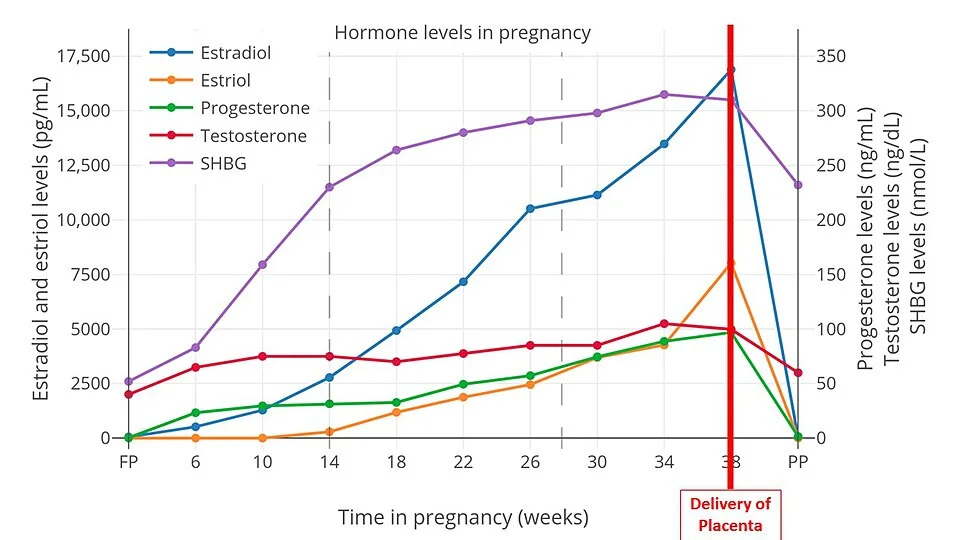
Illustrative graph of maternal serum hormone levels during pregnancy and the postpartum period.
Credit: Medgirl131 · CC BY-SA 4.0 · sourceResized and converted to WebP; uncropped.
1. Hormones and chemical coordination
Hormones are signalling molecules produced in small quantities that alter the activity of responsive cells. In the classical endocrine system, glands release hormones into the bloodstream, which carries them to distant targets. Their effects depend on specific receptors rather than merely on whether blood reaches a tissue. Hormones regulate homeostasis, meaning the maintenance of relatively stable internal conditions despite external changes.
Endocrine coordination complements the nervous system. Nerve impulses usually produce rapid, localised responses, whereas hormonal effects are often more widespread and longer-lasting. This is a general distinction, not an absolute rule: adrenaline can act within seconds. Chemical signalling can also be paracrine, affecting neighbouring cells, or autocrine, affecting the secreting cell itself.
Endocrine glands lack ducts, unlike exocrine glands such as salivary and sweat glands. The pancreas is a mixed gland: its exocrine component sends digestive secretions into the intestine, while pancreatic islets release hormones into blood. The testes and ovaries also combine reproductive functions with hormone secretion.
- Peptide and protein hormones include insulin, glucagon and growth hormone; they generally act through cell-surface receptors.
- Steroid hormones include cortisol, aldosterone, testosterone, oestrogens and progesterone; they are derived from cholesterol and generally act through intracellular receptors.
- Amino-acid-derived hormones include adrenaline and thyroid hormones. Despite this shared chemical category, their receptor locations and mechanisms differ.
- Hormones are not nutrients or enzymes: their main role is signalling, not supplying energy or directly catalysing metabolic reactions.
2. Hypothalamus, pituitary and endocrine regulation
The hypothalamus links neural activity with endocrine control. Its releasing and inhibiting hormones regulate the anterior pituitary. For example, gonadotropin-releasing hormone stimulates secretion of follicle-stimulating hormone and luteinising hormone. Although the pituitary is traditionally called the master gland, it is itself regulated by the hypothalamus and feedback from peripheral hormones. Some endocrine glands also respond directly to changes in blood composition.
The anterior pituitary secretes growth hormone, prolactin, thyroid-stimulating hormone, adrenocorticotropic hormone, follicle-stimulating hormone and luteinising hormone. Growth hormone supports body growth, partly through insulin-like growth factor 1. Excess secretion before growth-plate closure causes gigantism; excess in adults causes acromegaly, characterised by enlargement of structures such as the hands, feet and jaw. Childhood deficiency can cause growth hormone deficiency-associated short stature.
The posterior pituitary stores and releases antidiuretic hormone, also called vasopressin, and oxytocin, both synthesised in the hypothalamus. Antidiuretic hormone promotes water reabsorption by the kidneys. Oxytocin supports uterine contractions during childbirth and milk ejection during breastfeeding. Prolactin, in contrast, stimulates milk production.
Most endocrine regulation uses negative feedback: rising levels of a hormone or its effects suppress further secretion. In the thyroid axis, thyroid hormones inhibit hypothalamic thyrotropin-releasing hormone and pituitary thyroid-stimulating hormone. Positive feedback is less common; cervical stretching during labour promotes oxytocin release, which strengthens contractions and further stretching.
- Pituitary control is not universal: insulin responds strongly to blood glucose, while parathyroid hormone responds to blood calcium.
- The pineal gland secretes melatonin, which participates in circadian timing and the sleep–wake cycle.
- The thymus produces factors, including thymosins, associated with T-lymphocyte development and immune function.
Negative feedback in the thyroid axis
- 1. Hypothalamus releases thyrotropin-releasing hormone.
- 2. Anterior pituitary releases thyroid-stimulating hormone.
- 3. Thyroid synthesises and releases T3 and T4 using iodine.
- 4. Thyroid hormones act on responsive tissues.
- 5. Rising thyroid hormone levels inhibit hypothalamic and pituitary stimulation.
3. Metabolism, minerals and stress hormones
The thyroid secretes thyroxine, or T4, and triiodothyronine, or T3. These iodine-containing hormones regulate metabolic activity and support normal growth and brain development. Iodine deficiency can impair hormone synthesis and produce thyroid enlargement, or goitre. However, not every goitre is due to iodine deficiency. Hyperthyroidism means excessive thyroid hormone activity; Graves’ disease is an autoimmune cause.
The parathyroid glands secrete parathyroid hormone, which raises blood calcium through effects on bone, kidneys and vitamin D activation. Calcitriol, the active hormonal form of vitamin D, promotes intestinal calcium absorption. Thyroid C cells secrete calcitonin, which can lower blood calcium, although its role in adult human calcium regulation is smaller than that of parathyroid hormone and vitamin D.
Pancreatic beta cells secrete insulin, which promotes glucose utilisation and storage and suppresses liver glucose production. Alpha cells secrete glucagon, which raises blood glucose mainly through hepatic glycogen breakdown and glucose synthesis. Type 1 diabetes mellitus involves autoimmune destruction of beta cells in most cases. Type 2 involves insulin resistance with progressive impairment of insulin secretion; it is not simply a consequence of eating sugar.
The adrenal cortex secretes cortisol, aldosterone and adrenal androgens. Cortisol helps coordinate metabolic responses to stress; aldosterone promotes renal sodium retention and potassium excretion. The adrenal medulla secretes adrenaline and noradrenaline, supporting the fight-or-flight response. Diabetes insipidus, unlike diabetes mellitus, results from deficient vasopressin secretion or impaired renal response to it, causing excessive dilute urine.
- Excess cortisol causes Cushing syndrome; primary adrenal insufficiency is commonly called Addison’s disease.
- The kidneys secrete erythropoietin, which stimulates red blood cell production, and participate in calcitriol formation.
- The heart releases atrial natriuretic peptide in response to atrial stretching, encouraging sodium excretion.
| Pair | First hormone | Second hormone |
|---|---|---|
| Insulin and glucagon | Beta cells; lowers blood glucose | Alpha cells; raises blood glucose |
| Prolactin and oxytocin | Anterior pituitary; milk production | Hypothalamic synthesis, posterior pituitary release; milk ejection |
| ADH and aldosterone | Promotes renal water reabsorption | Promotes renal sodium retention and potassium excretion |
| Auxin and cytokinin | Associated with elongation, apical dominance and rooting | Associated with cell division, shoot formation and delayed senescence |
| Abscisic acid and ethylene | Drought response and seed dormancy | Climacteric fruit ripening and senescence |
4. Reproduction, digestion and health applications
Follicle-stimulating hormone and luteinising hormone regulate gonadal functions. In females, they support follicular development, ovulation and ovarian hormone secretion. Oestrogens support female reproductive development and endometrial growth; progesterone helps prepare and maintain the endometrium for pregnancy. In males, luteinising hormone stimulates testosterone production by Leydig cells, while follicle-stimulating hormone acts on Sertoli cells to support spermatogenesis.
During pregnancy, the placenta functions as a temporary endocrine organ. It produces human chorionic gonadotropin, progesterone, oestrogens and human placental lactogen. Early human chorionic gonadotropin maintains the corpus luteum; its detection in urine or blood forms the basis of pregnancy tests.
Endocrine functions extend beyond dedicated glands. Gastrin promotes gastric acid secretion, secretin stimulates bicarbonate-rich pancreatic secretion, and cholecystokinin promotes pancreatic enzyme secretion and gallbladder contraction. Gut incretins, including glucagon-like peptide 1, enhance glucose-dependent insulin secretion. GLP-1 receptor agonists are used in type 2 diabetes management, and some are approved for chronic weight management.
Hormone medicines include insulin, levothyroxine and corticosteroids. They differ in purpose and risk: corticosteroids suppress inflammation but can cause important adverse effects with prolonged use. Endocrine-disrupting chemicals can interfere with hormone synthesis, receptors or metabolism. Some pesticides, bisphenols and phthalates are studied in this context; effects depend on the substance, exposure and developmental stage.
5. Plant hormones and agricultural applications
Plant hormones coordinate growth and environmental responses without specialised endocrine glands. Their effects depend on concentration, tissue, developmental stage and interaction with other signals. The five classical groups are auxins, gibberellins, cytokinins, abscisic acid and ethylene. Additional signalling groups include brassinosteroids, jasmonates and salicylic acid.
Auxins promote cell elongation, apical dominance and root initiation. Unequal auxin distribution contributes to tropic growth. Synthetic auxins such as 2,4-D are used as selective herbicides against many broad-leaved weeds. Gibberellins promote stem elongation, bolting and germination; during cereal germination, they stimulate enzymes that mobilise stored food. Cytokinins promote cell division and can delay leaf senescence.
Abscisic acid is central to drought responses, including stomatal closure, and promotes seed dormancy. Ethylene promotes ripening in climacteric fruits such as bananas and tomatoes, and participates in senescence and abscission. Ethephon releases ethylene in plant tissues and has agricultural uses. Agricultural growth regulators include both natural hormones and synthetic compounds that mimic or modify their actions.
Fruit ripening is also a food-safety issue. The Food Safety and Standards Authority of India permits controlled ethylene use under prescribed conditions, including concentrations up to 100 parts per million depending on crop, variety and maturity. Calcium carbide, which releases acetylene on contact with moisture and may contain hazardous impurities, is prohibited for artificial fruit ripening.
- Auxin-to-cytokinin balance influences root and shoot formation in plant tissue culture.
- Do not confuse ethylene, the plant hormone, with acetylene produced from calcium carbide.
- Classifying all plant hormones as exclusively growth-promoting or growth-inhibiting overlooks their context-dependent effects.
Hormonal coordination in pregnancy and after childbirth
Pregnancy illustrates how hormones coordinate several organs rather than acting independently. Human chorionic gonadotropin (hCG), produced by placental trophoblast cells, supports the corpus luteum in early pregnancy, maintaining progesterone secretion. The placenta subsequently becomes a major source of progesterone and estrogens, which help sustain pregnancy and prepare maternal tissues for childbirth and lactation. Detection of hCG forms the basis of common pregnancy tests. The supplied metadata identifies a graph of maternal serum hormone levels, but does not specify the hormones plotted, units, sampling methods or reference population; it therefore cannot establish exact concentrations or universal clinical thresholds.
After placental delivery, progesterone and estrogen levels fall sharply, allowing prolactin to support substantial milk production. Suckling stimulates prolactin release from the anterior pituitary and oxytocin release from the posterior pituitary. Their functions differ: prolactin promotes milk synthesis, whereas oxytocin causes milk ejection. Oxytocin also promotes uterine contractions, illustrating positive feedback during labour, unlike the negative feedback typical of many endocrine pathways. In India, these concepts support understanding of antenatal care, breastfeeding counselling and maternal-health services. Clinical interpretation nevertheless requires symptoms, gestational stage and appropriate laboratory reference ranges; a teaching graph is not a diagnostic tool.
- Source versus release: oxytocin is synthesised in the hypothalamus but stored and released by the posterior pituitary.
- Placenta as endocrine organ: hormone secretion is not confined to the classic endocrine glands.
- Evidence limit: serum concentration alone does not measure tissue response; receptor sensitivity and hormone-binding proteins also matter.
Real-world case studies
India’s iodised salt strategy
India began the National Goitre Control Programme in 1962 and renamed it the National Iodine Deficiency Disorders Control Programme in 1992. Promoting adequately iodised salt addresses a preventable cause of thyroid dysfunction and impaired neurodevelopment. The case links micronutrient availability with hormone synthesis: iodine supplies an essential ingredient, rather than acting as a hormone itself.
Recombinant human insulin
Recombinant human insulin was approved in the United States in 1982, becoming an early landmark in biotechnology-based medicines. Genetically engineered microorganisms enabled production without relying on extraction from animal pancreases. Insulin is a protein, so conventional oral administration is ineffective because of digestive breakdown and poor absorption; routine delivery therefore uses injections or pumps.
Previous year questions
No source-linked PYQ is available here yet. Use the practice questions below.
Practice questions
Practice MCQ 1
Consider the following statements: 1. Oxytocin is synthesised in the hypothalamus. 2. Prolactin primarily causes milk ejection. 3. The posterior pituitary releases antidiuretic hormone. Which of the statements given above are correct?
- A. 1 and 2 only
- B. 1 and 3 only
- C. 2 and 3 only
- D. 1, 2 and 3
Practice MCQ 2
Which one of the following plant growth regulator–function pairs is incorrectly matched?
- A. Abscisic acid — Stomatal closure during water stress
- B. Gibberellins — Mobilisation of stored food during cereal germination
- C. Cytokinins — Promotion of cell division
- D. Ethylene — Principal signal maintaining apical dominance
Practice MCQ 3
Consider the following statements: 1. Diabetes insipidus necessarily involves elevated blood glucose. 2. Glucagon raises blood glucose mainly through its effects on the liver. 3. Aldosterone promotes renal potassium excretion. Which of the statements given above are correct?
- A. 1 only
- B. 1 and 2 only
- C. 2 and 3 only
- D. 1, 2 and 3
Mains practice · Explain the role of hormonal regulation in human homeostasis. Illustrate how knowledge of hormones has contributed to public health and agricultural productivity. Answer in 250 words.
- Define hormones, receptors, homeostasis and negative feedback.
- Use insulin–glucagon regulation, thyroid feedback and renal water regulation as examples.
- Discuss iodised salt, recombinant insulin and responsible therapeutic hormone use.
- Explain applications of auxins, gibberellins and controlled ethylene ripening.
- Conclude with safeguards against hormone misuse, endocrine-disrupting exposures and unsafe ripening agents.
Further reading
- NCERT Biology, Class XI: Chemical Coordination and Integration.
- NCERT Biology, Class XI: Plant Growth and Development.
- NCERT Biology, Class XII: Human Reproduction; Biotechnology and its Applications.
- Ministry of Health and Family Welfare: National Iodine Deficiency Disorders Control Programme.
- Food Safety and Standards Authority of India: Guidance Note on Artificial Ripening of Fruits.
- National Institute of Diabetes and Digestive and Kidney Diseases: Diabetes and endocrine disease resources.
- https://commons.wikimedia.org/wiki/File:Hormone_Levels_in_Pregnancy_and_Postpartum_Period.jpg
Preparing for UPSC Civil Services? Get classroom teaching, answer-writing evaluation and mentorship at Pragnya IAS Academy, Ashok Nagar — see why aspirants choose us for IAS coaching in Hyderabad.