
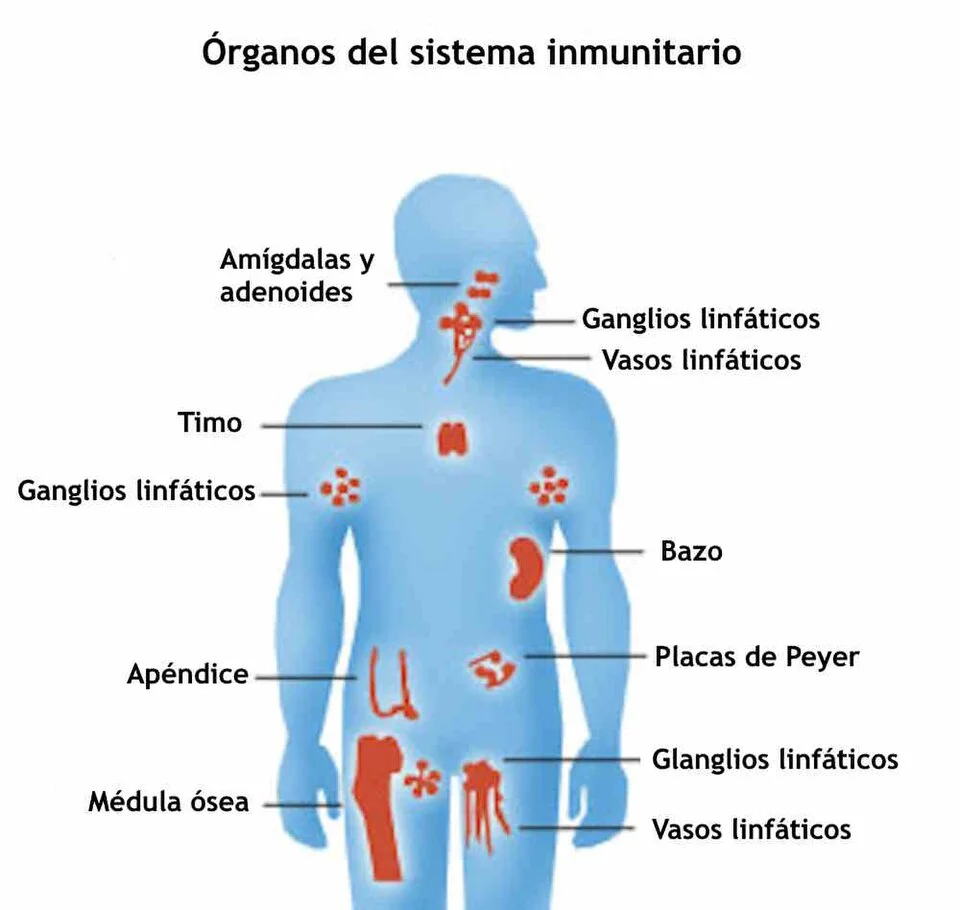
Human immune-system organs: an illustrative diagram with Spanish labels, attributed to AIDS.gov.
Credit: AIDS.gov · CC BY 4.0 · sourceResized and converted to WebP; uncropped.
1. Organisation of the immune system
Immunity is the capacity to resist infection and respond to potentially harmful biological material. A pathogen is a disease-causing agent, whereas an antigen is a substance or molecular feature recognised by antibodies or antigen receptors. These terms are not interchangeable: harmless pollen can contain antigens, and vaccines can present antigens without causing the disease they prevent. Effective immunity must recognise danger while limiting damage to the body's own tissues.
Most immune cells originate from blood-forming stem cells in bone marrow. White blood cells, or leucocytes, include neutrophils, monocytes, lymphocytes, eosinophils and basophils. Monocytes can develop into macrophages in tissues. Macrophages engulf material and coordinate inflammation; dendritic cells are particularly important for presenting antigens to naïve T cells. Lymphocytes include B cells, T cells and natural killer cells.
Primary lymphoid organs support lymphocyte development and maturation: B cells mature in bone marrow and T cells in the thymus. Secondary lymphoid organs are important sites where immune responses begin. Lymph nodes filter lymph, whereas the spleen monitors blood-borne antigens and removes ageing red blood cells. Tonsils and Peyer's patches are examples of mucosa-associated lymphoid tissue. Lymphatic vessels return tissue fluid to the circulation and transport immune cells and antigens.
- Immune defence is distributed throughout the body; it is not performed by a single organ.
- The thymus generally becomes smaller and less active with age, but immune function does not simply cease.
2. Innate immunity: rapid first-line defence
Innate immunity provides rapid defence through barriers, cells and soluble molecules. Skin forms a physical barrier, while mucus traps particles and respiratory cilia help remove them. Gastric acid, antimicrobial peptides and lysozyme in tears and saliva inhibit microbes. Normal microbiota also contribute by competing with pathogens. If these barriers are breached, internal innate mechanisms act within minutes to hours.
Innate cells recognise conserved microbial features and signals from damaged tissue through pattern-recognition receptors. Neutrophils and macrophages engulf microbes by phagocytosis and destroy them within intracellular compartments. Natural killer cells can kill infected or transformed cells, particularly when normal inhibitory signals are reduced. Although they are lymphocytes, natural killer cells belong to innate rather than conventional adaptive immunity.
Inflammation increases blood flow and vascular permeability and recruits immune cells to affected tissue. Its typical local signs include redness, heat, swelling and pain. Complement is a group of proteins that promotes inflammation, coats microbes to aid phagocytosis and can disrupt susceptible microbial membranes. Antiviral interferons released during infection help nearby cells establish an antiviral state. Fever may support host defence, but excessive systemic inflammation can injure organs.
- Innate immunity lacks the highly antigen-specific receptor diversity and classical memory of adaptive immunity.
- Inflammation can follow sterile tissue injury; it does not always indicate infection.
Simplified development of adaptive immunity
- 1. A pathogen or vaccine introduces an antigen.
- 2. Innate mechanisms respond and antigen-presenting cells process antigen.
- 3. Appropriate B and T lymphocytes are activated, often with helper T-cell support.
- 4. Selected lymphocytes multiply and develop effector functions.
- 5. Antibodies and effector cells help control the threat.
- 6. Most effector cells decline, while memory populations can persist.
3. Adaptive immunity, antibodies and memory
Adaptive immunity is antigen-specific and involves the selection and multiplication of responsive B and T lymphocytes. A first response takes time to develop, but subsequent exposure often produces a faster and stronger response because memory cells persist. Antigen-presenting cells connect innate recognition with adaptive activation. Major histocompatibility complex molecules display peptide fragments to T cells; in humans, these molecules are called human leucocyte antigens.
Humoral immunity is mediated mainly by antibodies secreted by plasma cells derived from B cells. Antibodies can neutralise toxins or viruses, coat pathogens for easier ingestion and activate complement. They do not independently kill every pathogen they bind. An antibody's variable region determines antigen-binding specificity, while its constant region helps determine its class and biological functions.
IgM commonly appears early in a primary response. IgG is the most abundant antibody class in blood and crosses the placenta. IgA protects mucosal surfaces and occurs in secretions, including breast milk. IgE participates in immediate allergic reactions and defence against certain parasites. Cell-mediated immunity depends on T cells: CD4 helper T cells coordinate responses, CD8 cytotoxic T cells kill infected or abnormal cells, and regulatory T cells help restrain excessive responses.
- Antibodies are proteins, not cells; B cells and T cells are living immune cells.
- Memory is not necessarily lifelong: protection varies with the pathogen, vaccine and individual.
| Component | Main mediators | Defining feature | Example |
|---|---|---|---|
| Innate immunity | Barriers, phagocytes, natural killer cells, complement | Rapid recognition of broad danger patterns | Neutrophils engulfing bacteria |
| Adaptive immunity | B and T lymphocytes | Antigen specificity and classical immune memory | Enhanced response after a vaccine booster |
| Humoral adaptive immunity | B cells, plasma cells and antibodies | Acts principally through antibodies in extracellular fluids | Antibodies neutralising a toxin |
| Cell-mediated adaptive immunity | T lymphocytes | Coordinates cellular defence or kills target cells | Cytotoxic T cells killing virus-infected cells |
4. Active immunity, passive immunity and vaccination
Active immunity develops when a person's own immune system responds to an antigen, either after infection or vaccination. It generally takes time but can establish memory. Passive immunity involves receiving preformed antibodies. It acts quickly but is temporary and does not itself establish recipient immune memory. Placental IgG and breast-milk IgA provide natural passive protection; administered immunoglobulins provide artificial passive protection.
Vaccines expose the immune system to antigens, or instructions for producing them, without requiring the risks of natural disease. Platforms include live attenuated, inactivated, toxoid, protein subunit, conjugate, viral-vector and nucleic-acid vaccines. Toxoid vaccines target inactivated bacterial toxins. Conjugate vaccines link polysaccharide antigens to carrier proteins, improving responses and memory, particularly in young children. Adjuvants enhance immune responses, while boosters reinforce protection where recommended.
India's Universal Immunisation Programme provides scheduled vaccines, and Mission Indradhanush, launched in December 2014, seeks to improve coverage among unvaccinated and partially vaccinated children and pregnant women. Population-level protection can reduce transmission when sufficient people are immune, indirectly protecting susceptible individuals. However, its extent depends on vaccine effects on infection and transmission, coverage and pathogen characteristics. Tetanus does not spread person-to-person, so community coverage cannot substitute for individual protection.
- Vaccination need not prevent every infection to substantially reduce severe disease and death.
- Vaccines and passive antibodies can both be used after certain exposures, as in indicated rabies prophylaxis.
5. Immune disorders and applications
Allergy is an inappropriate immune response to ordinarily harmless substances such as pollen or particular foods. In immediate allergy, IgE-associated activation of mast cells releases mediators including histamine. Anaphylaxis is a potentially life-threatening systemic reaction requiring urgent treatment. Not every food intolerance is an allergy: lactose intolerance, for example, usually reflects inadequate digestion of lactose rather than an immune reaction.
Autoimmunity occurs when immune tolerance to self-components fails. Examples include type 1 diabetes, rheumatoid arthritis and systemic lupus erythematosus. Immunodeficiency instead means inadequate immune defence and may be inherited or acquired. HIV infection can progressively impair CD4 T-cell function and lead to AIDS without effective treatment. Antiretroviral therapy suppresses viral replication and supports immune recovery, but is not a routine cure.
Immune recognition also explains transplant rejection and some cancer therapies. Matching donor and recipient tissue characteristics and using immunosuppressive medicines reduce rejection risk, although immunosuppression can increase susceptibility to infection. Monoclonal antibodies recognise defined molecular targets and may block inflammatory signals or target cancer cells. CAR-T therapy genetically modifies T cells to recognise selected targets, while checkpoint inhibitors release inhibitory controls on antitumour responses. These treatments can also cause serious immune-mediated adverse effects.
- Autoimmunity is misdirected immunity, not simply a weak immune system.
- Antibody tests detect an immune response, whereas antigen tests detect components of a pathogen; neither interpretation is independent of timing and test performance.
Immune organs: where defence develops and acts
The supplied metadata identifies a diagram of human immune-system organs, making it directly relevant to this microtopic. Immune defence is distributed across several sites rather than confined to one organ. Primary lymphoid organs support lymphocyte development: B cells mature in bone marrow, while T cells mature in the thymus. Secondary lymphoid organs and tissues, including lymph nodes, the spleen and mucosa-associated lymphoid tissue, provide settings where mature lymphocytes encounter antigens and adaptive responses develop. This functional distinction is more important for examination purposes than simply memorising organ names.
Lymph nodes help monitor lymph draining from tissues, whereas the spleen monitors blood-borne antigens. Mucosal immune tissues contribute to defence at surfaces exposed to the external environment, including the respiratory and digestive tracts. Innate cells, such as dendritic cells, connect early pathogen detection with adaptive responses through antigen presentation. For India’s public-health context, these relationships help explain vaccination, HIV-associated immunodeficiency and infection prevention. However, an anatomical diagram alone cannot establish immune function, diagnose disease or show how protection changes after vaccination; those questions require clinical and laboratory evidence.
- Primary versus secondary lymphoid organs describes development versus response organisation, not innate versus adaptive immunity.
- Antibodies are secreted by plasma cells derived from B cells; T-cell-mediated defence is distinct but often coordinated with antibody responses.
- HIV particularly affects CD4 T cells, weakening immune coordination. Vaccination generally induces active immunity; administered antibodies provide passive protection.
Real-world case studies
Rabies exposure: combining immediate and lasting protection
Following a potentially rabid animal exposure, prompt wound washing and medical assessment are essential. Post-exposure vaccination induces active immunity. For previously unvaccinated individuals with category III exposure, rabies immunoglobulin or an approved monoclonal antibody product is generally also indicated to provide immediate passive protection. The intervention illustrates why vaccination and antibody administration are complementary rather than interchangeable.
Smallpox eradication through vaccination and surveillance
WHO declared smallpox eradicated in 1980 following vaccination campaigns, surveillance and containment, including ring vaccination around identified cases. The absence of a non-human reservoir and the availability of an effective vaccine helped make eradication possible. This success cannot automatically be extrapolated to infections with animal reservoirs or substantially different transmission characteristics.
Previous year questions
UPSC Prelims 2022
What is the role of B cells and T cells in the human body?
- A. They protect the body from environmental allergens.
- B. They alleviate the body's pain and inflammation.
- C. They act as immunosuppressants in the body.
- D. They protect the body from diseases caused by pathogens.
Practice questions
Practice MCQ 1
Consider the following statements: 1. Natural killer cells are part of innate immunity. 2. Plasma cells secrete antibodies. 3. T lymphocytes normally mature in the spleen. Which statements are correct?
- A. 1 and 2 only
- B. 2 and 3 only
- C. 1 and 3 only
- D. 1, 2 and 3
Practice MCQ 2
Which of the following is an example of artificially acquired passive immunity?
- A. Recovery from measles infection
- B. Administration of a tetanus toxoid vaccine
- C. Administration of rabies immunoglobulin
- D. Transfer of maternal IgG across the placenta
Practice MCQ 3
Consider the following pairs: 1. IgG — crosses the placenta. 2. IgA — contributes to mucosal protection. 3. IgE — participates in immediate allergic reactions. How many pairs are correctly matched?
- A. Only one
- B. Only two
- C. All three
- D. None
Mains practice · Explain how innate and adaptive immunity cooperate in host defence. Distinguish active from passive immunity and discuss their relevance to vaccination and post-exposure prophylaxis. Answer in 250 words.
- Introduce barriers, pattern recognition, phagocytosis and inflammation as rapid innate defences.
- Explain antigen presentation as a link to antigen-specific B- and T-cell responses.
- Discuss antibodies, cytotoxic T cells and immune memory.
- Contrast active and passive immunity by source, onset, duration and memory.
- Use vaccination, maternal antibodies and rabies prophylaxis as examples.
- Conclude with the importance of coverage, timely prophylaxis and evidence-based schedules.
Further reading
- NCERT Biology, Class XII: Human Health and Disease.
- Ministry of Health and Family Welfare: Universal Immunisation Programme and National Immunisation Schedule.
- World Health Organization: Vaccines and immunization; rabies fact sheet and vaccine position papers.
- National AIDS Control Organisation: HIV/AIDS information and national treatment guidelines.
- Janeway's Immunobiology: introductory chapters on innate and adaptive immunity.
- https://commons.wikimedia.org/wiki/File:Organs_of_the_Immune_System_by_AIDS.gov-es.jpg
Preparing for UPSC Civil Services? Get classroom teaching, answer-writing evaluation and mentorship at Pragnya IAS Academy, Ashok Nagar — see why aspirants choose us for IAS coaching in Hyderabad.