
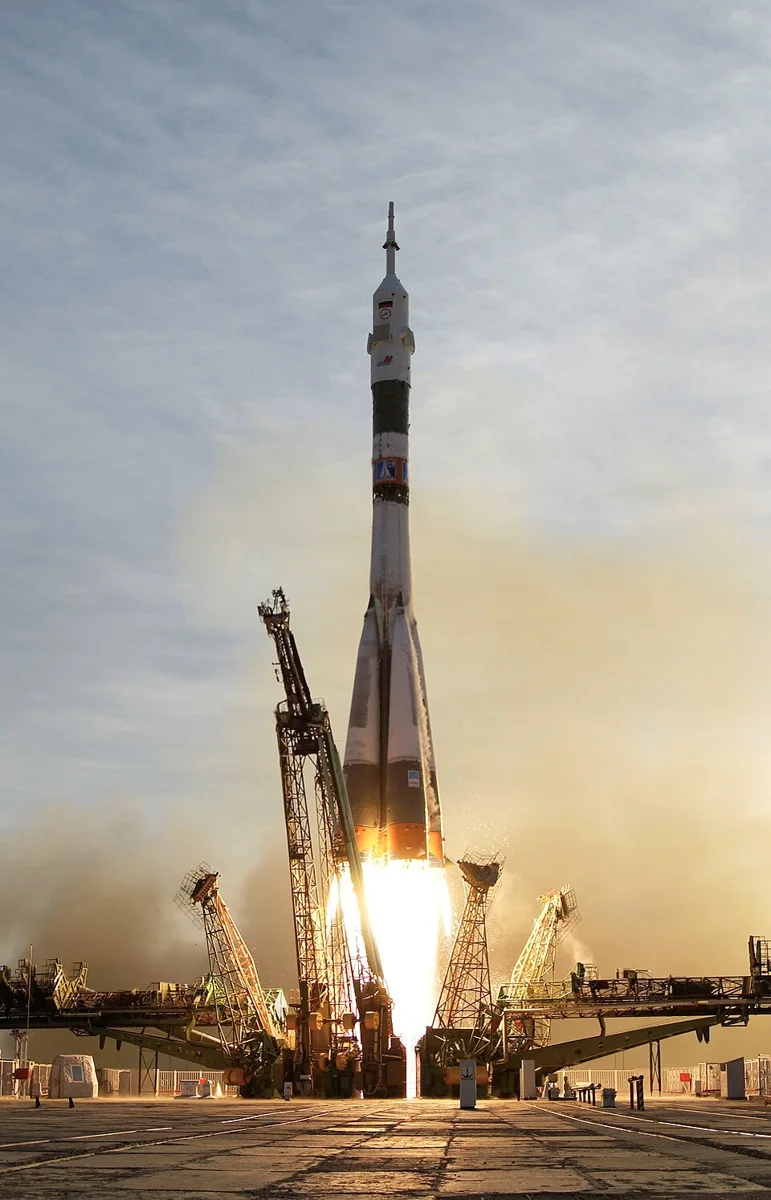
Soyuz TMA-5 launch from Baikonur, Kazakhstan: a comparative example of a crewed space launch.
Credit: Bill Ingalls · Public domain · sourceResized and converted to WebP; uncropped.
1. Principles of launch and orbital insertion
A launch vehicle is a rocket-based transportation system that accelerates a payload onto a prescribed trajectory. Payloads include communication satellites, Earth-observation satellites, planetary spacecraft and crew capsules. A sounding rocket generally follows a suborbital trajectory to investigate the upper atmosphere or conduct short-duration experiments; an orbital launcher must provide sufficient horizontal velocity for its payload to keep falling around Earth without striking the surface.
Rocket thrust results from expelling gases at high speed through a nozzle. Conservation of momentum produces motion in the opposite direction, illustrating Newton’s third law. Unlike an aircraft’s air-breathing engine, a conventional chemical rocket carries its oxidiser and can therefore function outside the atmosphere. Fuel and oxidiser together constitute the propellants. Atmospheric pressure influences nozzle performance, so engines may be optimised for operation near sea level or in vacuum.
An orbit is determined by both position and velocity. Reaching an altitude of 100 km, a commonly used boundary of space, does not establish an orbit. A circular low Earth orbit requires roughly 7.8 km/s, while Earth’s surface escape speed is approximately 11.2 km/s, ignoring atmospheric effects and rotation. Launch vehicles require additional velocity capability to compensate for gravity, drag and steering losses.
The rocket equation links the achievable change in velocity, or delta-v, to exhaust velocity and the ratio of initial to final mass. Consequently, structural mass, engine efficiency and propellant quantity strongly influence performance. Staging improves efficiency by discarding depleted tanks and engines. It is different from using strap-on boosters, which operate alongside the core during the early flight.
Timeline
18 July 1980
SLV-3 successfully placed Rohini RS-1 in orbit, establishing India’s indigenous satellite-launch capability.
15 October 1994
PSLV-D2 achieved the first successful PSLV orbital mission.
5 January 2014
GSLV-D5 successfully flew with an indigenous cryogenic upper stage.
5 June 2017
GSLV Mk III-D1 completed the vehicle’s first developmental orbital flight, carrying GSAT-19.
14 July 2023
LVM3-M4 launched Chandrayaan-3.
16 August 2024
SSLV-D3 launched EOS-08 and completed SSLV’s developmental flight programme.
2. Propulsion systems and vehicle components
Solid motors contain fuel and oxidiser incorporated into a solid propellant grain. They are relatively simple, storable and capable of producing high thrust, making them useful as first stages and boosters. However, ordinary solid motors cannot readily be throttled, stopped or restarted after ignition. The grain’s geometry helps determine the thrust profile during combustion.
Liquid engines store fuel and oxidiser separately and feed them into a combustion chamber. Depending on engine design, they allow thrust control, shutdown and restart. Storable liquid propellants are useful when a spacecraft must remain ready for extended periods. Some are hypergolic, meaning that fuel and oxidiser ignite on contact, but many commonly used combinations are toxic and require careful handling.
Cryogenic propulsion uses propellants stored at extremely low temperatures. India’s operational cryogenic upper stages use liquid hydrogen and liquid oxygen, stored near −253°C and −183°C respectively at atmospheric pressure. This combination offers high specific impulse, a measure of propellant efficiency. However, insulation, turbopumps, sealing, ignition and handling impose major engineering challenges. Semi-cryogenic propulsion commonly combines liquid oxygen with a hydrocarbon fuel such as kerosene; it is not equivalent to a hydrogen–oxygen cryogenic system.
Besides engines and propellant tanks, a launcher includes structural elements, guidance computers, navigation sensors, telemetry equipment and separation mechanisms. A payload fairing protects the spacecraft against aerodynamic pressure and heating during atmospheric ascent and is discarded when no longer needed. Guidance determines the desired path, navigation estimates the vehicle’s state, and control adjusts its orientation and trajectory.
Typical expendable orbital launch sequence
- 1. Integrate and test the payload, vehicle and ground systems
- 2. Ignite engines and lift off
- 3. Follow the programmed ascent trajectory and separate spent stages
- 4. Discard the payload fairing after leaving the dense atmosphere
- 5. Use upper-stage propulsion to achieve the intended insertion conditions
- 6. Separate the spacecraft and conduct mission-specific post-separation operations
3. India’s launch-vehicle family
The Polar Satellite Launch Vehicle, or PSLV, has four main stages using solid, liquid, solid and liquid propulsion respectively. Different configurations use different numbers of solid strap-on boosters, including none. Although associated with polar and Sun-synchronous missions, PSLV is not restricted to these orbits. It launched Chandrayaan-1 and the Mars Orbiter Mission spacecraft into initial Earth-bound trajectories. Its restartable fourth stage supports flexible mission profiles.
GSLV Mk II is a three-stage vehicle designed particularly for missions requiring geosynchronous transfer orbit insertion. It combines a solid core first stage with four liquid strap-ons, a liquid second stage and an indigenous cryogenic upper stage. The successful GSLV-D5 mission in January 2014 demonstrated the indigenous cryogenic upper stage in flight, strengthening India’s independent launch capability.
Launch Vehicle Mark-3, or LVM3, formerly GSLV Mk III, is a distinct vehicle rather than simply a renamed GSLV Mk II. Its principal propulsion elements are two S200 solid boosters, an L110 liquid core stage and a C25 cryogenic upper stage. Its nominal capability is about 4 tonnes to geosynchronous transfer orbit and 8 tonnes to low Earth orbit, subject to mission conditions. A human-rated configuration forms the launch basis for Gaganyaan.
The Small Satellite Launch Vehicle, or SSLV, serves the small-satellite market with simpler integration and shorter launch preparation objectives. It uses three solid stages and a liquid-propulsion Velocity Trimming Module for precise orbital injection. Its stated capability includes approximately 500 kg to a 500 km planar orbit under specified conditions. SSLV-D3 successfully launched EOS-08 in August 2024, completing the developmental flight programme.
| Vehicle | Main propulsion arrangement | Principal examination point |
|---|---|---|
| PSLV | Four stages: solid–liquid–solid–liquid; configuration-dependent solid strap-ons | Suitable for varied missions; not confined to polar orbits |
| GSLV Mk II | Solid core with liquid strap-ons; liquid second stage; cryogenic upper stage | Uses an indigenous hydrogen–oxygen cryogenic upper stage |
| LVM3 | Two solid boosters, liquid core and cryogenic upper stage | Formerly GSLV Mk III; supports heavy-payload and human-spaceflight requirements |
| SSLV | Three solid stages plus a liquid Velocity Trimming Module | Designed for small-satellite launches with operational flexibility |
4. Launch sites, trajectories and payload trade-offs
Earth’s eastward rotation gives an initial velocity advantage to eastward launches. This benefit is greatest near the equator and decreases towards the poles. Consequently, launch-site latitude matters for orbital inclination and payload capacity. Polar launches do not gain the same direct eastward rotational advantage. Altering orbital inclination after launch is propellant-intensive, so planners choose a launch direction suited to the desired orbit.
The Satish Dhawan Space Centre at Sriharikota, Andhra Pradesh, is India’s principal orbital launch site. Its coastal location enables many trajectories and discarded stages to pass over the Bay of Bengal, reducing risks to populated areas. Construction of a second spaceport at Kulasekarapattinam, Tamil Nadu, was initiated in 2024, particularly to support SSLV operations. Its location enables more direct southward trajectories for suitable missions.
A geosynchronous transfer orbit, or GTO, is normally an elongated intermediate orbit, not the final geostationary orbit. After separation, a satellite generally uses onboard propulsion to raise its perigee and adjust inclination. A geostationary orbit is circular, equatorial and prograde, at approximately 35,786 km altitude. Delivering payloads to higher-energy trajectories generally reduces the mass a given launcher can carry.
5. Reusability, human-rating and strategic significance
An expendable launch vehicle discards its major propulsion stages after one use. Reusable systems recover selected components for refurbishment and relaunch, potentially lowering costs when flight frequency is high. Reusability nevertheless requires additional systems, thermal protection, recovery infrastructure and sometimes reserved propellant, creating a trade-off with payload capacity. SpaceX’s Falcon 9 demonstrates operational first-stage recovery; its second stage is normally expendable.
ISRO’s reusable launch vehicle experiments investigate technologies such as autonomous approach, landing and aerodynamic control. The Pushpak landing experiments conducted in 2024 involved release from a helicopter and autonomous runway landing. These were technology demonstrations, not launches by an operational reusable orbital vehicle. Similarly, a successful landing experiment alone does not demonstrate the complete ability to withstand orbital re-entry and relaunch.
Human-rating imposes requirements for reliability, redundancy, fault detection, flight safety and safe crew escape. India’s Gaganyaan programme uses a human-rated LVM3 configuration with a crew escape system. Strategically, indigenous launch capability supports communication, navigation, disaster management, scientific exploration and national security. IN-SPACe facilitates and authorises non-governmental space activities, while NewSpace India Limited has a commercial role. The Indian Space Policy 2023 provides a framework for greater private participation.
Launch vehicles: propulsion, staging and orbital insertion
The supplied metadata identifies the launch of the Soyuz TMA-5 spacecraft on a mission to the International Space Station. This is directly relevant to launch vehicles, but it is a Russian comparative example, not evidence of Indian launch capabilities. A key distinction is between the launch vehicle, which accelerates its payload towards the required trajectory, and the spacecraft, which performs the mission after separation. Soyuz TMA-5 names the spacecraft and mission; it should not be treated as the designation of the carrier rocket.
Rocket engines generate thrust by expelling propellant at high speed and do not require atmospheric oxygen: chemical rockets carry their own oxidiser. Staging discards depleted hardware, reducing the mass that subsequent stages must accelerate. Reaching space is not equivalent to entering orbit; orbital insertion requires suitable velocity and direction at the intended altitude. For India, PSLV, GSLV, LVM3 and SSLV should be compared by payload capacity, target orbit, propulsion architecture and mission role. A launch photograph or its description alone cannot establish engine performance, payload capacity or human-rating status; these require technical documentation.
- Prelims distinction: solid, liquid and cryogenic describe propulsion characteristics; cryogenic propulsion is a specialised form of liquid propulsion.
- Payload capacity is orbit-dependent: a vehicle’s low-Earth-orbit capacity cannot be directly substituted for its geostationary-transfer-orbit capacity.
- Mains linkage: crewed launch capability requires system-wide safety and reliability, including abort provisions, not simply sufficient lifting capacity.
Real-world case studies
PSLV-C37: deploying 104 satellites
On 15 February 2017, PSLV-C37 launched 104 satellites, including Cartosat-2 Series and numerous international nanosatellites. The mission highlighted separation sequencing, collision avoidance and multi-payload integration. Satellite count alone does not measure launcher capacity: the combined mass and target orbit are equally important.
Chandrayaan-3: launcher and spacecraft perform different roles
LVM3-M4 inserted Chandrayaan-3 into an elliptical Earth orbit on 14 July 2023. Subsequent spacecraft manoeuvres enabled departure towards the Moon and lunar orbit insertion before the lander’s descent. The launcher did not directly deliver the lander onto the lunar surface, illustrating the distinction between launch-vehicle performance and spacecraft propulsion.
Previous year questions
No source-linked PYQ is available here yet. Use the practice questions below.
Practice questions
Practice MCQ 1
Consider the following statements: 1. A chemical rocket requires atmospheric oxygen throughout its flight. 2. Staging can improve launch performance by discarding depleted hardware. 3. Reaching an altitude of 100 km is sufficient to enter a stable Earth orbit. Which of the statements given above is/are correct?
- A. 1 and 2 only
- B. 2 only
- C. 2 and 3 only
- D. 1, 2 and 3
Practice MCQ 2
Which one of the following pairs is correctly matched?
- A. PSLV — Four main stages, all using liquid propulsion
- B. GSLV Mk II — Cryogenic first-stage core
- C. LVM3 — Two solid boosters, a liquid core and a cryogenic upper stage
- D. SSLV — Three cryogenic stages
Practice MCQ 3
Consider the following statements: 1. Eastward launches near the equator can benefit from Earth’s rotation. 2. Geosynchronous transfer orbit and geostationary orbit are identical. 3. Payload capacity depends on the orbit into which the payload is inserted. Which of the statements given above are correct?
- A. 1 and 2 only
- B. 2 and 3 only
- C. 1 and 3 only
- D. 1, 2 and 3
Mains practice · Explain the technological and strategic significance of India’s diversified launch-vehicle capabilities. How can reusability and private participation improve access to space? Answer in 250 words.
- Differentiate the roles of PSLV, GSLV Mk II, LVM3 and SSLV.
- Explain staging, indigenous cryogenic propulsion and human-rating.
- Connect launch autonomy with communication, navigation, Earth observation and exploration.
- Assess reusable systems through cost, flight frequency, refurbishment and payload trade-offs.
- Discuss private innovation, IN-SPACe authorisation and NSIL’s commercial role.
- Conclude with reliability, range capacity, orbital-debris mitigation and sustainable demand.
Further reading
- NCERT, Physics Part I, Class XI: Laws of Motion and Gravitation.
- ISRO official website: Launchers pages for PSLV, GSLV, LVM3 and SSLV.
- ISRO official mission pages: PSLV-C37, Chandrayaan-3, SSLV-D3/EOS-08 and RLV landing experiments.
- Department of Space: Annual Reports and Indian Space Policy 2023.
- IN-SPACe official website: authorisation framework and private-sector participation.
- https://commons.wikimedia.org/wiki/File:Soyuz_TMA-5_launch.jpg
Preparing for UPSC Civil Services? Get classroom teaching, answer-writing evaluation and mentorship at Pragnya IAS Academy, Ashok Nagar — see why aspirants choose us for IAS coaching in Hyderabad.