
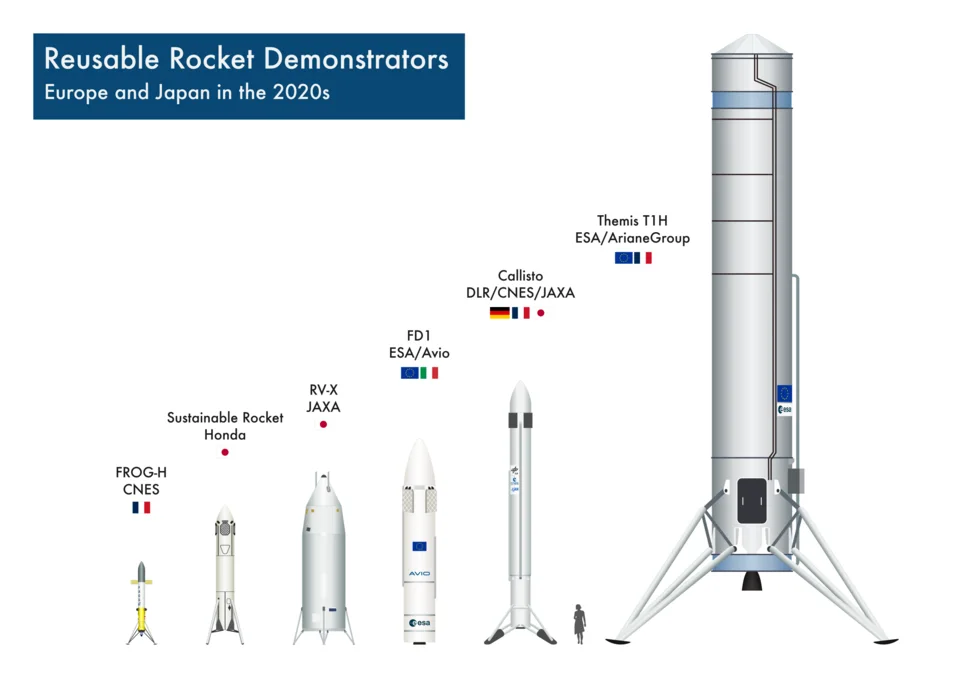
Comparative illustration of European and Japanese reusable rocket demonstrators; relative sizes are approximate.
Credit: Animalculum · CC BY 4.0 · sourceResized and converted to WebP; uncropped.
1. Meaning, scope and basic distinctions
A launch vehicle accelerates a payload, such as a satellite, to the speed and trajectory required for its mission. Conventional expendable launch vehicles discard stages as their propellant is consumed. A reusable launch system instead retrieves selected components, inspects and refurbishes them as necessary, and flies them again. The recovered hardware may include engines, complete stages, boosters, payload fairings or a winged orbital vehicle. The objective is to spread manufacturing expenditure over several missions.
Partial reusability means that only some major elements are recovered. Full reusability generally means recovering and reusing all major launch-vehicle stages; it does not mean that no propellant, consumables or replacement parts are required. A reusable spacecraft is not necessarily a reusable launcher: a crew or cargo capsule can return safely even when the rocket carrying it is expendable. Recovery itself is also not proof of reuse; an actual reflight establishes that recovered hardware can perform another mission.
Single-stage-to-orbit and two-stage-to-orbit describe vehicle architecture, not recovery arrangements. A single-stage vehicle must reach orbit without discarding stages, imposing demanding mass and propulsion requirements. A two-stage vehicle can also be designed for reusability. Similarly, reaching space on a suborbital trajectory differs fundamentally from entering orbit, which requires sufficient horizontal velocity to remain in continuous free fall around Earth.
- Expendable: major launch stages are used once.
- Partially reusable: selected stages or components are flown again.
- Fully reusable: all major launch stages are designed for recovery and subsequent reuse.
Timeline
1981
NASA’s Space Shuttle undertook its first orbital mission, STS-1.
December 2015
A Falcon 9 first stage landed successfully after supporting an orbital launch.
23 May 2016
ISRO conducted RLV-TD HEX-01.
March 2017
SpaceX successfully refl ew a previously flown Falcon 9 first stage on the SES-10 mission.
2023–2024
ISRO completed three autonomous RLV runway landing experiments.
September 2024
India approved development of the Next Generation Launch Vehicle.
2. Recovery methods and enabling technologies
Propulsive vertical landing uses rocket engines to decelerate a returning stage and place it upright on a landing pad or floating platform. Depending on the mission, the stage may undertake a boost-back manoeuvre, atmospheric-entry braking and a final landing burn. Grid fins or other aerodynamic surfaces help control its atmospheric descent. Offshore recovery can accommodate trajectories for which returning to the launch site would require too much propellant.
Winged runway landing relies on aerodynamic lift and control surfaces, followed by touchdown using landing gear. A winged vehicle can launch vertically yet land horizontally, as the Space Shuttle did. Parachute-assisted recovery offers another approach, including ocean splashdown or specialised retrieval arrangements. These methods are not interchangeable: they differ in vehicle mass, landing precision, recovery infrastructure and exposure to salt water or landing loads.
Reusability requires autonomous guidance, navigation and control; accurate sensors; fault-tolerant computers; reliable propulsion; and structures capable of repeated loading. Thermal protection is especially important during atmospheric re-entry. Vehicles returning from orbit encounter much greater energy dissipation requirements than typical first stages or low-altitude landing demonstrators. Tiles, blankets and ablative materials have different maintenance characteristics; a thermal shield is not automatically suitable for repeated flights without repair.
- Returning rocket stages may require engine restart capability and precise thrust control.
- Landing legs, wings, thermal protection and reserve propellant all impose mass penalties.
- Ground recovery, inspection and rapid servicing are as important as successful touchdown.
Typical reusable first-stage mission cycle
- 1. Launch and powered ascent
- 2. Stage separation while the upper stage continues the mission
- 3. Return trajectory and controlled atmospheric descent
- 4. Landing and recovery
- 5. Inspection, refurbishment and qualification
- 6. Integration and reflight
3. Economics, operational benefits and limitations
Launch hardware contains expensive engines, avionics and precision-manufactured structures. Reuse can reduce the manufacturing cost allocated to each flight and limit the need to build a complete new vehicle for every mission. Frequent launches may support satellite constellations, Earth observation, scientific missions and crew or cargo transportation. However, a lower launch price is a commercial outcome, while a lower launch cost is an engineering and operational outcome; the two should not be treated as identical.
Savings are not automatic. Each flight still consumes propellant and requires launch operations, tracking, recovery and safety services. Inspection, component replacement and refurbishment can be substantial. A vehicle needs enough successful reflights and sufficient market demand to recover its development and infrastructure expenditure. The Space Shuttle illustrates why reusable hardware can remain costly when servicing is complex and operational requirements are demanding.
Recovery also competes with payload performance. Propellant reserved for landing cannot be used to accelerate the payload, while recovery systems add dry mass. Some missions may therefore favour an expendable configuration to maximise performance. Environmental assessment must likewise cover the whole life cycle: reuse can reduce hardware production and discarded stages, but emissions, propellant choice, recovery operations and increased launch frequency remain relevant. Reusability alone does not solve orbital debris, especially when upper stages and payloads remain in orbit.
- Key economic variables: manufacturing cost, refurbishment cost, achievable flight rate and number of safe reuses.
- Key operational variables: turnaround time, landing reliability, weather and recovery-site availability.
- Debris mitigation additionally requires disposal planning, passivation and responsible satellite operations.
| System | Reusable or tested element | Important distinction |
|---|---|---|
| Falcon 9 | First stage; fairings can also be recovered | Second stage remains expendable |
| Space Shuttle | Orbiter and solid rocket booster hardware | External tank was expendable |
| New Shepard | Booster and capsule | Suborbital, not an orbital satellite launcher |
| ISRO Pushpak LEX | Winged landing demonstrator | Helicopter release followed by autonomous runway landing |
4. India’s reusable launch technology programme
ISRO’s Reusable Launch Vehicle–Technology Demonstrator programme develops capabilities relevant to future reusable transportation systems. Its first hypersonic flight experiment, HEX-01, took place on 23 May 2016 from Sriharikota, Andhra Pradesh. A winged demonstrator was carried aloft by a solid rocket booster and subsequently followed a controlled atmospheric flight path towards a designated area in the Bay of Bengal. The experiment tested technologies including hypersonic aerodynamics, autonomous navigation, guidance and control, and thermal protection; it was not an orbital flight.
The landing experiment series addressed autonomous runway approach and touchdown. RLV LEX-01 was conducted on 2 April 2023 at the Aeronautical Test Range, Chitradurga, Karnataka. An Indian Air Force Chinook helicopter released the winged vehicle from about 4.5 kilometres altitude, after which it navigated autonomously to the runway. This tested landing under specified approach conditions, not re-entry from orbital speed.
RLV LEX-02 on 22 March 2024 and LEX-03 on 23 June 2024 used the winged vehicle called Pushpak. They demonstrated landing under more demanding release and wind conditions, including correction of cross-range displacement. Reuse of the winged body and flight systems across the series supported the technology-development objective. Nevertheless, successful helicopter-drop landings do not establish an operational reusable orbital launcher.
In September 2024, the Union Cabinet approved development of ISRO’s Next Generation Launch Vehicle, envisaging a reusable first stage and increased payload capability. This is a development programme, not evidence of an already operational vehicle. Aspirants should distinguish the winged RLV demonstrator experiments from this separately approved launch-vehicle programme.
- Sriharikota: launch location for the 2016 hypersonic experiment.
- Chitradurga: runway landing experiment location.
- Pushpak: name used for the winged vehicle in the later landing experiments.
5. Global examples and examination relevance
Falcon 9 provides an operational example of partial reusability through first-stage recovery and reflight. NASA’s Space Shuttle, operational from 1981 to 2011, combined a reusable winged orbiter with recoverable solid rocket boosters and an expendable external tank. Blue Origin’s New Shepard demonstrates reusable suborbital operations, which should not be equated with placing satellites in orbit.
For Prelims, examine precisely what was demonstrated: recovery, reflight, autonomous landing, suborbital flight or orbital return. Claims that every reusable vehicle requires wings, that every recovered stage reaches orbit, or that reuse eliminates thermal protection are incorrect. The broader significance lies in potentially improving launch affordability and frequency while maintaining reliability, safety and environmental responsibility.
- Autonomous means onboard systems guide the vehicle without a pilot controlling the landing.
- A successful technology demonstrator validates selected capabilities, not necessarily the complete launch system.
Reusable launch demonstrators: testing recovery, not proving operational readiness
Reusable launch demonstrators test technologies needed to recover and fly launch-vehicle hardware again. The supplied metadata describes a comparison of European and Japanese projects based on hardware and visualizations from 2026, with approximate relative sizes. It is therefore an international comparative illustration, not evidence of Indian hardware or proof that every depicted design has flown. Such demonstrators can validate guidance, navigation and control, engine throttling and restart, landing stability, and structural survival under repeated flight loads. A successful recovery establishes only part of the case for practical reuse.
For India, the conceptual connection is ISRO’s reusable launch vehicle technology work, including winged-vehicle landing experiments. These must not be equated with an operational reusable orbital launcher. Vertical rocket landing and winged runway landing are different recovery approaches, each requiring suitable flight control, structures and recovery infrastructure. The economic objective is lower cost per successful mission, but recovery alone does not guarantee savings: refurbishment, inspection, turnaround time, payload penalties and achievable flight frequency all matter. Demonstration milestones should therefore be assessed alongside repeat-flight performance and the scope of hardware actually reused.
- Partial reusability recovers selected components; full reusability aims to reuse all major launch stages. Recovering a spacecraft does not establish launcher reusability.
- A suborbital hop or landing experiment does not demonstrate the energy management, heating tolerance and mission integration required for orbital-stage recovery.
- For Prelims and Mains, distinguish demonstrated capability from proposed design. Approximate comparison graphics cannot establish precise dimensions, payload capacity, reliability or cost savings.
Real-world case studies
Falcon 9: recovery followed by actual reflight
The March 2017 SES-10 mission reused a Falcon 9 first stage previously flown in April 2016. It demonstrated the essential step beyond landing: recovered hardware could support another orbital launch. The example establishes partial, not full, launch-vehicle reusability.
Pushpak: incremental validation
ISRO’s 2024 landing experiments tested autonomous approach and touchdown under increasingly challenging conditions at Chitradurga. They illustrate incremental engineering validation: landing control can be tested separately before combining it with the much harder demands of orbital ascent and re-entry.
Previous year questions
No source-linked PYQ is available here yet. Use the practice questions below.
Practice questions
Practice MCQ 1
With reference to reusable launch systems, consider the following statements: 1. A multistage launch vehicle can be reusable. 2. Recovery of a crew capsule necessarily makes its launch vehicle reusable. 3. Reserving propellant for stage recovery can reduce payload capacity. Which statements are correct?
- A. 1 and 2 only
- B. 1 and 3 only
- C. 2 and 3 only
- D. 1, 2 and 3
Practice MCQ 2
Which description correctly characterises ISRO’s Pushpak landing experiments conducted in 2024?
- A. Crewed orbital flights followed by ocean splashdown
- B. Autonomous runway landings after release from a helicopter
- C. Vertical landings of an operational orbital rocket’s first stage
- D. Single-stage-to-orbit missions using air-breathing engines
Practice MCQ 3
Which one of the following statements about reusability is correct?
- A. Every recovered rocket stage must first attain orbital velocity.
- B. A reusable vehicle requires no inspection between flights.
- C. Reuse economics depend partly on refurbishment expenditure and flight frequency.
- D. Reusing the first stage automatically prevents orbital debris.
Mains practice · Reusable launch systems can improve access to space, but technical recovery does not automatically ensure economic viability. Discuss with reference to India’s initiatives. Answer in 250 words.
- Define partial and full reusability and distinguish launcher reuse from spacecraft recovery.
- Explain potential manufacturing savings, increased launch frequency and strategic benefits.
- Discuss thermal protection, guidance, propulsion, payload penalties and turnaround requirements.
- Assess refurbishment expenditure, flight rate and life-cycle economics.
- Mention RLV-TD HEX-01, Pushpak landing experiments and the approved NGLV programme without presenting demonstrators as operational launchers.
- Conclude with incremental validation, safety, commercial demand and debris mitigation.
Further reading
- ISRO official website: Reusable Launch Vehicle–Technology Demonstrator and HEX-01 mission material.
- ISRO official mission updates: RLV LEX-01, LEX-02 and LEX-03.
- Press Information Bureau: Cabinet approval for development of the Next Generation Launch Vehicle, September 2024.
- NASA: Space Shuttle programme history and vehicle descriptions.
- SpaceX: Falcon 9 official vehicle information.
- https://commons.wikimedia.org/wiki/File:Reusable_Rocket_Demonstrators_%E2%80%93_Europe_and_Japan_in_the_2020s.png
Preparing for UPSC Civil Services? Get classroom teaching, answer-writing evaluation and mentorship at Pragnya IAS Academy, Ashok Nagar — see why aspirants choose us for IAS coaching in Hyderabad.