
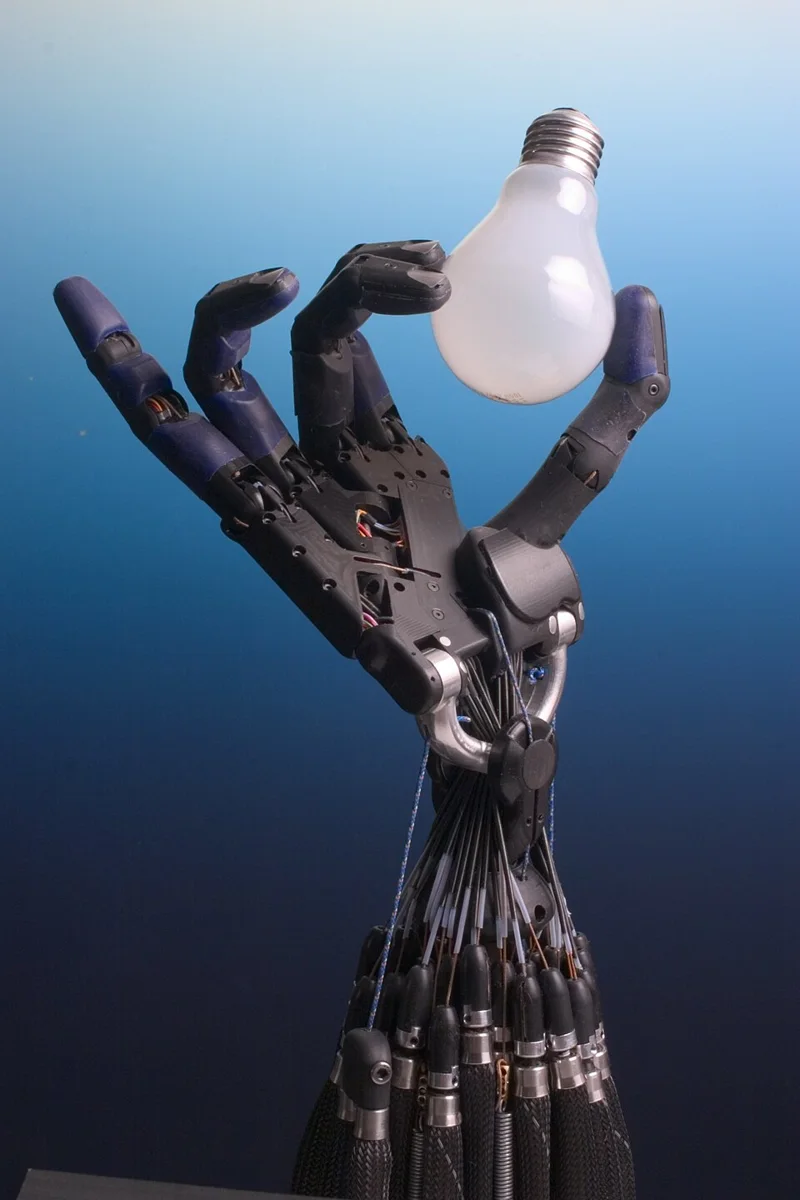
Shadow Dexterous Robot Hand holding a lightbulb: an illustrative example of robotic manipulation.
Credit: Richard Greenhill and Hugo Elias (myself) of the Shadow Robot Company · CC BY-SA 3.0 · sourceResized and converted to WebP; uncropped.
1. Core concepts and working principles
A robot is a programmed, actuated mechanism capable of performing physical tasks with some degree of autonomy. Unlike software-only automation, it interacts with the physical environment through movement or manipulation. Robotics integrates mechanical design, embedded electronics, control theory, computer vision and, increasingly, artificial intelligence. The distinction matters: a chatbot generates information, while a robotic arm can grasp an object, and an autonomous mobile robot can navigate around obstacles.
The basic architecture follows a perception–decision–action cycle. Sensors measure variables such as position, force, temperature and distance. Controllers interpret these inputs and issue commands; actuators convert electrical, hydraulic or pneumatic energy into movement. Feedback compares actual performance with the desired outcome and corrects errors. End-effectors, such as grippers, welding tools or surgical instruments, enable task-specific interaction.
Robot performance depends on payload, reach, degrees of freedom, speed, accuracy and repeatability. Accuracy means closeness to a target position, while repeatability means returning consistently to the same position. A machine can be highly repeatable without being equally accurate. Reliability also depends on power availability, maintenance and the operating environment, especially in dusty, wet or unpredictable Indian field conditions.
- Teleoperated robots: a human controls operations remotely, as in bomb disposal.
- Autonomous robots: systems perceive, plan and act within defined operating limits.
- Collaborative robots, or cobots: designed for specified human–robot collaborative applications; safe deployment still requires task-level risk assessment.
- Soft robots and swarm robots: respectively use compliant structures and coordinated groups of relatively simple machines.
2. Enabling technologies and applications
Machine vision uses cameras and algorithms to identify objects and inspect products. LiDAR, radar and ultrasonic sensors support distance measurement and obstacle detection. Simultaneous localisation and mapping, or SLAM, helps a mobile robot estimate its position while building a map. Sensor fusion combines multiple inputs to improve robustness. Edge computing processes information near the machine, reducing communication delays and dependence on continuous internet connectivity.
In manufacturing, robots improve consistency in welding, painting, machining and assembly, particularly in automotive and electronics production. They reduce exposure to fumes, heat and repetitive strain. However, robotic automation does not automatically generate competitiveness: firms also need stable processes, skilled technicians, reliable suppliers and sufficient production volumes. Flexible, affordable systems are especially important for micro, small and medium enterprises.
Societal applications include rehabilitation devices, assistive robots, laboratory automation and robot-assisted surgery. Most established surgical robotic systems are controlled by trained surgeons rather than independently conducting operations. In agriculture, robots can support precision spraying, mechanical weeding and harvesting, although irregular terrain and variable crops complicate deployment. Sewer inspection, underwater maintenance and disaster-site reconnaissance offer particularly strong public value by reducing human exposure to dangerous environments.
- Digital twins allow virtual testing of robotic cells before physical deployment.
- Additive manufacturing supports rapid prototyping and lightweight, customised components.
- AI can improve perception and adaptability, but incorrect predictions can become physical safety hazards.
Robot perception–action feedback loop
- 1. Sensors collect information about the environment and machine state.
- 2. Software estimates position, identifies objects and assesses uncertainty.
- 3. A planner selects an action within task and safety constraints.
- 4. Controllers command actuators and end-effectors.
- 5. Feedback checks the result and triggers correction or a safe stop.
3. Strategic significance and India's ecosystem
Robotics is a strategic technology because it connects industrial capability with security and technological sovereignty. Defence applications include explosive ordnance disposal, surveillance, logistics and unmanned ground or underwater operations. Space robots support exploration where human presence is expensive or impossible. Nuclear facilities can use remote manipulators and inspection robots to reduce radiation exposure. Such applications demand exceptional reliability, secure communications and resistance to hostile interference.
India's ecosystem includes research institutions, engineering colleges, start-ups, industrial integrators and public laboratories. DRDO's Daksh is a remotely operated system for handling suspicious objects and explosive threats. ISRO's Pragyan rover demonstrated robotic mobility and scientific investigation on the Moon in 2023. IITs and other institutions work on areas including manipulation, locomotion, medical robotics and human–robot interaction.
The Ministry of Electronics and Information Technology released the Draft National Strategy on Robotics in September 2023. It identified manufacturing, agriculture, healthcare and national security as priority sectors and proposed institutional support for innovation. Broader initiatives such as Make in India, the IndiaAI Mission and semiconductor ecosystem development can strengthen enabling capabilities, but they are not substitutes for robot-specific engineering, testing and deployment support.
Critical constraints include dependence on imported precision components, limited patient capital for hardware ventures and shortages of multidisciplinary talent. Indigenous capability must cover motors, drives, precision gearboxes, encoders, sensors, controllers and safety software, not merely final assembly. India also needs application-specific designs suited to smaller factories, diverse languages and difficult field environments.
| Technology | Defining feature | Example | Important distinction |
|---|---|---|---|
| Industrial robot | Programmable physical manipulation | Automotive welding arm | Can operate without AI |
| Cobot | Designed for collaborative applications | Assisted component assembly | Safety depends on the complete application |
| Autonomous mobile robot | Navigates using onboard perception and planning | Warehouse transport robot | Must operate within defined environmental limits |
| Teleoperated robot | Human-directed remote action | Bomb-disposal robot | Robotic operation does not imply full autonomy |
| Robotic process automation | Software automation of digital workflows | Automated invoice processing | Usually has no physical robotic mechanism |
4. Risks, ethical questions and governance
Robotics can displace particular tasks while creating demand for programmers, integrators and maintenance workers. The distribution of gains is not automatic: workers with limited access to training may face wage pressure or job loss. Policy should therefore assess task-level exposure rather than assume that entire occupations will disappear. Reskilling, apprenticeships and social protection must accompany productivity improvements.
Physical safety requires fail-safe design, emergency stops, protective separation and validated operating limits. ISO 10218 addresses industrial robot safety, while ISO/TS 15066 provides guidance for collaborative applications. These standards are useful technical references; their existence alone does not establish mandatory compliance across every Indian deployment. A cobot handling a sharp tool or heavy load can still be dangerous.
Connected robots can collect sensitive images, location information and health data. Governance must address cybersecurity, data minimisation, access controls and applicable obligations under India's data-protection framework. Hijacked robots may cause physical harm, making secure updates and incident reporting essential. Liability must distinguish design defects, negligent operation and maintenance failures. Autonomous weapons raise additional questions of distinction, proportionality and meaningful human control under international humanitarian law.
- High-stakes decisions should retain clear human responsibility rather than rely on claims of machine autonomy.
- Public procurement should evaluate lifecycle costs, repairability, accessibility and independently demonstrated outcomes.
5. Policy priorities and an inclusive roadmap
India should prioritise applications where robotics solves a clearly established problem: hazardous sanitation, industrial inspection, affordable rehabilitation and precision production. Shared testing facilities and demonstration centres can reduce costs for start-ups and MSMEs. Procurement-linked pilots should specify measurable outcomes, such as reduced worker exposure, improved inspection coverage or lower downtime, rather than reward technology adoption for its own sake.
A balanced roadmap combines component manufacturing, translational research, technician training and proportionate regulation. Certification capacity should grow alongside deployment, particularly in healthcare and human-facing applications. Cybersecurity and maintenance must be built into contracts from the outset. Publicly funded projects should report failures as well as successes so that pilots generate usable evidence.
Robotics should augment human capabilities and dignity. Mechanisation of sanitation must complement enforcement of the Prohibition of Employment as Manual Scavengers and their Rehabilitation Act, 2013, worker rehabilitation and safe operating procedures. The ultimate policy test is whether robotic systems improve productivity, public safety and service access without transferring unreasonable risks to workers or citizens.
Dexterous Robotics: Linking Sensing, Control and Physical Action
The supplied metadata identifies a Shadow Dexterous Robot Hand holding a lightbulb, making this a relevant illustration of robotic manipulation. Handling a fragile object involves more than moving fingers: a robot must establish contact, maintain a stable grasp and limit forces that could damage the object. Dexterous manipulation links mechanical design and actuators with sensing, motion planning and feedback control. However, the metadata does not establish which sensors, control methods or degree of autonomy were used; holding an object alone does not demonstrate independent decision-making.
This example helps distinguish robotics from artificial intelligence. A robot physically acts on its environment, whereas AI may operate entirely through software. Robots can follow predetermined instructions, respond through feedback control, be remotely operated or use AI for perception and planning. In India, reliable manipulation could support manufacturing, assistive devices and the handling of hazardous materials. Yet a specialised robotic hand is not automatically suitable for field deployment: affordability, maintenance, power requirements and performance under dust, moisture or unpredictable contact matter. This is an illustrative technology example, not evidence of Indian development or deployment.
- Degrees of freedom describe independent motions; more joints can improve dexterity but increase control complexity and cost.
- Closed-loop control uses measured feedback to adjust action; it does not necessarily require AI or machine learning.
- For public deployment, assess task-specific safety, cybersecurity, worker training and human accountability—not merely a successful demonstration.
Real-world case studies
Pragyan rover: robotics for lunar exploration
Following Chandrayaan-3's landing on 23 August 2023, ISRO's six-wheeled Pragyan rover explored the lunar surface. Its LIBS and APXS instruments investigated elemental composition; LIBS confirmed sulphur near the landing site. The mission illustrates robotic mobility, remote operations and scientific instrumentation under severe energy, terrain and communication constraints. It should not be equated with unrestricted autonomous decision-making.
Bandicoot: mechanising hazardous sanitation
Developed by Kerala-based Genrobotics, Bandicoot uses a robotic mechanism to remove waste from manholes while workers operate it from outside. Deployment by urban authorities illustrates how robotics can reduce hazardous human entry. Its effectiveness depends on suitability for local sewer conditions, maintenance, operator training and complementary equipment; purchasing a robot alone cannot establish elimination of hazardous sanitation practices.
Previous year questions
No source-linked PYQ is available here yet. Use the practice questions below.
Practice questions
Practice MCQ 1
With reference to robotics, consider the following statements: 1. Every robot requires artificial intelligence. 2. A teleoperated machine can qualify as a robot. 3. Repeatability and positional accuracy are identical. Which of the statements given above is/are correct?
- A. 1 and 2 only
- B. 2 only
- C. 2 and 3 only
- D. 1, 2 and 3
Practice MCQ 2
Simultaneous localisation and mapping, frequently discussed in mobile robotics, primarily enables a machine to:
- A. Generate unlimited power from its surroundings
- B. Eliminate the need for actuators
- C. Estimate its position while constructing a map
- D. Guarantee secure communication without encryption
Practice MCQ 3
Consider the following measures for deploying robots in hazardous sanitation: 1. Training operators and ensuring maintenance 2. Verifying compatibility with local infrastructure 3. Treating procurement as sufficient proof that hazardous entry has ended Which measures represent sound public policy?
- A. 1 only
- B. 2 and 3 only
- C. 1 and 2 only
- D. 1, 2 and 3
Mains practice · Robotics can strengthen India's strategic autonomy while addressing hazardous and socially undesirable work. Discuss the opportunities, constraints and safeguards necessary for an inclusive robotics ecosystem. Answer in 250 words.
- Explain robotics as the integration of sensing, computation and physical action.
- Cover manufacturing, defence, space, healthcare and sanitation applications.
- Use Pragyan, Daksh and Bandicoot as examples.
- Identify component dependence, financing constraints, skills shortages and maintenance challenges.
- Discuss worker transition, cybersecurity, physical safety, privacy and liability.
- Recommend shared testing, outcome-based procurement, domestic component capability and human accountability.
Further reading
- Ministry of Electronics and Information Technology: Draft National Strategy on Robotics, 2023.
- International Federation of Robotics: World Robotics 2025, Industrial Robots.
- ISRO: Chandrayaan-3 mission pages and scientific updates.
- DRDO: Daksh remotely operated vehicle information.
- ISO: ISO 10218 industrial robot safety standards and ISO/TS 15066 collaborative robot guidance.
- India Code: Prohibition of Employment as Manual Scavengers and their Rehabilitation Act, 2013.
- https://commons.wikimedia.org/wiki/File:Shadow_Hand_Bulb_large.jpg
Preparing for UPSC Civil Services? Get classroom teaching, answer-writing evaluation and mentorship at Pragnya IAS Academy, Ashok Nagar — see why aspirants choose us for IAS coaching in Hyderabad.