
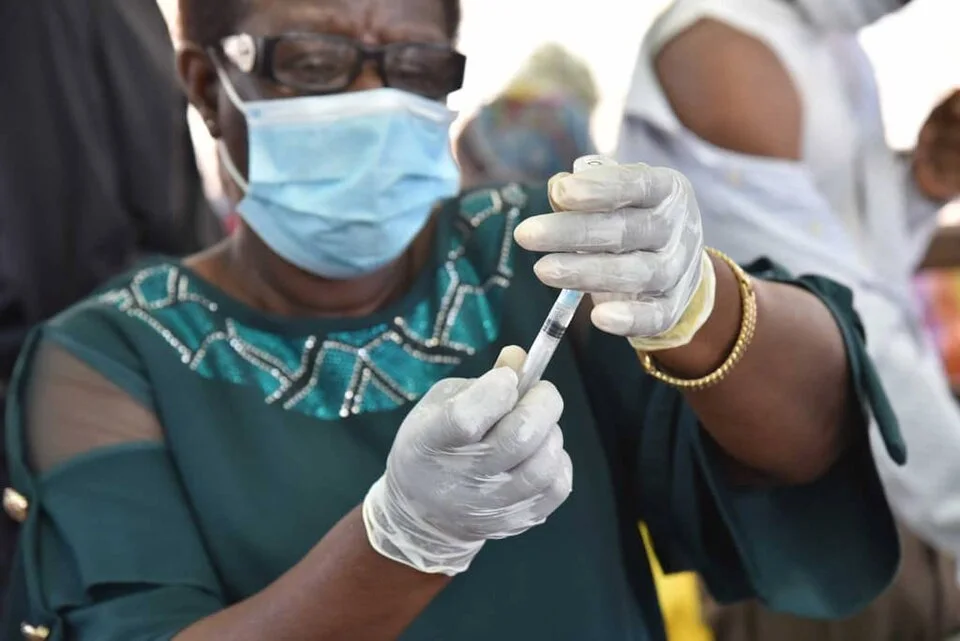
Yellow fever vaccination, identified by the file title; a comparative public-health example from Africa.
Credit: Ugochukwu2007 · CC BY-SA 4.0 · sourceResized and converted to WebP; uncropped.
1. Biological basis: antigens, antibodies and immune memory
A vaccine presents an antigen, or instructions for producing one, to the immune system without exposing the recipient to the full risks of natural disease. Antigens are structures recognised by immune receptors. Innate immune cells detect the vaccine and help activate adaptive immunity. B lymphocytes can differentiate into plasma cells that secrete antibodies, while T lymphocytes coordinate responses or destroy infected cells. The relative contribution of antibodies and T cells varies by vaccine and disease.
Following the initial response, memory B and T cells may persist. Subsequent exposure can therefore trigger a faster, stronger response. Protection is not necessarily lifelong: it depends on the pathogen, platform, number of doses, recipient’s immune status and changes in the pathogen. Booster doses reinforce or broaden protection. Multiple doses in a primary series are not automatically boosters.
Vaccination produces active immunity because the recipient generates the immune response. Passive immunity involves receiving ready-made antibodies, as through maternal antibodies or rabies immunoglobulin. It acts rapidly but generally lasts for a shorter period and does not itself establish immune memory. For severe rabies exposures, vaccine and immunoglobulin may both be required because they perform different functions.
- Antigen: the immune target; antibody: an immunoglobulin produced against a target.
- Adjuvant: an ingredient, such as an aluminium salt, that strengthens the immune response.
- A vaccine need not prevent every infection to substantially reduce severe disease and death.
Timeline
1796
Edward Jenner demonstrated protection against smallpox using cowpox material.
1980
The World Health Assembly declared smallpox eradicated.
1985
India launched the Universal Immunisation Programme.
2014
WHO’s South-East Asia Region, including India, was certified polio-free; India launched Mission Indradhanush in December.
2. Vaccine platforms and their distinguishing features
Live attenuated vaccines use weakened organisms capable of limited replication. They often produce strong immune responses but are generally avoided in pregnancy and severe immunodeficiency, subject to vaccine-specific guidance. Examples include BCG, oral polio vaccine and measles-containing vaccines. Inactivated vaccines contain organisms rendered non-infectious; they cannot replicate and may require repeated doses or adjuvants. Examples include inactivated polio vaccine and Covaxin.
Subunit vaccines contain selected components rather than the entire pathogen. Recombinant hepatitis B vaccine uses surface antigen produced through biotechnology. Human papillomavirus vaccines use non-infectious virus-like particles without viral genetic material. Toxoid vaccines contain detoxified bacterial toxins, as in tetanus and diphtheria vaccines. Conjugate vaccines link a polysaccharide antigen to a carrier protein, improving responses and immune memory in young children; examples include Hib and pneumococcal conjugate vaccines.
Viral-vector vaccines use a modified virus to deliver genetic instructions encoding an antigen; Covishield uses a non-replicating chimpanzee adenovirus vector. mRNA vaccines deliver messenger RNA, typically within lipid nanoparticles, for translation in the cytoplasm. They do not need to enter the nucleus or alter human DNA. DNA vaccines deliver plasmid DNA; ZyCoV-D is an Indian example. Platform names describe how immunity is induced, not an automatic ranking of safety or effectiveness.
- Oral administration does not identify a single platform: oral vaccines may differ in composition.
- Recombinant technology is a production approach used across several vaccine designs.
From vaccination to immune memory
- 1. Vaccine antigen is delivered or produced in the body
- 2. Innate immune activation and antigen presentation occur
- 3. Antigen-specific B and T lymphocytes are activated
- 4. Antibodies and cellular responses develop
- 5. Memory cells support a faster response on re-exposure
3. Efficacy, safety and population-level protection
Vaccine efficacy measures relative risk reduction under controlled trial conditions; effectiveness measures performance in real-world settings. An efficacy of 80% against a specified outcome means an 80% relative reduction in that outcome among vaccinated participants compared with controls. It does not mean that 20% of recipients necessarily develop disease. Estimates depend on the endpoint, follow-up period and population.
Herd immunity occurs when population immunity reduces transmission sufficiently to indirectly protect susceptible people. The simplified threshold, 1 − 1/R₀, assumes conditions such as homogeneous mixing and durable protection against infection. Actual vaccination requirements also depend on effectiveness, waning immunity, variants and clustering of unvaccinated people. Tetanus does not exhibit vaccine-induced herd protection because it is acquired from environmental spores rather than transmitted between people.
An adverse event following immunisation, or AEFI, is a medical occurrence after vaccination; temporal association alone does not prove causation. Fever and injection-site pain are common reactions, while serious reactions are rare and require investigation. Clinical trials and post-marketing surveillance assess safety continuously. Vaccination decisions compare potential harms with disease risks rather than assuming that either vaccination or non-vaccination is risk-free.
- Eradication means worldwide interruption of natural occurrence of an infection; elimination is geographically bounded and may require continuing preventive measures.
- Breakthrough infection is infection despite vaccination, not proof that all vaccine benefits have disappeared.
| Vaccine | Platform | Exam-relevant feature |
|---|---|---|
| BCG | Live attenuated bacterium | Especially protects children against severe forms of tuberculosis |
| OPV | Live attenuated virus | Produces intestinal immunity; rarely associated with vaccine-related poliovirus risks |
| IPV | Inactivated virus | Cannot cause vaccine-associated paralytic poliomyelitis |
| Hepatitis B | Recombinant protein | Can indirectly prevent liver cancer |
| Tetanus | Toxoid | Targets toxin-mediated disease; no herd protection |
4. India’s immunisation architecture
India launched the Expanded Programme on Immunization in 1978 and the Universal Immunisation Programme in 1985. UIP delivers vaccines free through public services under the National Immunisation Schedule. It protects against diseases including tuberculosis, poliomyelitis, diphtheria, pertussis, tetanus, hepatitis B, measles, rubella, rotavirus diarrhoea, Hib disease and pneumococcal disease. Japanese encephalitis vaccination is provided in identified endemic districts. Pregnant women receive tetanus-diphtheria vaccination according to their vaccination history and schedule.
Mission Indradhanush, launched in December 2014, seeks to reach unvaccinated and partially vaccinated children and pregnant women. Intensified rounds use focused mobilisation and microplanning in low-coverage areas. They supplement rather than replace routine immunisation. Last-mile challenges include migrant populations, remote settlements, missed sessions, misinformation and inadequate tracking of children who drop out between doses.
The electronic Vaccine Intelligence Network, or eVIN, supports visibility of vaccine stocks and storage temperatures. U-WIN supports digital recording and tracking of routine vaccination for pregnant women and children, while Co-WIN was central to COVID-19 vaccination management. The Central Drugs Standard Control Organisation and Drugs Controller General of India regulate vaccine approvals under the applicable legal framework. ICMR supports biomedical research, while the Ministry of Health and Family Welfare directs national immunisation policy.
- UIP coverage is not synonymous with availability of every licensed vaccine.
- Consult the latest National Immunisation Schedule for ages, doses and geographical targeting.
5. Delivery, public-health applications and emerging technologies
The cold chain maintains vaccines within specified temperature ranges from manufacture to administration. Many routine vaccines are stored at 2–8°C, but requirements vary by product and supply-chain level. Both heat and freezing can damage vaccines. Aluminium-adjuvanted vaccines are often freeze-sensitive. A vaccine vial monitor indicates cumulative heat exposure; it does not detect freezing or replace expiry-date checks.
Vaccination has uses beyond preventing acute infections. Hepatitis B vaccination reduces the risk of chronic infection and subsequent liver cancer, while HPV vaccination helps prevent cervical and other HPV-associated cancers. Preventing bacterial infections can reduce antibiotic use and contribute to controlling antimicrobial resistance. Vaccination may also be effective after exposure, as in rabies, when administered promptly according to guidelines.
Newer approaches include mucosal vaccines, thermostable formulations and rapid-update genetic platforms. Intranasal vaccination seeks to stimulate immunity at a common entry site, but route alone does not guarantee interruption of transmission. Access remains as important as innovation: affordability, reliable procurement, trained personnel, surveillance and public trust determine population impact. India’s smallpox and polio experiences demonstrate the importance of combining vaccination with active surveillance and community engagement.
- A controlled temperature chain permits specified, monitored excursions only for vaccines authorised for that use.
- Vaccines prevent disease; therapeutic vaccines, including some cancer applications, instead aim to treat existing disease.
Yellow fever vaccination: immune protection and public-health strategy
Yellow fever vaccination illustrates how immunisation complements disease prevention. Yellow fever is a mosquito-borne viral disease, and its vaccine uses a live, attenuated virus to stimulate protective immune responses without causing typical disease in most eligible recipients. Vaccination produces active immunity: the recipient develops an immune response and immunological memory. By contrast, administered antibodies provide passive protection that is generally temporary and does not itself establish immune memory. The supplied metadata identifies a yellow fever vaccination context in Africa; it does not establish the recipient’s identity, the vaccine product or the administration procedure.
For India, this is a comparative example rather than evidence of local yellow fever transmission or routine childhood vaccination. Yellow fever vaccination is relevant to international travel, designated vaccination centres and entry requirements associated with travel from risk areas. It should not be confused with vaccines routinely delivered through India’s Universal Immunisation Programme. The example also demonstrates why vaccination policy depends on transmission ecology: mosquito control and surveillance remain important, and protection cannot be understood solely through a simple person-to-person herd-immunity model.
- Platform distinction: live attenuated vaccines differ from inactivated, subunit, viral-vector and nucleic-acid vaccines; platform influences storage requirements and eligibility precautions.
- Safety distinction: live vaccines generally require special assessment in pregnancy and significant immunosuppression; recommendations depend on the vaccine and exposure risk.
- Evidence limit: the title supports topic relevance, but metadata alone cannot verify correct injection technique, cold-chain maintenance or successful immunisation.
Real-world case studies
India’s interruption of wild poliovirus transmission
India’s last reported wild poliovirus case occurred in Howrah, West Bengal, on 13 January 2011. Repeated vaccination rounds, transit-site vaccination and acute flaccid paralysis surveillance supported interruption. Regional certification in 2014 did not mean global eradication or an end to vaccination.
Smallpox eradication
Vaccination combined with case detection, isolation and vaccination of contacts helped eradicate smallpox. Its exclusively human reservoir and recognisable illness aided surveillance-containment. These advantages do not apply equally to every vaccine-preventable disease.
Previous year questions
No source-linked PYQ is available here yet. Use the practice questions below.
Practice questions
Practice MCQ 1
Which intervention provides artificially acquired passive immunity?
- A. Administration of tetanus toxoid
- B. Administration of rabies immunoglobulin
- C. Administration of recombinant hepatitis B vaccine
- D. Administration of an mRNA vaccine
Practice MCQ 2
Consider these statements: 1. mRNA vaccines require integration into human DNA. 2. Conjugation can improve responses to polysaccharide antigens in infants. 3. Inactivated vaccines cannot replicate. Which are correct?
- A. 1 and 2 only
- B. 2 and 3 only
- C. 1 and 3 only
- D. 1, 2 and 3
Practice MCQ 3
Which statement is correct?
- A. Every AEFI is caused by vaccination
- B. All vaccines tolerate freezing
- C. Tetanus vaccination generates herd protection
- D. Vaccine vial monitors indicate cumulative heat exposure
Mains practice · Vaccine innovation alone cannot ensure successful immunisation. Discuss with reference to India. (150 words)
- Distinguish vaccine availability from equitable coverage.
- Explain cold chains, surveillance and trained workforce requirements.
- Discuss UIP, Mission Indradhanush, eVIN and U-WIN.
- Address migrants, dropout, misinformation and public trust.
- Use polio elimination as an implementation example.
Further reading
- NCERT Biology, Class XII: Human Health and Disease.
- Ministry of Health and Family Welfare: Universal Immunisation Programme and National Immunisation Schedule.
- WHO: Vaccine position papers and vaccine safety resources.
- CDSCO: Vaccines and biological products regulatory information.
- https://commons.wikimedia.org/wiki/File:Yellow_fever_vaccination_03.jpg
Preparing for UPSC Civil Services? Get classroom teaching, answer-writing evaluation and mentorship at Pragnya IAS Academy, Ashok Nagar — see why aspirants choose us for IAS coaching in Hyderabad.