
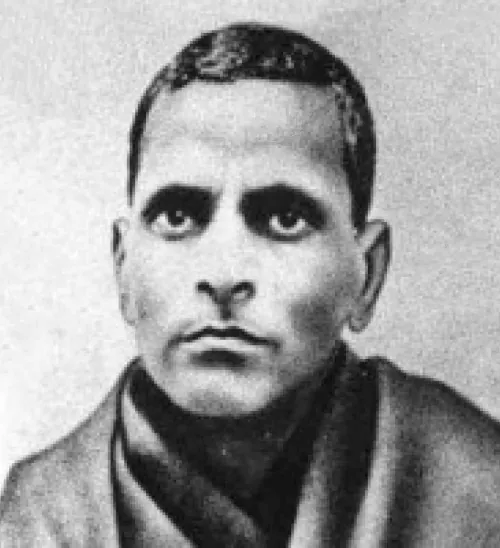
Potti Sriramulu, whose fast unto death in 1952 forced the creation of Andhra State
Credit: Unknown photographer · Public domain · source
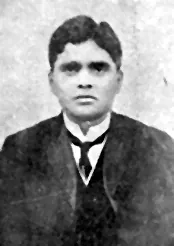
Tanguturi Prakasam, first Chief Minister of Andhra State (1953)
Credit: Unknown photographer · Public domain · source
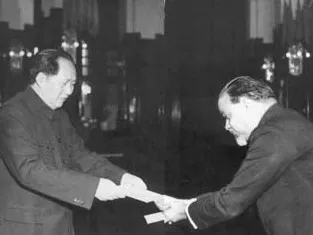
K.M. Panikkar (left) presenting his credentials as India’s ambassador to Mao Zedong in 1950; he later sat on the SRC
Credit: Unknown photographer · Public domain · source
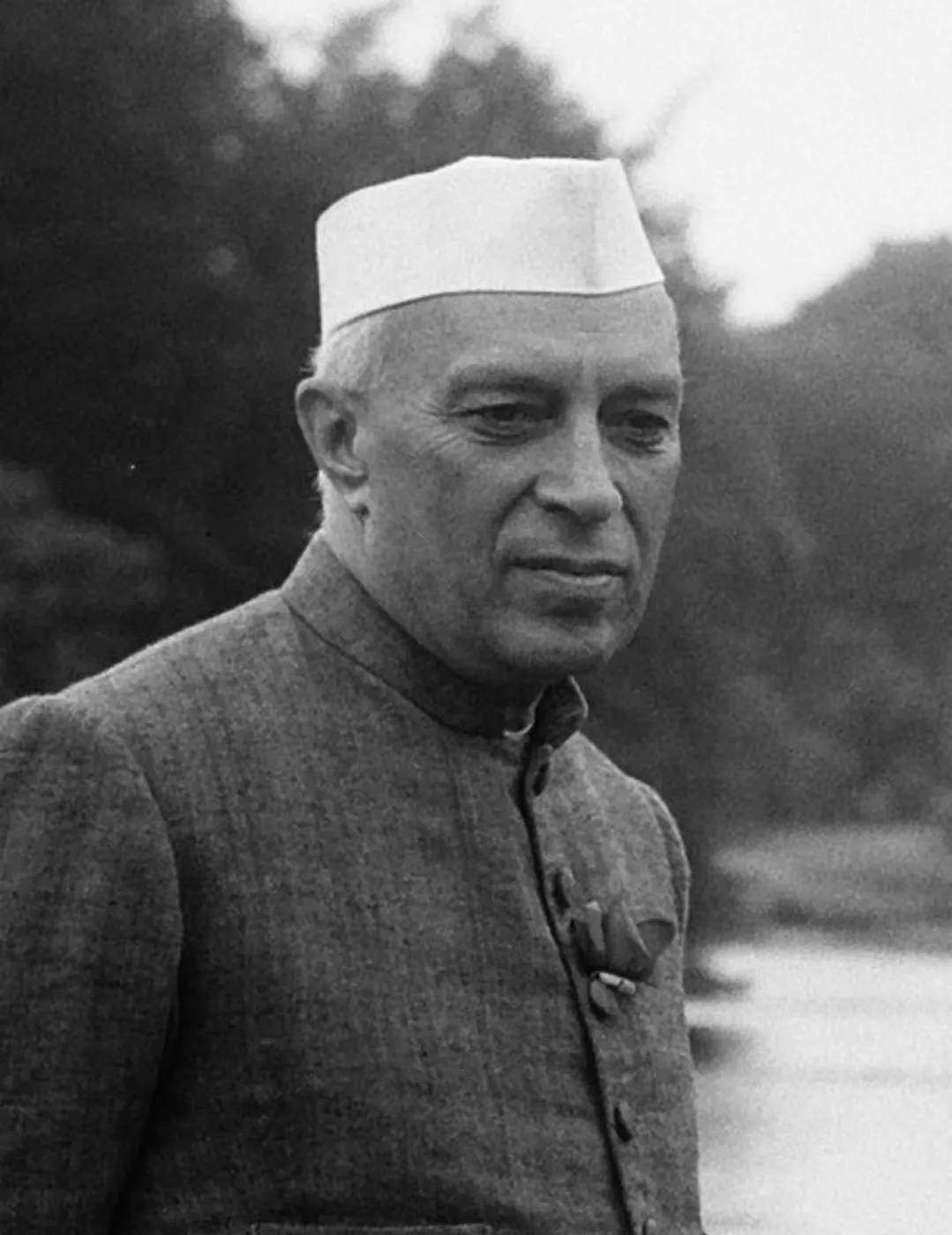
Prime Minister Nehru, whose government appointed the Commission in December 1953
Credit: Harry Pot · CC0 · source
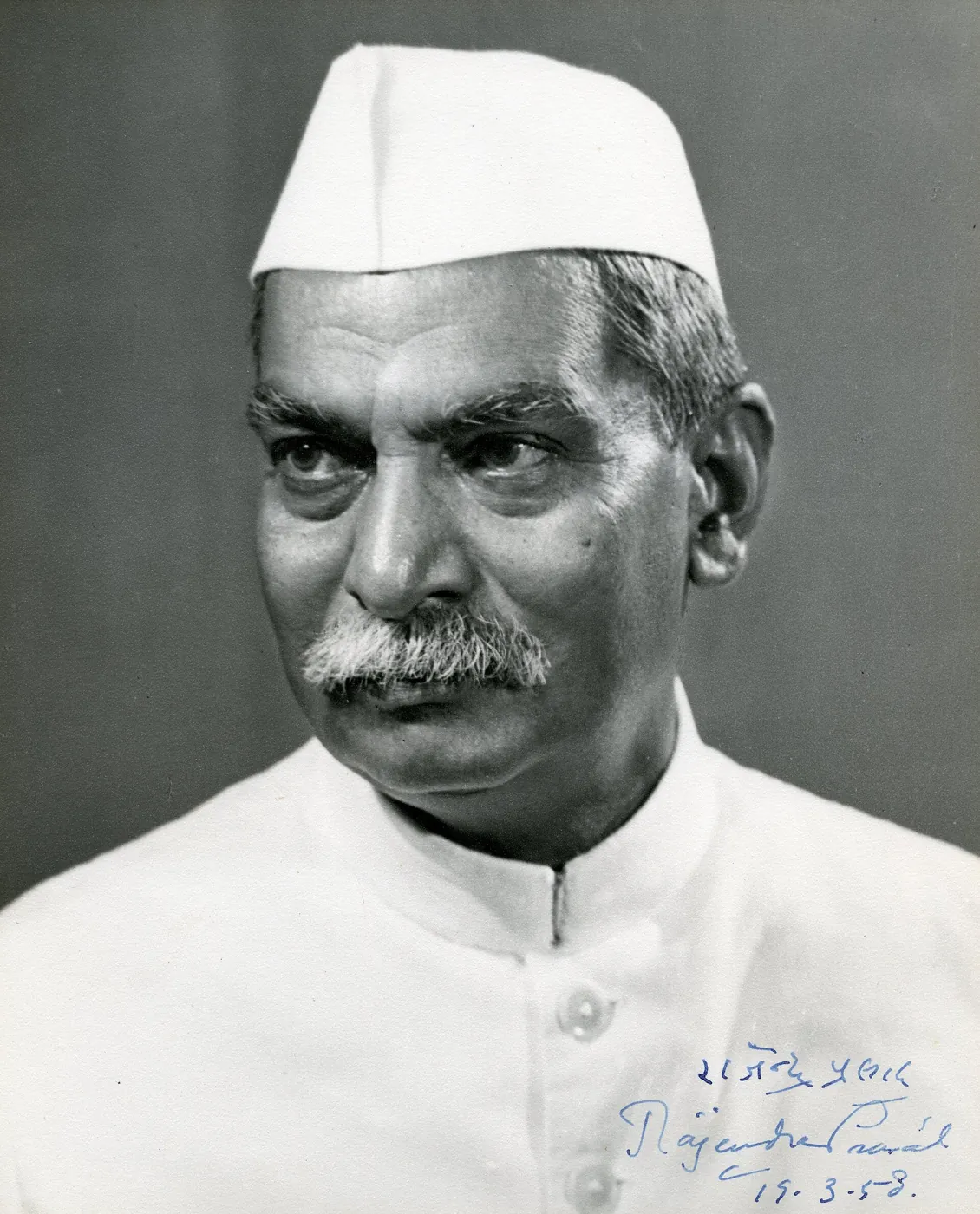
President Rajendra Prasad, in whose term the reorganisation was enacted
Credit: Archives New Zealand from New Zealand · CC BY-SA 2.0 · source
Burgula Ramakrishna Rao, the last Chief Minister of Hyderabad State
Credit: Photo Division, Government of India · Public domain · source
1. Why the Andhra precedent required a national response
The SRC arose from the difficulty of reconciling popular linguistic demands with a territorial structure inherited from colonial government and the integration of princely states. Potti Sriramulu’s death on 15 December 1952 intensified the Andhra agitation, and Andhra State was established on 1 October 1953 from Madras State. This was not the formation of Andhra Pradesh: Telangana still belonged to Hyderabad State. The Andhra precedent made it harder for the Union to treat comparable demands elsewhere as isolated local questions.
A national commission offered a way to examine connected claims without promising that every linguistic demand would produce the same outcome. Nehru announced the intended inquiry on 22 December 1953; the formal Home Ministry resolution followed on 29 December. The distinction matters because announcement, appointment and implementation belong to different institutional stages. For a mains answer, explain the commission as a response both to democratic mobilisation from below and to the Union’s need for an administratively coherent, politically sustainable federal arrangement.
- Separate Andhra State in 1953 from Andhra Pradesh in 1956.
- Distinguish the announcement from the appointment resolution.
- Explain popular pressure alongside the need for national coordination.
Timeline
15 December 1952
Potti Sriramulu died during his fast.
1 October 1953
Andhra State was established outside Telangana.
22 December 1953
Nehru announced the intended SRC in Parliament.
29 December 1953
The Home Ministry resolution appointed the commission.
23 February 1954
The SRC invited public memoranda.
8 April 1954
The all-India tour began, according to the report’s introduction.
30 September 1955
The report was submitted to the government.
1955, paragraph 386
The report proposed separate Hyderabad and conditional later union.
31 August 1956
The States Reorganisation Act was enacted.
1 November 1956
Andhra Pradesh formed as part of the revised territorial settlement.
Around 1961, as anticipated in 1955
Elections were the SRC’s proposed reference point for reconsideration, not a merger event that actually followed its formula.
2. Members, mandate and the character of the inquiry
Justice Fazl Ali chaired the commission, assisted by H. N. Kunzru and K. M. Panikkar. Its mandate was broader than the informal description of a linguistic commission suggests. The appointment resolution required attention to historical background, existing conditions and relevant factors bearing on reorganisation. It permitted recommendations on general principles and the broad outlines of particular states. The commissioners could therefore investigate cultural affinity without treating a common language as a sufficient answer to every administrative or economic difficulty.
The SRC was advisory: its conclusions did not themselves amend the Constitution or transfer districts between states. That institutional limit is essential to understanding the subsequent departures from its proposals. Government could accept the general direction of reorganisation while modifying particular combinations, and Parliament supplied the statutory settlement. Avoid judging the commission solely by the final map. Its report also offers a record of competing arguments, assumptions about development and concerns about minorities that remain analytically valuable even where its preferred boundaries were not adopted.
- Remember all three members rather than only the chairman.
- The mandate allowed a multi-factor assessment.
- Recommendations required subsequent political and legal action.
From regional demand to a federal settlement
- 1. Identify linguistic aspirations and inherited administrative divisions.
- 2. Gather representations, statistical material and local evidence.
- 3. Assess viability, regional inequality and national interests together.
- 4. Distinguish expert recommendations from government decisions and legislation.
- 5. Evaluate implementation by consent, institutional credibility and distribution of opportunities.
3. Hearing India: participation, evidence and its limits
The commission invited written memoranda through a press note dated 23 February 1954 and chose not to issue a questionnaire. Interviews and field visits supplemented documentary submissions. Guha’s account records visits to 104 towns and cities, interviews with more than 9,000 people and 152,250 written submissions. These figures convey the scale of public engagement, but they describe different kinds of evidence. A representation total should not be mistaken for the number of detailed research memoranda, distinct interview sessions or individual voters endorsing a boundary.
The report’s introduction is particularly useful for evaluating method. The commissioners recognised limitations in available census categories and treated estimates of future revenue and expenditure cautiously. They also declined to issue isolated interim conclusions because regional questions were interconnected. Such caution is a strength rather than an absence of certainty: a change benefiting one proposed unit could alter another’s resources or territorial claims. The report was submitted on 30 September 1955, a date corroborated by Nehru’s correspondence acknowledging its receipt that afternoon.
- Attribute consultation totals to Guha’s account.
- Written mobilisation was not a referendum.
- Connect the refusal of interim reports with interdependence among claims.
| Issue | SRC approach, 1955 | Settlement or qualification |
|---|---|---|
| Territorial structure | Sixteen states and three centrally administered territories | Fourteen states and six Union Territories in November 1956 |
| Telangana | Separate Hyderabad State for the present | Merged with Andhra State in 1956 |
| Later unification | Possible after elections anticipated around 1961, with two-thirds legislative support | The proposed waiting mechanism was not implemented |
| Vidarbha | Separate state of eight contemporary districts | Included in enlarged Bombay State |
| Old Hyderabad State | Redistribution rather than preservation of the multilingual unit | Telangana to Andhra Pradesh; other regions mainly to Bombay and Mysore |
| State categories | Move away from inherited unequal categories | Seventh Amendment replaced the Part A/B/C/D scheme |
| River integration | Fewer jurisdictions in the eastern Krishna–Godavari areas | Not complete control of either entire river basin |
| Safeguards | Concern about whether promises would work during transition | Must distinguish an assurance from enforceable protection |
4. Language, viability and the federal balancing exercise
The commission’s central methodological choice was to assess language alongside unity, security, finance, development and administrative effectiveness. Linguistic affinity could help citizens communicate with government and give democratic expression to regional identity. Nevertheless, a government still needed revenue, staff and workable links between its constituent areas. A linguistic majority also did not eliminate the presence or rights of minorities. Reorganisation therefore involved balancing several legitimate considerations rather than mechanically translating a language map into a set of sovereign territorial entitlements.
Telangana and Vidarbha demonstrate why this framework mattered. A shared language with neighbouring areas did not prevent the commission from recommending separate units when other considerations carried weight. Conversely, the eventual rejection of those recommendations did not mean that language was irrelevant. It showed that expert assessment interacted with political preferences for larger combinations. In an analytical answer, separate three questions: whether cultural association is desirable, whether a proposed state can function effectively, and whether the affected population has adequate confidence in the terms of association.
- Do not equate linguistic reorganisation with one language, one state.
- Discuss minority protection within new states.
- Treat fiscal viability as a test, not a promise of prosperity.
5. Why Vishalandhra attracted support
The report gave serious consideration to the advantages of a larger Telugu-speaking state. Hyderabad and Secunderabad offered an established capital for a region whose Andhra component still faced a permanent-capital question. Telangana’s coal resources and Andhra’s normal food surplus suggested economic complementarity. A combined administration could reduce duplicated expenditure, while commercial links might support a wider market. Support also drew on longstanding emotional attachment to Telugu political unity. These were substantive arguments, not merely claims dismissed by the commissioners before reaching their conclusion.
River development supplied another important argument, but it requires precise wording. A merger could reduce one jurisdictional division affecting the eastern areas of the Krishna and Godavari basins. The SRC expressly recognised that it would not unite either whole basin under one state: upstream territories would remain outside. Thus a potential coordination benefit was real without being comprehensive. For mains analysis, distinguish aggregate economic gains from the distribution of those gains. A larger resource base cannot by itself establish that every region will obtain a fair share of investment.
- Hyderabad’s suitability as a capital supported the merger case.
- Singareni coal and food exchange illustrated complementary resources.
- Partial river coordination did not mean complete basin control.
6. The separate-Telangana case: resources, water and opportunity
Telangana’s case combined the ability to sustain a separate government with concern about losing control over development priorities. Paragraph 376 discussed stronger revenue sources, including higher land-revenue incidence and excise receipts of approximately ₹5 crore annually. Paragraph 379 estimated current-account revenue receipts at about ₹17 crore and considered a favourable fiscal outlook possible, while recognising project-related burdens. These figures should not be described as a guaranteed surplus, a bank balance or evidence that every Telangana household enjoyed greater prosperity than households in Andhra.
The report also recorded apprehensions about future irrigation and employment. Telangana wanted its claims on Krishna and Godavari utilisation to retain weight alongside plans for coastal irrigation. Educational disadvantages outside Hyderabad city raised fears that nominally equal recruitment competition would produce unequal opportunities. Such concerns must be attributed to the historical actors and the commission’s assessment rather than converted into accusations against a community. Their analytical significance lies in the difference between formal equality and substantive access to public resources, employment and influence over regional planning.
- ₹5 crore referred approximately to annual excise receipts.
- ₹17 crore referred to estimated revenue receipts, not surplus.
- Regional educational inequality shaped public-service concerns.
7. Conditional union and the problem of credible safeguards
Paragraph 386 proposed that Telangana should first constitute a separate state, which could be called Hyderabad State. It left open union with Andhra after the general elections expected in or about 1961, provided two-thirds of the residuary Hyderabad legislature supported it. This was neither an automatic merger deadline nor a popular referendum. Nor was the specified institution Andhra’s legislature or Parliament. The proposed mechanism sought a sufficiently strong expression of regional legislative consent after an interval of separate administration and political deliberation.
The waiting period had an administrative as well as democratic purpose. Andhra was still managing the consequences of separation from Madras, while the two regions had different institutional histories and revenue arrangements. The commission doubted whether assurances of regional development and public-service opportunities would be effective without stronger supervision, and it did not recommend creating that supervisory arrangement. Paragraph 388 accordingly preserved continued separate existence if a favourable environment for union failed to develop. The report’s position is best understood as conditional integration rather than permanent prohibition of merger.
- The proposed vote belonged to residuary Hyderabad’s legislature.
- Two-thirds concerned union; one-third appeared in discussion of possible job safeguards.
- Continued separation remained possible if consent did not emerge.
8. What changed in 1956, and why the distinction matters
The SRC proposed sixteen states and three centrally administered territories: Delhi, Manipur, and the Andaman and Nicobar Islands. The 1956 territorial and constitutional settlement instead produced fourteen states and six Union Territories. The States Reorganisation Act was enacted on 31 August 1956, while its principal territorial changes operated from the appointed day, 1 November. The accompanying Seventh Amendment replaced the older Part A, B, C and D classification. Calling the report’s three proposed territories simply three Part C states obscures its intended new constitutional pattern.
Two departures are especially important for this chapter. The proposed Vidarbha, comprising eight contemporary districts of Madhya Pradesh, entered enlarged Bombay rather than becoming a separate state. Telangana joined Andhra to form Andhra Pradesh without the proposed waiting period, while other Hyderabad regions went mainly to Bombay and Mysore. The proposed residuary Hyderabad must therefore be distinguished from both the old multilingual Hyderabad State and present-day Telangana’s exact boundaries. Historically, the outcome illustrates how expert plans are translated and modified through political negotiation, legislation and choices about regional safeguards.
- Use the 1955 proposal and 1956 outcome as separate comparison columns.
- Vidarbha’s eight historical districts are not today’s district count.
- Do not describe the proposed Hyderabad unit as restored princely rule.
Real-world case studies
One river argument, two regional perspectives
The SRC saw an advantage in reducing a jurisdictional division affecting Krishna–Godavari planning. Telangana advocates, however, worried that coastal priorities could outweigh their own future requirements within a combined administration. Both positions could be logically coherent: integration can reduce coordination costs while leaving distribution contested. A strong answer therefore asks not only whether a project can be planned jointly, but also who sets priorities, pays costs and receives its benefits.
Vidarbha as a control comparison
Vidarbha helps prevent an overly narrow interpretation of the Telangana recommendation. The SRC proposed a separate Marathi-speaking state of eight existing districts even though neighbouring regions shared its principal language. Its inclusion in Bombay in 1956 shows again that the final map was not the commission’s map. Comparison should illuminate the distinction between linguistic affinity, administrative viability and political settlement, without assuming that the two regional movements had identical histories.
The credibility gap in regional promises
Paragraphs 383–384 considered possible employment and development assurances but doubted their effectiveness during transition without stronger supervision. The commission did not itself enact a one-third jobs quota or establish a supervisory authority. The lesson is institutional: the existence of a promise, the design of an enforcement mechanism and evidence of actual compliance are three different matters. Keep the proposed safeguards distinct from the later agreements surrounding the 1956 merger.
Previous year questions
No source-linked PYQ is available here yet. Use the practice questions below.
Practice questions
Practice MCQ 1 · Easy
Which set correctly identifies the SRC membership?
- Fazl Ali, H. N. Kunzru and K. M. Panikkar
- S. K. Dar, Nehru and Patel
- Nehru, Patel and Pattabhi Sitaramayya
- Fazl Ali, Ambedkar and Rajendra Prasad
Practice MCQ 2 · Moderate
Consider the dates: announcement in Parliament, formal appointment, report submission. Which sequence is correct?
- 29 December 1953; 22 December 1953; 30 September 1955
- 22 December 1953; 29 December 1953; 30 September 1955
- 22 December 1953; 30 September 1955; 1 November 1956
- 1 October 1953; 31 August 1956; 1 November 1956
Practice MCQ 3 · Moderate
Under paragraph 386, whose approval was central to the proposed later union?
- A simple majority of the Lok Sabha
- One-third of the Andhra legislature
- Two-thirds of the residuary Hyderabad legislature
- A majority of all Indian state legislatures
Practice MCQ 4 · Difficult
Which statement about Telangana’s estimated ₹17 crore is correct?
- It was the guaranteed annual surplus after merger.
- It was the cost of the capital city.
- It was the proposed compensation to Andhra.
- It represented estimated current-account revenue receipts.
Practice MCQ 5 · Easy
Which pairing correctly distinguishes recommendation and outcome?
- SRC: 16 states and 3 territories; 1956: 14 states and 6 Union Territories
- SRC: 14 states and 6 territories; 1956: 16 states and 3 territories
- SRC: 16 states and 6 territories; 1956: 14 states and 3 territories
- SRC and 1956 both: 14 states and 6 territories
Practice MCQ 6 · Difficult
Which interpretation best fits the SRC’s river-planning argument?
- A merger would bring both entire basins under one government.
- A merger could reduce jurisdictional divisions in the eastern basin areas.
- Water allocation would become irrelevant after merger.
- The report considered only the Godavari and ignored the Krishna.
Mains practice · Explain why the SRC could recognise the advantages of Vishalandhra while recommending a separate Telangana-based state for the present.
- Begin with the distinction between desirable integration and immediate readiness.
- Explain capital, resource and river-planning advantages.
- Assess fiscal confidence, educational inequality and regional development concerns.
- Analyse voluntary association and the two-thirds legislative test.
- Conclude with sequencing and credible institutional protection.
Mains practice · Language was important, but insufficient, in the SRC’s approach to reorganisation. Discuss with reference to Telangana and Vidarbha.
- State the multi-factor mandate and its national setting.
- Relate language to democratic accessibility without treating it as absolute.
- Discuss viability, administration and minority safeguards.
- Compare the two proposed separate states without erasing their differences.
- Distinguish the expert report from the 1956 political settlement.
Mains practice · Assess the significance of the gap between the SRC report and the 1956 territorial settlement for Indian federalism.
- Set out the respective sixteen-plus-three and fourteen-plus-six totals.
- Explain the advisory status of the commission.
- Use Vidarbha and residuary Hyderabad as concrete departures.
- Separate constitutional amendment, enactment and the appointed day.
- Evaluate accommodation alongside the challenge of enforcing regional commitments.
Further reading
- https://archive.org/stream/dli.csl.689/689_djvu.txt
- https://www.indiacode.nic.in/handle/123456789/1680
- https://nehruarchive.in/documents/to-chief-ministers-30-september-1955-5y8nk
- https://www.newindianexpress.com/states/andhra-pradesh/2009/Dec/08/states-reorganisation-commission-report-110971.html
- https://erenow.org/exams/indiaaftergandhiramachandraguha/10.php
Preparing for TGPSC Group 1 or Group 2? See the TGPSC Groups coaching course at Pragnya IAS Academy for fees, batches and registration.
Long study hours taking a toll? Try the free breathing exercise and self check-in in Pragnya’s student wellness programme for UPSC aspirants.