
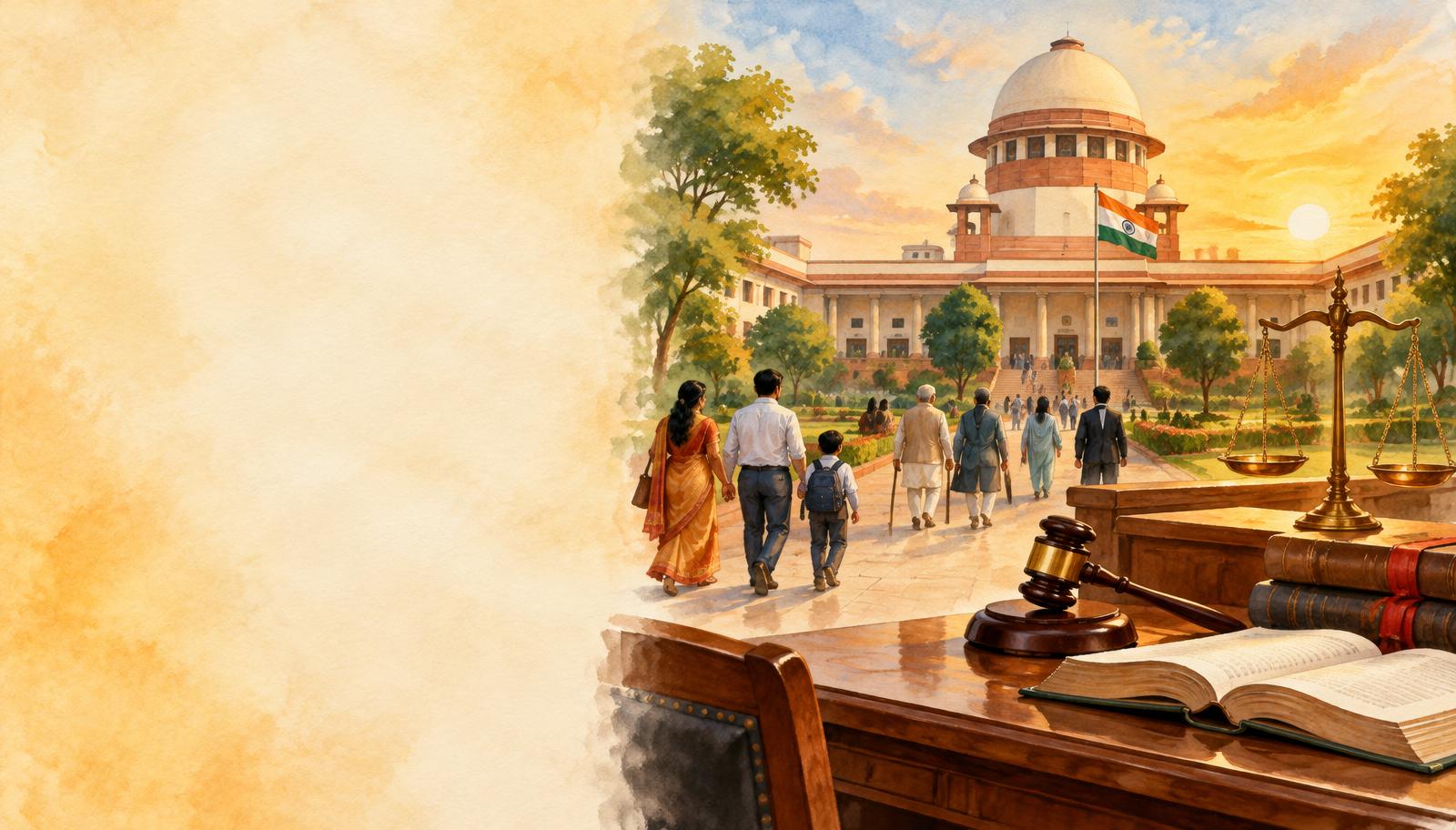
InfoGraphix by Pragnya · Indian Polity · Chapter 8
Judiciary
The integrated judiciary as visual maps — the Supreme Court and High Courts, appointments and the collegium, removal and independence of judges, jurisdiction and writs, subordinate courts, legal aid and Lok Adalats, judicial review, activism and PIL, tribunals, accountability and the landmark judgments.
- 18 visual topics
- 54 practice MCQs
- 54 flip cards
Three pillars of the chapter
Articles 124–147, 214–237
The courts
Supreme Court, High Courts and subordinate courts — who sits, how they are chosen and removed.
Writs, review, PIL
The powers
Jurisdiction, writs, judicial review, activism and Public Interest Litigation.
Safeguards and reforms
Independence & access
Collegium, tribunals, legal aid, contempt and the fight against pendency.
Chapter mind-map: 1774 → 2023
Scroll the ribbon and tap any milestone to open its infographic.
1774
Supreme Court at Calcutta
Set up under the Regulating Act, 1773.
Open topic →1862
First High Courts
Calcutta, Bombay and Madras.
Open topic →1950
Supreme Court inaugurated
28 January; succeeds the Federal Court.
Open topic →1963
15th Amendment
HC retirement age 62.
Open topic →1976
42nd Amendment
Tribunals and Article 39A.
Open topic →1979
Hussainara Khatoon
PIL era begins.
Open topic →1987
Legal Services Act
Lok Adalats get statutory basis.
Open topic →1993
Second Judges case
Collegium is born.
Open topic →1997
L. Chandra Kumar
Review over tribunals is basic structure.
Open topic →2002
Curative petition
Rupa Ashok Hurra.
Open topic →2015
NJAC struck down
Judicial primacy upheld.
Open topic →2019
34 judges · RTI
Strength raised; CJI's office under RTI.
Open topic →2023
e-Courts Phase III
Digital, paperless courts.
Open topic →
Topic index
Follow the numbers in order, or jump to what you need.
0 of 18 revised on this device
- 1Parts V & VI
Judiciary at a Glance
One integrated hierarchy and its four roles
How India's courts fit together — one integrated hierarchy from the Supreme Court through the High Courts to district and lower courts, the Articles that create them, and why an independent judiciary sits at the heart of the Constitution.
Open infographic - 2Arts 124–130
Supreme Court: Composition & Appointment
34 judges, qualifications, acting and ad hoc judges
Who sits in the Supreme Court and how they get there — strength fixed by Parliament (now 34), qualifications under Article 124(3), the retirement age of 65, and the acting, ad hoc and retired judges of Articles 126–128.
Open infographic - 3Judges cases
Collegium System & the NJAC
Four Judges cases and the 99th Amendment
How judges are actually chosen — the word 'consultation' in Articles 124 and 217, the three Judges cases that built the collegium, the 99th Amendment and NJAC, and why the Supreme Court struck the NJAC down in 2015.
Open infographic - 4Arts 124(4), 125, 50
Removal of Judges & Judicial Independence
Special majority, Judges (Inquiry) Act, safeguards
How a judge can be removed — proved misbehaviour or incapacity, a special majority in both Houses and the Judges (Inquiry) Act, 1968 — and the constitutional safeguards that keep judges free from fear or favour.
Open infographic - 5Arts 131–145
Jurisdiction & Powers of the Supreme Court
Original, writ, appellate, advisory, Article 142
The many hats of the Supreme Court — exclusive original jurisdiction (Art 131), writs (Art 32), appeals and special leave (Arts 132–136), advisory opinions (Art 143), review and curative petitions, and the 'complete justice' power of Article 142.
Open infographic - 6Arts 32, 226
Writs: Article 32 vs Article 226
Five writs and why High Court writ power is wider
The five writs at a glance, and why the High Courts' writ power under Article 226 is wider than the Supreme Court's under Article 32 — rights covered, territorial reach, nature of the remedy and the effect of emergencies.
Open infographic - 7Arts 214–224A
High Courts: Constitution & Judges
25 High Courts, qualifications, tenure, transfer
The High Courts — one for each State under Article 214, common High Courts under Article 231, qualifications of judges, appointment after consulting the CJI and the Governor, retirement at 62, transfers, and additional and acting judges.
Open infographic - 8Arts 225–231
High Court Jurisdiction & Superintendence
Original, writ, appellate, Articles 227 and 228
What a High Court can do — original and appellate jurisdiction, wide writ powers under Article 226, superintendence over all courts and tribunals under Article 227, withdrawal of constitutional cases under Article 228, and its status as a court of record.
Open infographic - 9Comparison
Supreme Court vs High Courts
Side-by-side comparison for Prelims
Supreme Court and High Courts side by side — Articles, appointment, qualifications, retirement, writ scope, original, appellate and advisory jurisdiction, court-of-record status and superintendence, with the comparisons most often tested.
Open infographic - 10Arts 233–237
Subordinate Courts
District judges, civil and criminal ladders
The courts most citizens actually meet — appointment of district judges (Art 233), recruitment of other judicial officers (Art 234), High Court control (Art 235), the civil and criminal ladder below the High Court, and the idea of an All India Judicial Service.
Open infographic - 11Art 39A
Lok Adalats, Legal Aid & Special Courts
Article 39A, NALSA, Gram Nyayalayas, family courts
Justice beyond the courtroom — free legal aid under Article 39A, NALSA and the Legal Services Authorities Act, Lok Adalats and their final awards, Permanent Lok Adalats, Gram Nyayalayas, family courts and other specialised forums.
Open infographic - 12Arts 13, 32, 226
Judicial Review
Basis, scope, doctrines and the basic structure
The power of courts to test laws, executive action and even constitutional amendments against the Constitution — its textual basis, scope, interpretive doctrines, limits, and why it is part of the basic structure.
Open infographic - 13Debate
Judicial Activism, Restraint & Overreach
Where the line lies, with Indian cases
Three ways courts use their power — activism that expands rights and fills gaps, restraint that defers to elected branches, and overreach that strays into policy — with Indian cases on each side of the line.
Open infographic - 14PIL
Public Interest Litigation
Relaxed locus standi, letter petitions, misuse
Public Interest Litigation — how relaxed locus standi and letter petitions opened the courts to the poor, the landmark cases, how PIL differs from ordinary litigation, and the guidelines that check its misuse.
Open infographic - 15Arts 323A–323B
Tribunals
Articles 323A & 323B, L. Chandra Kumar, CAT, NGT
Tribunals under Part XIV-A — Articles 323A and 323B added by the 42nd Amendment, how they differ from courts, major tribunals like CAT, NGT and NCLT, and why L. Chandra Kumar (1997) kept them under High Court review.
Open infographic - 16Reforms
Accountability, Contempt & Judicial Reforms
Contempt law, ethics, RTI, pendency, e-Courts
Balancing independence with accountability — contempt of court, the in-house procedure and judicial ethics, RTI and transparency, pendency of cases, and reforms from e-Courts to the debate on an All India Judicial Service.
Open infographic - 17Cases
Landmark Judgments on the Judiciary
Ten cases every aspirant must know
Ten judgments that shaped the judiciary and the Constitution — from Kesavananda Bharati and Maneka Gandhi to the Judges cases, L. Chandra Kumar, Vishaka, NJAC and Puttaswamy — with the principle each one established.
Open infographic - 18Revision
Chapter Quick Revision
Articles 124–147, 214–237 and the traps, on one sheet
The Judiciary on one sheet — Article map, numbers, appointments, removal, jurisdiction, writs, tribunals and PIL, with the traps most often set in Prelims.
Open infographic
Full reading notes in the Study Library
- Supreme Court →
- High Courts →
- Judicial independence →
- Judicial appointments →
- Collegium →
- Writ jurisdiction →
- Writs →
- Constitutional remedies →
- Pendency →
- Judicial review →
- Judicial activism →
- PIL →
- Tribunals →
- Contempt →
Previous year questions