
InfoGraphix by Pragnya · Indian Polity · Chapter 12
Special Constitutional Provisions
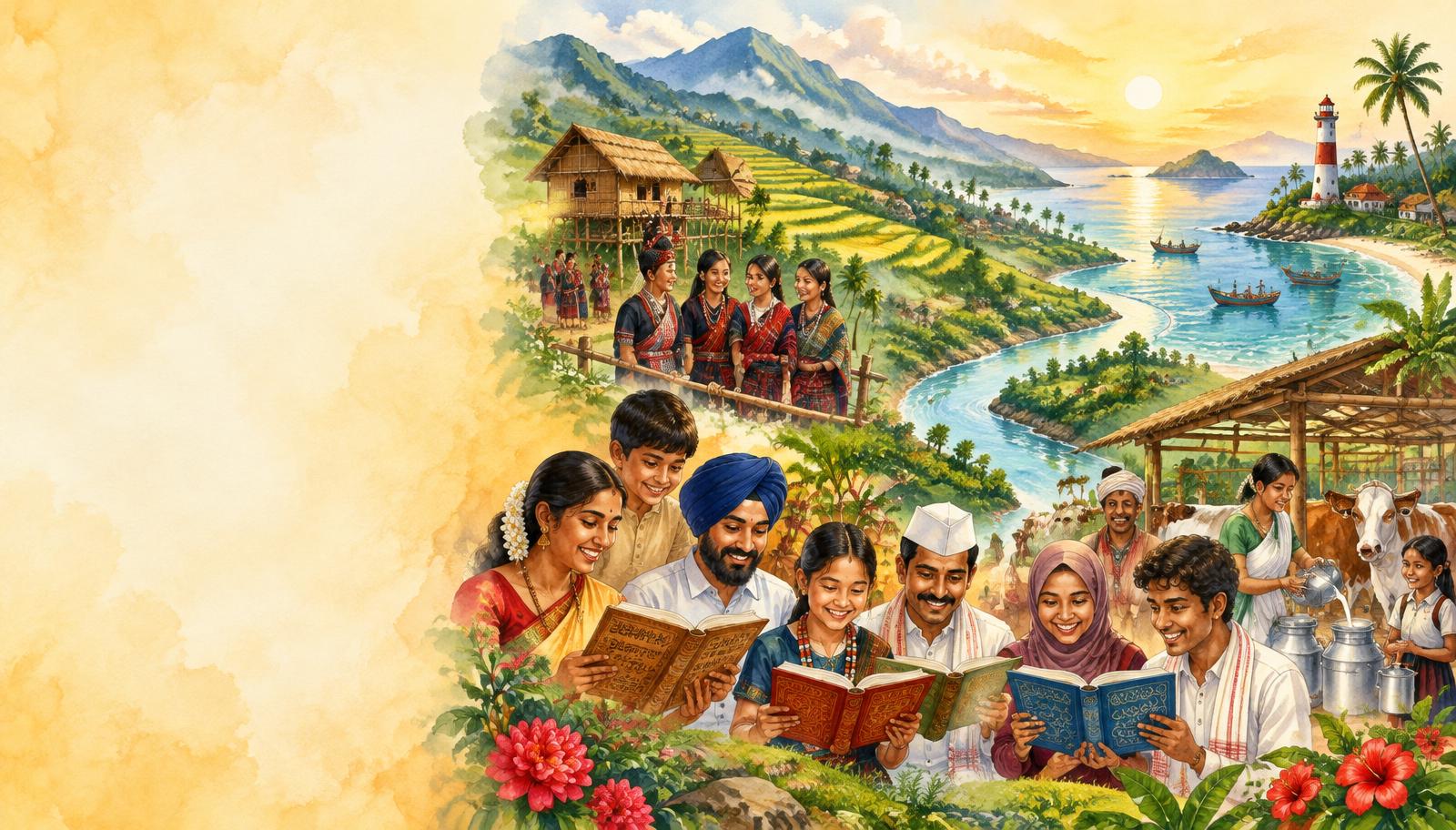
India's asymmetric arrangements as visual maps — the Fifth and Sixth Schedules, State-specific provisions of Articles 371–371J, the official language and the Eighth Schedule, linguistic minorities, Union Territories including Delhi, Puducherry and Jammu & Kashmir, cooperative societies under Part IXB, the twelve Schedules and the cases that shaped them.
- 18 visual topics
- 54 practice MCQs
- 54 flip cards
Three pillars of the chapter
Part X, Arts 371–371J
Tribes and regions
Fifth and Sixth Schedules and State-specific special provisions.
Part XVII, Eighth Schedule
Languages
Official language, courts, linguistic minorities and the 22 scheduled languages.
Parts VIII, IXB; Schedules
Territories and institutions
Union Territories, Delhi, cooperatives and the twelve Schedules.
Chapter mind-map: 1956 → 2024
Scroll the ribbon and tap any milestone to open its infographic.
1956
7th Amendment
Art 371 boards; Arts 350A, 350B.
Open topic →1962
13th Amendment
Article 371A for Nagaland.
Open topic →1963
Official Languages Act
English continues alongside Hindi.
Open topic →1969
22nd Amendment
Article 244A and 371B.
Open topic →1975
36th Amendment
Sikkim joins; Article 371F.
Open topic →1991
69th Amendment
Delhi Assembly — Article 239AA.
Open topic →1997
Samatha
Tribal land protected from mining leases.
Open topic →2003
92nd Amendment
Eighth Schedule reaches 22.
Open topic →2011
97th Amendment
Cooperatives get Part IXB.
Open topic →2012
98th Amendment
Article 371J for Karnataka.
Open topic →2019
J&K Reorganisation
Two new UTs.
Open topic →2023
Delhi services ruling
Elected government's control over services.
Open topic →2024
Five classical languages
Total rises to 11.
Open topic →
Topic index
Follow the numbers in order, or jump to what you need.
0 of 18 revised on this device
- 1Overview
Special Provisions at a Glance
Five families of asymmetric arrangements
Why the Constitution treats some regions and groups differently — Scheduled and Tribal Areas (Part X), special provisions for States (Part XXI, Arts 371–371J), language (Part XVII), Union Territories (Part VIII) and cooperative societies (Part IXB).
Open infographic - 2Art 244(1)
Fifth Schedule: Scheduled Areas
President, Governor, TAC and the ten States
Administration of Scheduled Areas under Article 244(1) and the Fifth Schedule — declaration by the President, the Governor's law-modifying and regulation powers, Tribes Advisory Councils and the ten Fifth Schedule States.
Open infographic - 3Art 244(2)
Sixth Schedule: Tribal Areas
Ten Autonomous District Councils and their powers
Tribal self-government under Article 244(2) and the Sixth Schedule — the ten Autonomous District Councils in Assam, Meghalaya, Tripura and Mizoram, their legislative, judicial and financial powers, and the Governor's role.
Open infographic - 4Comparison
Fifth vs Sixth Schedule
Two tribal models, Art 244A, pending demands
The two tribal models side by side — Governor-led protection in Fifth Schedule areas versus elected autonomy in Sixth Schedule areas — plus Article 244A and the demands to extend the Sixth Schedule.
Open infographic - 5Arts 371–371J
Articles 371–371J at a Glance
Article–State–amendment map and purposes
Articles 371 to 371J at a glance — which State each covers, the amendment that inserted it, and the three broad purposes: regional development, protection of customary law, and governance in sensitive areas.
Open infographic - 6Arts 371A–371H
Article 371: North-Eastern States
371A, B, C, F, G and H in detail
North-eastern special provisions in detail — Nagaland's customary-law shield (371A), Assam's tribal committee (371B), Manipur's Hill Areas committee (371C), Sikkim's arrangements (371F), Mizoram (371G) and Arunachal (371H).
Open infographic - 7Arts 371, 371D–371J
Article 371: Western & Southern States
Maharashtra, Gujarat, AP, Telangana, Goa, Karnataka
Development-focused special provisions — regional boards in Maharashtra and Gujarat (Art 371), equitable opportunity zones in Andhra Pradesh and Telangana (371D), the central university clause (371E), Goa's Assembly (371I) and Kalyana-Karnataka (371J).
Open infographic - 8Arts 343–344
Official Language of the Union
Hindi, English, Commission and Committee
The Union's language — Hindi in Devanagari with international numerals (Art 343), the 15-year English transition, the Official Languages Act, 1963, and the Official Language Commission and Parliamentary Committee (Art 344).
Open infographic - 9Arts 345–349
Regional Languages & Language of Courts
Arts 345–349 and High Court proceedings
Languages of States and courts — State official languages (Art 345), inter-State communication (Art 346), recognising a section's language (Art 347), English in the Supreme Court and High Courts (Art 348) and the special procedure for language Bills (Art 349).
Open infographic - 10Arts 350–350B
Linguistic Minorities
Petitions, mother tongue, Special Officer
Safeguards for language groups — the right to petition in any language (Art 350), mother-tongue instruction at the primary stage (Art 350A), the Special Officer for Linguistic Minorities (Art 350B), and links with Articles 29 and 30.
Open infographic - 11Eighth Schedule
Eighth Schedule & Classical Languages
22 languages and 11 classical languages
The 22 languages of the Eighth Schedule, the amendments that added them, why English is not among them, and the eleven classical languages recognised by the Union government.
Open infographic - 12Arts 239–241
Union Territories
Eight UTs, Arts 239–241
Union Territories under Part VIII — administration by the President through an administrator (Art 239), legislatures in some UTs (Art 239A), presidential regulations (Art 240), High Courts (Art 241) and the eight UTs today.
Open infographic - 13Arts 239A–239AB
Delhi, Puducherry & Jammu and Kashmir
Art 239AA, 2018 and 2023 rulings, 2019 reorganisation
The three UTs with legislatures — Delhi under Article 239AA and the 2018 and 2023 Supreme Court rulings, Puducherry under Article 239A, and Jammu & Kashmir after the 2019 Reorganisation Act and the 2023 Article 370 judgment.
Open infographic - 14Comparison
States vs Union Territories
Status, executive, legislature and representation
States and Union Territories compared — constitutional status, executive, legislature, representation in Parliament, and why UTs exist.
Open infographic - 15Arts 243ZH–243ZT
Cooperative Societies
97th Amendment and Rajendra N. Shah
Cooperatives in the Constitution — the 97th Amendment's Article 19(1)(c), Article 43B and Part IXB, board and election rules, audit, and the 2021 Rajendra N. Shah ruling that limited Part IXB to multi-State cooperatives and UTs.
Open infographic - 16Schedules
The Twelve Schedules
Contents, amendments and traps
All twelve Schedules in one view — what each contains, the amendments that added the Ninth to Twelfth, and the traps examiners set around them.
Open infographic - 17Cases
Cases & Current Issues
Samatha, Niyamgiri, Ladakh, Delhi, Article 370
Cases and debates that shape special provisions — Samatha on tribal land, Niyamgiri and the Forest Rights Act, PESA implementation, Ladakh's Sixth Schedule demand, Delhi's governance tussle and the Article 370 judgment.
Open infographic - 18Revision
Chapter Quick Revision
Article map and traps on one sheet
Special provisions on one sheet — Fifth vs Sixth Schedule, Article 371 map, language Articles, UTs, cooperatives and the twelve Schedules, with the traps examiners love.
Open infographic
Full reading notes in the Study Library
All Polity notes →Previous year questions