
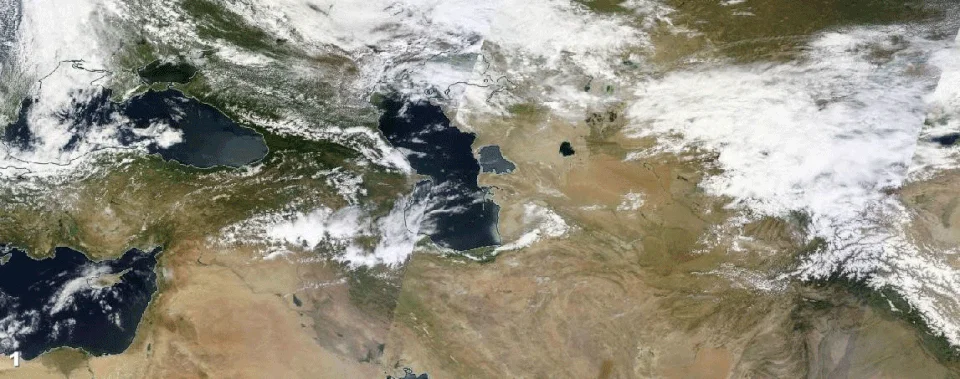
Animation described as tracing a western disturbance eastward from the Black Sea region towards the Indian subcontinent.
Credit: NASA · Public domain · sourceResized and converted to WebP; uncropped.
Map study
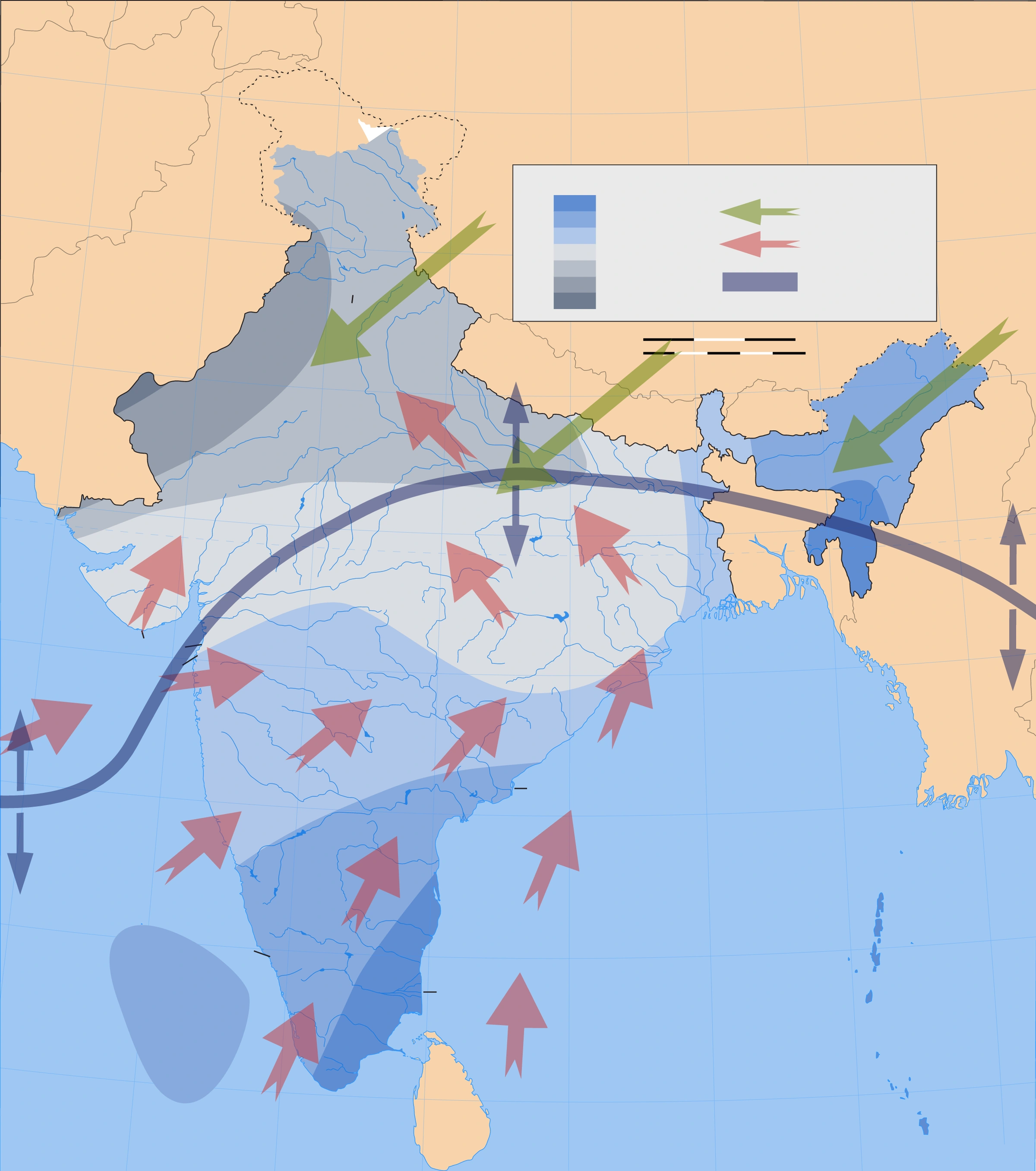
Southwest monsoon onset progression in the source reference map. Actual dates vary each year; consult IMD for current onset information.
- Read the source legend, scale and reference period before comparing regions.
- Connect spatial patterns to the processes discussed in this topic; this map is a study reference, not live operational data.
Credit: Saravask; Planemad; Nichalp · CC BY-SA 3.0 · sourceConverted to WebP on an opaque white background; proportionally resized without cropping. Original cartography and legend retained.
1. Meaning, origin and atmospheric setting
A western disturbance is an eastward-propagating synoptic-scale weather system within the mid-latitude westerlies that affects the Indian subcontinent. Synoptic-scale systems extend over hundreds to thousands of kilometres and persist for several days. The India Meteorological Department identifies these systems through upper-air troughs and cyclonic circulations, satellite observations and associated weather. They are extratropical disturbances, not warm-core tropical cyclones.
Many systems develop or intensify around the Mediterranean and adjoining West Asia before travelling across Iran, Afghanistan and Pakistan towards India. However, describing every disturbance as a surface cyclone born over the Mediterranean is misleading. Their formation and evolution are connected to larger-scale atmospheric waves and contrasts in temperature across the mid-latitudes; some are traceable farther upstream.
Their energy is associated with baroclinic processes, in which horizontal temperature gradients support the growth of atmospheric disturbances. The subtropical westerly jet helps steer them and provides a favourable upper-air environment. The disturbance is the dynamical weather system, whereas water vapour feeding its precipitation can come from several sources along its path.
- Baroclinicity: atmospheric conditions in which pressure and density surfaces intersect, commonly associated with horizontal temperature contrasts.
- Upper-air trough: an elongated region of relatively low geopotential height, often accompanied by conditions favourable for rising air ahead of it.
- Induced circulation: a lower-level cyclonic circulation that may develop over Pakistan or adjoining northwestern India in association with a western disturbance.
2. Track, seasonality and precipitation mechanism
In winter, the subtropical westerly jet lies south of the Tibetan Plateau, bringing its disturbances into a favourable position to influence northwestern India. Their tracks and intensity vary with the configuration of the jet and upstream atmospheric circulation. Jammu and Kashmir, Ladakh, Himachal Pradesh and Uttarakhand receive varying amounts of precipitation, while Punjab, Haryana, Chandigarh, Delhi, Rajasthan and western Uttar Pradesh may receive rain depending on the system's track and moisture supply.
Cloud formation requires both moisture and ascent. Large-scale uplift associated with the disturbance can combine with low-level convergence and Himalayan orographic lifting. When moist winds encounter mountain slopes, they rise, cool and may produce precipitation. Snow or rain depends on the atmospheric temperature profile and elevation; therefore, not every Himalayan location receives snow during every disturbance.
The Mediterranean, Caspian and Black Sea regions may contribute moisture, but the Arabian Sea can be a major immediate source for precipitation over India. Strong southwesterly moisture transport can substantially increase rainfall and snowfall. The simple statement that all western-disturbance moisture comes from the Mediterranean should therefore be avoided.
During summer, the main subtropical westerly jet shifts north of the Himalaya, reducing the usual winter-style influence over the northern plains. Nevertheless, western disturbances and related westerly troughs can still occur. Their interaction with a moisture-rich monsoon circulation can produce exceptionally heavy rainfall, especially where mountain topography concentrates uplift.
- Core precipitation zone: the western Himalayan region, with event-dependent extension into the northwestern plains.
- Seasonality is not exclusivity: western disturbances are winter-dominant in importance, not winter-only systems.
- Precipitation is uneven because track, moisture availability, elevation and windward–leeward exposure differ.
Typical pathway to western-disturbance precipitation
- 1. A disturbance develops or propagates within the mid-latitude westerlies.
- 2. Upper-level steering carries it across West Asia towards the subcontinent.
- 3. Favourable circulation draws moisture towards northwestern India and the Himalaya.
- 4. Dynamical ascent, convergence and mountain lifting promote cloud formation.
- 5. Rain or snow occurs according to moisture supply and the atmospheric temperature profile.
- 6. The system moves eastward, followed by changes in winds, temperature and cloud cover.
3. Importance for agriculture, water and ecosystems
Western-disturbance rainfall supplies useful winter moisture to the rabi agricultural belt. Wheat, mustard, gram and other crops can benefit when rainfall arrives at suitable growth stages and in moderate amounts. In rainfed areas it directly supports soil moisture; in irrigated areas it can reduce irrigation demand. Benefits depend on timing, because excessive rain near maturity or harvest can cause lodging, waterlogging, grain-quality deterioration and harvesting delays.
Snowfall contributes to seasonal snow storage in the Himalaya. Subsequent melting supports mountain streams and downstream flows, including in the Indus basin and parts of the upper Ganga basin. Snowfall also contributes to glacier accumulation, but a glacier's annual mass balance depends on both accumulation and losses through melting and other processes. One heavy snowfall event does not establish that glaciers are recovering.
Winter precipitation supports soil moisture, springs and mountain ecosystems, although its effects vary across catchments. Snow conditions influence horticulture, tourism and hydropower operations. The elevation at which precipitation changes from snow to rain matters: rain tends to generate more immediate runoff, while snow can temporarily store water and release it later.
- Agricultural value is conditional on rainfall amount, crop stage, drainage and accompanying hail or wind.
- Seasonal snow is temporary water storage, not a guarantee of adequate summer water availability.
- Weak winter precipitation can increase irrigation pressure and create snow deficits even when the preceding monsoon was adequate.
| Feature | Western disturbances | Tropical cyclones |
|---|---|---|
| Atmospheric setting | Mid-latitude westerlies; often linked to the subtropical jet | Tropical oceanic environment |
| Main energy source | Horizontal temperature contrasts and baroclinic processes | Ocean heat and latent heat release in organised convection |
| Typical movement | Generally west to east towards India | Track varies with steering winds; recurvature is possible |
| Structure | Often prominent as an upper-air trough or circulation | Organised warm-core, low-pressure circulation |
| Characteristic Indian impact | Winter rain in the northwest and Himalayan snowfall | Coastal winds, storm surge and heavy rainfall, with inland effects |
4. Weather hazards and compound extremes
Western disturbances can bring thunderstorms, lightning, hail, gusty winds and intense precipitation. In the mountains, heavy snow can close passes and roads, disrupt electricity and telecommunications, and contribute to avalanche danger. Heavy rain, rapid snowmelt or rain falling on an existing snowpack can increase runoff under favourable conditions. Saturated slopes may become more susceptible to landslides.
Temperature effects change during the passage of a system. Cloud cover can suppress daytime heating while limiting night-time radiative cooling. After passage, cold-air advection and clearing skies may promote a fall in temperature and, in some cases, cold-wave conditions. Moist ground, high humidity, light winds and a shallow stable boundary layer may favour fog, but a western disturbance does not automatically cause either fog or a cold wave.
Compound events are particularly important for disaster management. A westerly trough interacting with monsoon moisture can produce rainfall much heavier than either circulation would suggest in isolation. Impacts also depend on exposure and vulnerability: settlements on floodplains, unstable road cuts, obstructed drainage and poorly planned construction can turn meteorological extremes into major disasters.
- Distinguish the meteorological trigger from factors that amplify losses.
- Assess snowfall hazards separately from rainfall hazards; their timing and affected locations may differ.
- Use event-specific forecasts rather than assuming that every western disturbance will produce widespread severe weather.
5. Forecasting, climate context and examination distinctions
The India Meteorological Department monitors western disturbances using satellite imagery, surface observations, upper-air measurements, radar where available and numerical weather prediction. Forecasts consider the disturbance's track, vertical structure, moisture transport and interaction with topography. Ensemble forecasts help assess uncertainty, especially in mountain precipitation, where sharp elevation changes are difficult to represent precisely.
Operational preparedness includes agrometeorological advisories, warnings for heavy precipitation and thunderstorms, road-management measures and avalanche bulletins from the Defence Geoinformatics Research Establishment. Forecast users should distinguish between a system being detected and a high-impact event being expected: impacts depend on its intensity, moisture supply and local conditions.
Climate-change implications require qualification. Warming raises the atmosphere's moisture-holding capacity and can alter the rain–snow partition, but precipitation also depends on circulation and uplift. Reported changes in western-disturbance frequency, seasonality or intensity vary with the period, region and identification method used. A single flood or snow deficit cannot by itself demonstrate a long-term trend.
For Prelims, connect western disturbances with extratropical dynamics, the subtropical westerly jet, winter rain in northwestern India and Himalayan snowfall. Contrast them with the northeast monsoon, which is especially important for autumn and early-winter rainfall over southeastern peninsular India. Also remember that a western disturbance may influence weather well beyond its usual winter precipitation zone.
- Incorrect: western disturbances are tropical cyclones moving westward.
- Incorrect: their moisture comes exclusively from the Mediterranean Sea.
- Incorrect: they affect India only in winter or always benefit agriculture.
Western Disturbances: Track, Uplift and Winter Precipitation
The supplied metadata describes an animation of a western disturbance moving eastward between the Mediterranean region and the Indian subcontinent. This directly illustrates the transport pathway of these extratropical systems within the mid-latitude westerlies. Western disturbances are commonly associated with upper-air troughs and cyclonic circulation; they should not be understood merely as isolated cloud patches travelling towards India. The described emergence near the Black Sea represents this particular sequence, not a fixed birthplace for every western disturbance.
Their effects over India depend on circulation strength, available moisture and interaction with terrain. Large-scale ascent, reinforced by orographic uplift along the western Himalaya, can produce snowfall at higher elevations and rainfall over adjoining plains. Winter rain can support rabi crops such as wheat, while excessive rain, hail or strong winds may damage crops. Himalayan snowfall contributes to seasonal snow storage and subsequent meltwater, but precipitation type and amount vary with temperature and elevation. The animation’s description alone cannot establish moisture sources, precipitation totals or agricultural impacts; these require meteorological observations and supporting analysis.
- Prelims distinction: Western disturbances are extratropical systems embedded in the westerlies, not tropical cyclones or a branch of the southwest monsoon.
- Seasonality: Their Indian precipitation influence is especially important in winter, but western disturbances are not restricted to that season.
- Mains linkage: Explain impacts through circulation, moisture supply and relief; distinguish beneficial winter precipitation from event-specific hazards such as hail, heavy snow and avalanches.
Real-world case studies
Uttarakhand floods, June 2013
Exceptionally heavy rainfall during 15–17 June involved interaction between a westerly trough and a moisture-rich monsoon circulation. Himalayan uplift intensified precipitation. Floods, debris flows and landslides caused catastrophic losses, notably around Kedarnath. The event illustrates how a circulation associated with the westerlies can contribute to a major summer disaster rather than only winter precipitation.
Northwestern India floods, July 2023
Heavy rainfall during 8–10 July affected Himachal Pradesh and adjoining northwestern India amid interaction between a western disturbance and monsoon circulation. Flooding, landslides and infrastructure damage demonstrated the importance of monitoring overlapping weather systems and mountain catchments, rather than treating monsoon and western-disturbance hazards as entirely separate.
Previous year questions
No source-linked PYQ is available here yet. Use the practice questions below.
Practice questions
Practice MCQ 1
With reference to western disturbances, consider the following statements: 1. They generally move eastward within the mid-latitude westerlies. 2. They require a warm tropical ocean beneath them throughout their journey. 3. They can draw moisture from the Arabian Sea. Which of the statements given above are correct?
- A. 1 and 2 only
- B. 1 and 3 only
- C. 2 and 3 only
- D. 1, 2 and 3
Practice MCQ 2
Which one of the following best explains the importance of western disturbances for northwestern India's agriculture?
- A. They provide the principal summer rainfall for rice throughout India.
- B. They provide winter moisture that can benefit rabi crops, depending on timing and intensity.
- C. They prevent all frost and hail during the winter cropping season.
- D. They ensure uniform irrigation-free cultivation across Rajasthan.
Practice MCQ 3
Consider the following statements: 1. Himalayan orographic lifting can enhance precipitation associated with a western disturbance. 2. A western disturbance interacting with monsoon moisture can contribute to extreme summer rainfall. 3. Heavy snowfall during one western disturbance establishes a positive annual mass balance for all Himalayan glaciers. Which of the statements given above are correct?
- A. 1 only
- B. 2 and 3 only
- C. 1 and 2 only
- D. 1, 2 and 3
Mains practice · Explain the mechanism of western disturbances and assess their significance for agriculture, water security and disaster risk in northern India. Answer in 250 words.
- Define them as eastward-moving extratropical disturbances embedded in the westerlies.
- Explain jet-stream steering, moisture transport, dynamical ascent and Himalayan orographic lifting.
- Discuss beneficial rabi rainfall alongside crop damage from hail, waterlogging and untimely rain.
- Connect Himalayan snow storage with seasonal runoff while distinguishing snow accumulation from glacier mass balance.
- Examine avalanches, landslides, flooding and interactions with monsoon circulation.
- Conclude with integrated forecasting, crop advisories, catchment management and risk-sensitive infrastructure.
Further reading
- NCERT, India: Physical Environment, Class XI, chapter Climate.
- NCERT, Fundamentals of Physical Geography, Class XI, chapter Atmospheric Circulation and Weather Systems.
- India Meteorological Department: weather bulletins, seasonal reports and agrometeorological advisories, mausam.imd.gov.in.
- Ministry of Earth Sciences, Assessment of Climate Change over the Indian Region, 2020.
- Defence Research and Development Organisation: Defence Geoinformatics Research Establishment information and avalanche advisories.
- https://commons.wikimedia.org/wiki/File:Western_Disturbance_Animated.gif
Preparing for UPSC Civil Services? Get classroom teaching, answer-writing evaluation and mentorship at Pragnya IAS Academy, Ashok Nagar — see why aspirants choose us for IAS coaching in Hyderabad.