

Chilika Lake Odisha
Credit: Hellohappy · CC BY-SA 4.0 · source

The Phumdis formed on Loktak Lake as seen from flight
Credit: Ishani Nath · CC BY-SA 4.0 · source
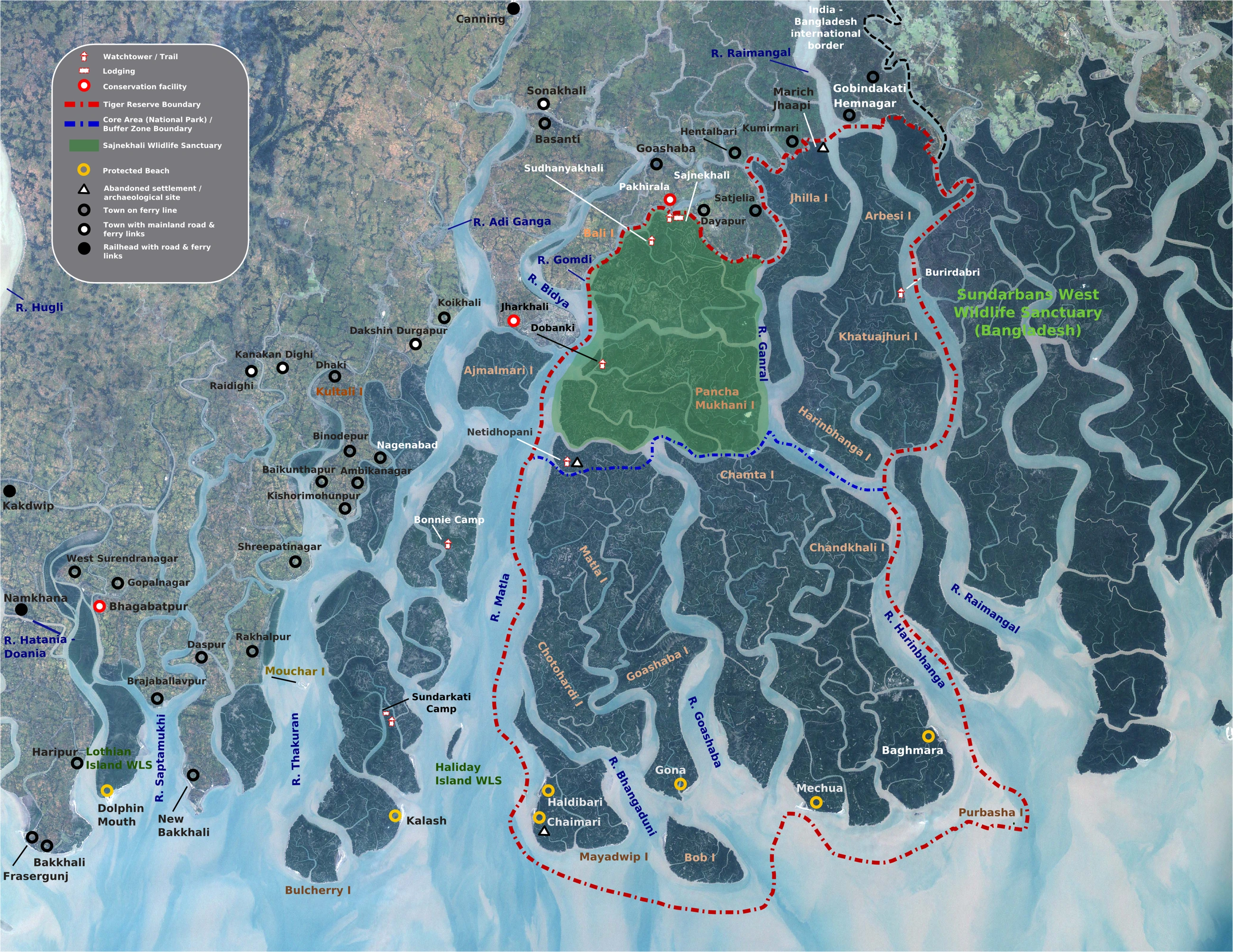
Map study
Sundarbans delta: relate distributaries and the Bay of Bengal coast to mangrove habitats. This geographic view is not a complete current protected-area boundary inventory.
- Read the source legend and reference date before interpreting the map.
- Use spatial patterns to support topic revision; verify current official boundaries, designations and warnings separately.
Credit: Pradiptaray · Public domain · sourceConverted to WebP on an opaque white background; proportionally resized without cropping. Original cartography and legend retained.
1. Meaning, formation and classification
A wetland is an area where inundation or saturation by water strongly influences ecosystem development. Its hydroperiod—the timing, duration and frequency of flooding—is often more important than whether open water is visible throughout the year. Many wetlands have hydric soils, formed under prolonged saturation, and hydrophytic vegetation adapted to waterlogged conditions. Wetlands can occupy transitions between terrestrial and aquatic environments, but the term also covers extensive lakes and shallow coastal waters.
The Ramsar Convention defines wetlands broadly as marsh, fen, peatland or water areas, whether natural or artificial, permanent or temporary, with static or flowing water that is fresh, brackish or saline. It includes marine waters whose depth at low tide does not exceed six metres. Consequently, rivers, reservoirs, rice paddies and some aquaculture areas can fall within the Convention's scope; wetlands are not synonymous with freshwater lakes.
Inland wetlands include riverine systems, floodplain marshes, oxbow lakes, lakes, peatlands and saline depressions. Coastal wetlands include estuaries, lagoons, mangroves, salt marshes and tidal flats. Marshes are generally dominated by herbaceous plants, whereas swamps support woody vegetation. Peatlands accumulate partly decomposed organic matter under waterlogged conditions. An estuary receives river water and exchanges water with the sea; a lagoon is separated from the sea by a barrier but may retain tidal connections.
2. Distribution and important Indian examples
India's wetland diversity reflects its monsoon climate, long coastline, Himalayan relief and extensive alluvial plains. The National Wetland Atlas, 2011, prepared by the Space Applications Centre, ISRO, estimated about 15.26 million hectares of wetlands. This is a dated inventory estimate, not a measure of present ecological health. Gujarat had the largest wetland area among states in that assessment, substantially influenced by extensive coastal and intertidal systems.
Himalayan wetlands include high-altitude Tso Moriri in Ladakh and Wular Lake in the Kashmir Valley. Wular is linked to the Jhelum drainage and helps accommodate floodwater. Across the Ganga–Brahmaputra plains, river migration, channel abandonment and seasonal inundation create oxbow lakes, marshes and beels. Deepor Beel, southwest of Guwahati, is an important freshwater wetland in Assam.
Coastal examples include Chilika in Odisha, a brackish-water lagoon; the Sundarbans mangrove wetlands in the Ganga–Brahmaputra–Meghna delta; and the Vembanad–Kol system in Kerala. Sambhar in Rajasthan illustrates an inland saline wetland in an arid environment. Loktak in Manipur is associated with floating phumdis—masses of vegetation, organic matter and soil. Keibul Lamjao National Park, located on Loktak, protects habitat of the endangered sangai deer.
- Map practice: locate Wular, Harike, Sambhar, Keoladeo, Deepor Beel, Loktak, Chilika, Kolleru, Pulicat and Vembanad.
- Distinguish neighbouring coastal sites: Kolleru is a freshwater lake between the Krishna and Godavari deltas; Pulicat is a brackish lagoon along the Andhra Pradesh–Tamil Nadu coast.
Catchment-based wetland restoration
- 1. Map the wetland, catchment, drainage connections and zone of influence
- 2. Assess hydroperiod, water quality, biodiversity and livelihood dependence
- 3. Identify pressures and agree on ecological restoration objectives
- 4. Restore water connections and control sewage, waste and encroachment
- 5. Manage habitats and resource use with local communities
- 6. Monitor ecological character and adapt management
3. Ecological and economic importance
Wetlands temporarily store runoff and can reduce downstream flood peaks when their storage space and natural connections remain intact. Some recharge groundwater, while others are sustained by groundwater discharge; recharge is therefore not a universal property. Vegetation slows flowing water and traps sediments. Microbial processes and plant uptake can retain or transform nutrients, but wetlands cannot absorb unlimited untreated sewage without degradation.
Wetlands provide breeding, feeding and refuge habitats for fish, amphibians, reptiles and waterbirds. Indian wetlands form important nodes along the Central Asian Flyway. Seasonal shallow waters and exposed mudflats offer feeding opportunities different from those of permanently deep lakes. Maintaining a mosaic of water depths and habitats is therefore often more valuable than keeping every wetland permanently full.
Fisheries, grazing, reeds, edible plants, tourism and culturally significant landscapes support local economies. Mangroves and tidal wetlands can reduce coastal erosion and wave energy, although protection varies with vegetation, topography and storm intensity. Peatlands and vegetated coastal wetlands store substantial carbon. Some wetlands also emit methane, so their climate role must be evaluated through the full greenhouse-gas balance rather than a simple claim that all wetlands are uniformly carbon sinks.
| Wetland | State or Union Territory | Type or key feature |
|---|---|---|
| Wular | Jammu and Kashmir | Freshwater lake linked to the Jhelum |
| Chilika | Odisha | Brackish lagoon; important Irrawaddy dolphin habitat |
| Loktak | Manipur | Freshwater lake with floating phumdis |
| Sambhar | Rajasthan | Inland saline lake |
| Deepor Beel | Assam | Freshwater wetland near Guwahati |
| Vembanad–Kol | Kerala | Interconnected lake, backwater and floodplain wetland system |
4. Threats and ecological change
Major pressures include reclamation, encroachment, catchment deforestation, sedimentation, untreated sewage, industrial effluents and excessive extraction. Roads, embankments and dams can sever wetland–river connections or alter natural flood pulses. Upstream diversions reduce inflow, while blocked sea mouths can alter a lagoon's salinity and fish recruitment. Climate change adds pressures through altered rainfall, drought, sea-level rise and changing Himalayan snowmelt.
Nutrient enrichment can cause eutrophication: excessive algal or plant growth followed by decomposition that consumes dissolved oxygen. Fish deaths may result from oxygen depletion rather than direct poisoning. Invasive alien plants such as water hyacinth can obstruct navigation, reduce light penetration and alter habitat conditions. Their removal without controlling nutrient inputs usually treats a symptom rather than the underlying cause.
Wetland degradation is not limited to a reduction in mapped area. A lake can remain visible while losing native species, seasonal variability, water quality or connections with its catchment. Restoration must therefore recover ecological character and hydrological processes. Routine deepening, concrete embankments, ornamental plantations and conversion of seasonal marshes into permanent ponds may damage rather than restore wetland functions.
5. Ramsar Convention and Indian governance
The Ramsar Convention promotes conservation and wise use of wetlands. Wise use means maintaining ecological character through ecosystem approaches within sustainable development; it does not mean excluding every human activity. Sites enter the List of Wetlands of International Importance by meeting at least one of nine criteria. These concern representative wetland types, threatened species, biodiversity and populations of waterbirds, fish or other wetland-dependent animals. Regular support for 20,000 or more waterbirds is one criterion, not a mandatory condition for every site.
The Montreux Record identifies listed Ramsar wetlands where ecological character has changed, is changing or is likely to change because of technological developments, pollution or other human interference. It is a mechanism for attention and assistance, not a separate protected-area category. Chilika was placed on the Record in 1993 and removed in 2002 after restoration. Keoladeo National Park and Loktak Lake are Indian sites associated with the Record.
India's Wetlands (Conservation and Management) Rules, 2017, were issued under the Environment (Protection) Act, 1986, replacing the 2010 Rules. They apply to Ramsar wetlands and wetlands notified under the Rules, with exclusions for specified areas already covered by other legal regimes. Their wetland definition excludes river channels, paddy fields, certain purpose-built human-made water bodies and tanks, and structures specifically constructed for drinking water, aquaculture, salt production, recreation or irrigation.
State and Union Territory Wetlands Authorities identify wetlands, recommend notification and guide management. Prohibited activities in covered wetlands include conversion to non-wetland uses or encroachment, establishment or expansion of industries, solid-waste dumping and discharge of untreated waste or effluents. The Rules also restrict permanent construction within 50 metres of the mean high flood level observed over the preceding ten years, with an exception for boat jetties. They should not be reduced to a blanket claim that every activity is prohibited near every water body.
6. Conservation priorities and examination approach
Effective conservation starts with delineating the wetland, its catchment and zone of influence. Management should maintain environmental flows, protect natural drainage, control pollution at source and integrate fisheries, biodiversity and livelihood needs. The National Plan for Conservation of Aquatic Ecosystems supports conservation and management of wetlands and lakes. Mission Sahbhagita emphasises participatory conservation, while the Amrit Dharohar initiative announced in the Union Budget 2023–24 promotes conservation values and local livelihood opportunities associated with Ramsar sites.
For Prelims, separate three questions: whether an ecosystem is scientifically a wetland, whether it falls within the 2017 Rules, and whether it has Ramsar status. These categories overlap but are not identical. Learn site–state–river associations and distinctive features rather than only changing designation totals. Monitoring should assess water quality, hydroperiod, habitat connectivity and indicator species alongside wetland extent.
Real-world case studies
Chilika: restoring lagoon–sea exchange
Siltation and reduced exchange with the sea altered Chilika's salinity and affected its fisheries. Restoration by the Chilika Development Authority included opening a new sea mouth in 2000, supported by hydrological studies and ecological monitoring. Improved exchange helped recover ecological functions and fisheries. Removal from the Montreux Record in 2002 illustrates why restoring water movement can matter more than beautifying a shoreline.
East Kolkata Wetlands: wastewater-linked livelihoods
The East Kolkata Wetlands, designated a Ramsar site in 2002, combine sewage-fed fish ponds, agriculture and resource recovery. Sunlight, biological processes and managed pond systems help treat wastewater while supporting livelihoods. Encroachment and pollution threaten this functioning landscape. The example illustrates wise use, but does not imply that any untreated industrial or municipal effluent can safely be released into wetlands.
Previous year questions
No source-linked PYQ is available here yet. Use the practice questions below.
Practice questions
Practice MCQ 1
With reference to wetlands, consider the following statements: 1. Ramsar's definition includes artificial and temporary wetlands. 2. All wetlands necessarily recharge groundwater. 3. Marine waters up to six metres deep at low tide fall within Ramsar's definition. Which of the statements given above are correct?
- A. 1 and 2 only
- B. 2 and 3 only
- C. 1 and 3 only
- D. 1, 2 and 3
Practice MCQ 2
Consider the following pairs: 1. Loktak — Phumdis 2. Sambhar — Freshwater floodplain lake 3. Chilika — Brackish-water lagoon. How many pairs are correctly matched?
- A. Only one
- B. Only two
- C. All three
- D. None
Practice MCQ 3
Which one of the following statements correctly describes wetland governance?
- A. Ramsar designation automatically converts a wetland into a national park.
- B. The Montreux Record lists every artificial Ramsar wetland.
- C. Wise use requires the complete exclusion of local communities.
- D. River channels and paddy fields are excluded from the wetland definition under India's Wetlands Rules, 2017.
Mains practice · Wetland conservation requires management of hydrological connections rather than protection of isolated water bodies alone. Discuss with Indian examples. Answer in 250 words.
- Define wetlands and explain hydroperiod, ecological character and catchment connectivity.
- Describe links with rivers, groundwater, floodplains and the sea.
- Use Chilika's sea-mouth restoration and Wular's Jhelum connection as examples.
- Explain threats from sewage, encroachment, embankments and upstream diversions.
- Discuss the 2017 Rules, wise use and participatory management.
- Conclude with catchment planning, environmental flows and outcome-based monitoring.
Further reading
- NCERT, India: Physical Environment, Class XI, chapter on Drainage System.
- Ramsar Convention Secretariat, Convention text, Ramsar criteria and guidance on wise use: ramsar.org.
- Ramsar Sites Information Service, official site information sheets: rsis.ramsar.org.
- Ministry of Environment, Forest and Climate Change, Wetlands (Conservation and Management) Rules, 2017, and implementation guidelines.
- Space Applications Centre, ISRO, National Wetland Atlas, 2011.
- Wetlands of India Portal, Ministry of Environment, Forest and Climate Change: indianwetlands.in.
Preparing for UPSC Civil Services? Get classroom teaching, answer-writing evaluation and mentorship at Pragnya IAS Academy, Ashok Nagar — see why aspirants choose us for IAS coaching in Hyderabad.