
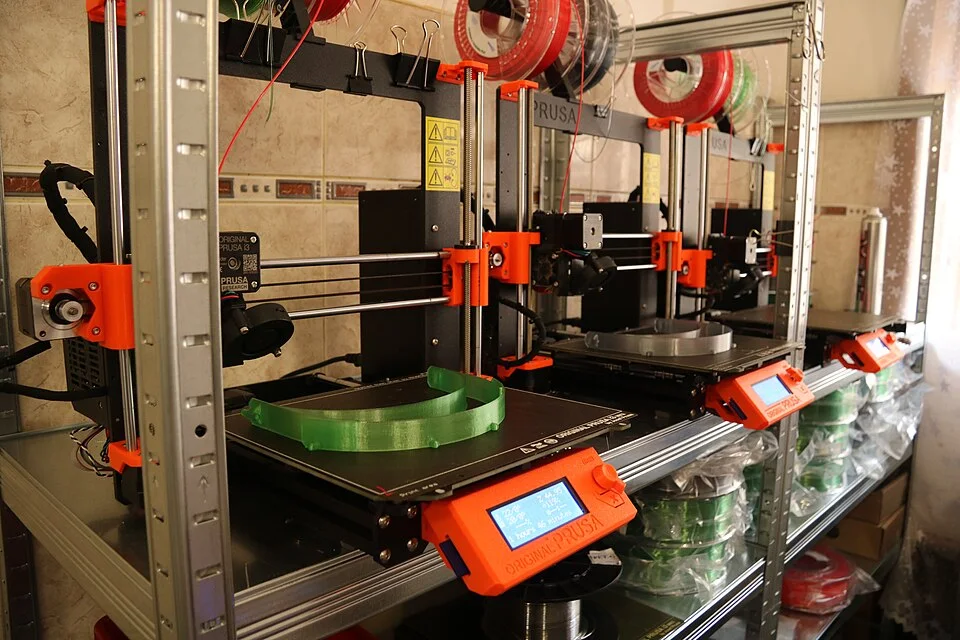
3D printing for face-shield production in Kadaň, Czechia: a comparative example of distributed manufacturing.
Credit: Jan Beránek · CC BY-SA 3.0 · sourceResized and converted to WebP; uncropped.
1. Meaning, working and distinguishing features
3D printing converts a digital model into a three-dimensional object through controlled addition or solidification of material. The design may originate in computer-aided design software, a 3D scan or medical imaging. Slicing software divides it into layers and generates instructions for the machine. Depending on the process, a nozzle deposits material, a light source cures resin, or thermal energy fuses selected regions of a powder bed.
The crucial distinction is between additive, subtractive and formative manufacturing. Additive manufacturing builds up an object; subtractive manufacturing removes material through operations such as milling or turning; formative manufacturing shapes material using moulds, dies or deformation, as in casting and forging. Hybrid manufacturing combines additive and subtractive operations to obtain complex shapes with accurately finished surfaces.
Design freedom is a major advantage. Lattice structures, internal cooling channels and topology-optimised parts can reduce weight while retaining the required mechanical performance. However, not every imaginable design is printable. Overhangs, minimum wall thickness, heat dissipation, machine size and the need to remove trapped powder or supports constrain production.
- Rapid prototyping: quickly producing a model to test shape, fit or function.
- Mass customisation: manufacturing individually tailored products without making a new mould for each design.
- Near-net-shape production: creating a part close to its final geometry, reducing subsequent machining.
- Build orientation: the direction in which a part is printed; it influences strength, surface quality, supports and production time.
2. Major processes and materials
Different additive processes suit different feedstocks and applications. A desktop plastic printer cannot automatically manufacture a metal implant or a concrete building. Process selection depends on material behaviour, dimensional accuracy, mechanical properties, production volume and regulatory requirements.
Material extrusion commonly deposits a heated thermoplastic filament through a nozzle. Polylactic acid, or PLA, and acrylonitrile butadiene styrene, or ABS, are widely used polymers. Vat photopolymerisation selectively cures liquid photosensitive resin using light. Stereolithography belongs to this category and is useful for detailed models, dental applications and patterns.
Powder bed fusion uses thermal energy to fuse selected regions of a powder layer. Selective laser sintering is widely associated with polymer powders, while laser powder bed fusion can manufacture metal components. Binder jetting instead deposits a binding agent onto powder; many metal and ceramic parts subsequently require debinding and sintering. Directed energy deposition feeds material into a focused heat source and is valuable for adding features or repairing high-value metal components.
- Metal feedstocks include titanium alloys, aluminium alloys, stainless steels and nickel-based superalloys.
- Ceramic printing can produce specialised biomedical, electronic and heat-resistant components, but shrinkage during firing needs control.
- Concrete extrusion uses specially formulated mixtures with suitable flow, setting and load-bearing behaviour.
- Bioprinting deposits cells, biomaterials or both in controlled arrangements; it is distinct from printing an inert prosthetic limb.
Typical additive manufacturing workflow
- 1. Create or acquire a digital three-dimensional model.
- 2. Check printability and choose material, process and build orientation.
- 3. Slice the model and generate machine instructions.
- 4. Build the object through controlled material addition or solidification.
- 5. Remove supports and undertake necessary curing, sintering or finishing.
- 6. Inspect dimensions, defects and required functional properties.
3. Applications and emerging frontiers
In healthcare, patient-specific anatomical models help surgical planning, while customised dental devices, prostheses and selected implants are already manufactured commercially. Porous titanium implants can support bone ingrowth. Bioprinting has applications in tissue models, drug testing and regenerative-medicine research, but routinely printing fully functional transplantable human organs remains a research goal rather than established clinical practice.
Aerospace and automotive industries use additive manufacturing for lightweight structures, tooling and components with complex fluid passages. Consolidating several separate pieces into one component can reduce joints and assembly work. In space programmes, the technology supports rapid design iteration and specialised propulsion components. Qualification remains essential because hidden defects can have severe consequences in safety-critical systems.
Construction printers can deposit wall sections or other building elements, potentially reducing formwork and accelerating selected operations. They do not necessarily print an entire finished building: foundations, reinforcement, roofs, wiring and plumbing may still require conventional work. Other applications include jewellery patterns, educational models, spare parts and food printing with suitable edible pastes.
Emerging approaches include multi-material printing and 4D printing. In the latter, smart materials respond to heat, moisture, light or another stimulus after fabrication. Digital inventories may allow a spare part’s design to be stored and manufactured on demand, although legal permissions, compatible equipment and validated production parameters are still necessary.
| Process | Basic mechanism | Common application |
|---|---|---|
| Material extrusion | Deposits material through a nozzle | Polymer prototypes and fixtures |
| Vat photopolymerisation | Light selectively cures liquid resin | Dental models and detailed patterns |
| Powder bed fusion | Thermal energy selectively fuses powder | Polymer parts and metal aerospace components |
| Binder jetting | Liquid binder joins powder particles | Sand casting moulds and metal preforms |
| Directed energy deposition | Focused heat melts material as it is deposited | Metal component repair and feature addition |
4. Advantages, limitations and governance
The strongest economic case often concerns customised products, small production batches and complex high-value parts. Avoiding dedicated moulds lowers the cost of design changes. Local production may shorten supply chains and reduce inventories. Nevertheless, conventional injection moulding, casting or machining can remain cheaper and faster for large volumes of standardised products.
Printed parts may exhibit anisotropy, meaning their properties vary with direction. Weak bonding between layers, porosity, residual stresses and distortion can impair performance. Metal printing may require inert atmospheres and tightly controlled powder handling. Inspection, process monitoring and post-processing are therefore integral to manufacturing, not optional extras.
Lower material waste does not automatically mean a lower environmental footprint. Electricity consumption, powder production, support structures, failed builds and end-of-life disposal influence life-cycle impacts. Worker safety also matters: ultrafine particles, resin exposure, fumes and combustible metal powders require ventilation, protective equipment and appropriate handling.
Governance issues include intellectual property infringement through copied design files, cybersecurity risks from altered instructions, product liability and the manufacture of restricted items. Medical and aerospace applications demand traceability and validated quality systems. ISO/ASTM standards provide terminology and technical frameworks, but compliance with applicable sector-specific regulations remains necessary.
- Exam caution: additive manufacturing is neither universally cheaper nor inherently waste-free.
- A biodegradable feedstock does not guarantee that the final object will degrade rapidly under ordinary environmental conditions.
- Customisation and geometric complexity are advantages; high throughput and uniform properties are not assured.
5. Indian policy and strategic relevance
MeitY’s National Strategy for Additive Manufacturing, released in 2022, sought to develop an ecosystem spanning hardware, software, materials, design and skilled personnel. It set ambitions including a 5% share of the global additive manufacturing market and an addition of nearly US$1 billion to India’s GDP by 2025. These were policy targets, not evidence that the outcomes were achieved.
The strategy also envisaged 50 India-specific technologies, 100 new start-ups, 500 products and training at least one lakh skilled workers. Priorities included strengthening domestic capabilities, research infrastructure, standards and collaboration among industry, academia and government. The National Centre for Additive Manufacturing in Hyderabad is an institutional initiative supported by MeitY and the Telangana government.
For India, potential gains include customised affordable medical devices, localised tooling, aerospace capability and support for small enterprises. Constraints include expensive imported machines, specialised feedstocks, inadequate testing facilities and shortages of design-for-additive-manufacturing skills. Strategic self-reliance therefore requires control over the wider production ecosystem, not merely purchasing printers.
3D Printing and Distributed Production of Protective Equipment
The supplied metadata identifies 3D printing of face shields in Czechia, making this a directly relevant example of additive manufacturing. Such production illustrates how a digital design can be shared and manufactured locally without first creating dedicated moulds. In many face-shield designs, the printed component is a supporting frame, while a separately manufactured transparent sheet provides the barrier. The metadata does not establish which components were printed, the material used, the printing process or the equipment’s protective certification.
For India, this comparative example helps explain the potential of additive manufacturing for decentralised production, rapid design iteration and supply-chain resilience. It is not evidence of Indian production or regulatory approval. Local printing can support hospitals, research institutions and small enterprises, but capacity depends on suitable feedstock, skilled operators, reliable equipment and quality assurance. India’s National Strategy for Additive Manufacturing is relevant to building this wider ecosystem. For a Mains answer, distinguish emergency responsiveness from industrial competitiveness: printing may suit small batches and customised parts, while conventional processes can remain more economical for large, standardised production runs.
- Process distinction: additive manufacturing builds material from digital geometry; it is not synonymous with plastic extrusion, since several other printing processes exist.
- Safety distinction: a face shield provides splash protection but does not replace a respirator where respiratory protection is required; a printable design alone does not demonstrate safety.
- Evidence limit: assess production speed, unit cost, dimensional consistency, cleaning compatibility and certification before claiming that decentralised printing outperforms conventional manufacturing.
Real-world case studies
Bengaluru’s 3D-printed post office
India’s first 3D-printed post office building was inaugurated at Cambridge Layout, Bengaluru, in August 2023. Larsen & Toubro executed the project with technical guidance from IIT Madras. Its reported 43-day construction demonstrated the potential of concrete printing for faster building delivery. The example concerns a building using printed structural elements, not automated printing of every service and fitting.
GE Aerospace’s LEAP engine fuel nozzle tip
GE’s additively manufactured LEAP fuel nozzle tip consolidated roughly 20 previously separate pieces into one and was about 25% lighter than its predecessor. It illustrates how complex geometry and part consolidation can justify additive manufacturing in a high-value application. The benefit depended on rigorous materials engineering and qualification, rather than printing alone.
Previous year questions
UPSC Prelims 2018
In which of the following can 3D printing be used? 1. Preparation of confectionery items 2. Manufacture of bionic ears 3. Automotive industry 4. Reconstructive surgeries 5. Data processing technologies. Select the correct answer.
- A. 1, 3 and 4 only
- B. 2, 3 and 5 only
- C. 1 and 4 only
- D. 1, 2, 3, 4 and 5
Practice questions
Practice MCQ 1
Consider the following statements: 1. Binder jetting necessarily uses a laser to melt each powder layer. 2. Vat photopolymerisation uses light to cure photosensitive resin. 3. Directed energy deposition can repair existing metal components. Which statements are correct?
- A. 1 and 2 only
- B. 2 and 3 only
- C. 1 and 3 only
- D. 1, 2 and 3
Practice MCQ 2
Which of the following best describes 4D printing?
- A. Printing four identical objects simultaneously
- B. Producing an object without a digital model
- C. Printing a structure that subsequently responds to a stimulus by changing shape or properties
- D. Printing exclusively with four different materials
Practice MCQ 3
With reference to additive manufacturing, consider the following statements: 1. Mechanical properties may depend on build orientation. 2. Lower material wastage alone establishes a lower life-cycle environmental footprint. 3. Printed parts may require machining or heat treatment. Which statements are correct?
- A. 1 only
- B. 2 and 3 only
- C. 1 and 3 only
- D. 1, 2 and 3
Mains practice · Additive manufacturing offers India opportunities for industrial self-reliance, but its adoption requires more than access to printers. Discuss. (150 words)
- Define additive manufacturing and explain customisation, complex geometry and distributed production.
- Illustrate opportunities in medical devices, aerospace, tooling and spare parts.
- Refer to the National Strategy for Additive Manufacturing, 2022.
- Identify dependencies in machines, feedstocks, software, skills and testing infrastructure.
- Address certification, cybersecurity, intellectual property and worker safety.
- Recommend shared facilities for MSMEs, domestic research and application-specific life-cycle assessment.
Further reading
- MeitY: National Strategy for Additive Manufacturing, February 2022.
- National Centre for Additive Manufacturing, Hyderabad: official website and programme resources.
- ISO/ASTM 52900: Additive manufacturing — General principles — Fundamentals and vocabulary.
- NIST: official additive manufacturing research and measurement resources.
- Press Information Bureau: August 2023 releases on Bengaluru’s 3D-printed post office.
- UPSC: Civil Services Preliminary Examination 2018, General Studies Paper I and official answer key.
- https://commons.wikimedia.org/wiki/File:3D_printing_of_face_shields.jpg
Preparing for UPSC Civil Services? Get classroom teaching, answer-writing evaluation and mentorship at Pragnya IAS Academy, Ashok Nagar — see why aspirants choose us for IAS coaching in Hyderabad.