
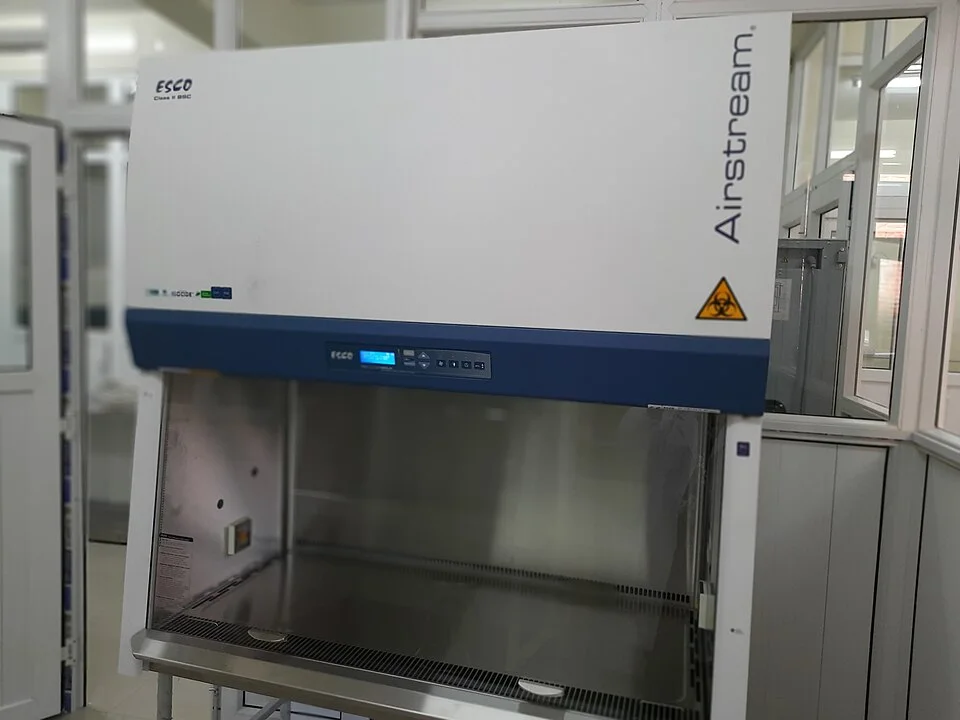
Biosafety cabinet described for use in a molecular biology laboratory.
Credit: Ajay Kumar Chaurasiya · CC BY-SA 4.0 · sourceResized and converted to WebP; uncropped.
1. Scope and scientific foundations
Modern biotechnology uses recombinant DNA, genome editing, cell culture and related techniques to alter or exploit biological systems. Biosafety asks whether these activities could harm workers, communities, animals, plants or ecosystems, and what measures can keep risks acceptable. Its scope extends from a research laboratory to confined field trials, industrial production, transport, waste disposal and environmental release. It is therefore broader than either laboratory hygiene or regulation of genetically modified crops alone.
A hazard is the potential to cause harm, whereas risk combines the likelihood of harm with its consequences under particular exposure conditions. A pathogenic organism in a sealed, validated system may present a different risk from the same organism handled in an aerosol-generating procedure. Assessment considers pathogenicity, infectious dose, transmission routes, host range, environmental survival, availability of treatment, and the scale and nature of the activity.
Biosafety differs from biosecurity, although both contribute to biological risk management. Biosafety prevents accidental infections and releases; biosecurity prevents unauthorised access, theft or deliberate misuse of biological materials, technology and information. A laboratory needs both safe handling procedures and appropriate access controls. Neither term should be confused with bioethics, which addresses wider questions such as consent, equity, animal welfare and acceptable uses of biotechnology.
- A genetically modified organism is not necessarily hazardous merely because it is genetically modified.
- Conversely, a naturally occurring microorganism can require stringent containment.
Timeline
1986
India enacts the Environment (Protection) Act.
1989
Rules governing hazardous microorganisms and genetically engineered organisms or cells are notified.
2000
The Cartagena Protocol on Biosafety is adopted.
2003
India ratifies the Cartagena Protocol in January; the Protocol enters into force on 11 September.
2022
India introduces a conditional exemption from Rules 7–11 for specified SDN-1 and SDN-2 genome-edited plants.
2. Laboratory containment and biosafety levels
Containment combines good microbiological practices, trained personnel, safety equipment and facility design. Primary containment protects the worker and immediate laboratory environment through measures such as biological safety cabinets and sealed centrifuge cups. Secondary containment includes building features such as controlled access, directional airflow and specialised ventilation. Personal protective equipment supplements these controls but does not replace them.
The familiar BSL-1 to BSL-4 framework represents progressively more demanding combinations of practices, equipment and facility safeguards. BSL-1 supports basic work with agents unlikely to cause disease in healthy adults. BSL-2 adds controls appropriate to moderate hazards. BSL-3 is used for activities involving agents that may cause serious or potentially lethal disease through inhalation. BSL-4 provides maximum containment for selected high-consequence agents and activities.
Risk groups and biosafety levels must not be treated as identical labels. The containment required depends on the organism and the specific procedure, including concentration, volume and aerosol generation. WHO’s Laboratory Biosafety Manual, fourth edition, emphasises an evidence-based, risk-assessment-driven approach rather than mechanically assigning controls from an agent’s name. An inactivated specimen and propagation of a live pathogen may require very different precautions.
- A clean bench mainly protects the product; it is not a substitute for a suitable biological safety cabinet when handling infectious material.
- Waste treatment and decontamination must be validated for the material and hazard; autoclaving is widely used but is not universally appropriate.
Biosafety decision-making
- 1. Define the organism, activity and receiving environment
- 2. Identify hazards and pathways of exposure
- 3. Assess likelihood and consequences of harm
- 4. Select containment and other risk-management measures
- 5. Obtain applicable permissions and implement controls
- 6. Monitor outcomes and revise the assessment when evidence changes
3. Biosafety assessment of genetically engineered organisms
Assessment is normally case-specific: regulators examine the organism, introduced trait, intended use and receiving environment together. Molecular characterisation identifies the genetic change and evaluates its stability. Food and feed assessment may examine toxicity, potential allergenicity, nutritional composition and unintended compositional changes. Comparison with a suitable conventional counterpart helps identify differences requiring investigation; similarity alone does not eliminate the need for scientific evaluation.
Environmental risk assessment considers gene flow to related plants, persistence or invasiveness, effects on non-target organisms, changes in agricultural practices, and development of resistance in target pests or weeds. Exposure matters: a trait that creates a concern in one ecological setting may not create the same concern elsewhere. Assessment must distinguish plausible pathways to harm from the mere detection of a genetic change.
Confined field trials generate evidence under specified conditions and are not equivalent to permission for commercial cultivation. Risk management may include reproductive isolation, restrictions on movement of trial material, monitoring of volunteer plants, resistance-management plans and post-release surveillance. For insect-resistant crops, refuges can help delay resistance by maintaining susceptible pest populations. Scientific assessment informs decisions, while socioeconomic considerations and public participation may also enter the broader policy process.
- Approval for research, import, food use and environmental release are distinct regulatory decisions.
- Genome editing is not synonymous with transgenesis: some edits introduce no foreign DNA into the final organism.
| Level | General application | Typical distinguishing controls |
|---|---|---|
| BSL-1 | Basic work with agents unlikely to cause disease in healthy adults | Standard microbiological practices and basic laboratory facilities |
| BSL-2 | Work involving moderate biological hazards | Restricted access; biological safety cabinet for aerosol- or splash-generating procedures |
| BSL-3 | Activities involving serious inhalation hazards | Controlled access, directional airflow and primary containment |
| BSL-4 | Selected high-consequence biological hazards | Maximum-containment facilities using cabinet or positive-pressure suit arrangements |
4. India’s legal and institutional framework
The principal environmental framework is the Rules for the Manufacture, Use, Import, Export and Storage of Hazardous Micro-organisms, Genetically Engineered Organisms or Cells, 1989, notified under the Environment (Protection) Act, 1986. These rules cover research and specified uses of hazardous microorganisms and genetically engineered organisms or cells. India’s system distributes responsibilities across institutions, central authorities and state-level monitoring bodies rather than placing all biosafety decisions with one committee.
The Recombinant DNA Advisory Committee reviews developments and recommends safety regulations. Institutional Biosafety Committees provide institution-level oversight. The Review Committee on Genetic Manipulation, functioning under the Department of Biotechnology, monitors safety aspects of ongoing research and specified activities involving genetically engineered organisms. The Genetic Engineering Appraisal Committee, under the environment ministry, appraises activities involving large-scale use from the environmental angle and proposals for environmental release, including experimental field trials.
State Biotechnology Coordination Committees and District Level Committees perform monitoring and supervisory functions. Food safety is a separate but connected dimension: the Food Safety and Standards Act, 2006, gives the Food Safety and Standards Authority of India a role concerning genetically modified foods. A favourable decision under one regulatory pathway should not be interpreted as blanket clearance under all applicable laws.
In March 2022, the environment ministry exempted genome-edited plants falling under SDN-1 and SDN-2 categories, and free from exogenous introduced DNA, from Rules 7 to 11 of the 1989 Rules. Department of Biotechnology guidelines subsequently provided a safety-assessment framework. This is a conditional, category-specific exemption, not deregulation of every genome-edited organism. SDN-3 modifications are not covered by that exemption.
- GEAC means Genetic Engineering Appraisal Committee, not Genetic Engineering Approval Committee in its current name.
- RCGM belongs to the biotechnology department; GEAC belongs to the environment ministry.
5. International governance and examination relevance
The Cartagena Protocol on Biosafety was adopted in 2000 under the Convention on Biological Diversity and entered into force in 2003. India ratified it in January 2003. It seeks safe handling, transport and use of living modified organisms resulting from modern biotechnology that may adversely affect biodiversity, taking also into account risks to human health. Its central focus includes transboundary movement.
A living modified organism is capable of transferring or replicating genetic material and possesses a novel combination obtained through modern biotechnology. Viable genetically modified seeds may qualify; highly refined oil does not itself become an LMO merely because it originated from a modified crop. The Advance Informed Agreement procedure principally applies before the first intentional transboundary movement of LMOs for intentional introduction into the importing party’s environment. LMOs intended for direct use as food, feed or processing follow a distinct procedure.
The Biosafety Clearing-House facilitates information exchange, including national decisions and regulatory information. The Protocol incorporates a precautionary approach: scientific uncertainty need not prevent an importing party from taking an appropriate decision to avoid or minimise potential adverse effects. The Nagoya–Kuala Lumpur Supplementary Protocol addresses liability and redress. It should not be confused with the separate Nagoya Protocol concerning access to genetic resources and benefit-sharing.
- Cartagena Protocol: biosafety and living modified organisms.
- Nagoya Protocol: access and benefit-sharing.
- Codex Alimentarius: internationally recognised food safety principles and guidelines.
Biosafety Cabinets: Containment Within a Wider Safety System
A biosafety cabinet is directly relevant to laboratory biosafety because it provides primary containment during procedures that may generate infectious aerosols or splashes. Depending on its class and design, controlled airflow and high-efficiency particulate air (HEPA) filtration help protect personnel, the environment and, in some cabinets, the material being handled. The supplied metadata identifies a cabinet for a molecular biology laboratory; it does not establish its class, certification status or suitability for any particular organism.
Cabinet selection must follow a risk assessment considering the biological agent, procedure, aerosol generation and consequences of exposure. A cabinet alone does not establish a laboratory’s biosafety level: containment also depends on facility design, training, access controls, decontamination and waste management. In India, work involving hazardous microorganisms and genetically engineered organisms falls within the applicable framework of the Rules of 1989 under the Environment (Protection) Act, 1986. Institutional Biosafety Committees support oversight at the institutional level. Laboratory containment complements, rather than replaces, environmental and food-safety assessments associated with biotechnology.
- Do not equate cabinet classes I, II and III with biosafety levels BSL-1 to BSL-4; equipment classification and overall laboratory containment are different concepts.
- A clean-air laminar-flow bench primarily protects the sample, not the operator; it is not a substitute for a biosafety cabinet when handling infectious material.
- HEPA filters capture particles, not all gases or vapours. Safe operation requires appropriate installation, performance testing and practices that preserve protective airflow.
Real-world case studies
Bt cotton and resistance management in India
India approved commercial cultivation of Bt cotton in 2002. Its insect-resistance traits illustrate why biosafety extends beyond initial approval: pink bollworm resistance to Bt cotton has been documented in India. Refuges, resistance monitoring and integrated pest management help preserve trait effectiveness. Resistance development does not, by itself, establish food toxicity; these are different assessment endpoints.
High containment at ICMR–National Institute of Virology, Pune
ICMR–National Institute of Virology, Pune, has a BSL-4 facility supporting work with high-risk pathogens. It illustrates the combination of specialised infrastructure, trained personnel, controlled access and validated operating procedures required for high containment. The presence of such a facility does not mean every diagnostic procedure performed by the institute requires BSL-4 conditions.
Previous year questions
No source-linked PYQ is available here yet. Use the practice questions below.
Practice questions
Practice MCQ 1
With reference to India’s biotechnology regulatory system, consider the following statements: 1. GEAC functions under the Ministry of Environment, Forest and Climate Change. 2. RCGM functions under the Department of Biotechnology. 3. Permission for a confined field trial automatically permits commercial cultivation. Which statements are correct?
- A. 1 and 2 only
- B. 2 and 3 only
- C. 1 and 3 only
- D. 1, 2 and 3
Practice MCQ 2
Which of the following best describes the distinction between biosafety and biosecurity?
- A. Biosafety concerns only plants, while biosecurity concerns only animals.
- B. Biosafety prevents accidental exposure or release, while biosecurity prevents unauthorised access and misuse.
- C. Biosafety applies only internationally, while biosecurity applies only domestically.
- D. Biosafety and biosecurity are identical terms for waste disposal.
Practice MCQ 3
Regarding the Cartagena Protocol, consider the following statements: 1. A viable genetically modified seed may be a living modified organism. 2. Highly refined oil is necessarily an LMO if produced from a genetically modified crop. 3. The Protocol provides a distinct procedure for LMOs intended for direct use as food, feed or processing. Which statements are correct?
- A. 1 only
- B. 2 and 3 only
- C. 1 and 3 only
- D. 1, 2 and 3
Mains practice · Biosafety regulation must protect health and biodiversity without treating all biotechnology applications as equally risky. Discuss with reference to India. Answer in 250 words.
- Define biosafety and distinguish hazard from exposure-dependent risk.
- Explain case-specific assessment of the organism, trait, activity and receiving environment.
- Outline the 1989 Rules and the roles of IBSCs, RCGM and GEAC.
- Discuss food safety, gene flow, non-target effects and resistance management.
- Use the conditional SDN-1/SDN-2 exemption to illustrate differentiated regulation.
- Recommend transparent assessment, stronger monitoring, trained personnel and proportionate precaution.
Further reading
- NCERT Biology, Class XII: Biotechnology: Principles and Processes; Biotechnology and its Applications.
- WHO: Laboratory Biosafety Manual, fourth edition, 2020.
- India Biosafety Knowledge Portal, Department of Biotechnology: Rules, guidelines and institutional framework.
- Ministry of Environment, Forest and Climate Change: GEAC website and Rules, 1989.
- Convention on Biological Diversity: Cartagena Protocol text and Biosafety Clearing-House.
- Department of Biotechnology: Guidelines for the Safety Assessment of Genome Edited Plants, 2022.
- Codex Alimentarius: Principles for the Risk Analysis of Foods Derived from Modern Biotechnology.
- https://commons.wikimedia.org/wiki/File:Biosafety_Cabinet.jpg
Preparing for UPSC Civil Services? Get classroom teaching, answer-writing evaluation and mentorship at Pragnya IAS Academy, Ashok Nagar — see why aspirants choose us for IAS coaching in Hyderabad.